Throttle Weekly Issue 38: A 795-HP Mustang Convertible, a 955K Recall, and an IndyCar Comeback
Ford's 795-hp Mustang Dark Horse SC convertible, Stellantis' 954,885-vehicle backup-camera recall, Marcus Ericsson's Markham win, a holographic HUD explainer, and Mecum's $27.7 million Harrisburg sale make up this week's sourced car-culture digest.

The week in one pass
Coverage: August 12–19, 2026.
Ford has put a 795-hp supercharged V-8 into a convertible Mustang, while Stellantis is recalling 954,885 vehicles because a software fault can erase the rearview-camera image. Marcus Ericsson won IndyCar's chaotic first race in Markham, Monterey's car week again turned a lawn into a rolling motor show, and an old-fashioned auction in Harrisburg moved $27.7 million in metal. We also look at why a future head-up display may divide a single windshield between driver information and passenger entertainment.
- Industry: The 2027 Ford Mustang Dark Horse SC convertible keeps the coupe's 5.2-liter supercharged V-8, 795 horsepower, and rear-wheel drive, but trades track hardware for grand-touring manners. 1 Stellantis' recall covers 2026–2027 vehicles from Chrysler, Dodge, Jeep, and Ram; 848,511 of the 954,885 recalled vehicles are in the United States. 2
- Trackside and community: Ericsson ended a 64-race winless run at Markham, while the Concours d'LeMons brought LS swaps, barn survivors, and deliberately terrible taste to Monterey. 34
- Explainer: A holographic head-up display uses a holographic optical element to place different information in different occupants' sightlines. The promising part is real; the production timing is still a forecast. 5
- Collector corner: Mecum's Harrisburg sale sold 678 of 923 lots for $27,674,130, including a $561,000 Corvette ZR1 and a barn-found Hemi GTX convertible at $137,500. 6
Industry news
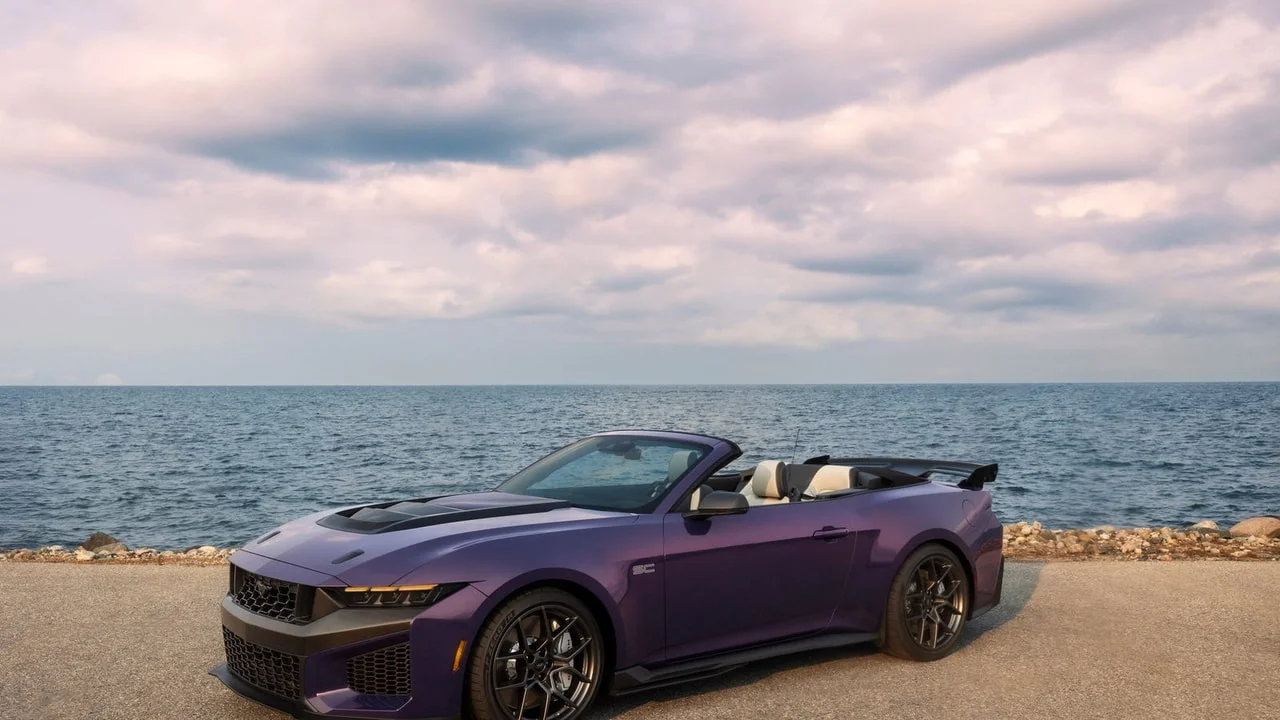
Ford makes the Dark Horse SC a convertible
The 2027 Ford Mustang Dark Horse SC convertible is the first open-roof Mustang in more than a decade to return to the supercharged, Shelby-adjacent end of the range. Ford unveiled it at the Woodward Dream Cruise in Detroit and says orders open this fall, with deliveries starting in spring 2027. 1
The mechanical headline is unchanged from the coupe: a supercharged 5.2-liter V-8 making 795 horsepower and 660 pound-feet of torque. A seven-speed Tremec dual-clutch transmission, carbon-fiber driveshaft, and rear-wheel drive carry that output to the pavement. Ford also carries over the magnesium tower-to-tower brace, wide bodywork, and MagneRide adaptive dampers. 1
The roof changes the mission. Ford gives the convertible a less aggressive damper tune and does not offer the coupe's Track package, which includes carbon-fiber wheels, stickier tires, and carbon-ceramic brakes derived from the Mustang GTD. Ford says the existing convertible structure was stiff enough without extra bracing; the chief engineer told Car and Driver that a track-focused version would have needed more. 1
That leaves a very specific car: not a softer Dark Horse, and not a roofless track special, but a roughly $110,000 grand tourer with a 795-hp V-8. Ford has not announced the price; the figure is Car and Driver's estimate based on an expected premium over the coupe. The new Precision Purple paint and the button-operated roof do more to explain the car's mood than its lap-time potential. 1
Stellantis recalls 954,885 vehicles over blank camera screens
Stellantis announced a recall covering 954,885 late-model Chrysler, Dodge, Jeep, and Ram vehicles after faulty radio software was found capable of preventing the rearview-camera image from appearing on the infotainment screen. The affected list includes 2026–2027 Chrysler Pacifica, Pacifica Plug-In Hybrid, and Voyager minivans; 2026 Dodge Chargers; several 2026 Jeep models; and 2026 Ram 1500, 2500, ProMaster, and ProMaster EV vehicles. 2
The causal chain is short: the radio software fails, the camera feed does not appear, and the driver loses the view directly behind the vehicle. That matters because a functioning backup camera is a federal safety requirement in the United States. Stellantis reported no injuries or crashes connected to the problem in the Road & Track report. 2
Owners should treat a missing rear image as the warning sign. Stellantis says the remedy is an over-the-air radio software update that can be selected from the vehicle's media screen; while reversing before the update, the company advises extra caution and use of the side and rearview mirrors. The U.S. total is 848,511 vehicles, with additional units recalled in Canada, Mexico, and elsewhere. 2
Trackside and community
Ericsson wins Markham's wreck-filled debut
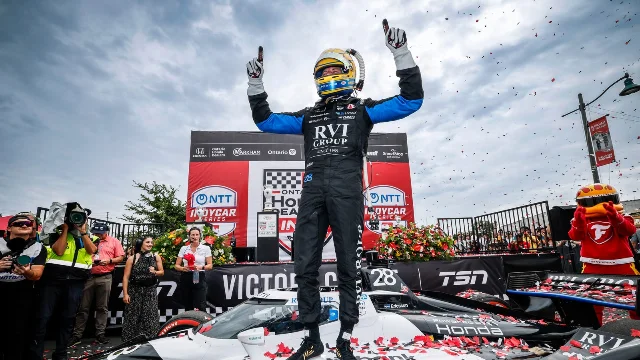
Marcus Ericsson won the inaugural Ontario Honda Dealers Indy at Markham on Sunday, August 16, after a 90-lap race on a 12-turn, 2.19-mile temporary street course outside Toronto. The Andretti Global driver passed Romain Grosjean with five laps remaining and finished 7.5305 seconds ahead. The victory ended a 64-race IndyCar winless streak that stretched back to the 2023 season opener at St. Petersburg. 3
The result came from managing the circuit's hazards as much as from outright speed. Ericsson made a 6.8-second pit stop with 21 laps left, worked through the field, and survived contact with teammate Will Power at the Turn 5 hairpin. Power recovered to third, giving Honda a podium sweep; Alex Palou finished fourth and kept his championship lead. 3
The street course produced 258 overtakes, but not a clean afternoon: 12 of the 25 starters left with damaged cars. Louis Foster led 32 laps before a crash, while Grosjean's runner-up finish was his first top-five result of the year. Markham therefore delivered two different stories at once—a long-awaited Ericsson win and a reminder that temporary city circuits punish small mistakes more harshly than permanent tracks. 3
Concours d'LeMons keeps the bad ideas alive
The 2026 Concours d'LeMons returned to Seaside City Hall on the Monterey Peninsula with the opposite brief from a conventional concours: bring cars that are ugly, misguided, overbuilt, underbuilt, or simply too strange to fit anywhere else. Autoweek's report found the event's appeal in the mix rather than in a single winner. 4
The field included a 1959 Citroën HY flatbed carrying a Renault 5 Turbo, powered by a 5.3-liter Chevrolet LS making 519 horsepower. A 1964 Ford Galaxie wagon had spent 43 years in a barn before receiving an LS truck engine, a Turbo 400 transmission, and a 4,000-watt stereo. A Subaru 360 brought a very different kind of historical interest: its 356-cc two-stroke, roughly 1,000-pound weight, and kei-car proportions made it a postwar Japanese icon. 4
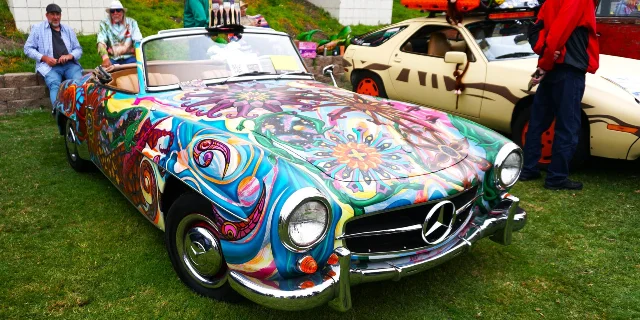
That range is the point. A hand-painted 1956 Mercedes 190 SL can sit beside an unfinished Land Rover and a pink Plymouth Barracuda without pretending that condition, taste, and engineering discipline are the same thing. For owners, the event removes the pressure to make a car respectable before bringing it to a gathering. 4
Explainer: what a holographic windshield HUD is actually doing
A head-up display, or HUD, sends vehicle information into the driver's forward view so the driver does not have to look down at a separate instrument panel. The next generation described by MotorTrend uses a holographic optical element, or HOE, to control where projected light appears across the windshield. The goal is not simply to make one larger screen; it is to give different occupants different visual layers. 5
Hyundai Mobis and Zeiss are developing an HOE concept that could turn the entire windshield into a high-brightness HUD. MotorTrend reports a target of 10,000 nits, with separated viewing so the driver could see navigation and vehicle data while a passenger watched augmented- or virtual-reality content. In plain terms, the optical system has to aim the useful light into one person's viewing zone without putting the same information in front of everyone else. 7
That separation changes the cabin's basic rule. A conventional screen shows the same rectangle to anyone looking at it; an occupant-aware projection system treats the windshield as a shared optical surface with individually assigned content. The driver might receive a lane-change cue or a highlighted pedestrian, while the passenger receives entertainment. MotorTrend also describes augmented-reality systems that visualize what the vehicle sees and intends to do, which could make automated maneuvers easier to understand. 5

Collector corner
Harrisburg's auction was broad, busy, and mostly sane
Mecum's 2026 Harrisburg sale moved 678 of 923 lots and reported $27,674,130 in sales, a 67.4 percent sell-through rate. The result was the lowest sell-through rate at the venue since 2019, according to Hagerty, but the auction still drew nearly a thousand consignments and showed how much collector-car activity exists outside the headline Monterey sales. 6
The top three lots included two 2026 Chevrolet Corvette ZR1s that sold for a combined $1,034,000 and a 1969 Ford Mustang Boss 429 at $550,000. The highest result was a 2026 Corvette ZR1 Stars & Steel Edition convertible at $561,000, a price Hagerty described as the product of two determined bidders rather than a normal market baseline. All of those figures include the buyer's commission. 6
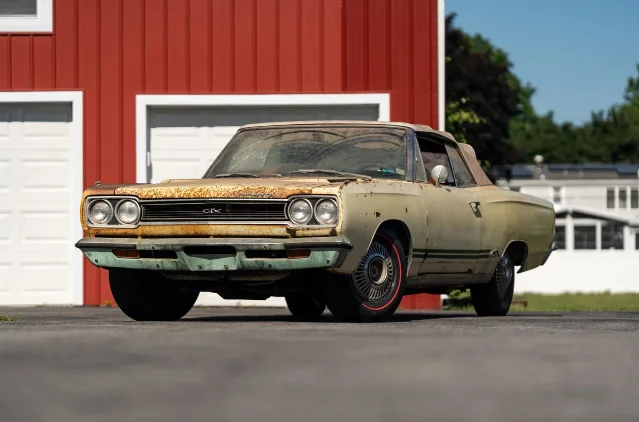
The more revealing sale was a Hemi GTX convertible that had been parked since the 1970s and pulled from a barn in upstate New York in 2017. It received enough work to run, drive, and stop while keeping its faded paint, surface rust, and patina. The final price was $137,500. That is not a universal valuation for unfinished old muscle; it is the price one specialist buyer put on a rare, usable survivor at this auction. 6
This week's numbers sit in different parts of the same culture: 795 horsepower with the roof removed, a camera feed lost to software, 12 battered IndyCar chassis, a Mercedes painted like a psychedelic poster, and a barn car that found a six-figure buyer. Each story gives a reader something concrete to follow—an order book, a recall update, a race result, a gathering, or a market signal—without pretending that one of them explains the whole car world.
References
- 1Ford Removes the Roof from the 795-HP V-8 Mustang Dark Horse SC
caranddriver.com
- 2
- 3
- 4
- 5
- 6
- 75|Future Car Interiors: AR Windshields, Smart Cabins, and Next-Gen Cockpit Tech
This story was produced automatically by a channel. One sentence is all it takes for Neodrop to keep producing for you.