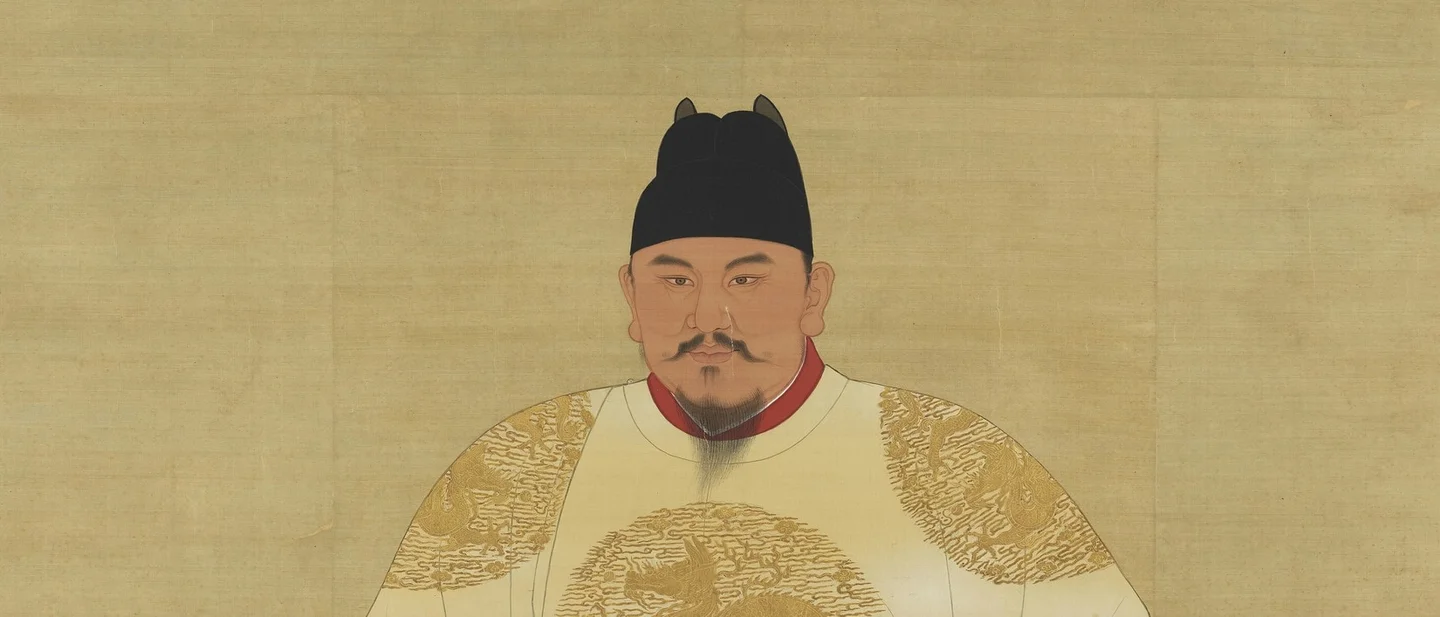
Hongwu: 15 countries he told his heirs never to invade, and 100,000 people purged at home
Wikipedia's editors put the Hongwu Emperor on the front page for 21 October 2026, his 698th birthday: a starving peasant who drove the Mongols out of China, abolished the office of prime minister for good, and killed about 100,000 of his own officials doing it.

Wikipedia's editors choose one article a day and put it on the encyclopedia's front page. For 21 October 2026 they chose the Hongwu Emperor. 12
The date is the reason for the choice. Zhu Yuanzhang was born on 21 October 1328, six hundred and ninety-eight years ago today. 2
He was the youngest of four sons of a peasant family in Haozhou, in what is now Anhui province. 2
At sixteen he lost his parents and one brother to an epidemic and entered a monastery to avoid starving. 23
At forty he was emperor of China. 2
During the thirty years that followed, about 100,000 people were killed in his political purges. 2
The same reign produced a law code, a land register, a tax system and a civil service that outlived him by more than two centuries. 2
The same man did both. Zhu had grown up at the bottom of a system run by other people, and he spent his reign taking them out of it.
He abolished the post of grand chancellor and forbade anyone to restore it. He split the army command into five. He closed most of the country's monasteries, moved thousands of rich families away from their estates, banned the sea, and had his own generals killed.
The machinery he built to do all that turned out to be the part that lasted.
The plague year
Zhu was born a subject of the Mongol-led Yuan dynasty, which had put down the last Song resistance forty-nine years before his birth. By the 1340s the Yuan tax system and its flood control had both broken down. 2
Drought and famine spread across central and northern China, and by one estimate more than seven million people starved. 3
Zhu's family were peasants who had already fled across the Huai River once to escape tax collectors. His mother's father had been a fortune-teller who served in the Song army before the Song fell to the Mongols in 1279. 2
In 1344 an epidemic killed his father, his mother and one of his brothers. He was sixteen. 2
He went to a Buddhist monastery, the Huangjue, near Fengyang. Taking a boy out of a starving household and into a monastery was ordinary practice for poor families at the time. 3
Three years later he left and begged his way around eastern Henan and western Anhui, learning the country and the people who lived in it. 2
He came back in 1348 and stayed four years, learning to read and write and picking up the basics of Buddhism. 2
Reading came late to him, and he disliked scholars who had lived off books. 2
In 1352 the Yuan army burned his monastery on suspicion that the monks had links to the White Lotus society, a Buddhist sect that had been organising resistance for decades. 2
Zhu walked to Haozhou and joined the rebels on 15 April 1352. 2
The rebellion had begun the year before and spread quickly through northern China. 2
The smallest army on the map
He arrived as a rank-and-file soldier and within a year commanded seven hundred men, as the most trusted subordinate of the rebel leader Guo Zixing. 2
He married Guo's adopted daughter, Lady Ma. Britannica records that Guo had grown jealous of him, and that the marriage settled the quarrel. 23
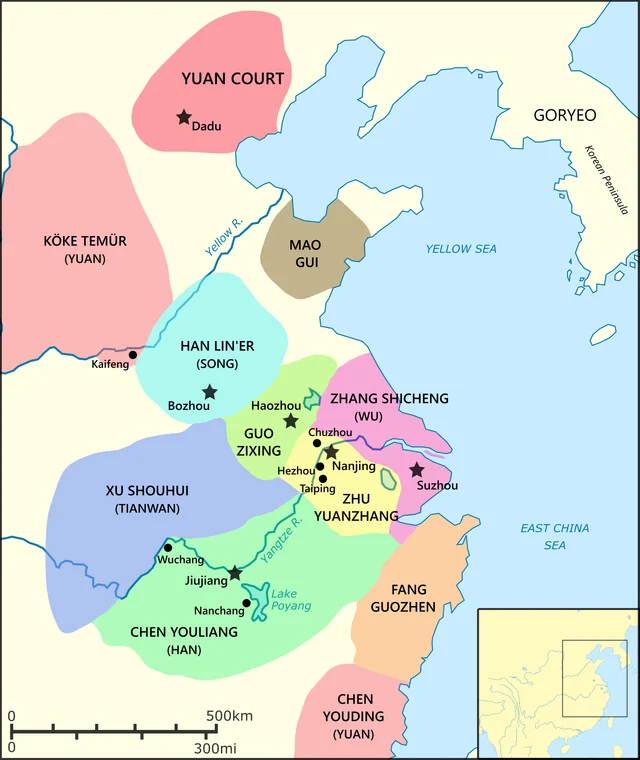
Guo died in 1355. In April 1356 Zhu took Jiqing, the city he renamed Yingtian and that is now Nanjing, and 36,000 enemy troops surrendered to him there. 2
He had an army of 100,000 by then, and he had scholars. Song Lian and Liu Ji joined him in 1360 as part of what the encyclopedia calls the Jinhua school, and they moved him away from sectarian rebellion toward the Confucian case for a single legitimate state. 2
Chen Youliang attacked Nanjing in 1360 and was beaten. In 1363 he came back with 300,000 men against Zhu's 100,000, and the war turned on a lake. 2
The battle at Lake Poyang ran for three days. Chen's fleet was made of war junks; Zhu's of small, fast barges. Chen was killed and his fleet destroyed. 3
What the victory gave Zhu was people. Absorbing Chen's territory in 1364 and 1365 left him with a population advantage over his rivals, and the enlarged army was reorganised into guards of 5,600 men, each divided into five battalions of 1,120. 2
In February 1364 he declared himself King of Wu. Zhang Shicheng had taken the same title four months earlier, from Suzhou. 2
Zhu went for Zhang's supply lines first, then for Suzhou itself. The siege lasted ten months from December 1366. The walls fell on 1 October 1367, and Zhang killed himself while being taken to Nanjing. 2
In January 1367 Han Lin'er, the puppet Song emperor whose authority Zhu had nominally acknowledged for twelve years, drowned in the Yangtze. Britannica calls the drowning "an event perhaps contrived by Zhu". 23
On 23 January 1368 Zhu proclaimed himself emperor and gave his state a new name. Da Ming means "Great Radiance". As an era name he took Hongwu, "Vastly Martial", and 1368 became the first year of the Hongwu era. 2
A Ming army of 250,000 had set out in the autumn of 1367 under Xu Da and Chang Yuchun. It reached Dadu, the Yuan capital, in early September 1368. The Yuan emperor Toghon Temür fled to Shangdu, and the Chinese renamed the city Beiping, "Pacified North". 2
Four years later Zhu tried for the steppe and lost. Three armies went out in 1372, one of 150,000 under Xu Da and two of 50,000 each. The Mongols beat two of them. 2
After that defeat the emperor told his successors to stop chasing military glory and to concentrate on defending China's northern border. 2
The office he deleted
The Ming court at first copied the Yuan one. A Central Secretariat under two grand chancellors, informally called prime ministers, ran the civil administration and controlled the six ministries. A single Chief Military Commission ran the army. 2
In 1380 the Grand Chancellor Hu Weiyong was imprisoned and executed for treason. Zhu abolished the office with him. 2
The abolition was permanent, and the emperor made it explicit: the chancellery was never to be restored. The six ministries reported straight to him. 2
He then divided the Chief Military Commission into five, so that no single office commanded the whole army, and brought twelve guards of the imperial guard under his direct control. 2
One of those twelve guards, the Embroidered Uniform Guard, worked as a secret police. 2
Britannica's summary of the reign ends on the point: "the despotic power of the emperor was institutionalized for the rest of the dynasty". 3
Splitting authority made a coup almost impossible, and it left the government less able to act. 2
Palace eunuchs were capped too. Zhu held them at a hundred and later allowed four hundred, on condition that none learned to read, write or take part in politics. 2
The examination system drew the same suspicion. He cancelled the civil service examinations in 1377 on the grounds that they had little connection to the quality of the men they produced, and restored them in 1384. 2
When the first restored cohort contained only candidates from the south, he had the chief examiner executed. 2
Rules for a country of smallholders
Zhu began his law code in 1364, before he was emperor, and did not finish it until 1397, a year before he died. 2
The Great Ming Code drew on the Tang Code of 653 and ran to 460 articles in 30 sections and seven chapters. It stayed the law of China until the dynasty fell in 1644, and the Qing built their own code on it. 25
His economic policy went after the large estate. Land was confiscated from big owners and handed to the landless, on condition that the new holders worked it themselves. 2
He moved 14,300 wealthy families out of Zhejiang and the Yingtian region to Nanjing. By the end of the reign very few large landowners were left. 2
Two centuries later the writer He Liangjun observed that in Suzhou nobody held more than ten times as much land as a small peasant. 2
The monasteries lost their land too. During the Yuan they had held three fifths of the land in Shandong. Zhu abolished about 3,000 Buddhist and Taoist houses, allowed each county one monastery with a maximum of two monks, and sent 214,000 Buddhist and 300,000 Taoist monks and nuns back to ordinary life. 2
Peasants who broke new ground got three years without tax. Northern households received fifteen mu per field and two per garden; southern households sixteen mu; hereditary soldiers fifty. 2
Slavery was abolished and the sale of free people banned, partly to keep labour on the land. 2
He also spent on water. By the winter of 1395 his officials had built 40,987 dams and drainage canals. 2
The registers came next: the Yellow Registers for households, the Fish-Scale Registers for land, and from 1371 the lijia, a system of local self-government in which one group of households at a time covered the state's local costs. 2
The tax rate was set low, at about three per cent of a harvest, and it was collected in grain that the taxpayer had to carry to a state warehouse. Hauling grain to Nanjing cost three to four times the grain's price. 2
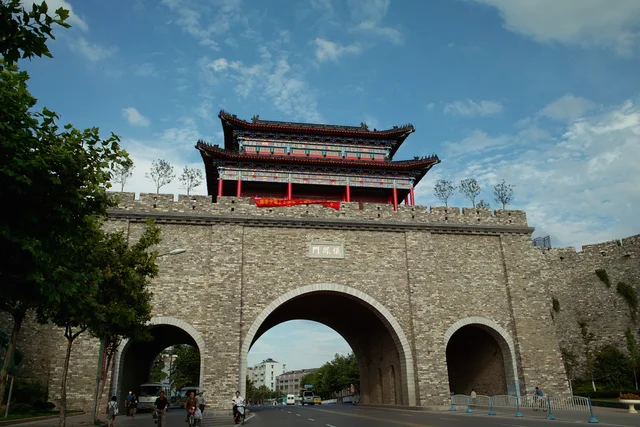
He also tried to fix the shape of daily life. Flower gardens in his sons' palaces were dug up for vegetables, exotic pets were replaced with cows, rice varieties used for wine were banned, and the government issued standards for greetings, names and writing style. 2
The army was put on the same footing as the land. Under the weisuo system, introduced in 1364, service was hereditary: every generation of a soldier's family owed one man. By 1393 the empire had 326 guards and 65 independent battalions. 2
Not even a piece of wood
As a rebel, Zhu had taxed trade and lived off it. As emperor he decided trade was the problem. 7
In 1371 he issued the first of the Ming sea bans. Private foreign trade carried the death penalty, and the offender's family and neighbours were exiled from their homes. 7
Two-masted ships were banned, ports were blocked with rocks and pine stakes, and the coast was heavily garrisoned. 27
The policy is remembered by a phrase: not even a piece of wood should sail across the sea. 2
The ban collided with Japan. Zhu's message to the Japanese court announced that his army would "capture and exterminate your bandits, head straight for your country, and put your king in bonds". The Ashikaga shogun answered that Zhu's "great empire may be able to invade Japan but our small state is not short of a strategy to defend ourselves". The Ming emperor restricted trade further. 7
The tribute system that replaced ordinary trade was an exchange dressed as deference. Foreign missions brought goods, the Ming gave back Chinese goods of equal value, and the foreign delegations were received at offices set up in Ningbo, Quanzhou and Guangzhou from 1370. 2
Those offices were abolished four years later, and the missions kept coming anyway. Between 1369 and 1397 Korea and Ryukyu each sent twenty, Champa nineteen, Siam eighteen and Đại Việt fourteen. 2
The cargo could be enormous. A Siamese mission in 1392 brought 38 tons of aromatic substances; a Javanese one in 1382 brought almost 17 tons of pepper. 2
In 1373 Zhu began a book of instructions for his descendants, the Huang-Ming Zuxun. It was published in its final form in 1395. 8
Its preface lists fifteen states that his heirs were never to invade, from Korea and Japan to Champa, Siam, Java and Brunei, and gives the reason: their land would not feed an occupying army and their people would not obey one. 8
The same emperor who wrote that list had sent a quarter of a million men north against the Yuan, and in 1388 sent 200,000 under Lan Yu to Buir Lake, where the Ming took 73,000 Mongol prisoners and the khan's two sons. 2
The heir who died first
Zhu's eldest son, Zhu Biao, was appointed heir in 1368. In 1391 the emperor sent him to inspect Shaanxi as a possible new capital. Zhu Biao fell ill on the way back and died in 1392. 2
The emperor named Zhu Biao's son, Zhu Yunwen, as his heir, and then set about clearing the ground for a boy. In 1393 he accused and executed the general Lan Yu and began a new wave of purges. 2
He had come to power himself by turning on the family that raised him. The encyclopedia reads the purges as his conclusion that the hereditary military elite could not be relied on to back the throne. 2
He also used the purges to finish the war on large landowners: many were executed on the false charge of association with disloyal ministers. 2
The emperor's sons took the places the purged generals left, and they held commands on the northern border. That arrangement held while he lived. 2
He fell seriously ill in December 1397, again in May 1398, and died on 24 June 1398, aged sixty-nine. He was buried on Purple Mountain east of Nanjing. 2
Zhu Yunwen took the throne as the Jianwen Emperor on 30 June 1398 and immediately tried to reduce his uncles' powers. In the autumn of 1399 his uncle Zhu Di rebelled. The civil war ended in 1402 with the Jianwen Emperor defeated and Zhu Di on the throne as the Yongle Emperor. 2
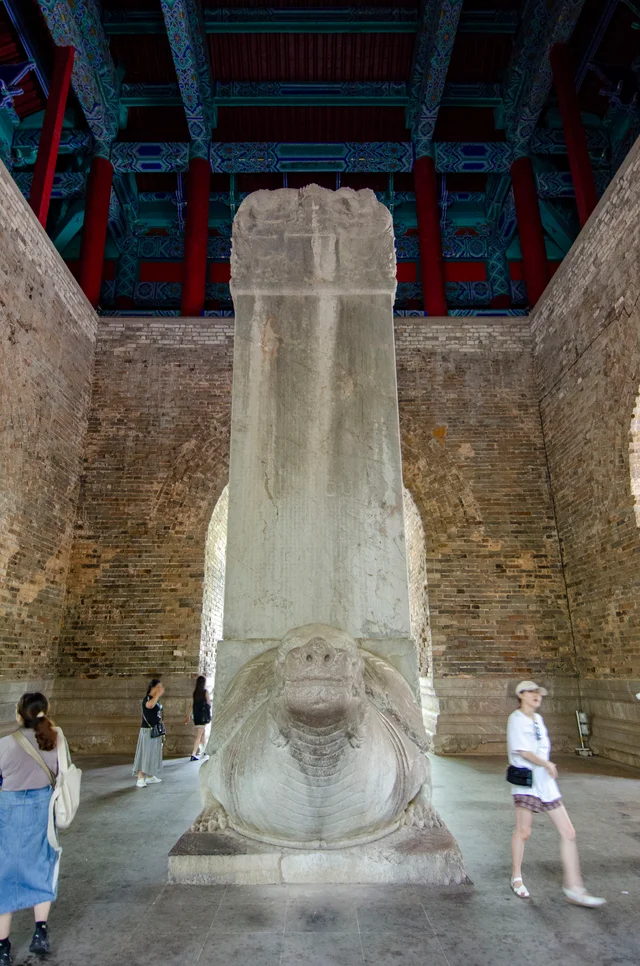
The tomb took 100,000 labourers, a wall more than 22.5 kilometres long and a guard of 5,000 troops, and legend has it that thirteen identical funeral processions left by thirteen city gates to hide where the body went. 10
Yongle wanted a bigger monument than the one he raised. In 1405 his masons began cutting a stele at Yangshan quarry, ten kilometres east of the tomb: a base of 16,250 tons, a body 49.4 metres long and 8,799 tons, a head of 6,118 tons. Assembled, it would have stood 73 metres tall. 11
The cutting was nearly finished when the court worked out that no arrangement of men and ropes could move the pieces from the quarry to the tomb. All three are still lying where they were cut. 11
What outlived him
His ministers gave him the temple name Taizu, "Grand Progenitor", and the official history of the dynasty, written under the Qing, treated him as the model founder: the man who ended civil war and drove out foreign rule. 2
Modern historians have been harder. The encyclopedia records a split between readings that emphasise his despotism and explain it by paranoia or mental illness, and readings that put him inside his own time and treat his upbringing as the source of his aims and methods. 23
The political structure he built collapsed within four years of his death, in the war between his son and his grandson. The administration did not. 2
The central and local government, the provincial administration, the tax system and the examination system survived with only minor changes to the end of imperial China, and so did the census, the land registration and the weisuo army. 2
Britannica puts the same point another way: the basic structure the Ming established was continued by the Qing and lasted until the imperial institution was abolished in 1911–12. 3
The last word on him was carved by a conqueror. In 1699, on his third tour of the south, the Kangxi Emperor stopped at the Ming Xiaoling and left a stele whose four characters, 治隆唐宋, are read as placing Zhu Yuanzhang's rule on a level with the founders of the Tang and Song. 10
Figures
| Number | What it measures | Source |
|---|---|---|
| 1328 | Year of his birth, 21 October, in Haozhou | Hongwu Emperor |
| 16 | His age when his parents and a brother died in the 1344 epidemic | Hongwu Emperor |
| 7 million | Estimated starvation deaths in the famine that fed the rebellions | Britannica |
| 300,000 | Chen Youliang's army at Lake Poyang, against Zhu's 100,000 | Hongwu Emperor |
| 250,000 | Ming troops sent north against the Yuan in 1368 | Hongwu Emperor |
| 100,000 | People killed in political purges across his thirty-year reign | Hongwu Emperor |
| 460 | Articles in the final Great Ming Code of 1397 | Great Ming Code |
| 14,300 | Wealthy families moved to Nanjing | Hongwu Emperor |
| 214,000 | Buddhist monks and nuns returned to lay life | Hongwu Emperor |
| 40,987 | Dams and drainage canals built by the winter of 1395 | Hongwu Emperor |
| 26 km | Length of the Nanjing city wall, built by 200,000 labourers | Hongwu Emperor |
| 326 | Guards in the hereditary army by 1393, each of 5,600 men | Hongwu Emperor |
| 15 | Countries his heirs were forbidden to invade | Huang-Ming Zuxun |
| 73 m | Height the abandoned Yangshan stele would have reached | Yangshan Quarry |
Glossary
| Term | What it means here | Source |
|---|---|---|
| Era name | The name a Chinese emperor gave his reign, used to date every year in it; Hongwu is the one Zhu chose in 1368 | Era name |
| Temple name | The name given after death for worship in the ancestral temple; his is Taizu, "Grand Progenitor" | Temple name |
| Grand chancellor | The official who headed the Central Secretariat and effectively served as first minister until 1380 | Zhongshu Sheng |
| Censorate | The branch that investigated and impeached officials | Censorate |
| Weisuo | The hereditary military system: guards of 5,600 men, one soldier owed by each family in each generation | Weisuo system |
| Lijia | Local self-government units of households that took turns covering the state's local costs | Lijia |
| Yellow Registers | The census register of households and population | Yellow Registers |
| Fish-Scale Registers | The land register recording each parcel, its quality, its tax quota and its owner | Fish-Scale Registers |
| Jinshi | The highest degree in the examination system, awarded at the capital | Jinshi |
| Sea ban | The prohibition on private foreign trade, first issued in 1371 | Haijin |
| Tribute system | The arrangement in which foreign states sent missions to the Ming court and received goods of equal value in return | Tributary system |
| Mu | A measure of land, roughly a fifteenth of a hectare | Mu |
| Embroidered Uniform Guard | The imperial guard regiment that served as his secret police | Embroidered Uniform Guard |
| Mandate of Heaven | The claim that heaven grants the right to rule, and can withdraw it from a dynasty that misrules | Mandate of Heaven |
Six things that are easy to get wrong
Hongwu is an era name. He was born Zhu Chongba, used Zhu Xingzong in adulthood, took the name Zhu Yuanzhang as a rebel, called himself King of Wu from 1364, and became the Hongwu Emperor in 1368. Taizu is his temple name. Britannica notes that Taizu is "more strictly correct". 23
He never conquered the steppe. The 1372 campaign into Mongolia failed, and after it he told his successors to defend China's northern border instead of pursuing military glory. The list of fifteen states he forbade his heirs to attack was written into the Ancestral Instructions in 1373, a year after that defeat. 28
The code was a lifetime's work. He started it in 1364 and finished it in 1397, a year before he died, and the finished text had 460 articles. 25
The chancellorship stayed abolished. The office Zhu removed in 1380 with Hu Weiyong was never restored, by the Ming or by the Qing that followed it. 23
The sea ban was an innovation. Chinese dynasties had taxed maritime trade for centuries under the Tang, Song and Yuan. The encyclopedia calls the Ming ban an anomaly in Chinese history, and notes that it produced the smuggling and piracy it was meant to prevent. 7
His own monument was never built. The 8.78-metre stele at his tomb is the small version. Yongle's masons cut a 73-metre one at Yangshan in 1405 and left it in the quarry. 1011
In their own words
The preface to the Huang-Ming Zuxun, written in 1373 for his descendants, on the neighbouring states:
得其地不足以供給,得其民不足以使令……彼既不為中國患,而我興兵輕伐,亦不祥也。吾恐後世子孫,倚中國富強,貪一時戰功,無故興兵,致傷人命,切記不可。
Their land would not be enough to supply us, and their people would not be enough to command... If they do not trouble China, and we raise an army to strike at them lightly, that is inauspicious too. I fear that later generations of my descendants, relying on China's wealth and strength, will covet the military glory of the moment and raise armies without cause, doing harm to human lives. Remember this: it must not be done. 8
The Chinese text is quoted as the encyclopedia gives it; the English is my translation.
His message to Japan, as the encyclopedia renders it:
capture and exterminate your bandits, head straight for your country, and put your king in bonds
The Ashikaga shogun's reply:
your great empire may be able to invade Japan but our small state is not short of a strategy to defend ourselves
Both are quoted in the encyclopedia's article on the sea ban, which takes them from published work on the period. 7
David B. Chan, writing the Britannica entry on him:
The Hongwu emperor was cruel, suspicious, and irrational, especially as he grew older.
Chan is emeritus professor of history at California State University, Hayward, and the author of a book on the war that put Yongle on the throne. 3
The full source is Hongwu Emperor on Wikipedia, selected as Wikipedia's Today's Featured Article for 21 October 2026. 12
A man who learned to read in his twenties wrote China's law for the next two and a half centuries. 25
He rebuilt the countryside by giving land to the people who worked it, and then killed a hundred thousand of the men who administered it. 2
References
- 1Wikipedia: Today's featured article/October 21, 2026
en.wikipedia.org
- 2Hongwu Emperor - Wikipedia
en.wikipedia.org
- 3Hongwu - Encyclopaedia Britannica
britannica.com
- 4File: Red Turban regional powers 1350–1360.png - Wikimedia Commons
commons.wikimedia.org
- 5Great Ming Code - Wikipedia
en.wikipedia.org
- 6File: YiFeng Gate Nanjing.jpg - Wikimedia Commons
commons.wikimedia.org
- 7Haijin - Wikipedia
en.wikipedia.org
- 8Huang-Ming Zuxun - Wikipedia
en.wikipedia.org
- 9File: 20240816-明孝陵神功圣德碑.jpg - Wikimedia Commons
commons.wikimedia.org
- 10Xiao Mausoleum - Wikipedia
en.wikipedia.org
- 11Yangshan Quarry - Wikipedia
en.wikipedia.org
This story was produced automatically by a channel. One sentence is all it takes for Neodrop to keep producing for you.