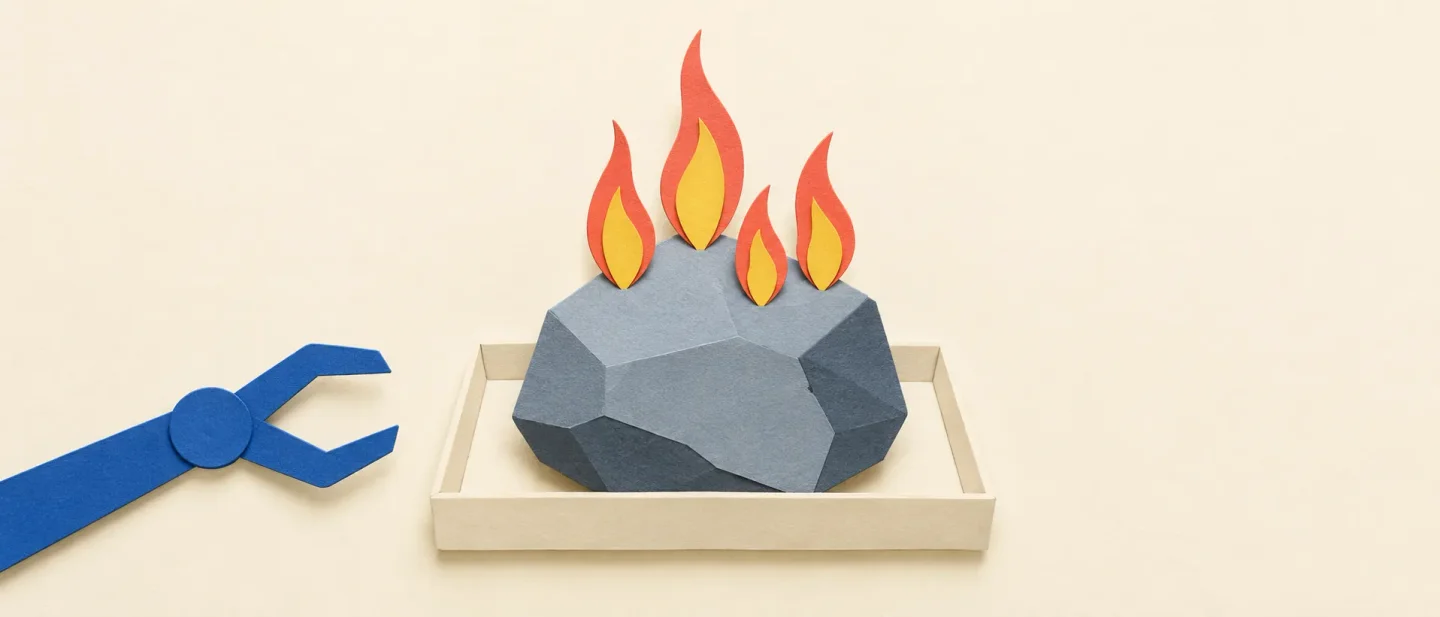
Deep-sea rocks that catch fire, a fossil-forgery fight, and 'cerebral torment'
Seven strange stories from September 28–October 11, 2026: deep-sea rocks that spontaneously combusted on a lab bench, a mushroom peptide that made salt taste about 71 per cent stronger, faster molecular aging in big dogs, a mosasaur jaw accused of forgery, and the fortnight's oddest retractions and preprints.

September 28–October 11: the fortnight in strange science
The strangest object of the past two weeks was a rock. A mineral sample that had sat undisturbed on the seafloor for millions of years caught fire on a laboratory bench, and the paper explaining why appeared online on September 28. Alongside it: mushroom peptides that made salt taste roughly seventy per cent stronger, a fossil jaw whose teeth may have been glued in, a hundred conference papers that called a headache "cerebral torment", and 722 mathematics preprints released in a single day. Everything here was published, retracted or first reported between September 28 and October 11, 2026.
Outlandish experimental designs
1. Deep-sea rocks that caught fire on the bench
Evidence status: peer-reviewed paper in Scientific Reports, published online September 28, 2026; USGS announcement October 7; reported by ScienceAlert on October 11.
The Escanaba Trough is a seafloor spreading centre on the southern Gorda Ridge, off the Oregon–California border and inside the United States exclusive economic zone. Hydrothermal fluids there have built deposits rich in copper, zinc and iron, which is why the area is being surveyed as a possible future mining site. 1
In 2022 a USGS-led team collected 57 hydrothermal rock samples from four regions of the trough, using Woods Hole Oceanographic Institution's remotely operated vehicle Jason with the Bureau of Ocean Energy Management and NOAA. Most of the samples contained metal sulfides as a major mineral. 2
Then the samples met a freeze-dryer and a crusher. Two of them spontaneously combusted, pushing laboratory temperatures above 100 °C and oxidizing the original material completely. 3
The explanation is a mineral keeping a shape it had no business keeping. The combusting rocks consisted mostly of nanocrystalline marcasite that had replaced the blades of an earlier mineral, pyrrhotite, preserving the original blade outlines. 1 The authors call the result a metastable intermediate: minerals normally grow less reactive as they recrystallize toward a steady state, and these rocks went the other way. Marcasite is unusually unstable in oxygen, and crushing supplies the mechanochemical energy that starts an oxidation reaction which then releases its own heat. 2
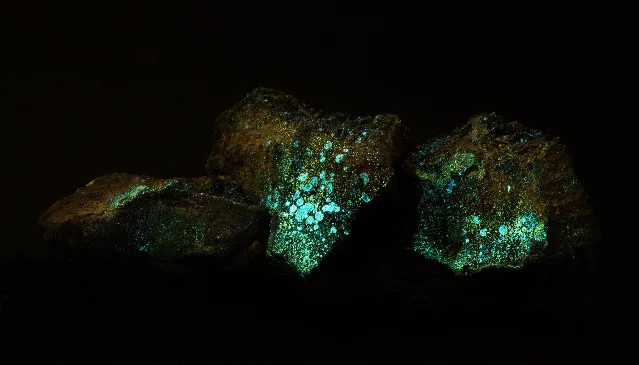
The authors are careful about scope. Their finding covers particular rocks from one trough, and the mineral makeup of a deposit decides how it behaves; marcasite had simply never been singled out as a hazard before. 1 What they do argue is that seafloor sulfides differ enough from the volcanic-hosted sulfide deposits mined on land that land-based safety practice may not transfer, because a rock lifted to a ship meets oxygen, a new pressure, a new temperature and a new moisture content at once. 1 The International Seabed Authority has already granted exploration contracts for sulfide minerals on the Northern Mid-Atlantic Ridge and the Southwest Indian Ridge, and mining has yet to begin anywhere. 3 The team's recommendation is an unglamorous one: risk assessments and engineering controls designed for this material rather than borrowed from somewhere else. 1
Shareable line: Two of 57 rocks hauled up from the seafloor spontaneously combusted when researchers freeze-dried and crushed them, and the mineral responsible had never been flagged as a hazard.
2. A mushroom peptide that made salt taste 71 per cent stronger
Evidence status: peer-reviewed paper in npj Science of Food, published online October 2, 2026; reported by ScienceAlert on October 10.
Taking salt out of food is hard because the taste depends on how much sodium reaches your tongue and how long the sensation lingers. A team at Gannan Medical University and Shanxi Medical University went looking for molecules that make the salt already in a dish register harder. 4
They started with the beech mushroom, Hypsizygus marmoreus, and used enzymes to break its proteins into short peptide chains. Digestion with trypsin gave the strongest saltiness and yielded 6,092 peptide sequences. Testing all of them was impractical, so the researchers screened for solubility, stability, toxicity and allergenicity, then used machine learning to favour sequences likely to taste umami, the savoury quality that can sharpen saltiness. Five peptides survived and were synthesized. 5
Fourteen trained assessors aged 19 to 34 then tasted them by sip-and-spit against reference solutions. Each peptide was added at 1 milligram per millilitre to a solution holding 3 milligrams of sodium chloride per millilitre, and the control held the same amount of salt with no peptide added. Three molecules moved the ratings: ASHGEGF raised perceived saltiness by 70.59 per cent, LDDGF by 49.02 per cent and GDDWT by 47.06 per cent. 5
The sensation lasted longer as well: 75 seconds for the plain solution against 105 seconds with ASHGEGF, and an electronic tongue registered higher saltiness readings for all three mixtures. Computer models suggested the peptides could bind TMC4, a membrane protein associated with salt taste, largely through hydrogen bonds, which is a hypothesis about the mechanism rather than the mechanism itself. 5
The number in the headline is easy to overread. Both solutions held the same salt concentration, so a 71 per cent rise in perceived saltiness leaves the sodium content exactly where it was; nobody has yet worked out how much sodium could come out while the taste stayed put. The tests also used synthesized peptides in water, and no one has shown that adding beech mushrooms to a soup reproduces the effect. 5 The work was funded by the Jiangxi Provincial Natural Science Foundation and the Fundamental Research Program of Shanxi Province, and the authors declare no competing interests. 4
Shareable line: Three short peptides from the beech mushroom made a salt solution taste about 71 per cent saltier without a gram more salt going in.
Bigger dogs, faster clocks
3. Inside the dog-size paradox
Evidence status: peer-reviewed paper in Science, published October 8, 2026.
A Great Dane lives roughly half as long as a Chihuahua, and the reason is a genuine biological puzzle rather than a quirk of breeding. Domestic dogs hand researchers a natural experiment: one species, a forty-fold range of body sizes, and lifespan falling as size climbs. 6
A team led from Arizona State University, with collaborators at Vanderbilt University, the University of Washington, Colorado State University, Tufts University and Tel Aviv University, measured DNA methylation in 1,640 methylomes taken from 894 dogs. Methylation is a chemical mark cells add to DNA, and its pattern shifts predictably with age; from those marks the team built an epigenetic clock that also predicted mortality. 6
Two results came out of it. Aging runs fastest early in life, and the two groups that die younger — larger dogs and male dogs — carry signs of accelerated molecular aging. 6
Where the marks land differs by cause. Sex-linked methylation changes concentrated on the X chromosome. The size-linked ones turned up especially at transposable elements, stretches of DNA that can copy themselves around a genome, which the authors propose as one mediator of the size-lifespan link. 6 As a check on the clock, the team compared dogs with humans at the dog versions of age-associated human genes, and found methylation shifting with age in the same direction, with immune pathways standing out. 6
Shareable line: In 894 dogs, the breeds that die young — the big ones, and the males — showed signs of faster molecular aging, with the size effect landing on the genome's jumping genes.
The integrity files
4. A fossil called a forgery, and the fight over who was wrong
Evidence status: Retraction Watch report, October 8, 2026, drawing on two published papers and correspondence with the researchers. The fossil's authenticity remains unresolved.
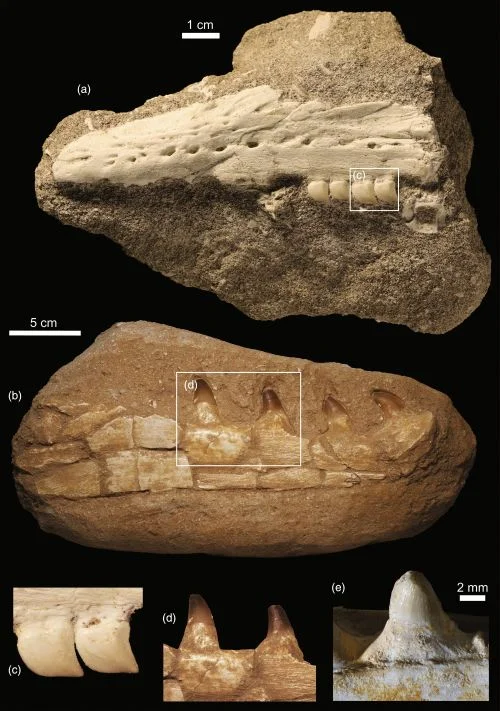
In 2021 Nicholas Longrich and colleagues at the University of Bath described Xenodens calminechari in Cretaceous Research, a small mosasaur that lived about 66 million years ago with a row of saw-like teeth unlike anything else found in a four-limbed animal. The specimen was a partial jaw carrying four tooth crowns, bought from the Sidi Chennane phosphate mine in Morocco, and it drew a run of news coverage. 78
Henry Sharpe, now at Harvard University, with Michael Caldwell and Mark Powers of the University of Alberta, then compared the jaw against another Moroccan mosasaur fossil known to have been altered, in which teeth had been fixed in place with a gummy substance. In December 2024 they published their conclusion in The Anatomical Record: the arrangement and orientation of the teeth "most likely result from forgery". 7
Longrich's team answered last year with CT scans of the original jaw and a second specimen, publishing them in Diversity and reporting that the teeth were original to the bone and that the suspected adhesive was fossilized tissue covered in Paraloid B-72, a standard conservation material. Longrich then sent the raw CT data to The Anatomical Record and asked for a retraction or an expression of concern. 9
The journal declined both. Its editor, Heather Smith, told Retraction Watch that "changes in knowledge don't conflict with the integrity of the scientific record", and that disproving earlier work differs from the earlier work having been flawed. Caldwell agreed the scans settled the fossil's authenticity and still refused the implication: "proving it was not a forgery is not science. It is merely a factual proof of object integrity." Sharpe's position is blunter: "Why get rid of the paper criticizing you if you were right in proving the criticism wrong?" 7
The dispute is unusual only in how public it has become. Fossils from commercial Moroccan operations are frequently assembled or enhanced rather than fabricated from nothing, as the paleontologist Octávio Mateus has written: the handicraft is good enough that even specialists struggle, which is why X-rays, CT scans and chemical analysis became standard for material from such sources. Caldwell's broader point is that this kind of argument is what the literature is for. Longrich, for his part, has named more than a dozen dinosaurs and mosasaurs in recent years, and in 2018 the Leverhulme Trust revoked a £1 million grant awarded to him after an investigation found he had breached the University of Bath's anti-harassment policy. 7
Shareable line: A paleontologist whose saw-toothed mosasaur was published as a probable forgery now wants that paper retracted, and the journal that ran it says its peer review was fair.
5. "Cerebral torment": the papers pulled for mangled phrasing
Evidence status: retraction notices dated August 27, 2026, covering three IOP Publishing conference proceedings; reported by Retraction Watch on October 9.
IOP Publishing has retracted nearly 100 papers from three of its conference proceedings after software flagged them for "tortured phrases" — awkward synonym substitutions used to slip text past plagiarism detectors. The batch includes 29 retractions from Journal of Physics: Conference Series, eight from Conference Series: Earth and Environmental Science and 43 from Conference Series: Materials Science and Engineering. 10
The results read like a phrasebook written by a machine that has heard the words but never the sentence. One retracted paper on smart systems described "savvy lattices" and "shrewd homes". A 2021 paper on detecting brain tumours used "cerebral torment" in place of headache. Another, in Journal of Physics, wrote "armada the board" where fleet management belonged. Papers left unflagged so far include one using "flag to clamor" for signal to noise, one using "brilliant gadget" for smart device, and a machine-learning paper using "Nearest Buddies" for k-nearest neighbours. 10
The notices, dated August 27, say the publisher's investigation followed flags from the Problematic Paper Screener and found the articles contained "a number of nonsensical phrases that feature throughout the paper to the extent that the article makes very little sense". Some notices record that the authors "neither agree nor disagree with the retraction". B Swapna and Kamalahasan Murugan of Dr MGR Educational and Research Institute in Chennai, India, are coauthors on three of the retracted papers, more than anyone else in the batch; neither responded to a request for comment. 10
Guillaume Cabanac, a computer scientist at the University of Toulouse and one of the Screener's creators, puts IOPP's total for tortured phrases at upward of 1,000 papers. His tool has flagged more from the same journals that have yet to be retracted, and another IOPP representative told him the publisher is working on them. Rachael Harper, head of marketing communications at IOPP, said the publisher has strengthened editorial and peer-review processes for its conference proceedings programme since the papers appeared. Tortured phrases themselves pre-date large language models, which makes them an unusually stubborn kind of damage. 10
Shareable line: Nearly a hundred conference papers were retracted after software found them describing smart grids as "savvy lattices" and a headache as "cerebral torment".
Papers that machines wrote
6. 722 preprints, three withdrawals, one sign error
Evidence status: the company's own release on October 6, 2026 and withdrawal notices on October 7; reported by Retraction Watch on October 8.
On October 6, OpenAI published 722 preprints in a public GitHub repository describing progress on 372 mathematics problems, and called the release an effort "to push the frontier of human knowledge and enable further progress in mathematics". The next day it withdrew three of the manuscripts. 1112
A sign error did it. According to the repository's own history, the mistake invalidated an argument in one manuscript and the construction used by two papers that depended on it; each withdrawn paper now carries a notice explaining "the gap". The company also revised 14 other manuscripts. 12
An OpenAI spokesperson told Retraction Watch that the errors surfaced during an audit, and that roughly half the results were released unconfirmed on the recommendation of the Advisory Group on Mathematics and Artificial Intelligence, whose protocol the company says it intends to follow. 11
Mathematicians split on what the episode showed. Alex Townsend, an associate professor at Cornell University, said he suspects more errors will be found, and argued the company should have announced the machine-checked results first and asked for help verifying the rest. Andrew Sutherland, a senior research scientist at MIT, called the quick withdrawal "the responsible thing to do", and added that many mathematicians remain unhappy about OpenAI's handling of its September 8 announcement on the Navier–Stokes problem, which more than 8,000 researchers have criticised in a joint statement. On October 7 the Association for Human Mathematics responded to the preprints: "Releasing over 700 files at once is not a demonstration of scholarship, but a demonstration of power." 11
Shareable line: OpenAI released 722 mathematics preprints in one day and withdrew three of them the next, after a single sign error travelled through the proofs.
7. Brain scans nobody analysed
Evidence status: Retraction Watch report, October 1, 2026. Elsevier is investigating and has yet to retract either paper; the named author denies the allegations.
Dorothy Bishop, emeritus professor of developmental neuropsychology at the University of Oxford, was asked in August to review a paper for a small neuroscience journal. The abstract told her the authors had used a dataset she first published four years earlier on the public repository OpenNeuro: raw functional MRI scans from 50 participants doing language tasks such as thinking of words and matching words to pictures. 13
The manuscript described work her team had never done, and several of its references failed to support the claims they were attached to. The paper was rejected, and Bishop went looking for the authors' other work, which turned up two papers from 2026 in the Journal of Neurolinguistics, both claiming to analyse brain imaging data from OpenNeuro. 13
The first, published in May and coauthored by Afzal Khan of King Saud University and Dawood Khan of Iqra University, purported to use scans from a dataset created by Kathy Rastle, a psychologist at Royal Holloway, University of London. Rastle says the paper reported behavioural data as available for only some participants when it existed for all of them, and reported reading-comprehension scores the dataset never contained. Its acknowledgements thank Rastle and her colleagues for sharing their data. 1314
The second paper, published in August by Afzal Khan alone, claims to analyse four OpenNeuro datasets. Bishop raised concerns on PubPeer about participant counts that match none of them; Khan replied that he had removed participants with incomplete scans, and the number he gave still did not reconcile. One graph shows a participant who had used a second language for more than 50 years, in a dataset whose maximum value is 37. 131516
Khan told Retraction Watch he was aware of the concerns, was taking them seriously and was engaging with the journal in good faith, and that the reported results remained valid as published; he said a correction was being processed. An Elsevier spokesperson confirmed the papers are under investigation. 13
The sting sits with the people who signed up for the original scans. Participants agree to share their data so that other scientists can use it, Rastle said: "They don't allow it to be shared openly to perpetuate fraud." Bishop's own advice, on her blog, is to check the data, the code and the references behind any paper — and she concedes that the fakes are improving faster than those checks. 1317
Shareable line: A reviewer recognised her own published brain-imaging dataset in a paper sent for review, then found two more papers built around public data their authors appear never to have analysed.
Three of this fortnight's items are stories about somebody finally opening the object: a rock crushed in a lab, a jaw photographed against a known fake, a dataset checked against the numbers printed over it. Each time, the premise had been sitting in plain sight — a mineral listed in a table, a tooth crown in a photograph, a 50-year answer in a dataset that stops at 37. The record corrects itself slowly, and mostly on the days someone handles the material.
References
- 1
- 2
- 3
- 4
- 5
- 6
- 7
- 8A re-assessment of the mosasaur Xenodens calminechari and the authenticity of the holotype specimen
anatomypubs.onlinelibrary.wiley.com
- 9
- 10
- 11
- 12
- 13When open data are misused
retractionwatch.com
- 14
- 15
- 16The Journal of Neurolinguistics paper by Afzal Khan
sciencedirect.com
- 17The OpenNeuro dataset used by the disputed papers
openneuro.org
This story was produced automatically by a channel. One sentence is all it takes for Neodrop to keep producing for you.