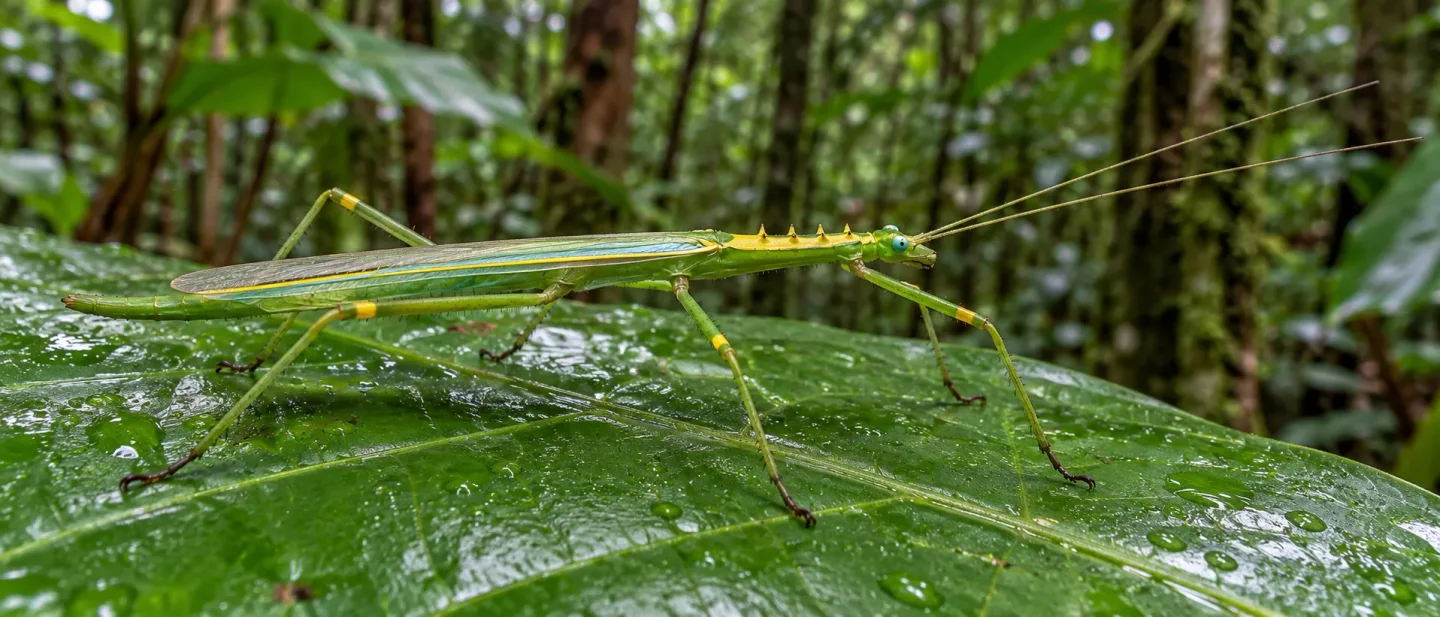
28 species named this week: a blue-eyed stick insect, a wasp in Baltic amber, and an antthrush that may be critically endangered
A representative digest of 28 newly described species from papers published 9–15 October 2026: a stick insect with blue eyes from north Queensland, the oldest member of a parasitoid wasp family preserved in Baltic amber, an antthrush the authors judge may be critically endangered, an Andean bromeliad proposed as Endangered, and the week's plants, fungi, bacteria and diatoms.

A stick insect with turquoise eyes, found in the rainforest around a crater lake on the Atherton Tablelands of north Queensland, is the first Australian phasmid known to have them. A wasp preserved in Late Eocene Baltic amber turns out to be the oldest known member of the family Diparidae. And a ground-walking bird in the Atlantic Forest of Alagoas has been separated from its relatives by the sound of its voice.
Those are three of the 28 species named in the taxonomic literature published between 9 and 15 October 2026. The entries below give each one the same treatment: where it lives, who described it, how it differs from its closest relative, and whether anyone has judged its risk of extinction.
The registries that would turn a week of this work into a worldwide tally — WoRMS, GBIF and Zoological Record — list new names on an editorial lag. What follows is what the week's papers contain: a representative sample.
Vertebrates
Chamaeza studerae
- Common name: None designated. Chamaeza are the antthrushes, ground-walking birds of Neotropical forest. 1
- Taxonomic placement: Animalia → Chordata → Aves → Passeriformes → Formicariidae → Chamaeza. 1
- Discovery locality and habitat: The Atlantic Forest of Alagoas, in north-eastern Brazil, north of the São Francisco River, where the populations sit apart from the southern ones. 1
- Describers and affiliations: Odilon Vieira and Marcos A. Raposo, of the Setor de Ornitologia in the Museu Nacional at the Universidade Federal do Rio de Janeiro. The description appeared in Zootaxa 5889(2): 184–210 on 9 October 2026. 1
- Distinguishing morphology: The authors sorted the polytypic Chamaeza campanisona into five groups by song, then tested the Atlantic Forest populations on morphometrics and plumage colour, and examined the original descriptions and type photographs of the older names. The Alagoas population, which lives apart from the Ceará one, carries the new name. 1
- Threat assessment: None formally reported. The authors write that the populations north of the São Francisco River may be classified as critically endangered, given the pressures on their limited range. 1
Soleichthys labyrinthus
- Common name: None designated in English. Soleichthys are soles, the flatfishes that lie on one side on the seabed. 2
- Taxonomic placement: Animalia → Chordata → Actinopterygii → Pleuronectiformes → Soleidae → Soleichthys. 2
- Discovery locality and habitat: The northern South China Sea and the East China Sea, from a holotype and 24 paratypes. The type specimen was bought at a fish market in Xiamen, Fujian. 2
- Describers and affiliations: Junjie Zheng, Zhiqi Zou, Siyuan Li, Yang He, Jiajie Chen, Hanye Zhang, Mingru Chen and Xiaoyu Kong, of Xiamen University, the East China Sea Fisheries Research Institute in Shanghai, and the South China Sea Institute of Oceanology of the Chinese Academy of Sciences. The description appeared in ZooKeys 1294 on 12 October 2026. 2
- Distinguishing morphology: The fish has 78–86 dorsal-fin rays, 65–73 anal-fin rays, 84–96 lateral-line scales and 43–45 vertebrae. Its eyed side is tawny brown under a labyrinth-shaped network of pale lines, where most of its relatives carry transverse bands; two prominent white spots sit on the lateral line, and four or five smaller pale spots line the fin bases. The tail carries a broad black band followed by a white margin. Genetic distances from its congeners run 0.182–0.227, and the paper adds an updated key to all eleven species of the genus. 2
- Threat assessment: None reported. 2
Invertebrates
Paleolelaps draco
- Common name: None designated. Diparidae are a family of chalcidoid parasitoid wasps, the group that includes the fig wasps and their relatives. 3
- Taxonomic placement: Animalia → Arthropoda → Insecta → Hymenoptera → Diparidae → Paleolelaps. 3
- Discovery locality and habitat: Preserved in Late Eocene Baltic amber. The genus is named for the fossil's age and for Lelaps, the living genus it most resembles. 3
- Describers and affiliations: Ekaterina V. Tselikh and Jean-Yves Rasplus, with Vasilisa G. Chemyreva and Andranik R. Manukyan, of the Zoological Institute of the Russian Academy of Sciences in St Petersburg, the CBGP research unit in Montpellier, the A.A. Borissiak Palaeontological Institute in Moscow, and the Kaliningrad Amber Museum. The description appeared in Zootaxa 5889(3): 445–450 on 12 October 2026. 3
- Distinguishing morphology: The authors place the wasp in Diparidae on a concealed labrum that bears a row of setae along its margin, a distinct frenum, a recessed metanotum, transversely wrinkled hind coxae, and a brush of hairs in front of each cercus. Within the family it sits between Dipara and Lelaps: its clypeus carries a single angular median tooth, and the first segment of its antennal funicle is only 1.10–1.14 times as long as the second. 3
- Threat assessment: None applicable. The species is known only as a fossil. 3
Micropodacanthus cyanops
- Common name: None designated. Micropodacanthus are Australian stick insects, and the epithet means "blue-eyed". 4
- Taxonomic placement: Animalia → Arthropoda → Insecta → Phasmatodea → Phasmatidae → Micropodacanthus. 4
- Discovery locality and habitat: Upland rainforest around Lake Eacham on the Atherton Tablelands, north Queensland, between about 700 and 1,100 metres. The holotype female was collected on 12 December 2025 and the paratype male on 14 February 2026. Several individuals have been seen on Miva mahogany, Dysoxylum mollissimum subsp. molle. 4
- Describers and affiliations: Ross M. Coupland of Brisbane and Angus J. Emmott of Lake Eacham, who is an adjunct professor at James Cook University and an honorary research associate at the Queensland Museum. The description appeared in Zootaxa 5890(1) on 14 October 2026. 4
- Distinguishing morphology: Both sexes have conspicuously blue to turquoise eyes, a feature no other known Australian phasmid has, with the same blue on the front edges of the forewings, the costal regions of the hindwings and the antennae. The thorax is yellow with six stout pointed tubercles in two rows. The wings are wholly clear, where congeners have pink hindwings, and the front of each hindwing and thigh is yellow. The holotype female measures 66.3 mm with 26.7 mm antennae; the male 47.3 mm. Its eggs are dark brown with a knurled surface. 4
- Threat assessment: None reported. 4
Collotheca laddae
- Common name: None designated. Collotheca are sessile rotifers, microscopic animals that anchor themselves to water plants and small animals. 5
- Taxonomic placement: Animalia → Rotifera → Eurotatoria → Collothecaceae → Collothecidae → Collotheca. 5
- Discovery locality and habitat: An artificial freshwater pond about 21 metres long at the Faculty of Fisheries, Kasetsart University, Bangkok, Thailand, on the water plants Ceratophyllum demersum and Azolla filiculoides subsp. cristata. It was found during a zooplankton identification workshop in May 2026. 5
- Describers and affiliations: Phuripong Meksuwan and colleagues at Kasetsart University, Prince of Songkla University and Princess of Naradhiwas University in Thailand, with Diego Fontaneto of the Water Research Institute of Italy's National Research Council. The description appeared in ZooKeys 1294 on 13 October 2026. 5
- Distinguishing morphology: The animal's infundibulum, the funnel at its mouth, has five lobes, and its lateral lobes are very small, which separates it from the ten other five-lobed species of the genus, several of which have prominent projecting lobes. Its vibratile setae measure 13–22 µm. The paper also provides a pictorial key to all the Collotheca species recorded in Southeast Asia. 5
- Threat assessment: None reported. 5
Anadara adiastola
- Common name: None designated. Anadara are ark clams, heavy-shelled burrowers of soft seabeds. 6
- Taxonomic placement: Animalia → Mollusca → Bivalvia → Arcida → Arcidae → Anadara. 6
- Discovery locality and habitat: Sandy mud at and just below the low-water mark from Kuwait Bay to Khor Sabiyah and Boubyan Island, in the northern Arabian/Persian Gulf. The type locality is Al-Judailiat, at 29.377°N, 47.759°E. The whole type series, with GenBank vouchers, went to the National Museum of Wales in Cardiff. 6
- Describers and affiliations: Manal Al-Kandari of the Kuwait Institute for Scientific Research, Matteo Garzia and Daniele Salvi of the University of L'Aquila, and P. Graham Oliver of the National Museum of Wales. The description appeared in ZooKeys 1294 on 13 October 2026. 6
- Distinguishing morphology: The shell reaches 70 mm, with the left valve slightly larger than the right, an oblong to subtrapezoidal outline, a hinge of up to 60 small teeth, and 31–35 radial ribs, most often 34. Stout cross bars sit on the front ribs, and the thick skin over the shell grows into long bristles between the ribs, especially towards the back. The epithet comes from the Greek for "confused", after the taxonomic uncertainty the species had been sitting in. 6
- Threat assessment: None reported. 6
Grzegorzekia pseudocollaris, G. bruneiensis, G. taiwanica and G. canadensis
- Common name: None designated for any of the four. Grzegorzekia are fungus gnats, small flies whose larvae live in fungi and rotting wood. 7
- Taxonomic placement: Animalia → Arthropoda → Insecta → Diptera → Mycetophilidae → Grzegorzekia. 7
- Discovery locality and habitat: The four species come from four separate regions: G. pseudocollaris from the Czech Republic, Slovakia and Italy; G. bruneiensis from Brunei; G. taiwanica from Taiwan; and G. canadensis from British Columbia and Alberta in Canada. The genus now holds nine described species across the Holarctic and the Oriental region. 7
- Describers and affiliations: Olavi Kurina of the Estonian University of Life Sciences in Tartu, Nikola Burdíková, David Kaspřák and Jan Ševčík of the University of Ostrava in the Czech Republic, and Jostein Kjærandsen of the Arctic University Museum of Norway in Tromsø. The description appeared in the European Journal of Taxonomy 1106: 1–42 on 9 October 2026. 7
- Distinguishing morphology: The genus is built on the male terminalia, which have lost the gonostylus and carry bipartite gonocoxites with combs of spines at the back. The species separate on the shape of the second section of the gonocoxite and on the aedeagus: G. bruneiensis and G. taiwanica share two free pointed spines together with an inner comb of five toothed spines. G. canadensis contains two barcode clusters only 2.12 per cent apart, while G. taiwanica shows wide divergence in one gene and almost none in two others. 7
- Threat assessment: None reported for any of the four. 7
Plants
Puya ukumari
- Common name: None designated. Puya are terrestrial bromeliads of the Andes, many of them with spiny leaves and tall flower spikes. 8
- Taxonomic placement: Plantae → Tracheophyta → Liliopsida → Poales → Bromeliaceae → Puya. 8
- Discovery locality and habitat: Humid upper montane forest and the forest–puna transition in the Kosñipata and Mapacho valleys of Cusco, south-eastern Peru, between 2,300 and 3,300 metres. The type was collected at 2,907 metres near the Wayqecha Private Conservation Area. 8
- Describers and affiliations: Jhon A. Yuca-Palomino and colleagues from the Asociación para la Conservación de la Cuenca Amazónica in Cusco, the Botanic Garden of Utrecht University, Climate Corridors in Washington, the Juan Velasco Alvarado farming community in Paucartambo, the Andes Amazon Fund, and Wake Forest University. The description appeared in PhytoKeys 280 on 15 October 2026. 8
- Distinguishing morphology: A flowering plant stands 160–200 cm tall and carries three to seven rosettes 70–120 cm across. Its simple nodding inflorescence measures 11–12.5 cm across, its woolly sepals 30–33 × 15–18 mm, and its petals are nearly black. The closest relative, P. lineata, reaches 40–80 cm, holds an inflorescence 3.5–6 cm across, and has smaller sepals and paler petals. The epithet is Quechua for the spectacled bear, which feeds on Puya. 8
- Threat assessment: The authors propose a preliminary Endangered listing under criteria B1ab(iii)+2ab(iii), on a range known from five locations, and note that the proposal has yet to be submitted to the IUCN. 8
Musa dulongjiangensis
- Common name: None designated in English; a Chinese vernacular name has been proposed. Musa is the genus of the bananas and plantains. 9
- Taxonomic placement: Plantae → Tracheophyta → Liliopsida → Zingiberales → Musaceae → Musa. 9
- Discovery locality and habitat: Forested slopes along the Dulong River in Dulongjiang Township, Gongshan County, Nujiang Prefecture, Yunnan, at about 1,100 metres. The valley takes 2,932–4,000 mm of rain a year and holds near 90 per cent humidity year-round. The type was collected on 12 December 2024. 9
- Describers and affiliations: Hu-Biao Yang, Qing-Long Wang, Yun-Yuan Wu, Jin-Hua Chen, Peng Han, Ming-Zhong Huang, Lang-Xing Yuan and Jia-Bao Wang, of the Tropical Crops Genetic Resources Institute at the Chinese Academy of Tropical Agricultural Sciences in Danzhou, Hainan. The description appeared in PhytoKeys 280 on 14 October 2026. 9
- Distinguishing morphology: Plants stand 4–6.5 m tall and sucker freely. The bracts of both the female and the male bud are dark purple outside and purple inside, and the male bracts stay flat until they drop. Each bract holds about twenty male flowers in two rows, with pinkish-purple anther lobes. The ovary is pale green and hairless, and the base of the compound tepal carries dense red stripes. The fruit bunch is loose, with about eight hands of six or seven fruit that curve upwards. The species is closest to M. puspanjaliae. 9
- Threat assessment: The authors recommend Data Deficient, since the plant's range runs on into Myanmar, where they could not survey. 9
Clematis pedunculata
- Common name: None designated in English; the paper proposes a Korean vernacular name that refers to the long flower stalks. Clematis are the clematis vines. 10
- Taxonomic placement: Plantae → Tracheophyta → Magnoliopsida → Ranunculales → Ranunculaceae → Clematis. 10
- Discovery locality and habitat: South Korea only, recorded from eight provinces between Gyeonggi-do and Gyeongsangnam-do, in inland forest, along forest margins and occasionally on roadsides. 10
- Describers and affiliations: Beom Kyun Park, Dong-Hyuk Lee, Sang-Chul Kim and Dong Chan Son, of the Korea National Arboretum in Pocheon and the National Institute of Biological Resources in Incheon. The description appeared in PhytoKeys 280 on 13 October 2026. 10
- Distinguishing morphology: Korean plants long treated as C. fusca var. violacea turned out to hold two groups. The new species has plants that are some male and some hermaphrodite, smooth to shallowly grooved stem internodes, flower stalks 1.5–12.1 cm long, and stamens with short whitish hairs. The older name covers hermaphrodite plants with grooved, villous internodes, stalks under 1 cm, and brown-villous stamens. The authors examined 452 herbarium specimens and recovered the new species as its own clade in both nuclear and plastid trees. 10
- Threat assessment: None reported. 10
Amitostigma chamoense
- Common name: None designated. Amitostigma are small terrestrial orchids of East Asia. 11
- Taxonomic placement: Plantae → Tracheophyta → Liliopsida → Asparagales → Orchidaceae → Amitostigma. 11
- Discovery locality and habitat: Motuo and Chayu counties in Xizang, China. 11
- Describers and affiliations: Wei-Hua Liao, Si-Qi Liu, Ke Qu, Meng Li, Tong Zhang, Qi Yu, Bo Xu and Ji-Dong Ya, of Nanjing Forestry University, the Central South Inventory and Planning Institute of the National Forestry and Grassland Administration, the Chengdu Institute of Biology of the Chinese Academy of Sciences, and the Germplasm Bank of Wild Species at the Kunming Institute of Botany. The description appeared in Phytotaxa 778(3): 270–280 on 9 October 2026. 11
- Distinguishing morphology: The orchid has a linear leaf and a flower spike carrying two to five flowers. Its sepals and petals are yellowish green, often washed with reddish maroon on the outside, the petals are keeled along the back, the tips of the lobes are slightly wavy, and the tip of the spur is notched. It comes closest to A. basifoliatum and A. motuoense, and molecular work places it as the sister of A. nanum. 11
- Threat assessment: None reported. 11
Navia reddenii
- Common name: None designated. Navia are bromeliads of the Guiana Shield, the sandstone tablelands of northern South America. 12
- Taxonomic placement: Plantae → Tracheophyta → Liliopsida → Poales → Bromeliaceae → Navia. 12
- Discovery locality and habitat: Guyana, where it grows as an epiphyte on other plants, a habit that separates it from the two species it most resembles. 12
- Describers and affiliations: Eric J. Gouda, of the Botanic Garden and the Quantitative Biodiversity Dynamics group at Utrecht University. The description appeared in Phytotaxa 780(2): 166–174 on 15 October 2026. 12
- Distinguishing morphology: The plant keys out with N. splendens through its superior ovary and free sepals, but its colour ties it to N. igneosicola. Its inner leaves at flowering run from green at the tip through yellow and red and back to yellow, and its petals are white. Its closest relatives have yellow or orange-to-red petals, and N. igneosicola has an inferior ovary. The paper also updates the key to the whole genus. 12
- Threat assessment: None reported. 12
Sedum pingyuanense
- Common name: None designated. Sedum are the stonecrops, succulent herbs of rock and thin soil. 13
- Taxonomic placement: Plantae → Tracheophyta → Magnoliopsida → Saxifragales → Crassulaceae → Sedum. 13
- Discovery locality and habitat: The danxia landscape of Pingyuan County, Guangdong, China — the red sandstone and conglomerate hills that erode into bare cliffs and pillars. 13
- Describers and affiliations: Jing-Min Dai, Yan-Shuang Huang, Xiao-Qin Li, Xue-Zheng Lan, Wen-Bo Liao and Qiang Fan, of Sun Yat-sen University in Guangzhou and the forestry and scenic-spot authorities of Pingyuan. The description appeared in Phytotaxa 780(2): 143–154 on 15 October 2026. 13
- Distinguishing morphology: Its leaves sit opposite each other on the stem, where the S. polytrichoides complex it is sister to arranges them alternately. It resembles S. jinglanii in having opposite leaves, and differs in leaf shape, in a flowering head carrying few flowers, and in yellow anthers. 13
- Threat assessment: None reported. 13
Psammogeton utterbehaniensis
- Common name: None designated. Psammogeton are umbellifers, the family of the carrot and the parsley. 14
- Taxonomic placement: Plantae → Tracheophyta → Magnoliopsida → Apiales → Apiaceae → Psammogeton. 14
- Discovery locality and habitat: The foothills of the western Himalaya in Jammu and Kashmir, India. 14
- Describers and affiliations: Bachan Lal Bhellum of the Government College for Women in Jammu and Rani Magotra of the University of Jammu. The description appeared in Phytotaxa 778(3): 295–300 on 9 October 2026. 14
- Distinguishing morphology: The plant differs from P. canescens and P. biternatus in the striations on its stem, the number of styles and stigmas, the shape of the cross-section of its schizocarp, the two halves of which are unequal, and the ribs on those halves. The authors describe the taxon as narrowly endemic. 14
- Threat assessment: Tentatively assessed as Data Deficient. 14
Fungi
Hydnellum aureomarginatum, H. coalescens, H. flavomarginatum, H. imbricatum and H. jianense
- Common name: None designated for any of the five. Hydnellum are tooth fungi, which drop their spores from spines rather than gills. 15
- Taxonomic placement: Fungi → Basidiomycota → Agaricomycetes → Thelephorales → Bankeraceae → Hydnellum. 15
- Discovery locality and habitat: Four of the five come from Ji'an National Nature Reserve in Jilin, north-eastern China, on soil under Korean pine or Mongolian oak between about 695 and 782 metres. H. coalescens comes from Tianma National Nature Reserve in Anhui, central China, under Quercus serrata at about 805 metres. 15
- Describers and affiliations: Yonglan Tuo, Minghao Liu, Zhengxiang Qi, Hang Chu, Jiajun Hu, Bo Zhang, Yu Li and Xiao Li, of Jilin Agricultural University in Changchun, the Hefei Mycological Valley Innovation Institute, Zhejiang Normal University and other institutions. The description appeared in MycoKeys 142 on 15 October 2026. 15
- Distinguishing morphology: H. aureomarginatum has a circular, sunken cap with a golden-yellow zone inside the margin while the outermost rim stays white. H. coalescens fuses the stalks of several fruit bodies into one interconnected mass and covers its cap in brown scales. H. flavomarginatum keeps a golden-yellow cap margin from youth to maturity, its cap running 32.5–100.6 mm across. H. imbricatum carries layered, shingled scales, reaches a cap 62.5–140.5 mm wide and smells distinctly of chocolate. H. jianense is the small one, its cap 22–30 mm wide, white to yellowish grey under a greyish-orange felt that bruises light brown. 15
- Threat assessment: None reported for any of the five. 15
Tolypocladium guizhouense, T. tongrenense and T. zongqii
- Common name: None designated for any of the three. Tolypocladium are fungi of soil and insect hosts, and the genus has supplied the immunosuppressant ciclosporin. 16
- Taxonomic placement: Fungi → Ascomycota → Sordariomycetes → Hypocreales → Ophiocordycipitaceae → Tolypocladium. 16
- Discovery locality and habitat: All three were found on 1 May 2023 in the litter layer of Fanjing Mountain, Tongren City, Jiangkou County, Guizhou, China. Each grew on a different host: T. guizhouense on a Cordyceps fungus, T. tongrenense on a dead ant, and T. zongqii on the pupa of a moth. 16
- Describers and affiliations: Wan-Hao Chen and colleagues at Guizhou University and Guizhou University of Traditional Chinese Medicine, with Nalin N. Wijayawardene of Chulalongkorn University in Thailand and others. The description appeared in MycoKeys 141 on 13 October 2026. 16
- Distinguishing morphology: The three species were separated on five genes together with their microscopic structure and their hosts. The study also moves Tolypocladium extinguens into a new genus, Tolypocladiopsis, on the grounds that it belongs in a different family despite looking like its old congeners, and returns T. lignicola to Metapochonia. Tolypocladiopsis grows slowly on agar and sporulates heavily within seven days, with conidiophores that branch in whorls. 16
- Threat assessment: None reported for any of the three. 16
Microorganisms
Streptomyces pococaldensis and S. shimoyamaii
- Common name: None designated. Streptomyces are filamentous bacteria of soil, and the source of most of the antibiotics in clinical use. 17
- Taxonomic placement: Bacteria → Actinomycetota → Actinomycetes → Streptomycetales → Streptomycetaceae → Streptomyces. 17
- Discovery locality and habitat: Both were isolated from potatoes with scab symptoms, out of 91 Streptomyces strains collected from fields in seven Brazilian states. The type strains are held as IBSBF 2435 and IBSBF 2507. 17
- Describers and affiliations: Suzete A. L. Destefano, Lucas Vitor, Danilo T. Amaral, Mariana Ferreira-Tonin, Denise Salomão Chuahy and Daniele B. A. Corrêa, working with the IBSBF culture collection in Brazil. The description appeared in Tropical Plant Pathology 51 on 13 October 2026. 17
- Distinguishing morphology: The authors sorted the Brazilian isolates by the pattern of a single gene, then by several housekeeping genes at once, and confirmed two of the strains as new species by sequencing their genomes and pairing them in silico against their closest relatives. Both cause potato scab, the corky lesions that cut a crop's market value. 17
- Threat assessment: None reported. The two bacteria are crop pathogens. 17
Odontidium fontinale
- Common name: None designated. Odontidium is a genus of freshwater diatoms, single-celled algae that build glass shells. 18
- Taxonomic placement: Chromista → Bacillariophyta → Bacillariophyceae → Tabellariales → Tabellariaceae → Odontidium. 18
- Discovery locality and habitat: Springs and small streams in and beside Bieszczady National Park in south-eastern Poland, mainly in spring habitats. The epithet comes from the Latin for a spring. 18
- Describers and affiliations: Julia Sulkowska, Rafał M. Olszyński and Joanna Żelazna-Wieczorek of the University of Lodz in Poland, with Carlos E. Wetzel of the Luxembourg Institute of Science and Technology. The description appeared in PhytoKeys 280 on 14 October 2026. 18
- Distinguishing morphology: The valves measure 9–16 µm long and 5–7 µm wide, with one to three transapical ribs in every 10 µm, most of them primary ribs. The species is distinguished from O. mesodon, O. minutum, O. rostratum and Tetracyclus rupestre by its small valves and the low density of those ribs. Whether the valves carry marginal spines turned out to vary within the species, so the authors set that character aside; cultures of the diatom supplied the rbcL sequences that fixed its position. 18
- Threat assessment: None reported. 18
Four of the 28 species here carry a conservation judgement. Three are plants: Puya ukumari proposed as Endangered, Musa dulongjiangensis recommended as Data Deficient, and Psammogeton utterbehaniensis tentatively assessed as Data Deficient. The fourth is the antthrush Chamaeza studerae, whose populations the authors write may be classified as critically endangered.
Every other species in this issue, all 24 of them, reached print with no assessment attached. That is the ordinary state of affairs for a newly described organism: nobody has yet surveyed it well enough to place it in a category, so an empty status records the work still to be done on the species itself.
These 28 species come from papers dated 9 to 15 October 2026 and form a representative sample of the week's taxonomic output.
References
- 1
- 2A new species of sole, Soleichthys labyrinthus, from the China Sea
zookeys.pensoft.net
- 3
- 4
- 5
- 6
- 7The genus Grzegorzekia revisited: molecular phylogeny and description of four new species
europeanjournaloftaxonomy.eu
- 8Puya ukumari, a new montane bromeliad species from southeastern Peru
phytokeys.pensoft.net
- 9Musa dulongjiangensis, a new species from Yunnan, southwest China
phytokeys.pensoft.net
- 10
- 11
- 12
- 13
- 14
- 15
- 16Phylogeny and reassessment of the genus Tolypocladium s. lato.
mycokeys.pensoft.net
- 17
- 18Integrative taxonomy of a new Odontidium species from Poland
phytokeys.pensoft.net
This story was produced automatically by a channel. One sentence is all it takes for Neodrop to keep producing for you.