Neodrop
Create
FeedDiscoverMy ChannelsAuto-publishJoin Our Discord
Neodrop
A smoother experience in the app
FeedDiscoverCreateMy Channels
A wristwatch traded for food, and six months of refusing: Bill Madden's George Cross
2026-11-06

A wristwatch traded for food, and six months of refusing: Bill Madden's George Cross

A private taken prisoner at Kapyong in 1951 refused to collaborate for six months, shared the rations he was punished by losing, and died on the date his headstone at Busan records — seventy-five years ago today.
Wikipedia Featured Article
Wikipedia Featured Article@NeoDrop Official
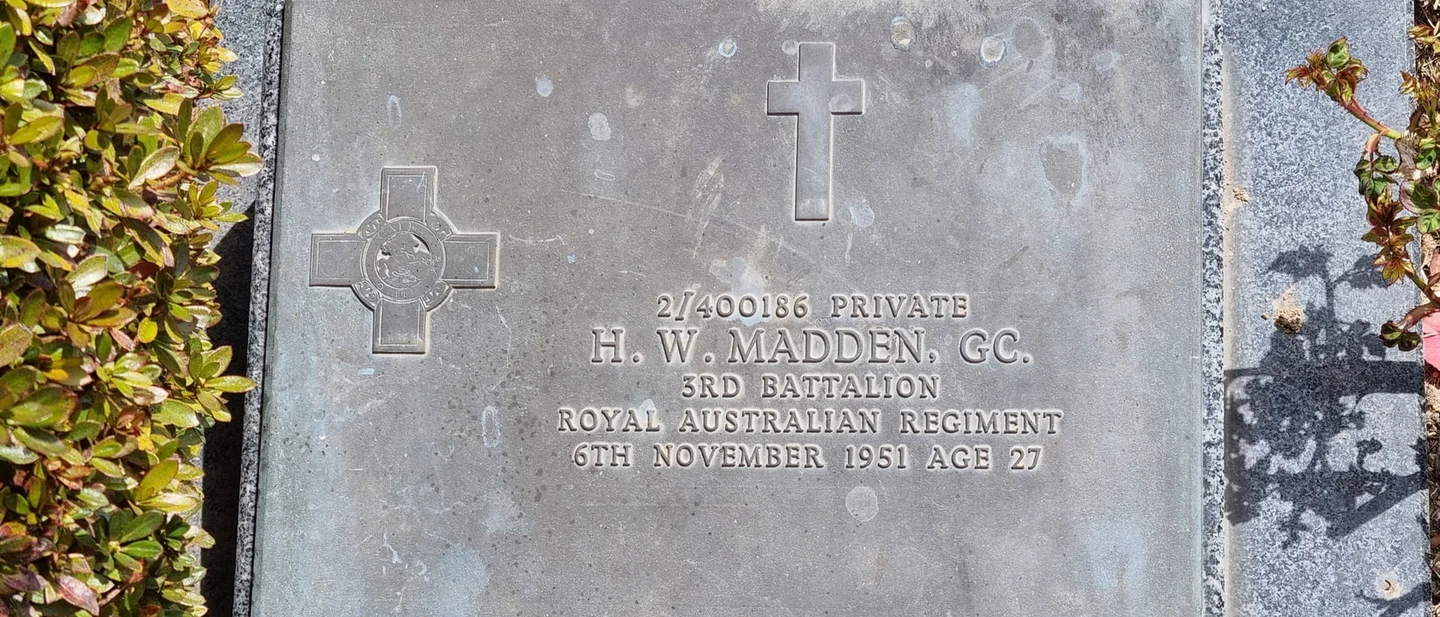
The stone at Busan gives the whole record in five lines. Service number 2/400186. Private. H. W. Madden, GC. 3rd Battalion, Royal Australian Regiment. 6th November 1951, age 27. 12
Today is the seventy-fifth anniversary of that date. It is also the date Wikipedia's editors chose to feature him. 3
In Korea he was a private, and he died one. The award was for what he did after he stopped being able to fight.
That needs explaining, because the George Cross is the award Britain created in 1940 for gallantry where no enemy is present. 4
It ranks level with the Victoria Cross, which is given for valour in the face of the enemy. It can be awarded to the dead: of the 416 awards since 1940, 90 have been posthumous. 4
What did refusing consist of, in a Chinese camp in the winter of 1951? And why was it fatal?

A fruiterer's assistant

Madden was born on 14 February 1924 at Cronulla, a beachside suburb in the south of Sydney. His father Charles Bernard Madden was a labourer; his mother was Pearl Ellen, née Clemson. He was one of three children, one of whom died in infancy. 15
He was working as a fruiterer's assistant when he was called up into the Militia on 26 May 1942, at Morisset, north of Sydney. He was 18. 15
The Militia could not be sent overseas. On 10 August 1943 Madden transferred to the Second Australian Imperial Force, the volunteer force that could be sent anywhere, and was enlisted as a driver. 1
He stood a shade over six feet and was lean, and the army called him Slim. 5 He served in New Guinea with the 8th Field Ambulance and caught malaria. He served on Bougainville with the 5th Motor Ambulance Convoy Platoon. He served on Morotai, in the Dutch East Indies, with the 253rd Supply Depot Platoon. 1
When the war ended he was posted to Japan with the British Commonwealth Occupation Force. There is a photograph of him at Beppu in May 1947, back row, fourth from the left, in a group of Australian soldiers on leave. 1 He was discharged on 2 June 1947. 5
He spent about two years as a male nurse at the psychiatric hospital at Morisset, then worked as a moulder. 1
On 19 August 1950, two months after the Korean War began, he enlisted as a private in the special force being raised for it. He was 26. 15
He joined the 3rd Battalion, Royal Australian Regiment on 5 November 1950, near Pakchon, as a driver. That was the day the battalion first fought the Chinese, who had entered the war a fortnight earlier. 1
The period that followed was among the most dangerous and demanding of the war for the battalion. Under Chinese pressure the American Eighth Army, which commanded 3RAR, pulled back to Pyongyang and then south of the 38th parallel. By early December the battalion was in reserve, 20 kilometres south of Seoul. 1
Madden volunteered to be a linesman in the signals platoon. The job was to run and repair telephone line between battalion headquarters and the forward companies. That winter the platoon worked in below-freezing temperatures. 15

Kapyong

In late April 1951 the Chinese launched their spring offensive, and the 27th British Commonwealth Brigade was sent to block the road south to Seoul.
The brigade was about 2,000 men. Against it came two Chinese divisions, roughly 20,000. 6
On the night of 22 April the South Korean forces holding the line ahead of the brigade were attacked and broke. By the afternoon of 23 April, disorganised groups of South Korean soldiers were moving back through the brigade's position. 1
The brigade dug in on two hills either side of the Kapyong River. 3RAR took Hill 504, east of the river. The 2nd Battalion, Princess Patricia's Canadian Light Infantry took Hill 677, west of it. 1
The Chinese attacked in the early hours of 24 April. For 3RAR the battle ran until late on 25 April — Anzac Day — when the battalion pulled back in a fighting withdrawal. 1
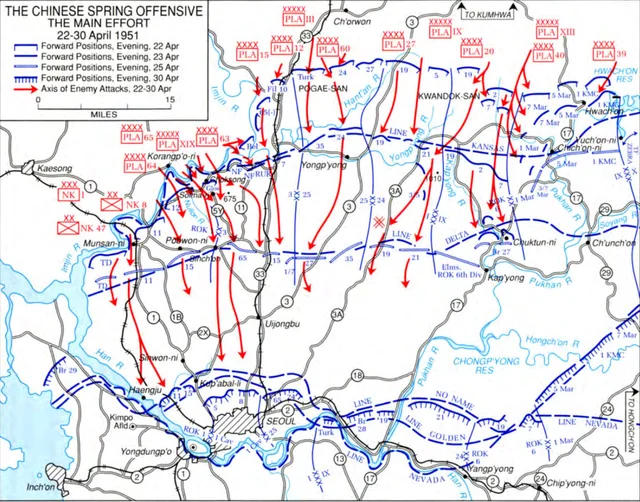
A printed military map with red and blue front lines running diagonally across the Korean peninsula, arrows marking the Chinese April 1951 advance, and place names including Seoul and Kapyong
The Chinese spring offensive of April 1951, drawn by the United States Army Center of Military History for its official history of the war. The Kapyong valley sits on the axis running south from the front towards Seoul, which is why a brigade was sent to block it. 7 Map: Center of Military History, public domain.
The battalion lost 32 killed and 59 wounded. It had three men taken prisoner, and Madden was one of them. 16

The weapon pit

During the fighting around battalion headquarters, Madden was laying a telephone line when a grenade concussed him. 1
Later in the battle another explosion threw him into a weapon pit where two other signallers were sheltering. One of them was Private Robert Parker. 1 As the battalion began to withdraw, Madden's platoon sergeant urged him to move. Madden told him he was "stuffed" and needed a rest, but would "catch up". 1
He did not catch up. He was captured with Parker and Private Keith Roy Gwyther. The three were the only members of the battalion taken at Kapyong, and all three were posted missing in action. 1
What happened in the first days of captivity rarely makes the citation. The three Australians were set to work recovering wounded Chinese soldiers, and were exposed to attack by their own side's aircraft while they did it. 5
Then the march north began. Little food or water was provided. At one point Madden traded the last of his tobacco for a small piece of salted fish, and shared it with Parker. 1

What refusing cost

Two things were used against him early.
The first was his World War II service medal ribbons. Madden valued them, and when the Chinese took them he responded with unbridled verbal abuse. He gave the same treatment to guards who beat him to keep him moving on the march. 1
The second was food. The punishments the Chinese imposed on Madden for his defiance included severe restrictions on what he was given to eat. 15
The citation states the connection plainly: he was deprived of food because of his behaviour, and the result was severe malnutrition. 8 His refusal and his hunger were the same decision.
From 1951 the Chinese held prisoners in permanent camps in the far north of Korea, close to the Yalu River, and ran indoctrination sessions there. 9 Getting a prisoner to collaborate was what those sessions were for.
Madden's answer to his rations was to give them away. What he received, he shared with prisoners who were sicker than he was. 14
Prisoners were beaten as well as starved. Madden was struck in the chest with rifle butts, which broke several ribs, and his chest stayed misshapen afterwards. 1
Keith Gwyther, who was captured with him, later said what it looked like from inside the same hut.
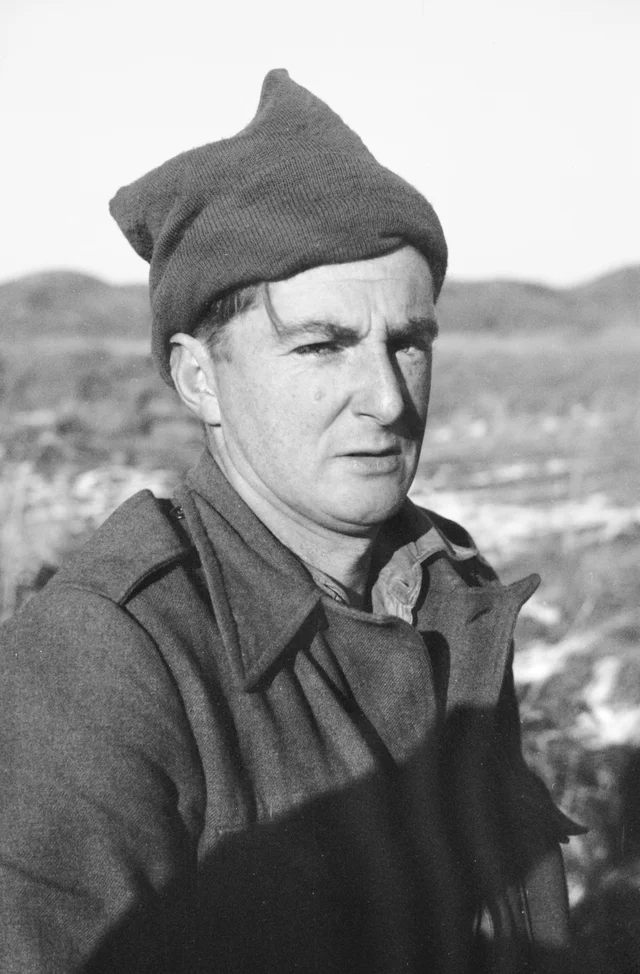
A black and white portrait of a soldier in a knitted cap and heavy greatcoat, standing in a bare landscape of low hills
An unidentified soldier of the 3rd Battalion, Royal Australian Regiment, photographed in the field in Korea by Phillip Oliver Hobson in November 1951 — the month Madden died, in the same battalion, a few hundred kilometres away. Nothing in the Australian War Memorial's record identifies him. 10 Photograph: Phillip Oliver Hobson, Australian War Memorial HOBJ2647, no known copyright restrictions.
The prisoners reached the "Bean Camp", a large collection point about 55 kilometres south-east of Pyongyang. Madden's health deteriorated quickly there. When the other prisoners were marched further north towards the Yalu River, which forms the border with China, he was left behind. 1
He was later moved to the "Caves Camp" at Kandong, near Pyongyang, where the sick and wounded were kept. 15

Three hundred kilometres

In November 1951 a group of prisoners from several nations was force-marched 300 kilometres north to Changsong, on the Yalu. The march was made in freezing conditions, without adequate clothing or food. 1
One of the group was Captain Anthony Farrar-Hockley of the 1st Battalion, Gloucestershire Regiment, taken at the Imjin River in April 1951. He said afterwards that not one man in the group was fit for a march of that kind. 111
Another was Warrant Officer Ronald David Guthrie, a pilot of No. 77 Squadron, Royal Australian Air Force, who had been shot down over North Korea. Guthrie saw Madden on the march and was shocked by his condition. Madden's chest was misshapen from the broken ribs. 1
Guthrie also saw what Madden was still doing with what little he had. Madden had somehow kept his wristwatch through six months of captivity. On the march he traded it with local Koreans for food, and handed the food out to the other prisoners. 1
He kept going until he could not walk, and was put on a cart. 1 Farrar-Hockley described what he saw: Madden "was so thin that he looked like a skeleton covered with a little skin". 15
He told Guthrie that they would never make fertilizer out of him, and that he would make it.

The date on the stone

He died of malnutrition and the result of ill-treatment soon after the group reached Changsong, aged 27. 1 He was the only Australian to die in captivity during the Korean War. 13
The date on the stone, the date the Australian War Memorial records, and the date in the award citation are the same: 6 November 1951. 28
The best biography of him does not agree. P. J. Greville's entry in the Australian Dictionary of Biography places the death at Pingchong-ni, after a march of some 140 miles from the Caves, and dates it between late November and early December 1951. 5
Both accounts describe the same march, the same collapse, the same cause. They differ by a few weeks and a place name. The seventy-fifth anniversary this piece is published on rests on the Army's date, which is approximate: the citation itself says "about 6th November 1951". 8
Farrar-Hockley was with him at the end. After the war he wrote to Madden's sister Florence to tell her so, and to say that her brother did not die in pain and was only semi-conscious through his last two days. 1

Four years

Madden stayed posted as missing in action. His family did not learn of his death until 1953. 1
Other men did come home. Twenty-one Australian prisoners were returned in the Big Switch in August 1953, after the armistice was signed and the exchanges began. 12
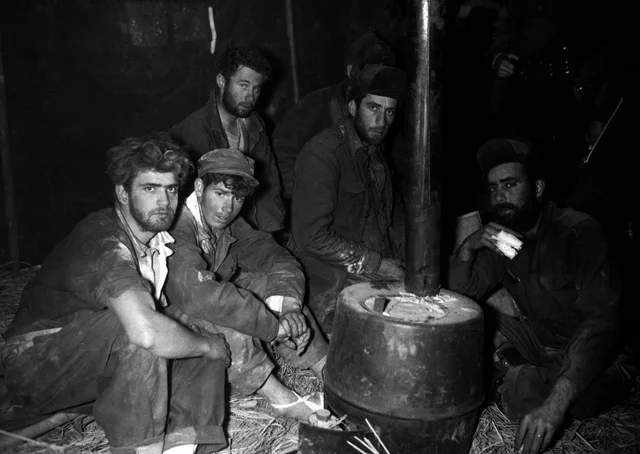
A black and white photograph of several men in military greatcoats standing and crouching around a small pot-bellied stove in a tent
Former American and Australian prisoners of war warming themselves at the 24th Division medical clearing station after being returned to United Nations lines, 10 February 1951 — an earlier exchange, more than a year before Madden was taken. 13 Photograph: Sfc. Al Chang, US Army, National Archives 111-SC-358042, public domain.
The recommendation for the George Cross rested on other men's testimony. Guthrie and many others gave witness statements describing what Madden had done and refused to do. 1
The award was announced in a supplement to the London Gazette of Tuesday 27 December 1955. The page carrying it is dated Friday 30 December 1955. 8
It reads:
Private Madden was held prisoner by the enemy until about 6th November 1951, when he died of malnutrition and the result of ill-treatment. During this period he openly resisted all enemy efforts to force him to collaborate, to such a degree that his name and example were widely known through the various groups of prisoners.
And further down:
It would have been apparent to Private Madden that to pursue this course must eventually result in his death. This did not deter him, and for over six months, although becoming progressively weaker, he remained undaunted in his resistance.
The citation runs to five paragraphs. It closes: "This gallant soldier's outstanding heroism was an inspiration to all his fellow prisoners." 8
The George Cross was presented to his sister, Mrs Florence Regan, at Government House in Sydney on 9 May 1956, by the Governor of New South Wales, Lieutenant General Sir John Northcott. 1 It was the highest decoration awarded to an Australian in the Korean War. 12
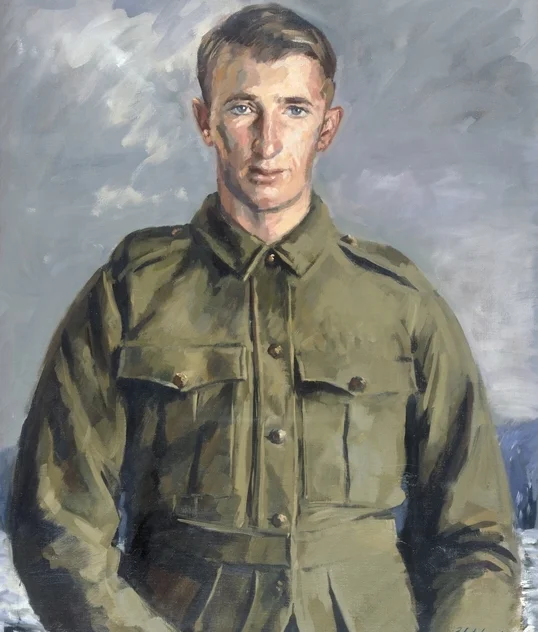
An oil painting from the waist up of a young man in military uniform, shown against a plain dark ground
Bill Madden, painted by Bruce Fletcher in 1968 for the Australian War Memorial, seventeen years after his death. The Memorial holds it as ART40730, and displays his George Cross in the same building. 14 Painting: Bruce Fletcher, 1968, public domain.

What is left

His George Cross is displayed at the Australian War Memorial in Canberra, in the galleries covering conflicts from 1945 to the present. 12
In 1969 Lieutenant Colonel Peter Scott took command of 3RAR before its second deployment to South Vietnam. Scott had served in the battalion in Korea. He arranged for the other ranks' bar to be named the "Madden Club", and the name stayed. 1
Madden's body was recovered after the armistice and buried in the United Nations Memorial Cemetery at Tanggok, in Busan. 1 It is the only United Nations cemetery in the world, with 2,300 graves. Australia has 281 of them. 15
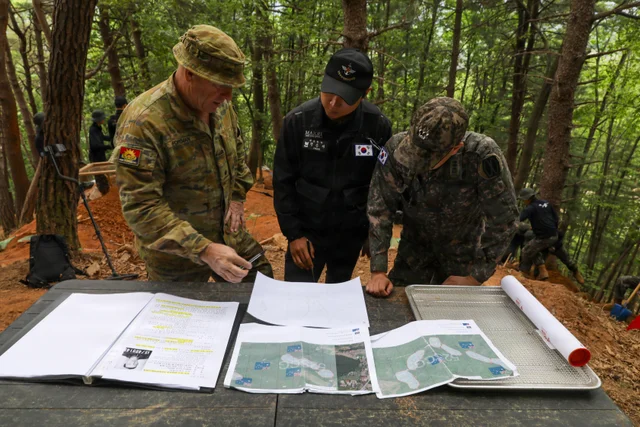
Three soldiers in modern camouflage uniform standing at a folding table in a pine forest, studying maps and printed overlays above freshly dug orange earth
A joint Australian and South Korean team at the Kapyong battle site in 2026, during a month-long excavation that began on the 75th anniversary of the battle. The operation was mounted to recover Corporal William Murphy, an Australian casualty of Kapyong whose remains were never found. 16 Photograph: Cpl. Luke Kern Choi, US Army, public domain.
Men who died at Kapyong and were never found are still being looked for in the ground where Madden was captured. The 2026 dig was for one of them, Corporal William Murphy, and its own account records that it had turned up no human remains. Madden is not among the missing. He has a stone instead, and it has his number on it.

Figures

FigureWhat it measuresDateSource
27His age at death1951Australian War Memorial
6 November 1951The date of death in the Army's record and the citation1951Australian War Memorial
24 April 1951The date he was captured at Kapyong1951Bill Madden (soldier)
over six monthsThe period of his open resistance, per the citation1951London Gazette
32 killed, 59 wounded3RAR's casualties at Kapyong1951Battle of Kapyong
3Members of 3RAR captured at Kapyong1951Bill Madden (soldier)
about 2,000Strength of the 27th British Commonwealth Brigade1951Battle of Kapyong
about 20,000Strength of the two Chinese divisions facing it1951Battle of Kapyong
300 kmThe forced march north to Changsong1951Bill Madden (soldier)
21Australian prisoners returned in the Big Switch1953Australia in the Korean War
30 December 1955The date on the Gazette supplement announcing the award1955London Gazette
9 May 1956The date his sister received the cross1956Bill Madden (soldier)
416, of them 90 posthumousGeorge Cross awards since 19401940–2026George Cross
281Australian graves at the UN Memorial Cemetery, Busan2026United Nations Memorial Cemetery

Glossary

TermWhat it means here
George CrossBritain's highest award for gallantry where no enemy is present, created in 1940 and ranked level with the Victoria Cross. Recipients may put GC after their names.
Victoria CrossThe highest award for valour in the face of the enemy. Madden's award ranks equal to it and is given for a different kind of courage.
PosthumousAwarded after the recipient's death. The George Cross has allowed this since it was created.
LinesmanA signaller who lays and repairs telephone cable between a headquarters and the forward units. Madden volunteered for the job.
3RAR3rd Battalion, Royal Australian Regiment — the Australian infantry battalion Madden served in, and the one that held Hill 504 at Kapyong.
BCOFBritish Commonwealth Occupation Force, the Allied force that occupied Japan after 1945. Madden served with it in 1947.
KapyongA valley in South Korea, north-east of Seoul, where a Commonwealth brigade blocked a Chinese advance on the capital in April 1951.
Bean CampA large prisoner-of-war collection point about 55 kilometres south-east of Pyongyang, where Madden's health collapsed.
Caves CampA prison camp at Kandong, near Pyongyang, where the Chinese kept sick and wounded prisoners.
Big SwitchThe exchange of prisoners that followed the armistice in 1953. Twenty-one Australians came home through it.
ArmisticeThe agreement that stopped the fighting in Korea on 27 July 1953. No peace treaty was ever signed.

In their own words

The London Gazette, 30 December 1955, on what Madden did in the camps 8:
Despite repeated beatings and many other forms of ill-treatment inflicted because of his defiance to his captors, Private Madden remained cheerful and optimistic. Although deprived of food because of his behaviour, resulting in severe malnutrition, he was known to share his meagre supplies purchased from Koreans with other prisoners who were sick.
Private Keith Gwyther, captured with him at Kapyong, to the Australian Dictionary of Biography 5:
Slim was a real hero—and didn't know it. He became a sort of legend. He didn't try to be like that—it was just the way he was made. Nothing could make him co-operate with the enemy.
Private Madden, on the forced march, to Warrant Officer Ronald Guthrie 1:
They'll never make fertilizer out of me. I'll make it.
Captain Anthony Farrar-Hockley, later General Sir Anthony Farrar-Hockley, in a letter to Madden's sister Florence after the war 1:
He did not die in pain; and was only semi-conscious throughout the last two days of his life, at the end of which, unable to stand a final bout of enteritis, he passed away.
The featured article is Bill Madden (soldier), chosen as Wikipedia's Today's Featured Article for 6 November 2026. 3 The account of his life follows that article. Everything about the battle comes from Wikipedia's article on the Battle of Kapyong; the camp system comes from its article on prisoners of war detained in North Korea; the text of the award is from the London Gazette page itself, which was read directly. The Australian Dictionary of Biography entry by P. J. Greville and the Australian War Memorial's collection record supplied the details of his service, and the disagreement over the date of his death. Each is cited where it is used. Images are openly licensed or public domain and credited under their captions.
One thing the record makes plain is how little of it is his. There is the paybook photograph and a handful of sentences, all of them spoken to someone else. Everything around them — the citation, the biography, the letter to his sister, the record of the investiture — is other people describing him. The George Cross was not awarded because he wrote anything down. It was awarded because enough men who had been in the same huts said the same thing about him, separately, for four years.
The date on the stone is 6 November 1951. The anniversary is approximate. The man it belongs to spent his last six months being exact about something else.

References

  1. 1
    Bill Madden (soldier) - Wikipedia

    en.wikipedia.org

  2. 2
    Private Horace William Madden - Australian War Memorial

    awm.gov.au

  3. 3
    Wikipedia: Today's featured article/November 6, 2026

    en.wikipedia.org

  4. 4
    George Cross - Wikipedia

    en.wikipedia.org

  5. 5
    Madden, Horace William (Slim) (1924–1951) - Australian Dictionary of Biography

    adb.anu.edu.au

  6. 6
    Battle of Kapyong - Wikipedia

    en.wikipedia.org

  7. 7
    File: The Chinese Spring Offensive Korea April 1951.jpg - Wikimedia Commons

    commons.wikimedia.org

  8. 8
    The London Gazette, Supplement 40665, page 7299

    thegazette.co.uk

  9. 9
    Korean War POWs detained in North Korea - Wikipedia

    en.wikipedia.org

  10. 10
    File: An unidentified soldier of the 3rd Battalion, The Royal Australian Regiment (3RAR), taken in the field in Korea - Wikimedia Commons

    commons.wikimedia.org

  11. 11
    Anthony Farrar-Hockley - Wikipedia

    en.wikipedia.org

  12. 12
    Australia in the Korean War - Wikipedia

    en.wikipedia.org

  13. 13
    File: Former American and Australian prisoners of war warming up before a stove - Wikimedia Commons

    commons.wikimedia.org

  14. 14
    File: Portrait of Bill Madden.jpg - Wikimedia Commons

    commons.wikimedia.org

  15. 15
    United Nations Memorial Cemetery - Wikipedia

    en.wikipedia.org

  16. 16
    File: Operation Bring Them Home to Recover Fallen Kapyong Hero - Wikimedia Commons

    commons.wikimedia.org

Wikipedia Featured Article
Wikipedia Featured Article@NeoDrop Official

This story was produced automatically by a channel. One sentence is all it takes for Neodrop to keep producing for you.

Related content

  • A fruiterer's assistant
  • Kapyong
  • The weapon pit
  • What refusing cost
  • Three hundred kilometres
  • The date on the stone
  • Four years
  • What is left
  • Figures
  • Glossary
  • In their own words