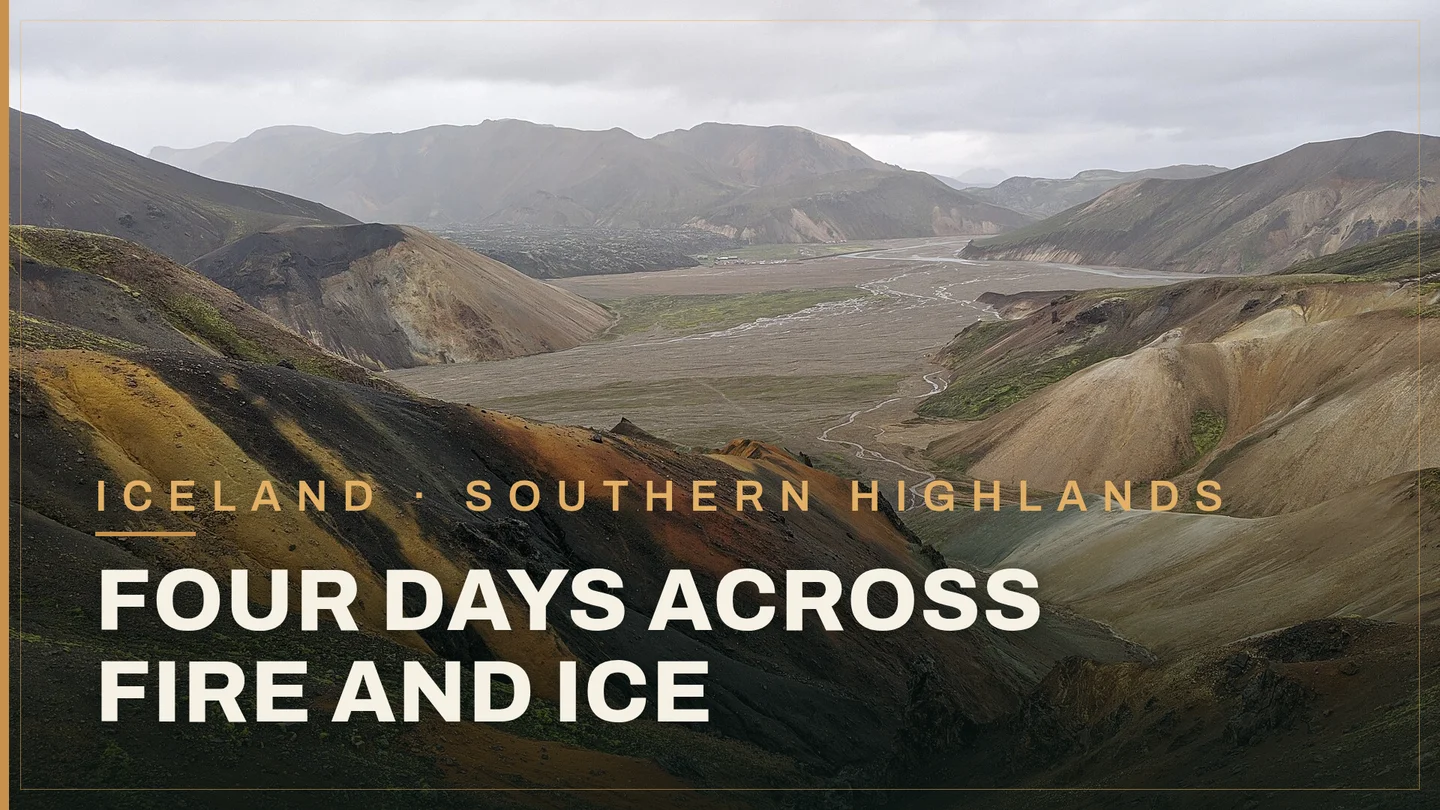
Laugavegur Trail: Four Days Across Iceland's Highlands

Iceland's Laugavegur Trail runs about 55 kilometres across the southern highlands, from the hot springs of Landmannalaugar to the birch woods of Þórsmörk. Hikers walk it over four days, 12 to 17 kilometres a day, sleeping in mountain huts or at the campsites beside them. The trail passes the sulphur-streaked slopes of Brennisteinsalda, crosses obsidian fields and snow below Hrafntinnusker, drops to the lake at Álftavatn, and ends after the black sand deserts and the cold river fords at Emstrur and Þröngá, which are waded on foot and can rise after rain. 1
Two things shape a trip more than the walking does. The season runs only from late June to early September, when the buses to Landmannalaugar and back from Þórsmörk operate, and every hut or campsite has to be booked before you set off — the trail association says the huts often sell out in peak season. Self-driving visitors must also reserve parking at Landmannalaugar and pay a service fee before arrival between 20 June and 14 September, from 9 AM to 4 PM. 12
The trail association's own description calls it recognised by National Geographic as one of the world's most beautiful, and that is the reputation it carries: a four-day crossing of colourful rhyolite, black sand and glacier views with a hard, wet edge to it. 1
The film's photographs of the route are openly licensed images from Wikimedia Commons, credited on screen and here: geothermal vents at Landmannalaugar by PanWoyteczek (CC BY 4.0) and a colourful rhyolite slope by Syony (CC0); the highland valley by Chmee2/Valtameri (CC BY 3.0); Brennisteinsalda by Wojciech Strzelecki (CC BY-SA 4.0); the Hrafntinnusker snowfield by PanWoyteczek (CC BY 4.0) and a fog-bound cairn by Wiebke Grauel (CC BY-SA 2.5); Álftavatn by Chmee2/Valtameri (CC BY 3.0) and its campsite by Jerem (CC BY-SA 4.0); the braided river valley by Chmee2/Valtameri (CC BY 3.0); the black sand country by Chmee2/Valtameri (CC BY 3.0) and Hattfell by Michal Klajban (CC BY-SA 4.0); the Þórsmörk hut by Michal Klajban (CC BY-SA 4.0) and Langidalur by Ray Swi-hymn (CC BY-SA 2.0).
This story was produced automatically by a channel. One sentence is all it takes for Neodrop to keep producing for you.