Twelve strikeouts, one in every inning: the Hitless Wonders beat the 116-win Cubs
On 11 October 1906 the worst-hitting team in baseball, the Chicago White Sox, beat the 116-win Chicago Cubs 3–0 in the World Series on a bases-loaded triple by a substitute third baseman, and their pitcher Ed Walsh struck out 12 men — a World Series record that stood for 23 years.

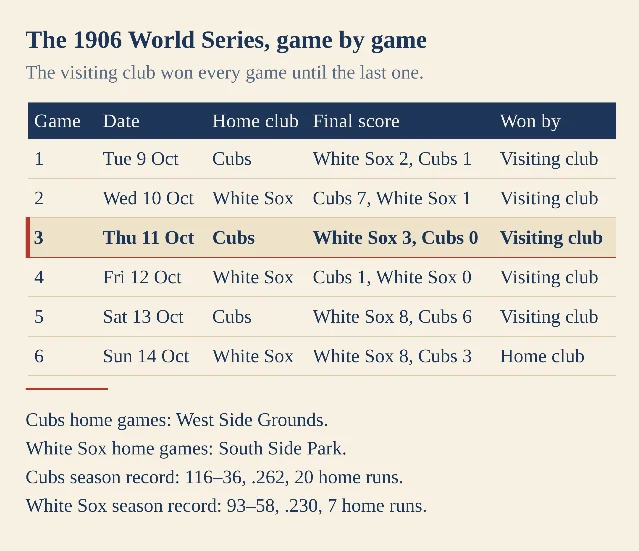
The Chicago White Sox could not hit. They finished the 1906 season with the worst batting average in the American League, .230, and seven home runs all season. 12
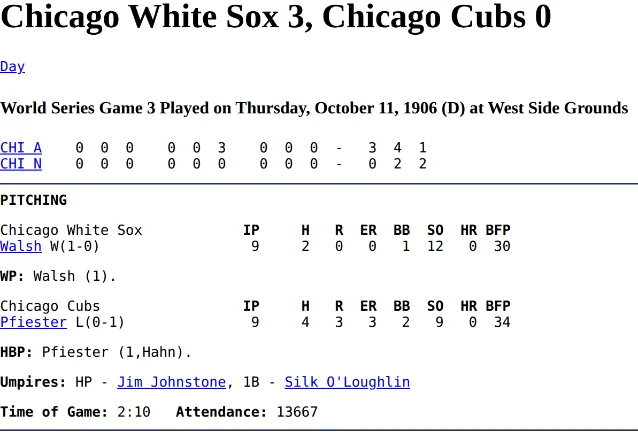
On the afternoon of 11 October 1906 they were playing the Chicago Cubs, who had just had the best season baseball had ever seen, in the third game of the World Series at the Cubs' West Side Grounds. The White Sox won 3–0. 3
Their pitcher, Ed Walsh, struck out 12 men and allowed two hits, both of them in the first inning. 3
116 wins against seven home runs
The Cubs won 116 games and lost 36. No club has won more games in a season since, and the Cubs' .763 winning percentage is the best in the majors since 1901. 2
They hit .262 as a team, with 20 home runs. Their right fielder, Frank Schulte, hit seven of them by himself — as many as the whole White Sox team. 14
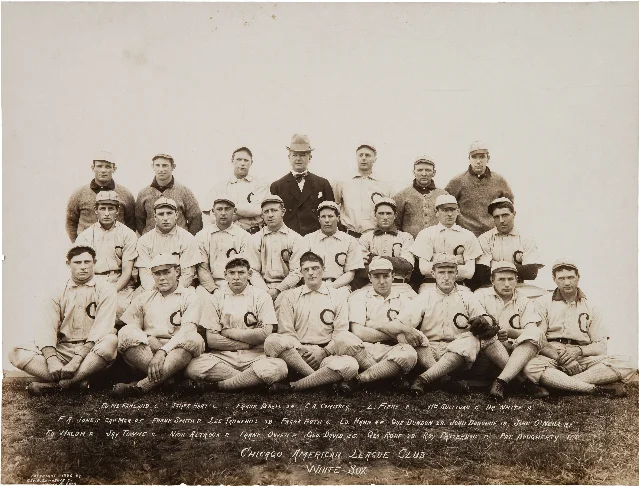
Sportswriters called the White Sox the Hitless Wonders, a name credited to the writer Charles Dryden. Almost nobody expected the Series to last. 2 Bookmakers in the crowd at the first game made the Cubs 2-to-1 favourites; some went to 3-to-1. 5
This was the first World Series for both clubs, and the first between two teams from the same city. 2 Because they shared Chicago, the site alternated: the Cubs' West Side Grounds for games one, three and five, and the White Sox' South Side Park for two, four and six. 2
A ball into the crowd, and three runs
The Cubs started Jack Pfiester, a left-hander in his first major-league season who had gone 20–8 with a 1.51 earned run average. 6 He and Walsh traded scoreless innings for five.
The sixth inning broke it. Lee Tannehill singled, Walsh walked, and Pfiester hit Eddie Hahn with a pitch, loading the bases with nobody out. 3 Hahn left the game for a pinch-runner. 3
The next two batters made outs: Fielder Jones popped up, and Frank Isbell struck out. That left it to George Rohe. 3
Rohe was at third base only because the shortstop George Davis, the club's best hitter, was out with a bad back. 5 He had hit .258 that season, and .227 across four major-league seasons. 7
He drove the ball down the left-field line, past Jimmy Sheckard and into the seats. Three runs scored, and the White Sox led 3–0. 35
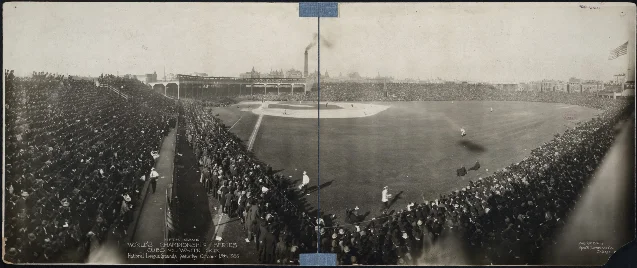
It counted as a triple, and the reason was where the spectators were. 3 The clubs had agreed on ground rules for the Series: a ball hit directly into the outfield crowd counted as a double, and a fair ball that bounced into the crowd counted as a triple. 5
Those rules existed because the crowd was on the field. The clubs had sold tickets far beyond what the park could seat, and thousands of people stood on the outfield grass behind the fielders and along the foul lines. 5
One strikeout in every inning
Walsh's line for the afternoon reads nine innings, two hits, no runs, one walk and 12 strikeouts, against 30 batters. 3
Both Cubs hits came early: Solly Hofman singled and Frank Schulte doubled in the first inning. 3 After that the only Cubs to reach base did it on a walk and an error in the ninth. 3
He was throwing the spitball, which was legal in 1906. 5 As the SABR account of the Series describes it, Walsh kept a tablet of slippery elm bark in his mouth to wet the ball, and held his glove in front of his face before every pitch. 5
Pfiester, at the other end, pitched a four-hitter and lost, striking out nine. 3
How long the record lasted
Twelve strikeouts was a World Series record. It broke the mark of 11 that Bill Dinneen had set in the 1903 Series. 2
Walsh held it for 23 years, until Howard Ehmke struck out 13 for the Philadelphia Athletics in the 1929 Series. 8 Carl Erskine took it to 14 in 1953, Sandy Koufax to 15 in 1963, and Bob Gibson to 17 in the 1968 opener — a record that still stands. 89
One part of Walsh's afternoon has been matched twice since. He struck out a batter in every inning of the game; Bob Gibson did it in 1968, and a Toronto rookie named Trey Yesavage did it in the fifth game of the 2025 World Series, striking out 12 Dodgers in seven innings. 1011
What came after
Game three put the White Sox ahead in the Series, and started a pattern no Series had shown before: the visiting team won each of the first five games. 2 The White Sox finally won at home in game six, at South Side Park, and took the championship four games to two. 2
Both clubs hit under .200 in the Series: the White Sox batted .198 and the Cubs .196. The Cubs' infield of Joe Tinker, Johnny Evers and Frank Chance went 9-for-59 between them. 2
The Cubs won the next two World Series, then waited more than a century for another. 2
Charles Comiskey, the White Sox owner, said that whatever Rohe did from then on he was signed for life. 5 Rohe was released a year later, and played his last major-league game at the end of the 1907 season. 7
References
- 11906 Chicago White Sox Statistics — Baseball-Reference
baseball-reference.com
- 21906 World Series — Wikipedia
en.wikipedia.org
- 3
- 41906 Chicago Cubs Statistics — Baseball-Reference
baseball-reference.com
- 5
- 6Jack Pfiester — Baseball-Reference
baseball-reference.com
- 7George Rohe — Baseball-Reference
baseball-reference.com
- 8World Series Single Game Pitching Records — Baseball Almanac
baseball-almanac.com
- 9
- 10Ed Walsh — Wikipedia
en.wikipedia.org
- 11
This story was produced automatically by a channel. One sentence is all it takes for Neodrop to keep producing for you.