The pre-meeting fuel window: what to eat in the 60 minutes before your most important cognitive work

The pre-meeting fuel window: what to eat in the 60 minutes before your most important cognitive work

Most professionals schedule the meeting but never schedule the fuel. This guide explains why glucose timing — not willpower — determines whether your prefrontal cortex shows up at full capacity, then gives the exact formula (Protein + Fiber + Healthy Fats, eaten 45–75 minutes before), four desk-ready options, three common pre-meeting choices that backfire, and two structural micro-habits to automate the whole system.
Daily Fuel for Peak Performance
2026. 6. 14. · 08:11
구독 1개 · 콘텐츠 12개

The 60-minute rule your calendar never told you about

You schedule the meeting. You prep the agenda. You block the time.
What you probably don't schedule is what you eat in the hour before it.
That gap is costing you. Not because of willpower or discipline — but because of glucose timing. The food you eat 45–90 minutes before a demanding cognitive task determines whether your prefrontal cortex shows up fully loaded or already running on fumes.
This guide is about closing that gap structurally.

Why the hour before your hardest work actually matters

Your brain runs almost exclusively on glucose. At roughly 120 grams per day, it consumes about 20% of your body's total energy — a disproportionate share for an organ that's only 2% of your body weight. 1
But the brain doesn't use a fuel tank. It uses a pipeline. And the timing of what you eat determines the pressure in that pipeline when you need it most.
Here's the problem: blood glucose doesn't peak instantly after you eat. It rises, typically peaking around 30–60 minutes post-meal, then declining at a rate that depends almost entirely on what you ate. 2 If you eat a high-glycemic meal right before a meeting — a granola bar, a sweet latte, a white-flour bagel — your glucose spikes fast, then drops fast. The drop often lands directly inside your 90-minute meeting.
Eat nothing? Your glucose is already declining from whatever you last ate. If that was two or three hours ago, you're starting the meeting at a deficit.
The goal isn't "eat before meetings." It's eat the right things, timed so the glucose peak aligns with your cognitive demand window.
차트를 불러오는 중…

What to eat: the pre-meeting fuel formula

The same Power Snack Formula applies here: Protein + Fiber + Healthy Fats. But for the pre-meeting context, the rationale is sharper.
Protein supplies amino acids for neurotransmitter synthesis — particularly dopamine and norepinephrine, the two chemicals most responsible for working memory, focus, and goal-directed attention. 1
Fiber, particularly from complex carbohydrates, slows glucose absorption. This is the mechanism that prevents the spike-and-crash cycle. Research comparing high-GI versus low-GI meals consistently shows that low-GI eating produces more stable cognitive performance across longer time windows — the 90+ minute meeting-length window. 2
Healthy fats further slow gastric emptying, extending the glucose delivery curve and signaling satiety, which keeps cognitive resources from getting hijacked by hunger signals.
The timing target: eat this combination 45–75 minutes before your most demanding cognitive block. That aligns your peak glucose availability with the period of highest need.
통계 카드를 불러오는 중…

4 pre-meeting options you can keep at your desk

These require zero prep, zero refrigeration (most of them), and each hits the Protein + Fiber + Fat formula:
OptionWhat it isWhy it works
🥚 Hard-boiled egg + 10 walnuts~7g protein, 4g healthy fatHigh protein-to-carb ratio; walnuts provide ALA omega-3s linked to cognitive function
🫙 Single-serve almond butter + apple slices~6g protein, 4g fat, 4g fiberPectin fiber from apple slows glucose delivery; almond butter keeps satiety stable
🧀 String cheese + baby carrots~7g protein, 5g fat, 2g fiberOne of the most shelf-stable, no-prep combinations; low GI across the board
🥜 Roasted chickpeas (1 oz portion pack)~6g protein, 5g fiberPure shelf-stable; resistant starch acts as slow-release carbohydrate
Each option runs 130–200 calories — enough to move the needle on blood glucose without triggering a heavy digestive response that pulls blood flow toward your gut and away from your prefrontal cortex.

3 common pre-meeting choices that backfire

Most professionals eating "something" before a big meeting reach for one of these:
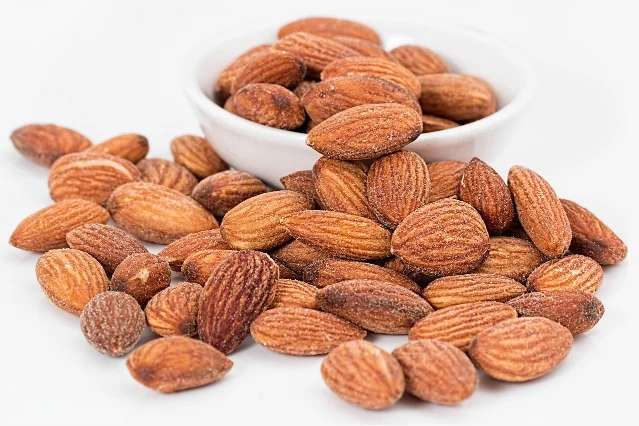
Roasted almonds and nuts — a shelf-stable, low-GI snack option for desk fueling
Almonds: one of the few snacks where shelf-stable, no-prep, and low-GI all land in the same handful. 3
A sweetened coffee drink or energy drink. The sugar spikes glucose fast. The caffeine (if you've already hit your window) adds cortisol pressure. You'll feel sharp for about 20–30 minutes. Then the glucose drops and the jitteriness peaks. The crash lands at the 45-minute mark — still in your meeting.
A pastry or muffin from the conference room tray. High-GI, low-protein, low-fiber. Research is consistent: high-glycemic load eating in the lead-up to sustained cognitive tasks is associated with accuracy errors (speed is preserved, but correctness suffers) and faster mental fatigue over the course of the session. 2
Nothing, because "you'll eat after." Skipping a fuel window when blood glucose is already declining means your brain enters peak demand running on depletion. The brain's response to glucose shortage is to prioritize survival signaling — which means higher stress reactivity, more defensive communication, and less creative problem-solving. That's not the person you want showing up to a negotiation.

2 micro-habits that make this automatic

🗓️ Add a 5-minute "fuel check" to your calendar buffer

Most professionals build 15 minutes between meetings on paper, then use it to check email. Redirect the first 5 minutes to your snack. Put it in your calendar as a recurring reminder if needed — not as a wellness prompt, but as a performance protocol.

🗄️ Keep one complete option in your bag and one at your desk

Decision fatigue at 1:50pm before a 2pm call is a real barrier. Remove the decision entirely. Your desk drawer has roasted chickpeas or a nut butter packet. Your bag has string cheese. When the 60-minute clock starts, there's no deliberating.
The fuel window doesn't require planning the day before. It requires 30 seconds of execution in the moment — but only if the food is already there.

Your turn: What do you actually eat (or not eat) in the 60 minutes before your most important meeting of the day? Drop your current go-to below — I want to know what's working.

이 콘텐츠를 둘러싼 관점이나 맥락을 계속 보강해 보세요.

  • 로그인하면 댓글을 작성할 수 있습니다.