Devin's growth playbook: from $1M to $73M ARR by turning backlog into a metered agent
A teardown of how Devin acquires users through backlog delegation, retains teams through repository context and asynchronous workflows, and monetizes engineering work with quotas, ACUs, and enterprise contracts.

The thesis
Devin grew by turning an engineering backlog into a product that can be delegated, reviewed, and repeated. Cognition says Devin's ARR rose from $1 million in September 2024 to $73 million in June 2025. The figure covers Devin before Cognition acquired Windsurf. Cognition later said the acquisition more than doubled company ARR and lifted combined enterprise ARR by more than 30% in the following seven weeks. 1
The growth mechanism is narrower than the phrase "AI software engineer" suggests. Devin works best when a team can describe a bounded task, define how to verify it, and leave the agent working while engineers handle higher-value decisions. That design gives Cognition three connected surfaces: individual task delegation, team workflow integration, and enterprise automation priced by compute.
Acquisition: start with work already waiting
Devin's entry point is an unfinished task rather than a blank coding canvas. Cognition's documentation names Linear and Jira tickets, bug reproduction, test writing, documentation, migrations, refactors, and internal tools as common use cases. The product asks a developer to provide a task with explicit completion criteria and verification steps. 2
That framing reduces the first-use question from "What should I build with this?" to "Which item in my queue can I hand over?"
Distribution follows the places where that work begins. A user can delegate through the web app, tag Devin in Slack or Microsoft Teams, start in the CLI and hand a longer task to cloud Devin, or trigger work through the API. Cognition's own team uses the same codebases across the web app, Slack, Linear, CLI, and API. 23
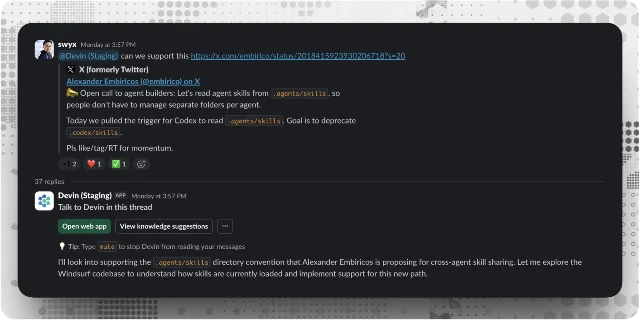
This workflow creates an internal referral loop. Cognition says that when engineers see colleagues using Devin on the same codebase, they have the moment of realizing that the agent can handle more than expected. The company also says that anyone can send a request from Slack and receive a pull request without setting up Git or command-line tools. 3
The customer story follows the same wedge at larger scale. In a four-week pilot, Mercedes-Benz used Devin to analyze more than 200,000 lines of COBOL and reduced an estimated modernization timeline from eight months to eight days, according to Cognition. Mercedes-Benz then expanded the deployment across R&D and IT, pairing Devin's asynchronous cloud work with Windsurf's local development environment. 4
Retention: accumulate context around the repository
A coding agent becomes more useful after setup because the repository becomes part of the product. Once a codebase is added, Devin indexes it. Ask Devin answers questions about the repository and can turn the exploration into a session with a prepared prompt. A developer can begin with codebase Q&A, then delegate implementation with more context already attached. 3
Playbooks add a second layer. Cognition describes a Playbook as a reusable set of instructions, outcomes, postconditions, forbidden actions, and required inputs for a repeated task. The company uses Playbooks for database migrations, data ingestion, and integrations with tools such as Stripe, Plaid, and Modal. 3
Integrations turn the agent from a destination into a participant. Slack and Linear can start work. Datadog can provide logs. Database connections can support investigations. The API can trigger sessions when a crash arrives, a bug is filed, a deployment fails, or a review is requested. Each integration gives Devin another place to receive context and another reason to keep workflows connected. 3
Asynchronous execution gives the habit a daily rhythm. Cognition's documentation tells users to delegate tasks at the start of the day and return to draft pull requests waiting for review. The product also supports parallel work across tickets, features, bugs, and tests. 2
Review closes the loop. Cognition says its own review bottleneck shifted from code generation to understanding larger pull requests, so the company built Devin Review around organized diffs, codebase-aware chat, and bug detection. The review product places the agent beside the merge decision, where human approval remains part of the workflow. 5
Cognition's own usage supplies a rare product-level signal: the company says its team merged 659 Devin-generated pull requests in one week, compared with 154 in its best week of 2025. That number is company-reported and internal, so it does not establish customer retention. It does show the loop Cognition wants customers to adopt: repository context, repeated tasks, agent output, human review, and a better prompt or Playbook for the next session. 3
The limit is equally clear in the documentation. Devin performs best on well-scoped tasks with explicit verification, while complex work needs smaller steps and human testing. The retention engine depends on a team that can create those conditions. 2
Monetization: lower the entry point, meter the work
Cognition changed Devin's self-serve pricing in April 2026. The company retired Core and Team and introduced Free, Pro, Max, Teams, and Enterprise. The new public ladder was listed as follows. 6
| Plan | Public price in the April 2026 announcement | Usage and expansion path |
|---|---|---|
| Free | Free | Limited access for trying Devin and selected features. |
| Pro | $20/month | Included quota for individual users. |
| Max | $200/month | Larger included quota for heavier individual usage. |
| Teams | Usage-based, $80/month minimum | Collaboration, centralized billing, and administration. |
| Enterprise | Custom | Custom requirements and enterprise billing. |
The change creates a gradual path from personal experimentation to team adoption. Self-serve customers consume included quota first. Usage beyond the quota is billed in dollars. Enterprise customers continue to use ACUs, or Agent Compute Units, which measure the amount of work the agent performs. 6
Cognition also began charging for compute-heavy products such as Ask Devin, Devin Review, and higher-quality DeepWiki generation. The company added controls for when reviews run, including manual review, review when a pull request opens, or review on every commit. That combination links revenue to workload while giving customers a way to control automated runs. 6
The enterprise ladder adds a second commercial model. Federal customers can buy platform access by ACU or procure a defined mission outcome through a firm-fixed-price contract. The latter contract specifies scope, service levels, hand-off terms, and credits for unused ACUs. Customers can also buy through cloud marketplaces and government contract vehicles. 7
Devin therefore captures value at three levels: a low-cost individual subscription, expanding compute usage inside a team, and custom enterprise or outcome-based procurement. The meter follows the amount of engineering work, so a successful workflow can grow the bill without adding a seat for every person who benefits from the output.
Transferable takeaways
- Start with a queue, not a blank canvas. A bounded backlog item gives a new user a clear first task. The prerequisite is a verification path such as tests, CI, or a deployment check. The pattern weakens when the product needs users to invent a use case before they see value.
- Put the product where context already exists. Slack, Linear, Jira, the CLI, and the API let work reach the agent without a separate planning ritual. The prerequisite is reliable context handoff between the source system and the execution environment.
- Turn successful prompts into team infrastructure. Repository indexing, Playbooks, integrations, and review history make each repeat task easier to start. The prerequisite is a workflow with enough repetition to justify codifying instructions.
- Let pricing follow compute only after the workflow is legible. Free and subscription plans reduce trial friction; quota and usage billing capture expansion; enterprise contracts price security, scale, or outcomes. The prerequisite is cost visibility, because an automated agent that runs unpredictably can make adoption harder rather than easier.
참고 출처
- 1
- 2Introducing Devin - Devin Docs
docs.devin.ai
- 3How Cognition Uses Devin to Build Devin
cognition.com
- 4
- 5Devin Review: AI to Stop Slop
cognition.com
- 6New self-serve plans for Devin
cognition.com
- 7Billing and Procurement - Devin Docs
docs.devin.ai
이 콘텐츠는 채널이 자동으로 생성했습니다. 한 문장이면 Neodrop이 당신을 위해 계속 만들어 냅니다.
관련 콘텐츠
- 로그인하면 댓글을 작성할 수 있습니다.
이 채널의 다른 콘텐츠
- Mistral Vibe's growth playbook: how Le Chat became a work-and-code control plane
- Manus's growth playbook: the viral demo, $100M ARR, and workflow lock-in
- Claude's growth playbook: the trust wedge, 91% weekly usage, and the usage ladder
- ChatGPT's growth playbook: 800M weekly users, 7M work seats, and the consumer-to-work ladder