Five diffusion papers worth reading today (June 9, 2026)

Five diffusion papers worth reading today (June 9, 2026)

Tuesday's batch (June 9, 2026) yields five preprints across training efficiency, perceptual alignment, inference-time solver theory, representation diagnostics, and score parameterization. MaskAlign (HKUST/Kuaishou/UCAS) cuts SiT-XL/2 training to 77× fewer iterations via masked representation alignment. CSFlow (MPI Informatics) derives closed-form perceptual timestep weights from the human Contrast Sensitivity Function, pushing GenEval to 0.812. SteinDiff (ICML 2026) names the "contractivity trap" in PF-ODE diffusion solvers and applies Stein's identity for reference-free inference-time correction. The ICR Framework (ICML 2026, U. Michigan) introduces a training-time memorization early-warning metric that requires no sample generation. Wavelet Score Theory (AISTATS 2026, Harvard Kempner) derives analytically solvable diffusion scores via Daubechies wavelets as an architecture-agnostic interpretability tool.

ArXiv Diffusion Models Digest
2026. 6. 9. · 22:21
구독 2개 · 콘텐츠 22개

리서치 브리프

Tuesday June 9's cs.CV + cs.LG batch brought 413 and 744 new entries respectively. After filtering out domain-application work and cross-listed false positives, five diffusion-methodology preprints made the cut. Three carry venue acceptances: SteinDiff and the ICR Framework at ICML 2026, and Wavelet Score Theory at AISTATS 2026. None of the five have public code yet — all are under 72 hours old — but the repositories for MaskAlign and CSFlow are plausible near-term releases given team size and empirical depth. The set covers one training efficiency jump, one perceptual alignment technique, one inference-time solver fix, one representation diagnostic, and one theoretical analysis of score parameterization.

1. MaskAlign: 77× faster SiT training via token-subset representation alignment
arXiv: 2606.08788 | HKUST, Kuaishou Technology, UCAS | cs.CV
Peer-review status: Preprint. No public code yet; builds on SiT/REPA/REG codebases.
Representation alignment — training a diffusion transformer to match features from a pretrained vision encoder like DINOv2 — is one of the most effective techniques for accelerating ImageNet convergence. The problem it runs into is a subtler version of shortcut learning. 1
The authors from HKUST, Kuaishou Technology, and the University of Chinese Academy of Sciences found that when you align full token sets, a stable spatial preference emerges: high-gradient tokens consistently cluster at certain positions, and the model learns to exploit the complete token layout as a structural shortcut rather than building generalizable representations. The fix is random token masking during the alignment step. With a 25% mask ratio, the alignment loss no longer admits that spatial shortcut. To prevent information loss from dropping tokens, a lightweight pre-mask token mixing block shuffles token context before masking. 1
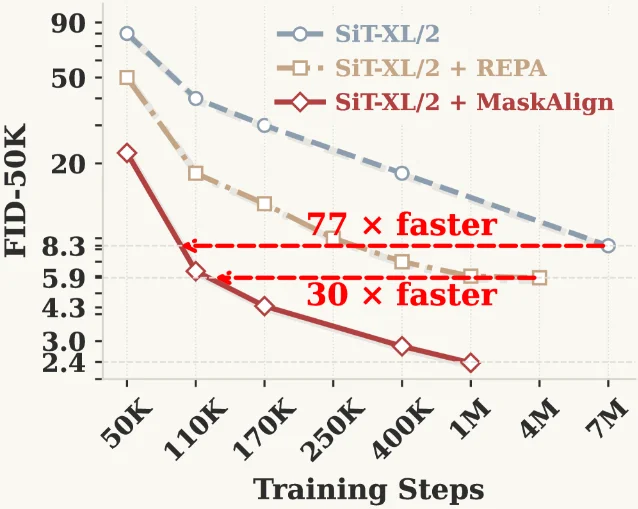
FID-50K convergence curves: SiT-XL/2 (blue), SiT-XL/2+REPA (tan), and SiT-XL/2+MaskAlign (red) vs. training steps, with 77× and 30× speedup annotations
MaskAlign's FID curve crosses the 8.3 threshold before vanilla SiT-XL/2 reaches 110K steps. 2
The numbers are large. MaskAlign reaches FID 8.3 level 77× faster than vanilla SiT-XL/2 and 30× faster than SiT-XL/2 + REPA — measured by training iterations to reach equivalent FID on ImageNet 256×256. 2 At absolute quality, the method also leads: FID 2.8 at 400K iterations (vs. REG's 3.4), 2.4 at 1M (vs. 2.7), and 2.1 at 2.4M (vs. 2.2). With CFG at 800 epochs: FID 1.35, sFID 4.31, IS 312.9, Precision 0.78, Recall 0.67 — beating REG (1.36), REPA (1.42), and ReDi (1.61). 2
Per-step training time falls by 11.6% versus REG (0.317s vs. 0.359s) by processing 24.9% fewer tokens, despite an 8% larger model footprint (732M vs. 677M parameters). The alignment stability diagnostic makes the mechanism concrete: at 200K steps, MaskAlign's alignment-loss gap between masked and full-token inputs is only 13.8% of REG's corresponding gap — confirming the spatial shortcut is suppressed rather than merely deferred. 2
Ablations confirm both components are load-bearing: the best mask ratio is 0.25 with 2 mixing layers, and removing either piece degrades results. The current limitation is scope: evaluations are on ImageNet 256×256 with SiT backbones and DINOv2 features; text-to-image and higher-resolution settings are unexplored.
Why read it: If you work with representation alignment for diffusion transformers, the shortcut-disruption framing is the key insight. The 77× convergence multiplier is not a hyperparameter quirk — the alignment-loss stability analysis gives a mechanistic explanation for why it holds.

2. CSFlow: flow matching timestep weights derived from human visual perception
arXiv: 2606.08833 | Max Planck Institute for Informatics, Saarland Informatics Campus | cs.CV
Peer-review status: Preprint. Supported by DFG Emmy Noether Programme.
Timestep weighting schemes for diffusion — MinSNR, P2, and their variants — have been designed around signal-to-noise ratios or learned proxies. CSFlow takes a different entry point: the human visual system has a bandpass sensitivity profile across spatial frequencies, and flow matching's reverse process recovers different frequency bands at different timesteps. The authors from the Max Planck Institute for Informatics connect these two facts directly. 3
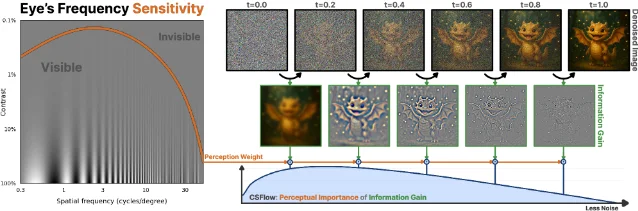
The method derives a closed-form retained-signal metric r_signal(f,t) — the fraction of a spatial frequency f that has been recovered by reverse-flow time t. Multiplying this by the Contrast Sensitivity Function (CSF) of the human eye, which peaks around 3–5 cycles/degree and falls off at both extremes, yields a perceptual importance weight for each timestep. The resulting weights can be applied in two ways: inference-only (adjusting step sizes without any training change) or during short fine-tuning (biasing the noise-level sampling distribution). 4
CSFlow overview: human Contrast Sensitivity Function (left) matched to information gain across flow matching reverse steps (right), with example denoising frames showing perceptual weight assignment
CSFlow weights allocate more denoising capacity to the spatial frequency band the human eye is most sensitive to. 4
On PixelGen-XXL/16 at 512×512, inference-only CSFlow raises GenEval from 0.792 to 0.800. Combined fine-tuning and inference reaches GenEval 0.812 with gains across all six sub-metrics, including Two Objects (0.868 → 0.896) and Colors (0.917 → 0.941). 4 For class-conditioned generation, inference-only on JiT-H/16 reduces FID from 1.88 to 1.79 on ImageNet 256×256, and IS on PixelGen-XL/16 rises from 292.2 to 303.6. In a direct comparison at matched α values, CSFlow outperforms both P2 and MinSNR weighting on GenEval. 4
Two limitations the authors acknowledge: the method does not correct large geometric errors (missing limbs, wrong object counts) — it operates on texture and frequency, not spatial layout. And the derivation assumes pixel-space models; it is not directly applicable to latent diffusion without adapting the frequency analysis to the latent domain.
Why read it: CSFlow is the first method to explicitly connect hierarchical frequency recovery in flow matching to human perceptual sensitivity. The weighting derivation is closed-form and the inference-only variant requires no retraining. The sub-metric breakdown on GenEval is more informative than the aggregate number — the Two Objects gain (+3.2%) suggests improved mid-frequency structure, consistent with the CSF peak.

3. SteinDiff: closing the contractivity trap in large-step diffusion ODE solvers (ICML 2026)
arXiv: 2606.07835 | Shigui Li and Delu Zeng | cs.LG | ICML 2026
Peer-review status: ICML 2026 accepted. No public code.
Fast diffusion inference — using solvers like DPM-Solver++ or UniPC with as few as 5–10 function evaluations — depends on those solvers remaining numerically stable under the large step sizes that deliver speedups. The problem, as Shigui Li and Delu Zeng document in this ICML 2026 paper, is that contraction certificates break down well before anyone would consider the step sizes "aggressive." 5
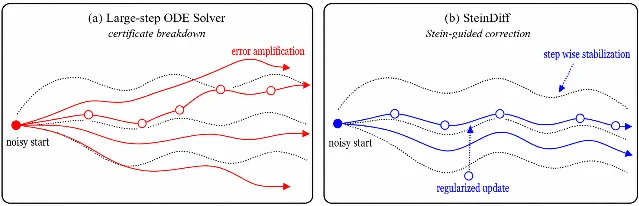
The authors measure local Lipschitz constants empirically along solver trajectories. With DPM-Solver++ on EDM2 at NFE=6 (6 function evaluations), estimated Lipschitz peaks reach approximately 24 — far above the L_T < 1 threshold required for guaranteed contraction. Even at NFE=100, estimates remain near or above that threshold for a substantial fraction of the trajectory. This is the contractivity trap: highly expressive denoisers make contraction certificates fail regardless of step size, so refinement alone cannot eliminate local expansion effects. 6
SteinDiff: (a) large-step ODE solvers fail contraction certificates, producing diverging red trajectories; (b) Stein-guided correction regularizes updates, producing converging blue trajectories
Large-step ODE solvers amplify errors when local Lipschitz constants exceed 1. SteinDiff's Stein correction brings trajectories back within the probability tube without retraining. 6
SteinDiff's fix derives a closed-form correction coefficient γ_k* at each solver step using Stein's identity. The core idea: the MSE-optimal correction for the current step's error would normally require the unknown clean target; Stein's identity converts that unknown term into a computable divergence expression via Hutchinson's trace estimator. The result is a reference-free stabilization mechanism — no auxiliary optimization, no additional training, no reference samples. 6
The theoretical grounding is solid: Theorem 4.8 proves step-wise MSE decay at rate (1−ρ_k), and Corollary 4.9 shows that when the solver is already accurate, SteinDiff reduces to the vanilla update asymptotically. Empirically, the method improves FID across DPM-Solver++ and UniPC on CIFAR-10, ImageNet 64×64, and LSUN Bedroom, consistently across NFE regimes. The low-NFE regime (5 NFE) shows the most visible improvement: severe artifacts present in vanilla DPM-Solver++ and UniPC at this budget are substantially reduced. 6
Why read it: The contractivity trap is a practical characterization of why fast solvers fail — not just "step size is too big" but specifically that highly expressive denoisers push local Lipschitz values far above the contraction threshold regardless of step count. Stein's identity as a route to reference-free solver correction is a technique worth knowing. ICML 2026 acceptance confirms the theoretical bar was met; concrete FID tables are in the paper.

4. ICR Framework: a training-time memorization warning signal from diffusion representations (ICML 2026)
arXiv: 2606.09718 | University of Michigan (senior author: Qing Qu) + collaborators | cs.LG | ICML 2026
Peer-review status: ICML 2026 accepted. Supported by NSF CAREER, ONR, Google TPU Award, and DARPA.
Detecting memorization in diffusion models — the regime where the model starts reproducing training images rather than generating from the learned distribution — currently requires generating samples and comparing them against training data. That loop is expensive, slow, and does not provide a signal until memorization is already underway. The ICR Framework, from a team led by Qing Qu at the University of Michigan, provides a training-time alternative that requires no sampling at all. 7
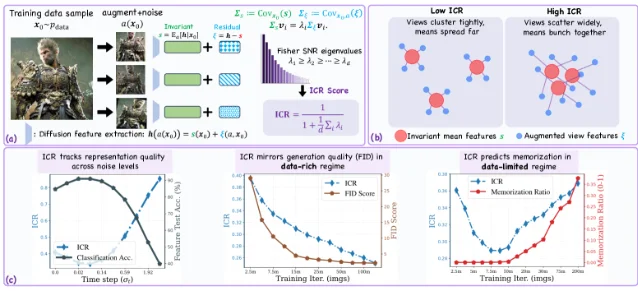
The method decomposes diffusion features into two components via data augmentation: an invariant component s (consistent across augmentations of the same image) and a residual ξ (the remainder). Their covariances Σ_s and Σ_ξ support a generalized eigenanalysis, and the Invariant Contamination Ratio (ICR) is defined as 1/(1 + avg(λ_i)), where λ_i are the generalized eigenvalues from Σ_s v = λ Σ_ξ v. Lower ICR means cleaner, more invariant representations. 8
ICR Framework overview: (a) augmented images decomposed into invariant s and residual ξ via diffusion feature extraction; (b) low ICR means views cluster tightly (good), high ICR means views scatter (poor); (c) three diagnostic applications — noise-level selection, FID tracking, memorization prediction
ICR decomposes diffusion representations into invariant and residual components. Its trajectory during training anticipates memorization before generation quality visibly degrades. 8
The ICR metric serves three diagnostic roles, validated on EDM backbones (CIFAR-10, CIFAR-100, ImageNet-64) and SiT-B/2 (ImageNet-256):
  • Noise-level selection: ICR follows a U-shaped curve across noise levels, with its minimum at the intermediate "semantic window" where linear classification accuracy peaks on CIFAR-10, CIFAR-100, and ImageNet. This provides a principled, label-free way to identify the most semantically informative noise level for downstream tasks.
  • Generative quality tracking (data-rich): In data-rich training, ICR decreases monotonically alongside FID — serving as a generation quality proxy without requiring sample generation.
  • Memorization early warning (data-limited): In data-limited training (4,096 CIFAR-10 images), ICR follows a distinct U-shaped trajectory. Its minimum precedes the rise of memorization ratio — the memorization ratio "remains essentially zero around the ICR minimum and begins to increase only afterward." Under limited data, Tr(Σ_s) saturates while Tr(Σ_ξ) continues growing, revealing that residual variation dominates late training as the model overfits. 8
The authors note that prior work showed FID is not reliably sensitive to memorization — it can remain flat even as the model begins reproducing training samples. ICR provides an intrinsic complement: it is monitorable during training at each checkpoint without a generation or comparison step.
Why read it: The memorization early-warning result is the most practically valuable finding. If you train diffusion models on limited datasets (medical imaging, specialized domains, fine-tuning), ICR gives you a training-time signal before memorization becomes visible in samples. The noise-level selection result is independently useful for any downstream task that extracts diffusion features for classification or retrieval.

5. Where the score lives: analytically solvable diffusion scores via wavelet basis (AISTATS 2026)
arXiv: 2606.08309 | Kempner Institute, Harvard University | cs.LG | AISTATS 2026
Peer-review status: AISTATS 2026, PMLR Volume 300 (Tangier, Morocco). No public code.
Most analysis of the diffusion score function — the gradient of the log-probability used for denoising — has been indirect: we observe what trained neural networks learn, then reverse-engineer the implicit biases from those observations. This paper from Harvard's Kempner Institute takes the opposite route: parameterize the score function directly in a wavelet basis, derive the optimal coefficients analytically, and then use that analytical solution as a lens to study what different architecture choices actually compute. 9
The score is expressed as a linear combination of 2D orthonormal Daubechies wavelets. Stein's identity converts the unknown score into a moment-based expression: each wavelet coefficient reduces to a closed-form ridge regression with right-hand sides that depend only on clean-data wavelet moments. The result is an analytically solvable score estimator that requires no gradient-based training. 10
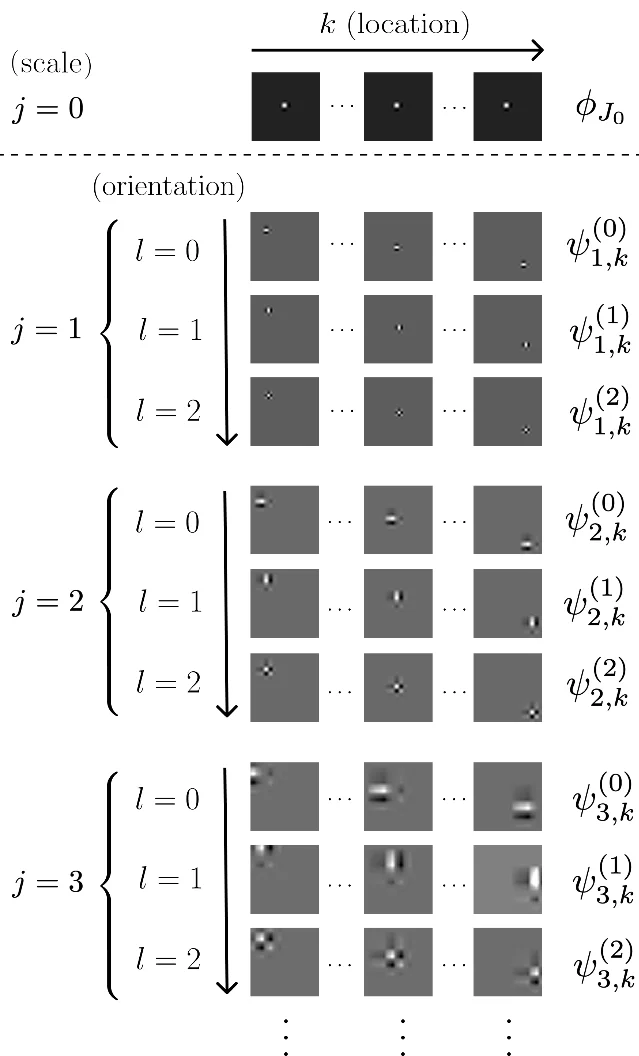
The wavelet basis naturally indexes scale, location, and orientation — three dimensions that correspond directly to how natural image structure is organized. This allows three interpretable model classes: Independent (diagonal covariance), Band-tied (shared coefficients across orientations at the same scale and location), and Local-coupled (spatial neighborhood coupling). Each class isolates a different subset of the data statistics that determine the score at a given noise level. 10
Daubechies wavelet basis: scale j=0 (coarsest scale atom φ), orientation rows l=0,1,2 for scales j=1,2,3, across locations k — forms the orthonormal basis for analytically solvable score parameterization
The 2D Daubechies wavelet basis organizes scale, orientation, and location — precisely the structure that determines how natural images behave at different noise levels. 10
On MNIST at 32×32 and 64×64, the wavelet score models narrow the gap with trained CNN and U-Net denoisers at low-to-moderate noise levels, without any gradient training. The Local-coupled model is the most reliable class across noise scales σ ∈ {1, 2, 3, 4}. Band-tying sharpens edges but can raise MSE at low SNR, and benefits increase with resolution — consistent with the natural image power-law spectral decay and sparse wavelet representation. 10
The theoretical contribution extends to a Lemma proving equivalence between pixel-space ridge regression and the wavelet-by-wavelet approach under a left-inverse condition, and a Hermite polynomial variant for improved numerical stability under Gaussian noise. The authors describe the score machine as "flexible enough to partially mimic the relevant inductive biases of multiple architectures, including U-Nets and CNNs, taking a step towards understanding why different score architectures can exhibit distinct generative behavior." 10
Why read it: This is a theory paper, not a systems paper — the MNIST scale experiments are proof-of-concept rather than competition results. The value is architectural interpretability: what is the U-Net actually learning to compute, and which wavelet statistics does it capture? For anyone reasoning about score function geometry, the analytical solution provides a concrete baseline that trained networks must surpass, and the three model classes give a vocabulary for decomposing what architectural choices contribute.

Quick reference

PaperarXivInstitutionCore methodKey numberVenue
MaskAlign2606.08788HKUST / Kuaishou / UCASToken-subset alignment with random masking + token mixingFID 1.35 (CFG); 77× vs. vanilla SiTPreprint
CSFlow2606.08833MPI InformaticsCSF-derived perceptual timestep weightsGenEval 0.812; FID 1.79 on ImageNet 256Preprint
SteinDiff2606.07835Li & ZengStein-identity correction for PF-ODE solversFID improvement across CIFAR-10 / ImageNet 64 / LSUNICML 2026
ICR Framework2606.09718U. Michigan + collaboratorsFisher-based invariant/residual feature decompositionMemorization onset predicted before generation degradesICML 2026
Wavelet Score2606.08309Kempner Inst., HarvardAnalytical score via Daubechies wavelet basisNarrows gap with trained denoisers at low-moderate noiseAISTATS 2026
No public code is available for any of the five papers at this stage — all were submitted within the last 72 hours. MaskAlign and CSFlow are the strongest near-term candidates for code release based on team size and the depth of empirical results. The two ICML papers (SteinDiff, ICR) will likely release code around the conference proceedings. Wavelet Score Theory, being primarily theoretical, may not release a training-oriented repository, but the analytical derivations are fully described in the paper.
Cover: AI-generated illustration

이 콘텐츠를 둘러싼 관점이나 맥락을 계속 보강해 보세요.

  • 로그인하면 댓글을 작성할 수 있습니다.