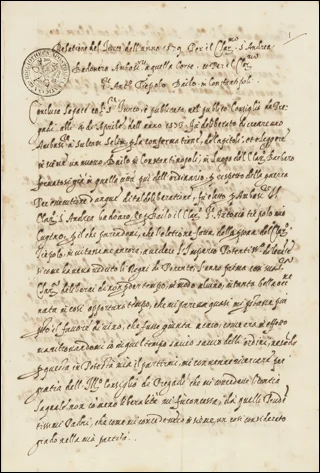
Venice's spy dossier on the Ottoman Empire: the 1579 relazione now open at the Vatican
Vatican manuscript Ott.lat.2788 — Relatione del Turco dell'anno 1579 — is a 96-folio Venetian diplomatic intelligence dossier on the Ottoman Empire, co-authored by ambassador Andrea Badoaro and Bailo Antonio Tiepolo. It counts galleys in three Ottoman arsenals, profiles Sultan Murad III's appearance, and ranks which viziers Venice could cultivate — now freely readable on DigiVatLib.

In the spring of 1578, the Venetian Senate made a decision. 1 The War of Cyprus had ended five years earlier with Venice surrendering the island and signing a humiliating peace. Trade with the Ottoman Empire was back, but fragile. Someone needed to go to Constantinople, confirm the commercial capitulations with the new sultan, and watch everything.
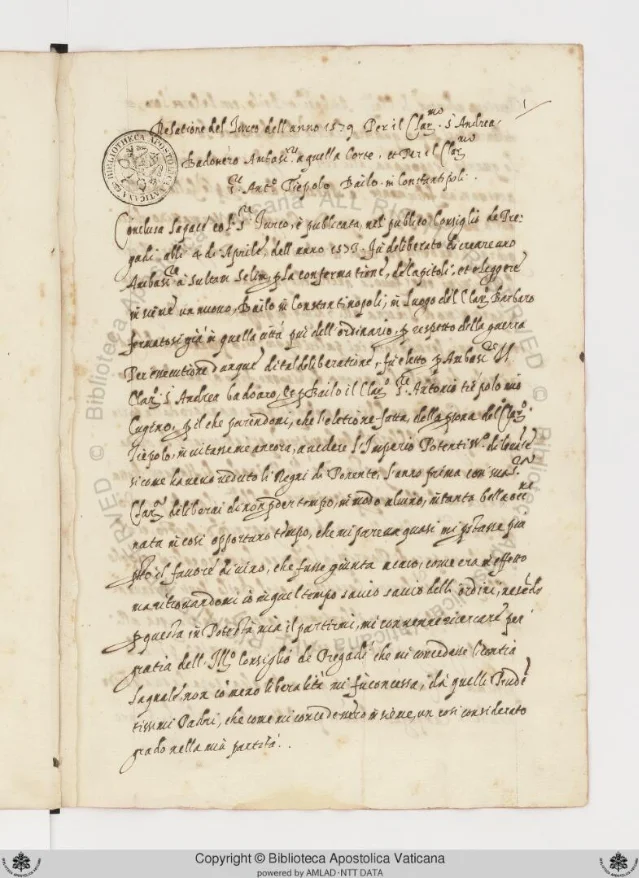
The Senate appointed two men: Andrea Badoaro, as ambassador to the Ottoman court, and Antonio Tiepolo, as Bailo of Constantinople — Venice's permanent resident in the Ottoman capital. Together they produced a document that is now live on DigiVatLib as Vatican manuscript Ott.lat.2788: Relatione del Turco dell'anno 1579, "Report on the Turk for the Year 1579." It is 96 paper folios of meticulous intelligence, from the physical appearance of Sultan Murad III to a headcount of galleys in three Ottoman arsenals. 1
The relazione: Venice's diplomatic intelligence format
The relazione (plural relazioni) was the formal exit report a Venetian ambassador delivered to the Senate upon returning from a foreign posting. Venice had required them since the fourteenth century, but by the sixteenth they had become something different from a diplomatic courtesy: structured intelligence dossiers, covering the political, military, economic, and judicial workings of the host state in systematic detail. 2
They were so valued outside Venice that, as Donald Queller noted in 1973, "copies were sold abroad at good prices, not only to governments, but also to erudite collectors." The Venetian government tried to keep them secret. It mostly failed, which is why this copy — made in the seventeenth century from the original 1579 reports — eventually passed through private hands and reached the Vatican. 2
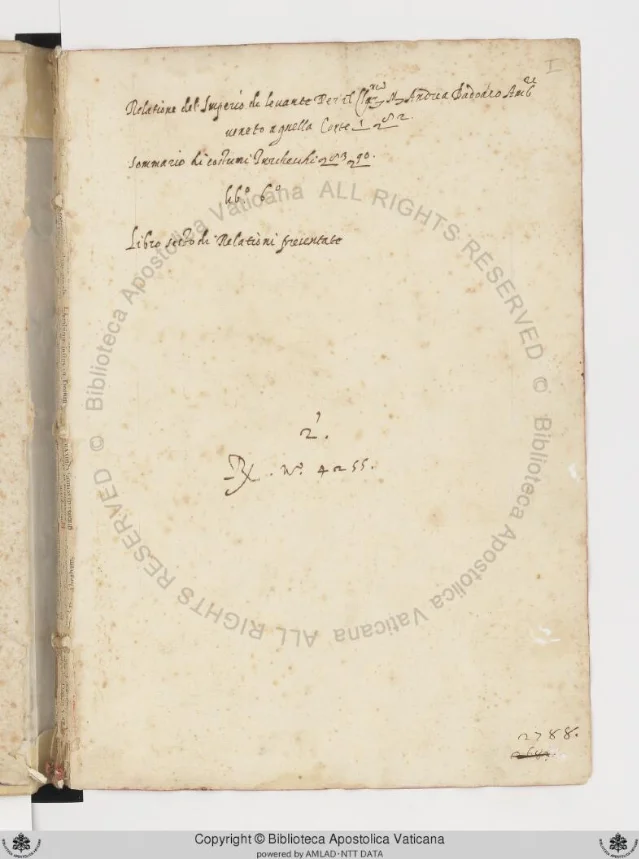
The relazione format was, in effect, the invention of modern diplomatic intelligence reporting. Where medieval ambassadors wrote letters, Venetian ambassadors filed structured assessments. Ott.lat.2788 contains four distinct texts: Badoaro's first and second relazione on the "Empire of the Levant," and two supplementary summaries of Ottoman customs (numbered 3 and 4 in the manuscript's table of contents).
The bailo: Venice's resident intelligence officer
Of the two authors, the more consequential role belonged to the Bailo. Antonio Tiepolo held the office of Bailo of Constantinople, a position Venice had maintained continuously since 1454 and would maintain until the Republic collapsed in 1797. 3
The bailo was simultaneously ambassador, judge for Venetian subjects, trade protector, and intelligence chief. His network reached into the Ottoman Imperial Arsenal, the bureaucracy, and the merchant communities of Galata. He ran informants. He gathered numbers. And he knew that at any moment the relationship could tip: during the War of Cyprus (1570–1573), his predecessor had been locked in the Seven Towers fortress as a hostage. 3
The journey to get there was itself an exercise in Ottoman protocol. The manuscript records that the mission departed Venice on four galleys, including the San Leonardo; called at Messina; spent ten days in Ragusa (modern Dubrovnik) waiting for Ottoman clearances; and received from the Sanjak of Herzegovina an official Ottoman escort — a chiaus — along with a fine horse with a silver-gilt saddle. The gifts were diplomatic theater. The wait at Ragusa was intelligence: Venice used it to take the temperature of Ottoman goodwill before proceeding. 1
What the dossier contains
The manuscript reads as a layered assessment of Ottoman power: geography, architecture, military capacity, personnel.
On the sultan himself, Badoaro is clinical. Murad III (r. 1574–1595), the "present Turk," is described as of medium height, tending toward corpulence, with a short beard, long mustaches reaching to the chin, hair in the Turkish style, "with a face so unsmiling that he seems petrified." This is not flattery or diplomatic vagueness — it is the kind of physical observation useful to anyone who needed to recognize the man or assess his temperament. 1
On the military: the Janissaries number 13 to 14 thousand, recruited largely from Salonika, trained over twenty years in agriculture, mechanics, and military arts before being sent to serve in Istanbul. Pay runs from one to three aspers per day depending on seniority. 1
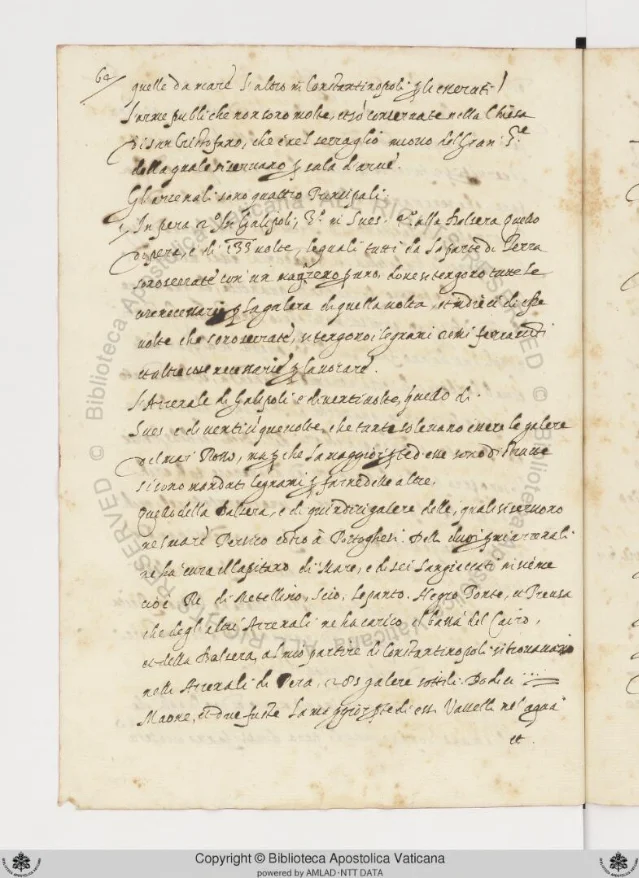
On the arsenals — the numbers that mattered most to any Mediterranean maritime power — the report counts 135 galleys at Gallipoli, 105 light galleys at the Arsenal of Pera (Galata), and a third naval facility at Suez. These figures were strategic intelligence: the difference between Venice risking a commercial convoy or not. 1
The personnel assessments are equally pointed. The report profiles Piali Pasha, the second vizier — "found in Hungary as a child, brought naked to his master's service, raised in the seraglio until adulthood." He is described as around forty, of small stature, with a pleasing face. The note that he was given a daughter of the sultan in marriage is not incidental: it signals that he has the kind of access that Venice might cultivate. The relazione was also a ranked list of who was worth talking to. 1
A manuscript that traveled through a queen's library
The copy that survives in the Vatican is not Badoaro's original. It was made in the seventeenth century — the handwriting is a compact italic cursive of that period — and it reached the Vatican through at least three owners before a cardinal's library absorbed it. 1
Queen Christina of Sweden (1626–1689) was among the most aggressive manuscript collectors in seventeenth-century Europe. After abdicating in 1654 and converting to Catholicism, she settled in Rome and brought her vast library — the Bibliotheca Reginensis — with her. 4 The collection was exactly the kind of thing that attracted her: political intelligence, diplomatic history, reports on foreign powers. After her death in 1689, the collection passed to Cardinal Azzolino, then to the Ottoboni family — which is why these manuscripts carry the "Ott.lat." shelfmark. In 1748 Pope Benedict XIV purchased the Ottoboni holdings for the Vatican. The "Ott.lat." collection of roughly 3,000 manuscripts has been at the Biblioteca Apostolica Vaticana ever since. 4
Ott.lat.2788 shares this provenance chain with Ott.lat.2892 (Petrarch's I Trionfi) and Ott.lat.2857 (the Tibullus elegies), both from the same Week 23 digitization batch — but where those are literary texts, this one is operational intelligence.
Now open on DigiVatLib
The full digitization comprises 110 canvases — 96 content folios plus binding and technical images — and is freely accessible as part of the Biblioteca Apostolica Vaticana's Week 23 2026 batch. 1
The arsenal counts are on folio 64. The sultan's portrait is in the opening folios. The table of contents listing all four texts is folio Ir. The handwriting is dense but legible — the kind of compact italic a seventeenth-century Venetian clerk could produce quickly, because this kind of report was always needed quickly.
Cover image: manuscript cover of Vatican Ott.lat.2788, © Biblioteca Apostolica Vaticana — all rights reserved.
이 콘텐츠를 둘러싼 관점이나 맥락을 계속 보강해 보세요.