www.swissinfo.ch
Gotthard Base Tunnel: how flattening the Alps cost CHF 12.2 billion and changed everything below it
A 5,070-word engineering teardown of the Gotthard Base Tunnel — the world's longest railway tunnel at 57.09 km, opened June 1, 2016. Traces the constraint→solution→cost chain from the geometry decision (boring at 549 m elevation instead of climbing to 1,151 m) through the political and geological constraints, the four Herrenknecht Gripper TBMs (Heidi, Sissi, Gabi I & II), the five simultaneous attack points including Sedrun's 800 m vertical shafts, multifunction stations, safety cross-passages, and the twin-tube trade-off against a double-track bore. Concludes with 10th-anniversary operational data (169K passenger + 276K freight trains, freight tonnage +36%) and the parallel road tunnel second-tube TBM Alessandra breakthrough April 2026.
On the afternoon of June 1, 2016, Swiss Federal President Johann Schneider-Ammann stood at the north portal in Erstfeld and called it "a giant step for Switzerland but equally for our neighbours and the rest of the continent." 1 He was describing the opening of the Gotthard Base Tunnel (GBT) — at 57.09 km, the world's longest railway tunnel and its deepest traffic tunnel, with 2,450 m of rock overhead at the maximum point. 1
But the superlatives obscure the actual engineering problem. The tunnel was not built to be long. It was built to be flat.
The geometry problem that 134 years of rail engineering couldn't fix
The original Gotthard Railway, opened in 1882, crosses the Alps by climbing. From the canton of Uri in the north, the line spirals upward through a sequence of helical tunnels, bored inside the mountain to gain altitude without impossible surface grades, reaching the old Gotthard Tunnel at 1,151 metres above sea level. The descent to Ticino in the south mirrors the climb. Trains on this vertex route face maximum grades of 27‰ (2.7%). 1
That grade is the load constraint. A heavy freight locomotive's adhesion (the friction force available between steel wheel and steel rail) limits what it can pull uphill. On the old Gotthard vertex line, a train using a single Re 420 locomotive was limited to 1,300 tonnes with a second locomotive; adding a banking engine at the rear raised this to 1,500 tonnes. For modern European freight, which routinely runs at 2,000–4,000 tonnes, those figures represent a bottleneck that had persisted for more than a century. 1
The base tunnel eliminates that constraint geometrically. Running through the base of the Gotthard Massif at a maximum elevation of 549 metres — close to the altitude of Bern — with grades no steeper than 6.76‰ on the south ramp and 4.055‰ on the north, the GBT allows standard freight trains of up to 3,600 tonnes to pass unaided. 1 The same geometry that moved freight lifted the grade constraint on passenger trains too: without the altitude penalty, intercity trains no longer need tilting-train technology to stay on schedule.
This is why the tunnel was worth building. Everything that follows — the 17-year construction programme, the four Herrenknecht TBMs, the 28.2 million tonnes of excavated rock, the CHF 12.2 billion bill — traces back to the decision to bore 600 metres lower through the same mountain that the 1882 railway merely crossed at its top. 1
The constraint set: politics, geography, and a constitutional mandate
Engineering constraints on the GBT came from three directions: Swiss direct democracy, the Alps' internal structure, and a budget that expanded by 28% between the 1998 funding vote and final completion.
The political sequence is unusually transparent. On September 27, 1992, Swiss voters accepted the New Railway Link through the Alps (NRLA, or Neue Eisenbahn-Alpentransversale — AlpTransit) by 63.6%. 1 The vote authorised a flat base tunnel as the core of the Gotthard axis, but it did not yet mandate the modal shift. That came from a separate popular initiative on February 20, 1994 — the Alps Initiative — accepted by 51.9% of voters, which added constitutional language requiring that as much freight tonnage as possible be shifted from road to rail through the Alps. 1 The GBT was no longer just an infrastructure project; it was the delivery mechanism for a constitutionally embedded transport policy. The 1998 funding vote (accepted by 63.5%) set a total NRLA budget of CHF 30 billion across multiple projects, with CHF 13.6 billion earmarked for the tunnels. 1
The final GBT cost, reported as CHF 9.56 billion for the base tunnel itself (December 2015 official figure), is often cited alongside a CHF 12.2 billion total for the broader Gotthard axis — the figure commonly reported in international media. 12 Both figures represent Swiss infrastructure investment as a fraction of GDP that almost no other country could commit over a 17-year build without public revolt.
The geographic constraint is the Gotthard Massif itself: a wedge of ancient crystalline rock — primarily gneiss and granite — that separates the Rhine catchment to the north from the Po catchment to the south, and two subranges of the Alps — the Glarus Alps and the Lepontine Alps — in between. The tunnel's 57.09 km route passes under multiple distinct massifs, reaching its maximum depth of 2,450 m below the surface near Piz Vatgira. 1 At that depth, without active ventilation, the ambient temperature inside the mountain reaches 46°C — a constraint that drove the ventilation design and set temperature limits for TBM mechanical components.
Geology and the TBM selection decision
Tunnelling through the Gotthard Massif means tunnelling through some of the hardest rock in Europe. The dominant lithologies are paragneiss, orthogneiss, and granite of the Aar Massif and Gotthard Massif, with compressive strengths commonly exceeding 150 MPa. Interspersed fault zones — particularly around the Tavetsch Intermediate Massif that the tunnel crosses between the two main ranges — present the opposite problem: crushed, water-saturated rock that can flow into an open tunnel face under the pressure of the overlying mountain. 1
These competing geologies drove a split excavation strategy. For the long straight drives through competent hard rock, Gripper TBMs were the correct tool: a rotating cutter head pushes forward as hydraulic grippers lock against the tunnel walls, advancing at up to 25–30 m per day in ideal conditions. 1 The gripper concept works specifically because hard rock provides the lateral reaction force the machine needs; in fractured or swelling rock, it fails. For the fault-zone sections and the area immediately behind the portals (where the rock is stress-relieved and variable), conventional drill-and-blast was used — slower but controllable, with each round excavated, supported, and lined before the face advances.
The temperature gradient deepened the TBM engineering challenge. At 2,450 m depth the host rock reaches 46°C without ventilation, and the TBM's own motors and hydraulics generate additional heat. Cooling ventilation — pushing cold surface air to the working face — was required throughout the deep sections to keep machine electronics and worker conditions within operational limits. The ventilation duct infrastructure added to the logistical burden of every supply and spoil cycle within the tunnel.
The spoil from 151.84 km of total excavation (including access tunnels, shafts, and connecting galleries) amounted to 28.2 million tonnes — equivalent to five Great Pyramid of Giza in volume. 1 AlpTransit Gotthard AG avoided creating a spoil disposal problem by processing and rebranding it: the excavated gneiss and granite were crushed and sold as Gotthard aggregate, used in concrete for building projects throughout Switzerland. This turned a waste stream into a commercial product and reduced the environmental footprint of the project's material balance.
The four Herrenknecht Gripper TBMs
AlpTransit deployed four Herrenknecht (Schwanau, Germany) Gripper TBMs on the GBT, all assigned machine designations and given nicknames by the construction crews: 1
| Machine | Designation | Direction | Nickname |
|---|---|---|---|
| East tube, south drive | S-210 | Northbound from Giornico | Sissi |
| West tube, south drive | S-211 | Northbound from Giornico | Heidi |
| East tube, north drive | S-229 | Southbound from Erstfeld | Gabi I |
| West tube, north drive | S-230 | Southbound from Erstfeld | Gabi II |
Each machine had the following parameters: 1
- Cutter head diameter: 8.83–9.58 m (the bore varies along the route depending on lining type)
- Total machine length (including backup train): 440 m
- Total weight: 3,000 tonnes
- Installed power: 5 MW
- Maximum daily advance: 25–30 m in excellent rock; actual campaign average lower due to fault zones, maintenance, and logistics
The four TBMs together covered approximately 45 km per tube of mechanically bored tunnel — roughly 90 km total primary bore across both tubes. The balance of the 151.84 km total tunnel complex consists of cross-passages, the two multifunction stations, access adits, and sections excavated conventionally. 1
East tube breakthrough: October 15, 2010, 14:17 local time. West tube breakthrough: March 23, 2011, 12:20. 1 Drilling operations were declared complete in March 2011 after 8 years of continuous TBM operation from multiple fronts — a campaign that Herrenknecht AG, in its 10th anniversary statement, called "more than a 'usual' tunnelling project — a true game changer" that gave the company "momentum, credibility, and new opportunities worldwide." 3
Twenty years before the GBT breakthrough, Herrenknecht had zero experience boring in hard Alpine rock at this depth. By the time the GBT was complete in 2011, the company's expertise in crystalline rock TBM design — disc cutter geometry, cutter head torque curves, mixed-ground bearing seal systems — had become the global reference. That directly explains why Herrenknecht was again selected for the Gotthard Road Tunnel second tube project, currently under construction: TBM "Alessandra" (12,225 mm cutter head diameter, 5,250 kW, 95,000 kN maximum thrust force) achieved its northern breakthrough on April 29, 2026, after boring approximately 3.8 km northbound through the same Gotthard gneiss. 4 The road tunnel second tube will not be completed until 2030 — 14 years after the rail tunnel opened — and will not add road capacity (Swiss constitutional law prohibits increasing trans-Alpine road traffic). Its purpose is safety: allowing the existing 1980-era road tube to be closed and renovated while traffic continues in the new bore.
Five attack points and the Sedrun problem
Boring 57 km from two ends would have taken 30+ years. AlpTransit cut the timeline roughly in half by opening five simultaneous attack points: Erstfeld (north portal), Amsteg (intermediate access adit), Sedrun (vertical shaft access), Faido (intermediate access adit), and Giornico (south portal). 1
Erstfeld and Giornico were standard portal attacks. Amsteg and Faido were reached by horizontal access adits drilled from valley floors — Amsteg at 507 m elevation, Faido at 757 m — giving contractors independent access to the tunnel horizon without going through the portal zones. 1
Sedrun was the hardest problem. The site sits directly above the planned Sedrun multifunction station, at 1,334 m elevation — 800 m vertically above the tunnel level. There is no practical horizontal adit route at Sedrun; the valley above the tunnel is occupied by the village and the Anterior Rhine. The solution: a 1 km horizontal exploratory and access tunnel from the valley floor near Sedrun leads to two vertical shafts, each 800 m deep, dropped straight down to the tunnel horizon. Material, equipment, and workers were transported vertically throughout the Sedrun construction period. 1
One of the four Herrenknecht Gripper TBM cutter heads on permanent display at the Pollegio Control Centre near the GBT south portal 1
The vertical shaft solution created the conditions for the tunnel's most dramatic construction sequence: at Sedrun, the multifunction station chambers were excavated via the shafts before the TBMs arrived. Workers were lowering concrete and steel 800 m underground and constructing a full rail-switching station while TBMs from Erstfeld and Giornico were still kilometres away. The civil works at the Sedrun station had to be completed before the TBMs passed through — a sequence that required precise scheduling across a construction site with no direct surface road access.
The five attack points also multiplied the concurrent workforce. At peak construction, approximately 2,000 workers were underground across all sections simultaneously. The material logistics — concrete delivery, spoil removal, equipment resupply — operated on temporary narrow-gauge rail systems installed within the active tunnel bores. Spoil trains ran in one direction while supply trains ran in the other, using the as-yet-unlaid track alignment as their corridor.
Nine workers died during the 13-year construction campaign: one in the Amsteg section (2000), two in the Sedrun section (2002 and 2003), three in the Faido section (2003, 2005, 2006), and three in the Giornico section (2005 and 2010 and 2012). 1 Their names — from Germany, Italy, South Africa, and Austria — are recorded on a bronze memorial plaque unveiled at the north portal on May 31, 2016, the day before the public inauguration. A Catholic shrine to Saint Barbara, patron of miners, stands inside the tunnel as a permanent memorial. 1
Multifunction stations: Sedrun and Faido
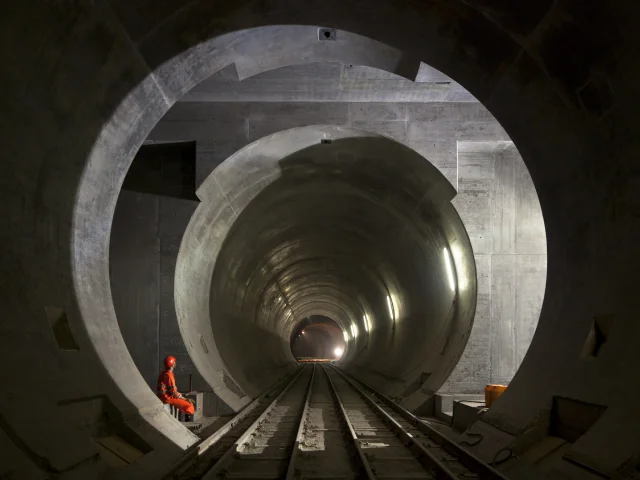
The two multifunction stations (MFS) at Sedrun (km 32.0) and Faido (km 45.5) serve four simultaneous functions that no ordinary tunnel requires: emergency stops, cross-tube train switching, ventilation plant housing, and access points for maintenance teams. 1
The cross-tube switching function is the most unusual. In normal operation, the GBT runs two separate single-track tubes — east and west — each carrying one direction of traffic. But the tubes must occasionally communicate: if one tube is blocked by a maintenance window or an incident, trains need to switch from one tube to the other and back again. The MFS contain the turnouts that make this possible. A turnout inside a tunnel at that depth is an engineering object requiring millimetre precision in curved geometry, designed to be installed and maintained by workers who descended 800 m by shaft or drove an hour through an access adit to reach it.
Faido had an additional significance during construction: it was the site of a serious flood incident in 2006, when water inflows from an unexpected fault zone caused significant disruption to tunnelling operations in that section. The event did not result in fatalities but required substantial rescheduling of the Faido and Giornico sections and contributed to the schedule pressure that pushed the final completion to 2011.
Safety systems: evacuation at 2,450 m depth
The primary safety design principle of the GBT is that each tube protects the other. Passengers in one tube can evacuate to the other through 178 cross-passages, spaced approximately 325 m apart, running horizontally between the two parallel bores. 1 Each cross-passage is maintained at positive air pressure relative to the tunnels, so that smoke from a fire in one bore cannot enter the evacuation route. A passenger who evacuates through a cross-passage enters the second tube — which is either empty or carrying trains in the opposite direction — and can be moved to a portal by rail or emergency vehicle.
The design requires that when an incident occurs in one tube, the second tube be cleared and held available for evacuation. This is operationally costly: every fire alarm or incident in one bore effectively halts traffic in the other until the all-clear. The operational trade-off between safety interruption frequency and train throughput was a known design constraint that the GBT's capacity figures — officially up to 260 freight and 65 passenger trains per day — already accommodate. 1
This system was stress-tested in practice. On August 10, 2023, a northbound freight train derailed inside the tunnel near the Faido multifunction station. Investigators from the Swiss Transportation Safety Investigation Board (STSB) found that a wheel tread had broken inside the tunnel; the damaged wagon was dragged several kilometres before reaching the Faido switching point, where the derailment cascaded to more than 20 following wagons. 1 Nobody was injured and no hazardous materials were released, but the damage was extensive: 8 km of track destroyed, 20,000 concrete sleepers demolished, one lane-change gate damaged, and two high-speed switches wrecked. The tunnel was closed to both tubes for most of the repair period, reopening to full normal service only on September 2, 2024 — 13 months after the derailment. 1
SBB responded by deploying derailment detectors at 10 sensitive locations inside the tunnel, the last batch installed in May 2026 — sensors that detect the lateral force signature of a dragged or derailed wheel before it reaches a turnout or station. 5 Annual maintenance investment runs at approximately CHF 35 million per year, covering robot-assisted cleaning (brake-wear metal deposits accumulate on tunnel surfaces under the heat of braking freight trains), precision track geometry measurement, and continuous monitoring of structures and systems. The radio system is scheduled for replacement by 2027. 5
링크 미리보기를 불러오는 중…
Engineering trade-offs: the decisions that shaped the operational tunnel
Twin single-track tubes vs. one double-track bore
The GBT uses two independent single-track tubes rather than one double-track tube — the choice that runs through every safety dimension of the project. A double-track bore would have been cheaper to excavate (one TBM run, one concrete lining programme) and would have required fewer cross-passages. The decisive argument against it was fire safety: in a double-track tunnel, a burning train cannot be isolated from oncoming traffic by tube separation. Swiss Federal Railways' safety requirements and the tunnel length (at 57 km, the evacuation path from mid-tunnel to portal is 28 km) made a single-bore double-track solution unacceptable regardless of cost. 1
The Channel Tunnel between Britain and France, which opened in 1994, used a three-bore configuration: two rail running tubes plus a central service tube that acts as the emergency evacuation spine. 1 The GBT achieves the same evacuation function differently: it uses each running tube to protect the other through the 178 cross-passages rather than a dedicated third bore. This saved excavation cost but placed a harder operational constraint on the system — a serious incident in one tube immediately removes the other tube from revenue service until the all-clear is given.
Each tube is 8.83–9.58 m internal diameter, dimensioned for the structure gauge needed by the SBB's current and planned rolling stock at 250 km/h, with 5.20 m clearance from rail top to overhead conductor. 1
The speed derate from 250 to 200 km/h
The tunnel was designed and tested for a technical maximum speed of 250 km/h — a test run on November 8, 2015, reached 275 km/h. 1 Operational passenger speed was set at 200 km/h, with a recovery allowance of 230 km/h for delayed trains. The 50 km/h derate to 200 km/h was a deliberate scheduling decision, not a structural limitation: at 200 km/h, the tunnel timetable slots for passenger trains and the 100 km/h slots for freight trains can be interleaved within the same operating period without requiring complete separation of passenger and freight operations into different time windows. Running at 250 km/h would have widened the headway differential to the point where mixed passenger–freight operation on a commercially viable timetable became impractical. 1
This is the central infrastructure trade-off in the GBT's operational design: the tunnel was built as high-speed rail but operates as a mixed-use corridor. The investment in 250 km/h geometry serves an insurance function — if Swiss Federal Railways eventually decide to separate the freight and passenger timetables (by shifting freight to night windows, as on several European high-speed lines), the physical capacity to run passenger trains faster is already in the infrastructure.
Grade geometry for freight adhesion
The asymmetric grades — 4.055‰ northbound, 6.76‰ southbound — reflect the altitude difference between portals. The north portal at Erstfeld sits at 460 m; the south portal at Giornico sits at 312 m. 1 The steeper south ramp is still less than a quarter of the vertex route's maximum 27‰ grade, placing it well within standard locomotive adhesion limits for heavy freight. The grade also means southbound trains gain momentum and northbound trains arrive with slightly reduced braking load — an asymmetry that SBB schedulers manage through locomotive selection and trailing weight limits.
Technical specifications
| Parameter | Value |
|---|---|
| Route length (GBT) | 57.09 km |
| Total tunnels, shafts, galleries | 151.84 km |
| Tubes | 2 single-track (east + west) |
| Tube internal diameter | 8.83–9.58 m |
| Track gauge | 1,435 mm (standard gauge) |
| Electrification | 15 kV 16.7 Hz AC |
| Maximum elevation | 549 m asl |
| Maximum rock cover | 2,450 m (near Piz Vatgira) |
| Technical maximum speed | 250 km/h |
| Operational passenger speed | 200 km/h (230 km/h for delay recovery) |
| Freight speed | 100 km/h |
| Maximum grade (north) | 4.055‰ |
| Maximum grade (south) | 6.76‰ |
| Cross-passages | 178, spaced ~325 m apart |
| Multifunction stations | 2 (Sedrun km 32.0, Faido km 45.5) |
| Excavated material | 28.2 million tonnes |
| TBMs used | 4 × Herrenknecht Gripper (5 MW, 3,000 t each) |
| Construction start | 4 November 1999 (official blasting) |
| TBM breakthroughs | East: 15 Oct 2010; West: 23 Mar 2011 |
| Inauguration | 1 June 2016 |
| Full passenger service | 11 December 2016 |
| Project cost | CHF 9.56B (GBT) / ~CHF 12.2B (full Gotthard axis) |
Ten years of operation: what the data shows
On June 1, 2026, SBB marked the GBT's 10th anniversary by releasing a decade of operational data. The numbers are a direct test of the 1992 referendum's modal-shift premise.
Freight: The tunnel carried 276,000 freight train transits in its first decade. Net tonnage grew from 17.8 million tonnes on the old Gotthard vertex route in 2015 to 24.2 million tonnes through the GBT in 2025 — a 36% increase. 2 Daily freight trains through the tunnel: 89 in 2025 (versus 87 on the old route in 2015). The train count is nearly flat, but the tonnage increase reflects the change in consist: where the vertex route was limited to ~1,500-tonne trains, the base tunnel accommodates 3,600-tonne consists, so the same number of train paths moves significantly more freight. 6
Passengers: 169,000 passenger train transits in the first decade. Daily passenger volume grew from 9,000 per day on the old route in 2015 to 16,400 per day via the GBT in 2025, with an additional ~1,400 per day still using the scenic old Gotthard vertex line (operated by Südostbahn under the Treni Gottardo branding). 5 Journey times contracted substantially: Zürich–Lugano from 2h41m in 2016 to 1h53m today; Zürich–Milan from 4h03m (2016, EuroCity service) to 3h17m. 1
The 1992 referendum campaign had floated a target of Zürich–Milan in 2 hours — which SBB CEO Vincent Ducrot acknowledged on the 10th anniversary remains out of reach: the figure would require not just the GBT but also a complete upgrade of the Italian high-speed rail network south of the border, beyond Swiss control. What Switzerland could deliver, it delivered. 2 Ducrot described the tunnel as having "permanently changed transalpine transport and strengthened the European north–south axis." 5
Hannes Wallimann, Widar von Arx, and Ann Hesse (University of Applied Sciences Lucerne) published a peer-reviewed study in Transportation Research Part A in April 2026 — "Rail infrastructure and road use: Causal evidence from the Gotthard base tunnel" (DOI: 10.1016/j.tra.2026.104922) — using synthetic control methodology to estimate the causal effect of GBT opening on road freight volumes through the Gotthard corridor. 7 The full text was not publicly accessible at the time of writing, but the existence of a synthetic control analysis allows the causal attribution question — does the tonnage shift reflect the GBT, or would freight volumes have risen anyway as the Swiss economy grew? — to be addressed with a method that compares the Gotthard corridor against a weighted composite of control corridors.
That the modal shift still has headroom is visible in the current capacity figures. The GBT's projected throughput ceiling — 180–260 freight trains per day, and 50–65 passenger trains per day — is not yet approached. 1 Loginfo24 reported in its 10th anniversary analysis that "capacity is only partially utilised" and that "fully developing the capacity is essential for advancing the shift of freight from road to rail." 8
The road tunnel context illustrates why that utilisation matters. During the Whitsun weekend of May 23, 2026, congestion at the north entrance to the old Gotthard Road Tunnel reached 20 km — doubling from 10 km at dawn to 20 km by mid-morning, with TCS (the Swiss touring club) estimating a 3-hour-20-minute delay. 9 The alternate route — the A13 San Bernardino tunnel — was simultaneously backed up 17 km. The single-tube Gotthard Road Tunnel, opened in 1980 and limited to 150 trucks per hour since the 2001 fire that killed 11 people, remains the road freight bottleneck that the rail tunnel was partly designed to relieve. The second road tube, under construction with a 2030 opening target, will not increase vehicle capacity; it will allow the first tube to be taken out of service for the long-deferred renovation it has needed for decades.
Legacy: what the GBT changed in long-distance tunnel engineering
The GBT's influence on subsequent tunnel engineering operates at three levels: construction logistics, TBM technology, and the base-tunnel concept itself.
Construction logistics: The five-attack-point model — using vertical shafts and horizontal adits to open intermediate construction fronts in a long tunnel — was not invented at Gotthard, but the GBT executed it at a scale and depth that had no precedent. The Sedrun vertical shaft solution (1 km horizontal + 800 m vertical to reach the tunnel horizon) demonstrated that access infrastructure can itself be the most technically demanding element of a long tunnel project. The model has influenced planning for the Brenner Base Tunnel (currently under construction under the Alps between Austria and Italy, 64 km — longer than the GBT), which also uses multiple attack points and intermediate access shafts. 1
TBM technology: Herrenknecht's four Gripper TBMs on the GBT logged over 90 km of continuous boring in rock with compressive strengths that had been near the practical limit of cutter technology at the time the machines were designed. The disc cutter specifications, bearing seal geometry, and torque management systems developed for the Gotthard drives became the baseline for subsequent Gripper TBM designs in hard-rock applications. The road tunnel TBM "Alessandra," boring in the same rock 15 years later, achieves daily advance rates of up to 32 m per day in the hardest Gotthard gneiss — compared to the GBT's 25–30 m benchmark — in part because the disc cutter metallurgy and bearing designs have been refined on the basis of the base tunnel data. 4
The base tunnel concept: The GBT proved, at operational scale, that a low-level flat tunnel through a major mountain range can achieve modal shift in measurable freight volumes, faster journey times, and commercially viable mixed-traffic operation on a single infrastructure investment. The New Railway Link through the Alps (NRLA) as a whole — the GBT plus the Lötschberg Base Tunnel (opened 2007, 34.6 km) and the Ceneri Base Tunnel (opened 2020, 15.4 km) — creates for the first time a continuous flat rail corridor from Basel to Lugano via the Gotthard, completing the north–south axis that Federal Councilor Moritz Leuenberger described in 2003 as "the only way to make the railway a flat line between Basel and Chiasso." 1
The GBT also generated a body of scientific data on deep mountain hydrogeology that had no prior equivalent. A study published in Chemical Geology (2026) — "Hydrochemistry in the Gotthard Base Tunnel (Central Alps) – Composition and evolution of deep groundwater in continental crust" — uses the tunnel's extensive groundwater inflow data to characterise water-rock interaction processes at depths previously accessible only through boreholes. 10 A 2023 simulation study by Zhao, Lei, Zhang, and Loew in the International Journal of Rock Mechanics and Mining Sciences found that ground deformation above the tunnel is primarily caused by water drainage induced by the tunnel itself, not by mechanical excavation — a finding with direct implications for how future deep tunnels in saturated crystalline rock should model their surface impact during design. 1
In June 2026, the Swiss engineering community and its European neighbours are ten years into operating what was built as a 100-year infrastructure asset. The maintenance regime — CHF 35 million annually, with rolling sensor upgrades and planned radio system replacement in 2027 — is already calibrated to that timeframe. The 2023 derailment was, in retrospect, the first serious test of the tunnel's resilience: the system absorbed 13 months of disruption, recovered to full service, and came out with a better wheel-health monitoring system than it had before. That is what infrastructure designed for a century looks like in its first decade: stressed, repaired, and better than it was.
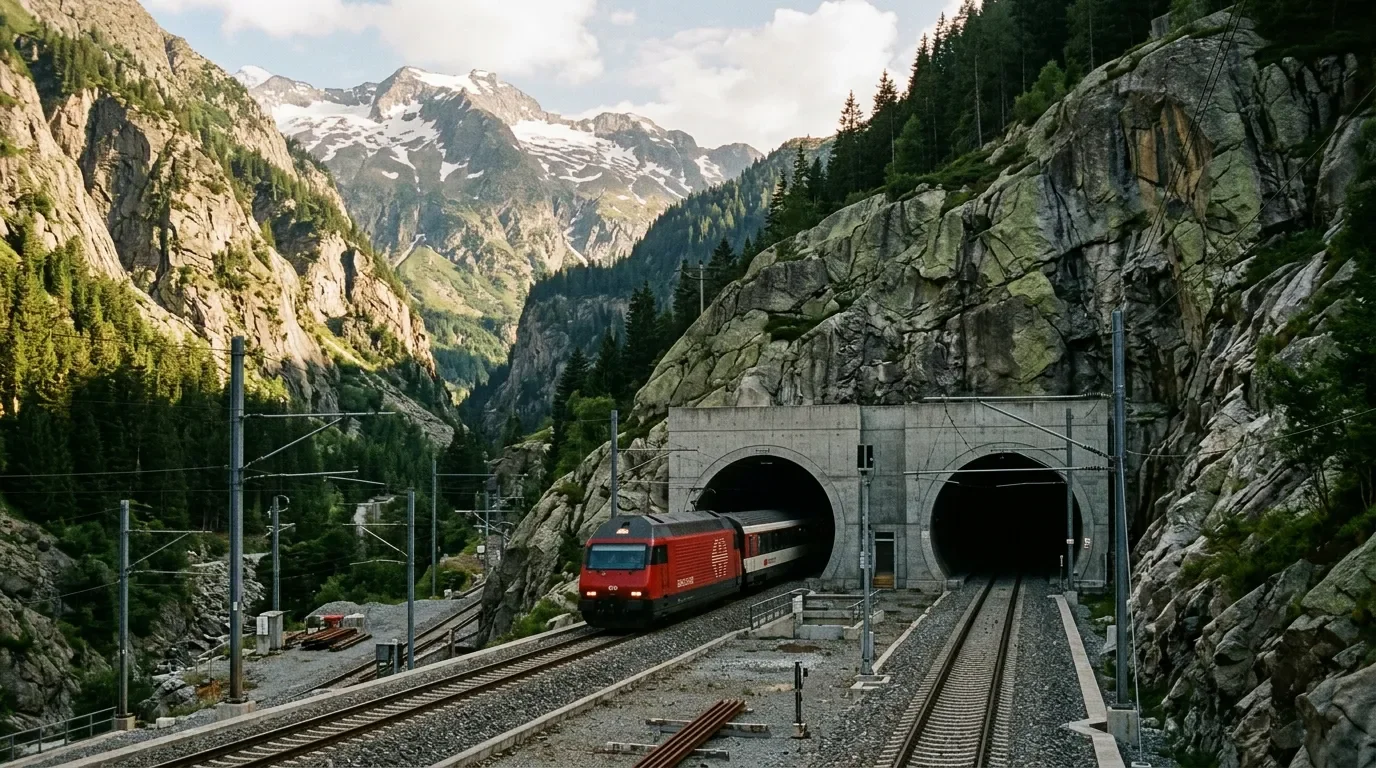
Cover image: AI-generated illustration based on twin-tube Alpine railway tunnel portal concept.
참고 출처
- 1Wikipedia — Gotthard Base Tunnelen.wikipedia.org
- 2
- 3
- 4
- 5
- 6
- 7Semantic Scholar — Wallimann et al. 2026semanticscholar.org
- 8Loginfo24 — 10 Years of the Gotthard Base Tunnelloginfo24.com
- 9
- 10Chemical Geology — Hydrochemistry in the Gotthard Base Tunnel (2026)sciencedirect.com
Engineering Marvel Teardown
One feat of engineering every two weeks (Hoover Dam, Burj Khalifa, Three Gorges, SR-71 Blackbird), with design intent and engineering trade-offs
이 콘텐츠는 채널이 자동으로 생성했습니다. 한 문장이면 Neodrop이 당신을 위해 계속 만들어 냅니다.
관련 콘텐츠
- 로그인하면 댓글을 작성할 수 있습니다.