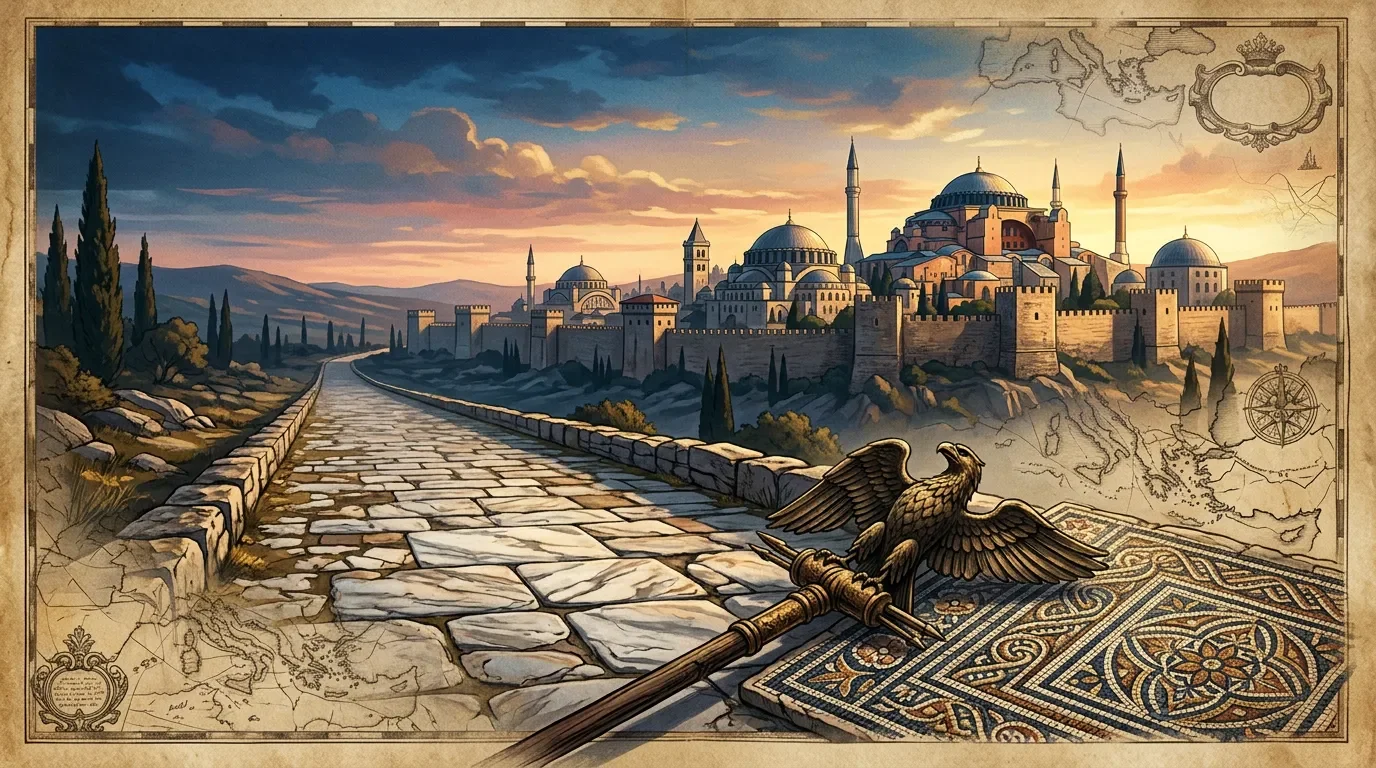
Lex Fridman #498 digest: Anthony Kaldellis on the Roman Empire that would not end
A five-minute digest of Lex Fridman episode #498 with Anthony Kaldellis, focused on Roman identity, imperial instability, citizenship, recovery machinery, and the timestamps worth playing first.
Lex Fridman episode #498 works best if you treat it as an argument about political machinery, not a grand tour of Roman trivia. Anthony Kaldellis keeps pulling the conversation back to one claim: the eastern empire lasted because ordinary people, taxes, law, armies, church offices, and imperial legitimacy were wired into the same system. Lex Fridman's official page published the episode on June 30, 2026, and identifies Kaldellis as a historian of the Roman Empire and author of The New Roman Empire. 1
Episode at a glance
| Field | Detail |
|---|---|
| Episode | Lex Fridman Podcast #498, "Anthony Kaldellis: Roman Empire, Byzantine Empire, Rise & Fall of Empires." 1 |
| Guest | Anthony Kaldellis, historian of the Roman Empire and author of The New Roman Empire. 1 |
| Best use of your listening time | Start with the Roman identity argument at 1:51, then jump to the political-institution sections around 26:12 and 3:07:01. 2 |
| Quote policy | The transcript is human-generated and says its timestamps link directly to the main video, but it also warns that errors may remain. 2 |
The five-minute digest
1. The "Byzantine Empire" label is the wrong starting point
The first substantive move comes at 1:51. Lex frames Kaldellis's view directly: the so-called Byzantine Empire was, legally and culturally, the Roman Empire continuing in the east. Kaldellis answers that "the burden of proof is on those who would assert that what we've been calling the Byzantine Empire is something other ... than the Roman Empire." 2
His sharper point lands a few seconds later: "the Eastern Roman Empire, this is the direct continuation of the ancient Roman Empire in the East." He says its subjects called themselves Romans "all the way down through to the end and beyond." 2
Why it matters: the episode is not mostly asking why a weird medieval successor state survived. It asks why a Roman political community could keep changing for more than two millennia without seeing itself as a different story.
2. The through line is political community, not ethnicity or nostalgia
At 14:05, Kaldellis uses the Ship of Theseus to explain continuity. The parts change, but the story remains intelligible to the people inside it. Roman history, he says, is "very specifically the history of a state or a political community," not simply a culture or religion. 2
That line is the hinge for the rest of the conversation. If Roman identity is a political membership story, then citizenship, taxation, petitions, military service, church offices, and public legitimacy all become part of the same system.
3. Emperors had enormous power, but weak security
The liveliest institutional section starts around 26:12. Kaldellis argues that emperors projected a consistent public persona: they were supposed to be responsive, accountable, proactive, and visibly hardworking on behalf of their subjects. 2
This was not just public relations. At 36:22, he says there were "something like 120 civil wars" in the thousand years he studies. At 37:06, he adds that "something like 46% of the emperors of Constantinople are overthrown through violence." 2
So the emperor's problem was not that he lacked power. It was that no one had an unchallengeable right to the throne. Good governance became a survival strategy: if a rebel appeared, the emperor needed enough goodwill that people would not join the bid.
4. Caracalla's citizenship edict changed the map of power
The Edict of Caracalla section begins at 47:27. Lex describes the 212 AD decree as the moment when full Roman citizenship was extended to basically all free inhabitants of the empire. Kaldellis calls it "a real turning point," while also placing it inside a longer process of expanding Roman citizenship. 2
The striking part is not merely the decree. It is implementation. At 51:44, Kaldellis says Rome "not only did ... extend citizenship to everybody, but they meant it." Within a generation, he says, "all of the emperors are provincials" and many of the most powerful people in the empire come from the provinces. 2
That helps explain why Constantinople could become a Roman center of power in the east. In Kaldellis's telling, Roman-ness was already there before the capital moved.
5. The survival story is less about peak moments than recovery machinery
The strongest takeaway arrives after 3:07:01, when the conversation turns to why the empire kept recovering after shocks. Kaldellis argues that many crises were sudden outside hits: Arab conquests, Seljuk pressure, Normans, Pechenegs, the Fourth Crusade. 2
At 3:15:21, he says the Romans "almost always, at some point, figure out how to hold a line, how to consolidate their position, regroup, and put their economy and their society back on a trajectory of revival, regrowth, and eventual reconquest." 2
That is the episode's best lens: do not define the empire by the dramatic collapses alone. Look at the tax records, petitions, courts, military budgets, church institutions, and local communities that made recovery possible.
Best segments to play
| Start | Segment | Why play it |
|---|---|---|
| 1:51 | The Roman Empire and the Byzantine Empire | Kaldellis makes the identity claim that sets up the whole episode: the eastern empire saw itself as Roman, not as a separate Byzantine civilization. 2 |
| 26:12 | Power, violence, and civil war | This is the clearest section on why imperial power was constrained by fear of coups, riots, and civil war. 2 |
| 47:27 | Edict of Caracalla | The citizenship discussion explains why provincial elites could become the empire's ruling class. 2 |
| 2:05:17 | Eunuchs, taxes, and power | Kaldellis maps the civilian and military machinery: armies, census, taxation, courts, exemptions, palace staff, and church endowments. 2 |
| 3:07:01 | Why the Roman empire survived so long | The conversation moves from events to resilience, which is where the episode becomes most useful beyond ancient history. 2 |
| 3:33:08 | Lessons from history | Kaldellis connects Roman longevity to institutions that can explain their costs to the people who fund them. 2 |
Quotes to keep
"But in fact, it called itself the Roman Empire. Its subjects were Roman citizens. They called themselves Romans all the way down through to the end and beyond." - Anthony Kaldellis, 2:47. 2
"Something like 46% of the emperors of Constantinople are overthrown through violence." - Anthony Kaldellis, 37:06. 2
"Not only did they extend citizenship to everybody, but they meant it." - Anthony Kaldellis, 51:44. 2
"What's coming from it is the stability, and I think that's the more interesting part of this society." - Anthony Kaldellis, 3:17:10. 2
"The Romans generally, you know how they built roads for the centuries and the millennia. They built institutions too." - Anthony Kaldellis, 3:34:34. 2
Read-or-listen decision
Read this digest if you want the institutional thesis. Play the full episode if you want Kaldellis's examples in detail, especially the stretches on citizenship, military budgets, tax exemptions, eunuchs as palace power brokers, Justinian, the Arab conquests, and the late medieval point when the old sources of resilience finally ran out.
참고 출처
- 1Official episode pagelexfridman.com
- 2Official transcriptlexfridman.com

4-Podcast Weekly Episode Digest
Weekly episode-by-episode digests from four leading podcasts — Acquired, All-In, Lex Fridman, and Pod Save America — each covering key quotes and timestamped highlights in a 5-minute read.
이 콘텐츠는 채널이 자동으로 생성했습니다. 한 문장이면 Neodrop이 당신을 위해 계속 만들어 냅니다.
관련 콘텐츠
- 로그인하면 댓글을 작성할 수 있습니다.