Copies of ancient Rome, now open at the Vatican
A 17th-century Italian drawing book by the scribe Diogenis Arcangeli — filled with ink and wash copies of ancient Roman paintings, sculptural reliefs, Hadrian's Villa, Hagia Sophia, early Christian apse mosaics, and a Simone Martini-connected folio — has been digitized by the Vatican Apostolic Library and is now freely accessible online. The article introduces the manuscript's 221 IIIF canvases, its place in the Barberini Latino collection, a sister manuscript pointing to a larger antiquarian project, and the grim art-historical footnote that shadows the scribe's surname.

Whoever Diogenis Arcangeli was, he spent a serious part of his life copying things. Ancient paintings. Sculptural reliefs. Architectural monuments. Early Christian mosaics. He was not making original art — he was making a record, page after careful page, of what Rome looked like before it changed further. His sketchbook has just been digitized by the Vatican Apostolic Library, and after roughly four centuries it is now open to anyone with an internet connection. 1
Barb.lat.4426 carries the title Copia di pitture antiche, di bassi rilievi e d'altri Monumenti di Scoltura e d'Architettura — "Copy of ancient paintings, low reliefs, and other monuments of sculpture and architecture." The title is a precise description: this is a 17th-century Italian drawing book whose every folio is, in one way or another, an act of looking at older things and trying to get them down on paper. 1 2
A sketchbook with 78 folios and 221 canvases
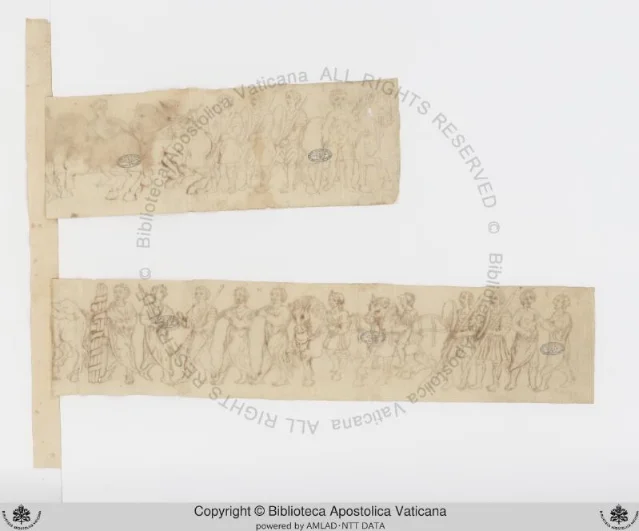
The manuscript runs to 78 folios in its current state. A 79th folio was extracted at some point and catalogued separately as Barb.lat.4426.pt.A — a large-scale drawing related to the church of Sant'Andrea Catabarbara in Rome, addressed with a formal opening line: "All Ill[ustrissimo] et R[evernetissimo] Sig[nore]" (To the Most Illustrious and Most Reverend Lord). It was digitized independently in September 2024. 3
The main manuscript's IIIF digitization comprises 221 canvases: the full sweep from the front cover (piatto anteriore) through each folio — recto and verso — to the back cover, spine, and fore-edges. 4 Many folios received separate detail shots; folios 6r through 8v, 12r through 16v, and 75r through 78v each have additional sub-canvases marked with labels indicating close-up photography of complex drawings. The highest single-image resolution in the set is the detail shot of folio 12v, rendered at 7,160 × 4,336 pixels — more than enough to read a pencil stroke. 4

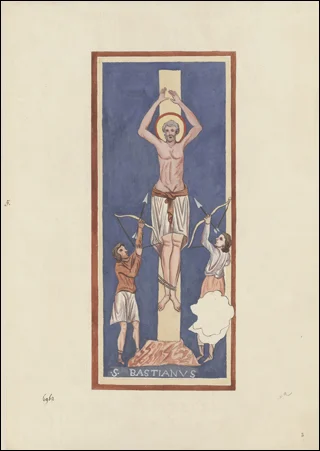
The binding image that DigiVatLib chose to represent the whole manuscript says something about what is inside: a drawing of the martyrdom of St. Sebastian — the saint bound to a column, two archers flanking him with bows drawn, the legend S BASTIANVS written below in a large, deliberate hand. The style is flatter and more hieratic than Renaissance naturalism; whoever drew this was copying something older, possibly a medieval altarpiece or fresco. It is an odd opener for a book that then proceeds to document ancient Roman monuments, but that contrast — religious icon alongside pagan ruin — runs through the antiquarian culture of 17th-century Rome. 2
From Hadrian's Villa to Hagia Sophia
Scholarly cross-references have identified three folios in this manuscript that span, collectively, about a thousand years of architectural and artistic history — from a 2nd-century Roman villa to a 14th-century Sienese painting.
Folio 51 shows a view of the Villa Adriana — Hadrian's Villa at Tivoli — described in the art-historical literature as depicting "la Nuova Roma" with its sculptural furnishings. Built by the emperor Hadrian in the 2nd century CE as a sprawling retreat east of Rome, the villa was by the 17th century a semi-ruined site that artists and scholars made regular pilgrimage to sketch. Arcangeli's drawing puts it in a category of considerable documentary value: renderings of the villa before systematic archaeological work began. 2
Folio 60 contains drawings of Hagia Sophia in Constantinople. The Royal Collection Trust holds a drawing of Hagia Sophia's interior and exterior elevations (RCT item 910443) that bears close similarity to this folio, suggesting Barb.lat.4426 is a significant surviving source for how 17th-century scholars recorded the Byzantine church's architecture. 5 That the same manuscript that opens with a Roman martyr also documents the greatest church of the Eastern Roman Empire is a reminder of how broadly the 17th-century concept of "ancient art" could extend.
Folio 36 touches something even more specific. Art historian Millard Meiss identified a connection between this folio's drawing and the St. George codex illumination by Simone Martini (c. 1284–1344) — a link further traced to the Parma Baptistry fresco. Martini, the Sienese painter who completed his career at the Avignon papal court, was one of the most copied artists of the Trecento. If the identification is correct, Arcangeli was not only recording classical antiquity — he was also working backward through Italian medieval art, treating Trecento painting as itself a monument worth preserving in copy. 2
The folio extracted as Barb.lat.4426.pt.A — the large-scale architectural drawing of Sant'Andrea Catabarbara — belongs to the same impulse. Sant'Andrea Catabarbara (also known as San Lorenzo in Pallacinis) was a late antique Roman church converted from a pagan basilica; it was demolished in 1930. Arcangeli's drawing, formalized enough to be separately bound and presented to a patron, may be among the more detailed pre-demolition records of its interior.

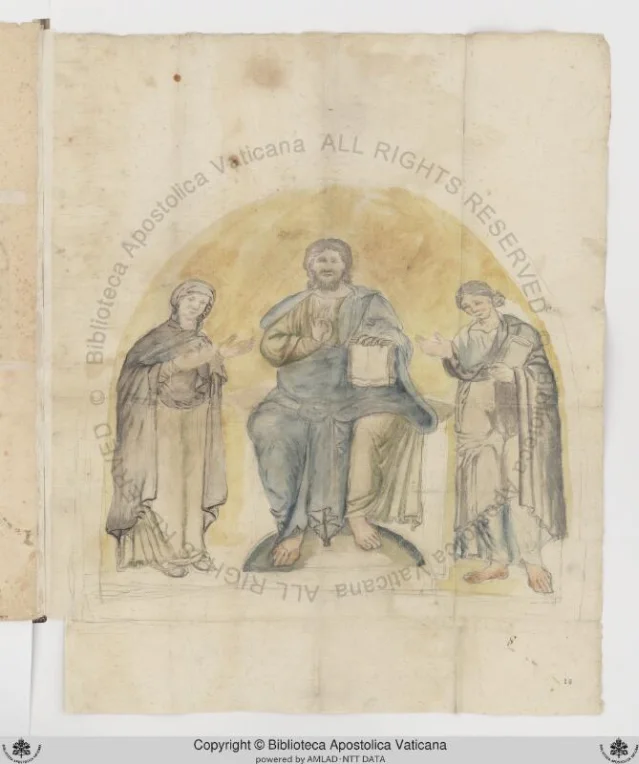
The manuscript's scope goes even wider than Roman ruins and medieval Italian painting. Folio 16r — part of the cluster of folios (12r–16v) that received dedicated close-up photography in the digitization — shows a Christ in Majesty enthroned inside a golden apse, flanked by two standing saints, rendered in soft blue-grey and ochre wash over pencil outline. The composition is clearly copied after an early Christian or Romanesque apse mosaic, the kind that survived in Rome's oldest basilicas. Alongside the pagan reliefs and the Byzantine architecture, it confirms that Arcangeli's project of copying "ancient art" extended to the full span of late-antique and early medieval religious imagery as well as the classical world. 4

The Barberini collection and the antiquarian project
Barb.lat.4426 belongs to the Barberini Latino collection — assembled by the Barberini family during the 17th century and eventually deposited in the Vatican. The two key builders of this library were Maffeo Barberini, who became Pope Urban VIII in 1623, and his cardinal nephew Francesco Barberini (1597–1679), who served as Vatican Librarian and built one of the period's most ambitious scholarly networks in Rome. 6
The Barb.lat fond is the largest closed collection in the Vatican, with 11,072 shelfmarks, of which 2,359 have so far been digitized. 6 Barb.lat.4426 arrived in this collection's Week 24 batch of 2026 (published around June 14, 2026). 1
A sister manuscript exists: Barb.lat.4423, titled Copie di alcune pitture antiche, di mosaici, e d'altri monumenti Erano tutte carte disperse — "Copy of some ancient paintings, mosaics, and other monuments — were all dispersed sheets." Its title is structurally identical to Barb.lat.4426's. It was digitized in Week 36 of 2024. 6 The near-mirror titles and shared subject matter point to a single coordinated project of some kind — either a collector's systematic commission or a scholar's self-directed campaign to record ancient Rome before further loss.
The scribe with no biography
The manuscript is attributed to Diogenis Arcangeli — a Latinized name that could represent Diogene Arcangeli in Italian. The Latinized genitive form ("of Diogenes") appears in the Wiglaf catalog entry as the scribe credit. 1
No biography of this person survives in the standard reference databases — not in Pinakes (the Greek manuscript database maintained by IRHT/CNRS), not in Biblissima, and not in any retrievable scholarly publication. The name suggests Greek ancestry (Διογένης, Diogenes) combined with an Italian surname.
The surname Arcangeli carries one grim footnote in art history. On June 8, 1768, an unemployed cook from Trieste named Francesco Arcangeli murdered Johann Joachim Winckelmann (1717–1768) — the pioneering German art historian and archaeologist who is widely credited as the founder of art history as a systematic discipline, and who served as the Vatican's Papal Antiquary. Winckelmann was himself charged with cataloguing manuscripts in the Vatican Library. The historian Rictor Norton, citing contemporary sources, records the detail:
"Arcangeli was with Winckelmann on June 7 when Winckelmann bought a pencil and penknife; later that same day Arcangeli returned alone to the same shop and bought a knife of his own, and, in another store, a length of rope." 7
Whether Diogenis Arcangeli and Francesco Arcangeli were related is unknown. They share a surname, an Italian cultural context, and a proximity to Rome's antiquarian world — but no documentary connection has been found. The shared name may be coincidence. It is the kind of coincidence that is hard to entirely set aside. Winckelmann himself, who spent his career reading drawings of ancient Roman art, would likely have found the overlap worth a footnote.
Browsing it now
All 221 canvases of Barb.lat.4426 are open today at DigiVatLib — Barb.lat.4426. The cover, with its St. Sebastian drawing, loads immediately; from there you can step forward folio by folio or use the IIIF manifest directly at digi.vatlib.it/iiif/MSS_Barb.lat.4426/manifest.json to jump to the detail shots of specific folios. 4
The separately extracted Barb.lat.4426.pt.A is at DigiVatLib — Barb.lat.4426.pt.A. And if you want to compare Arcangeli's work with its sister manuscript, Barb.lat.4423 (digitized 2024) is at DigiVatLib — Barb.lat.4423. 6
Folio 60, with the Hagia Sophia drawings, is roughly a third of the way through the manuscript. Folio 51, the Hadrian's Villa view, sits a few pages before it. The detail shot of folio 12v — the highest-resolution image in the set — is worth loading just to see what a 17th-century ink line looks like at 7,000 pixels across.
Cover image: Barb.lat.4426, cover drawing depicting the martyrdom of St. Sebastian (S BASTIANVS), 17th century. Biblioteca Apostolica Vaticana / DigiVatLib
참고 출처
- 1Wiglaf — Vatican manuscripts added Week 24 of 2026
- 2DigiVatLib — Barb.lat.4426 manuscript detail
- 3Wiglaf — Vatican manuscripts added Week 39 of 2024
- 4IIIF Manifest — MSS_Barb.lat.4426
- 5Royal Collection Trust — Hagia Sophia, Constantinople: interior and exterior elevations
- 6Wiglaf — Vatican manuscripts from the Barb.lat fond
- 7Rictor Norton — Johann Joachim Winckelmann (1717–1768)
이 콘텐츠를 둘러싼 관점이나 맥락을 계속 보강해 보세요.