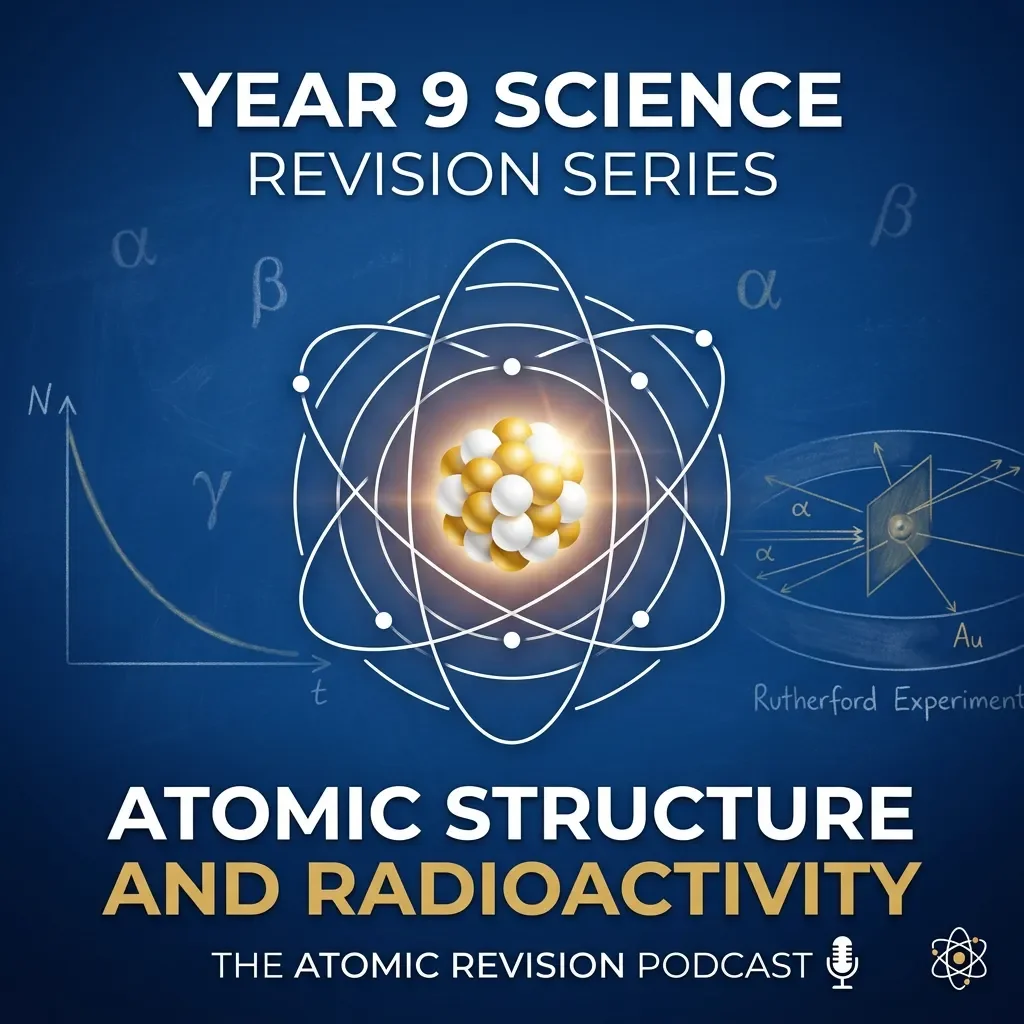
Year 9 Science Exam Prep — Episode 9: Atomic Structure and Radioactivity

A clear teacher-style lecture on Year 9 Atomic Structure and Radioactivity — covering the structure of the atom, the nuclear model, isotopes, radioactive decay (alpha, beta, gamma), half-life, and exam tips throughout. Ideal for exam-week revision.

Year 9 Science Exam Prep — Episode 9: Atomic Structure and Radioactivity
0:0031:18

Episode Overview

In this lecture-style revision episode, your science teacher walks you through everything you need to know about Atomic Structure and Radioactivity for your Year 9 science exam — from scratch, step by step.
Topics covered in this episode:
  • Subatomic particles: protons, neutrons, and electrons (charges, masses, locations)
  • Atomic number and mass number — how to calculate the number of neutrons
  • Isotopes — what they are, why they have the same chemical properties, and the carbon-14 dating example
  • The development of the nuclear model: Dalton → Thomson's plum pudding model → Rutherford's gold foil experiment → Bohr's electron shells → Chadwick's neutron
  • The gold foil experiment: what was expected, what was observed, and what it proved
  • The three types of radioactive decay: alpha, beta, and gamma — properties, penetration, ionising power, and dangers
  • Writing and balancing nuclear equations for alpha and beta decay
  • Half-life: what it means, worked calculation examples, and how to work backwards
  • Uses of radioactivity: medical tracers, radiotherapy, carbon dating, smoke detectors, nuclear power
  • Dangers of radiation and safety measures

Exam Tips Covered

  1. Always check mass numbers and atomic numbers balance on both sides of a nuclear equation.
  2. For half-life calculations, count half-lives first — never divide the amount directly by time.
  3. For the gold foil experiment, describe what was observed and then explain what it tells us.
  4. Always state whether a radiation hazard question is about internal or external exposure.
  5. Learn key half-lives: Carbon-14 (~5,730 years), Americium-241 (~432 years), Iodine-131 (~8 days).

Revision Suggestion

After listening, close your eyes and write down from memory:
  • The subatomic particles table (particle, location, charge, mass)
  • The alpha / beta / gamma comparison table
  • One worked half-life calculation
Active recall is the most effective revision technique. Keep going — you're doing brilliantly.

이 콘텐츠를 둘러싼 관점이나 맥락을 계속 보강해 보세요.

  • 로그인하면 댓글을 작성할 수 있습니다.