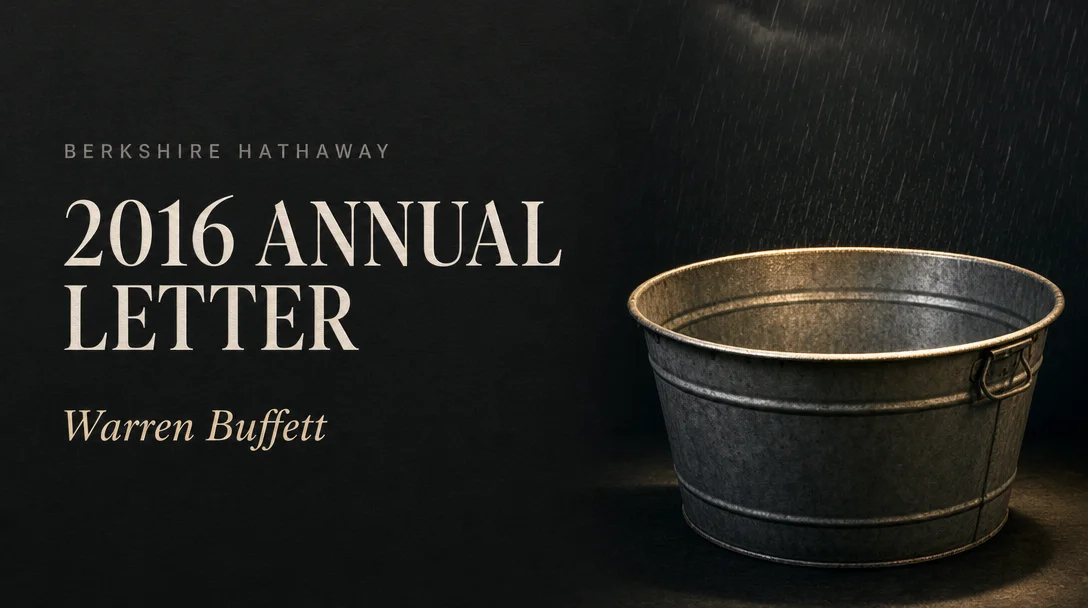
Buffett 2016 — Washtubs, not teaspoons

Buffett 2016 — Washtubs, not teaspoons

From Warren Buffett's 2016 Berkshire Hathaway letter: the ten-year bet's penultimate scorecard (S&P 500 at 85.4% vs. the average hedge fund-of-funds at 22%), a tribute to Jack Bogle and the psychology that keeps the wealthy paying for underperformance, the "washtubs not teaspoons" crisis doctrine backed by $91.6B in float, and the colonoscopy line on share issuance — distilled from the Dexter Shoe and General Re mistakes.

Shareholder Letter Excerpt
2026. 6. 5. · 20:30
구독 1개 · 콘텐츠 27개
Published: February 25, 2017 — Warren Buffett, Berkshire Hathaway 2016 Annual Report

By 2016, Buffett had spent nearly a decade running a single public wager against the hedge fund industry. The bet — $500,000 staked in 2007 that a plain Vanguard S&P 500 index fund would beat a basket of hedge fund-of-funds over ten years — was entering its penultimate year, and the score was becoming difficult to look away from. 1
The 2016 letter occupies a specific position in the Berkshire sequence. It is the year Apple and three airlines appeared in the portfolio for the first time, IBM held its ground in the tables with no accompanying commentary (a silence Buffett would resolve a year later by selling), and float crossed $91.6 billion on its way to $100 billion. But the passages that carry the most permanent weight — the ones that belong to no particular market cycle — are the ones about what destroys investor returns and what protects against crises. This letter contains Buffett's most direct treatment of both. 1

The bet's ninth year: 85.4% vs. 22%

In late 2007, Buffett published an open challenge in Fortune: he would wager $1 million that an S&P 500 index fund would outperform five hedge fund-of-funds over the following decade. Only one party accepted — Ted Seides of Protégé Partners. The amount was set at $500,000 per side. 1
Through nine years (2008–2016), the Vanguard S&P 500 index fund had gained 85.4% cumulatively — roughly 7.1% annualized. The five funds-of-funds, which collectively invested in more than 100 underlying hedge funds, averaged 2.2% annualized over the same period, with individual cumulative results ranging from 2.9% to 62.8%. 1
통계 카드를 불러오는 중…
Buffett was clear about what caused the gap. The managers involved were "honest and intelligent people," but the structure they operated in guaranteed the result. Active investors, in aggregate, must earn the market return before costs — because they are the market. After two layers of fees (the underlying hedge fund's "2 and 20" plus the fund-of-funds overlay of roughly 1% of assets), the same aggregate return becomes roughly the market return minus several percentage points per year. Buffett estimated that of all the gains the five funds-of-funds generated over the nine years, roughly 60% was diverted to the two layers of management fees rather than to investors. 1
He quoted Bill Ruane: "In investment management, the progression is from the innovators to the imitators to the swarming incompetents." And he added his own summary: "When trillions of dollars are managed by Wall Streeters charging high fees, it will usually be the managers who reap outsized profits, not the clients." 1
The math here is not controversial — it follows directly from arithmetic. What Buffett was documenting over ten years was the emotional and institutional machinery that causes investors to keep paying for underperformance anyway.

Why the wealthy keep choosing expensive advice

The most psychologically precise section in the 2016 letter is the one explaining why the bet's lesson goes unheeded. Buffett made the observation that despite his consistent public recommendation of low-cost S&P 500 index funds, "none of the mega-rich individuals, institutions or pension funds" had followed it. They would listen politely and then go listen to a high-fee manager instead. 1
His explanation: the wealthy are "accustomed to feeling that it is their lot in life to get the best food, schooling, entertainment, housing, plastic surgery, sports tickets." In most of those domains, paying more genuinely delivers more. So the expectation that expensive investment advice should outperform cheap advice seems reasonable — even natural. The fact that this particular domain works in the opposite direction is counterintuitive enough that no amount of evidence eliminates the habit. 1
He also identified the structural trap for investment consultants: recommending the same index fund year after year would be "career suicide." The client expects expertise, action, and differentiation. An advisor who responds to that demand by saying "just hold the index and do nothing" doesn't stay employed for long, regardless of whether that recommendation is correct.
The tribute he placed in this section is worth the price of the letter on its own. "If a statue is ever erected to honor the person who has done the most for American investors, the hands-down choice should be Jack Bogle." 1 Vanguard's founder spent decades urging investors toward ultra-low-cost index funds while accumulating only a small fraction of the wealth that flows to managers who promise large returns. Buffett estimated that investors, pension funds, and endowments wasted more than $100 billion over the prior decade seeking superior investment advice that the arithmetic of the market cannot broadly deliver. 1
He closed this section with a story from the Omaha stockyards. His brother-in-law Homer Rogers was a commission agent who sold livestock to the big four meatpackers — Swift, Cudahy, Wilson, and Armour. Buffett had once asked how Homer managed to charge a fee when the buyers were expert valuers and hogs were a commodity. Homer's reply: "Warren, it's not how you sell 'em, it's how you tell 'em." Buffett's annotation: "What worked in the stockyards continues to work in Wall Street." 1

"Washtubs, not teaspoons"

The crisis doctrine Buffett outlined in the 2016 letter is the clearest version of a belief he has held since at least the 1960s: the only sustainable edge for a patient investor with permanent capital is the willingness to deploy decisively when others cannot.
"Every decade or so, dark clouds will fill the economic skies, and they will briefly rain gold. When downpours of that sort occur, it's imperative that we rush outdoors carrying washtubs, not teaspoons. And that we will do." 1
The metaphor is deceptively simple. What it encodes is a capital structure argument: the companies that can move at scale during a crisis are the ones that prepared for it during tranquility. Berkshire's preparation runs through the insurance float engine — $91.6 billion at year-end 2016, up from $87.7 billion the year before and from $39 million in 1970. 1 That float is available to invest in whatever Berkshire chooses, costs nothing as long as underwriting discipline holds, and has funded 14 consecutive years of underwriting profit through 2016, generating $28 billion in cumulative pre-tax underwriting gains over that stretch. 1
차트를 불러오는 중…
Buffett's description of the float engine's culture is the same line he used in the prior year's letter — but it belongs here, because it explains why the washtub can be readied: "Disciplined risk evaluation is the daily focus of all of our insurance managers, who know that while float is valuable, its benefits can be drowned by poor underwriting results. All insurers give that message lip service. At Berkshire it is a religion, Old Testament style." 1
The washtub doctrine has a companion rule that applies outside crisis periods: Berkshire ranked first among all American companies in dollar volume of earnings retained in both 2015 and 2016. 1 No dividends, no buybacks at elevated prices, no distributions that shrink the reservoir before the rain arrives. The teaspoon problem is not just about readiness in the moment of crisis — it is about the steady drain of capital that prevents readiness from ever accumulating.

The colonoscopy line: on issuing shares

The most viscerally memorable sentence in the 2016 letter is the one where Buffett describes his current relationship with share issuance: "Today, I would rather prep for a colonoscopy than issue Berkshire shares." 1
The context was the Dexter Shoe acquisition. In 1993, Buffett paid $434 million for Dexter, a Maine shoe manufacturer. The value promptly went to zero — Dexter's competitive advantage dissolved as Asian competition emerged. The acquisition itself was a mistake. What compounded it into something far worse was the payment method: he used 25,203 shares of Berkshire Class A stock. At year-end 2016, those shares were worth more than $6 billion. 1
He extended the lesson to General Re, acquired in late 1998 using 272,200 Berkshire shares — increasing shares outstanding by 21.8%. That transaction was also paid with stock, and Buffett called it a "terrible mistake" for the same reason: shareholders gave far more than they received. 1 Since 1999, Berkshire's outstanding shares have grown by only 8.3%, with most of that increase from the BNSF acquisition — which Buffett judged to have made genuine economic sense. 1
The principle he extracted is not merely that stock-for-stock deals are bad. It is that the currency of an acquisition matters as much as the price. Every share Berkshire issues is a piece of a business with a per-share book value of $172,108 at year-end 2016 — and an intrinsic value Buffett described as far exceeding that figure. Using those shares to buy something that turns out to be worth zero is not a $434 million error — it is a $6 billion one. The error compounds at the same rate as the stock.

What this letter means for investors today

The 2016 letter covers considerable ground — the Apple position (first appearance in the top 15 holdings at $6.7 billion), three airline investments totaling roughly $6.8 billion across Delta, Southwest, and United Continental, a performance scorecard showing 52-year cumulative market value gains of 1,972,595% against the S&P 500's 12,717%, and a sharp critique of corporate management practices around "adjusted earnings" and stock-based compensation. 1
But the passages above — the bet's nine-year scorecard, the Bogle tribute, the washtub doctrine, and the colonoscopy line — carry the transferable logic. Together they form a coherent statement about where value destruction comes from and where readiness for value creation gets built.
On fees: the bet is nearly over, and the arithmetic was never the interesting part. The interesting part is the psychology Buffett diagnosed around why the expensive option keeps winning the sales conversation even when it loses the performance one. If you hold active funds, the question is not whether the manager is smart — it is whether the two-percentage-point annual fee drag has a commensurate probability of being overcome.
On crisis readiness: the washtub metaphor is only as useful as the capital structure behind it. The investors who can move at scale during a crisis are the ones who protected liquidity during tranquility — which means resisting the constant temptation to optimize yield at the cost of optionality. Berkshire's mechanism for this is insurance float. An individual investor's mechanism is simpler: cash held deliberately rather than apologetically.
On share issuance: the Dexter Shoe lesson applies to any company whose management regularly compensates itself or acquires competitors with shares. The currency of the transaction matters. A share-based acquisition is not a "low-cost" transaction — it is a transaction priced at whatever intrinsic value the acquirer's stock happens to carry at the moment the deal closes.

콘텐츠 카드를 불러오는 중…

The 2016 letter was published on February 25, 2017 — one month after a presidential inauguration that had generated significant economic commentary of every stripe. Buffett made no mention of it. What he wrote about instead was a thirty-year compounding chart, a galvanized washtub, and a commission agent in the Omaha stockyards. The subject of the letter, as always, was how wealth is actually built and how it is quietly taken away. The year in the dateline was incidental. 1

Cover image: AI-generated illustration

이 콘텐츠를 둘러싼 관점이나 맥락을 계속 보강해 보세요.

  • 로그인하면 댓글을 작성할 수 있습니다.