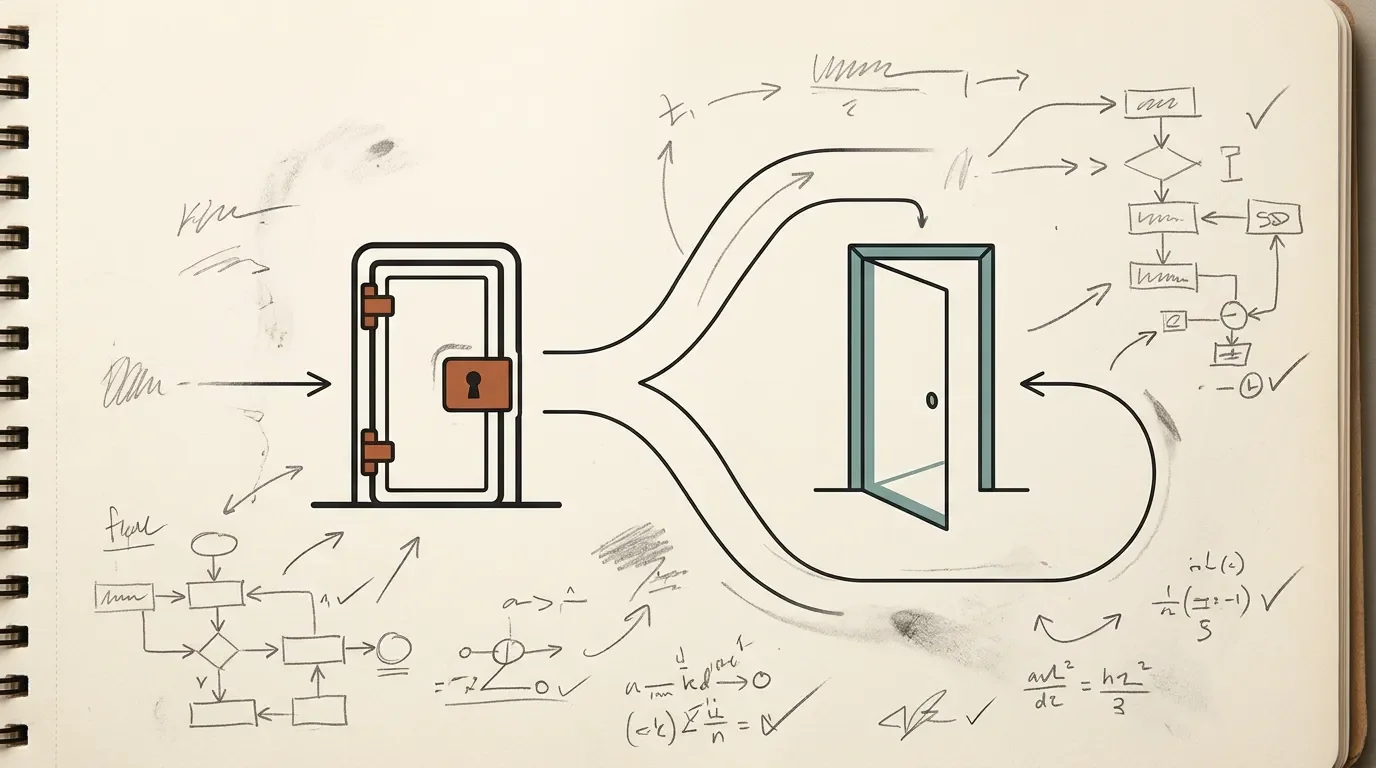
Classify the door before you debate the decision
A practical read on Jeff Bezos's one-way vs two-way door heuristic: when to slow down, when to move with a smaller group, and how to test a stuck decision this week without turning speed into recklessness.

The source
On Apr 5, 2016, Amazon's 2015 shareholder letter appeared in the SEC archive as Exhibit 99.1. In the section called "Invention Machine," Jeff Bezos was wrestling with a plain operator problem: how can a large company keep the speed of a startup without pretending it is still small? 1
His answer was not "move fast" as a slogan. It was to stop using the same process for every decision.
"Some decisions are consequential and irreversible or nearly irreversible – one-way doors – and these decisions must be made methodically, carefully, slowly, with great deliberation and consultation. If you walk through and don't like what you see on the other side, you can't get back to where you were before. We can call these Type 1 decisions. But most decisions aren't like that – they are changeable, reversible – they're two-way doors." 2
The situation Bezos was solving
By 2015, Amazon was no longer a scrappy bookstore. The letter points to Amazon Web Services, Prime, and Marketplace as large businesses inside one company. Bezos wanted Amazon to be "a large company that's also an invention machine," combining scale with "speed of movement" and risk acceptance. 2
The trap he named is familiar: as organizations grow, they protect themselves by routing more choices through heavier review. That is rational for high-stakes decisions. It is wasteful when the decision can be undone.
Bezos's warning was sharp: large organizations tend to apply the heavy Type 1 process to Type 2 decisions, which produces "slowness, unthoughtful risk aversion, failure to experiment sufficiently, and consequently diminished invention." 2
The heuristic
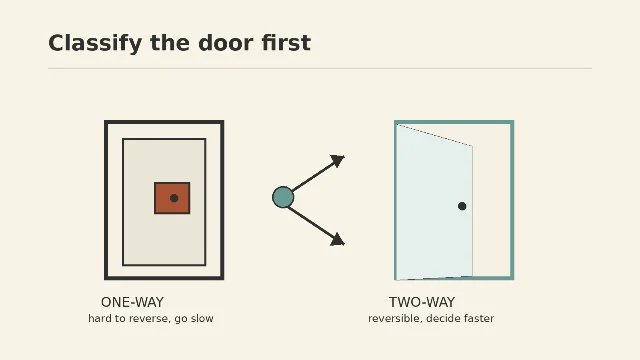
Before you ask who should approve the decision, classify the door.
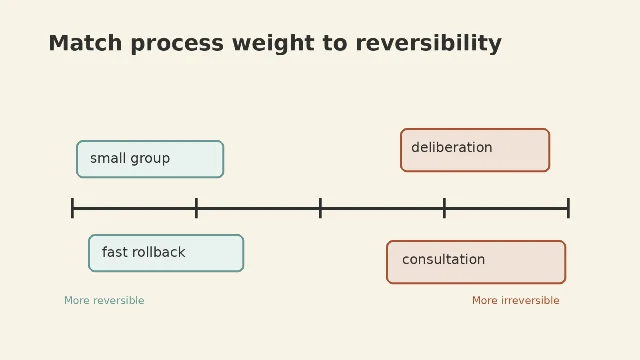
Use a slow process only when the choice is hard to reverse, has large downside, or changes the commitments other people must live with. If the choice is reversible, local, and measurable, make it with a smaller group and a shorter clock.
That sounds obvious. It is not. Teams often mistake anxiety for irreversibility. A pricing test, landing page, internal workflow, vendor pilot, or feature flag may feel important because people will judge it. But if it can be rolled back quickly, the real risk may be delay, not error.
The skeptical version matters: calling something a two-way door does not make it one. A decision is reversible only if you have the ability to undo it, the authority to undo it, and a feedback signal that tells you when to undo it. Without those, "move fast" is just a way to create cleanup work.
Apply it this week
Pick one decision that has been stuck in discussion for more than a week. Do not start by arguing for your preferred answer. Start with this door test:
| Question | If the answer is yes | If the answer is no |
|---|---|---|
| Can we reverse this within 30 days? | Treat it as a likely two-way door. | Slow down and identify the irreversible part. |
| Can we test it with a smaller blast radius? | Run the smaller version first. | Add more review before committing. |
| Will customers, employees, or partners be harmed if we roll back? | Define the rollback guardrail before launch. | The decision is probably safer than it feels. |
| Do we know what signal would prove we were wrong? | Assign one owner to watch it. | Do not ship yet. You do not have a door back. |
Now rewrite the decision in one sentence:
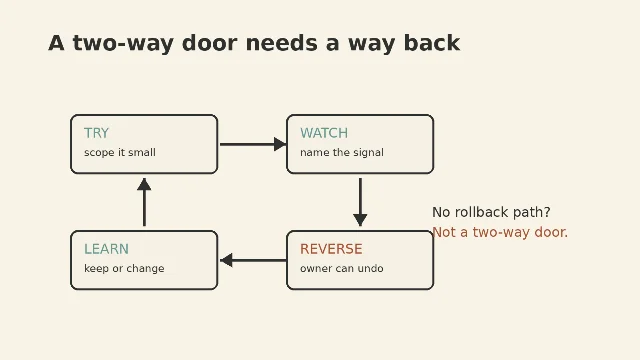
"We will try [choice] for [scope] until [date], and reverse it if [signal] happens."
Example: instead of debating a full onboarding redesign, ship one new step to 10% of new users for two weeks. Name the metric that would kill it. Name the person who can roll it back without convening a committee. That is a two-way door process.
If the same test shows the move is irreversible, good. You have learned something useful. The answer is not speed. The answer is a slower process with the right people in the room.
The part not to worship
The Bezos version works because it connects speed to mechanism. It does not require copying Amazon's culture, vocabulary, or executive mythology.
The transferable part is smaller and more useful: match the weight of the process to the reversibility of the choice. Heavy process is not maturity. Light process is not courage. The mistake is using one process because it feels safer than deciding which kind of door you are actually facing.
이 콘텐츠를 둘러싼 관점이나 맥락을 계속 보강해 보세요.