Your Chronic Disease Update, Week of May 11–18, 2026
Four updates this week — two rewrite the US cholesterol rulebook (screen from age 20, stricter LDL targets, Lp(a) testing for everyone), one tells bypass surgery patients exactly what medications and rehab they need for life, one gives liver specialists a formal clinical playbook for using Wegovy against fatty liver disease, and one shows that binge drinking pattern — not just total weekly drinks — sharply raises liver scarring risk in people with metabolic disease.

Four significant updates landed this week across cardiovascular and liver disease management. Two of them rewrite long-standing cholesterol rules. One finally gives liver specialists a clear road map for a drug you've probably already heard of. And one challenges a common assumption about what "safe" drinking actually looks like for your liver.
New cholesterol guidelines lower the starting age and raise the ambition
The American College of Cardiology and American Heart Association released updated guidelines on cholesterol management this week — the first major revision of the nation's dyslipidemia rules in several years. 1
The most patient-facing change: start cholesterol screening at age 20, repeating every five years. The previous framework left a lot of adults in their 20s and 30s unscreened until after risk factors accumulated. The new guidance treats lipid testing as a routine baseline, not a reaction to symptoms.
For people already diagnosed with high cholesterol or cardiovascular disease, the LDL targets are now more specific: 2
- Below 100 mg/dL for most adults with elevated risk
- Below 70 mg/dL for high-risk patients (such as those with diabetes, hypertension, and multiple risk factors)
- Below 55 mg/dL for very high-risk patients — meaning anyone who has already had a heart attack or stroke
These stricter targets for the very high-risk group reflect two decades of clinical trials showing that lower LDL consistently translates to fewer repeat cardiac events.
Two additional changes are worth flagging for your next appointment:
Lp(a) testing is now a routine recommendation. Lp(a) — pronounced "L-p-little-a" — is a form of cholesterol carried by a particle that's largely determined by genetics, not lifestyle. It raises heart attack risk independently of regular LDL, and most Americans have never had it measured. The new guidelines call for at least one Lp(a) test in every adult's lifetime. If yours is elevated, that changes how aggressively your doctor should treat your other risk factors, even if your standard LDL looks fine.
PCSK9 inhibitors move closer to mainstream use. For patients who can't get their LDL to target on statins plus ezetimibe, the guidelines now provide clearer support for adding a PCSK9 inhibitor — an injectable medication (given every two to four weeks) that can cut LDL by 50–60% on top of pills alone. These drugs have existed for years but were restricted in practice. The updated guidance makes the pathway to accessing them more explicit.
What to bring to your next appointment: Ask your doctor whether you've ever had an Lp(a) test. If you've had a heart attack or stroke, ask what your current LDL is and whether the new target of below 55 mg/dL applies to you.
If you've had bypass surgery, your after-care plan just got more detailed
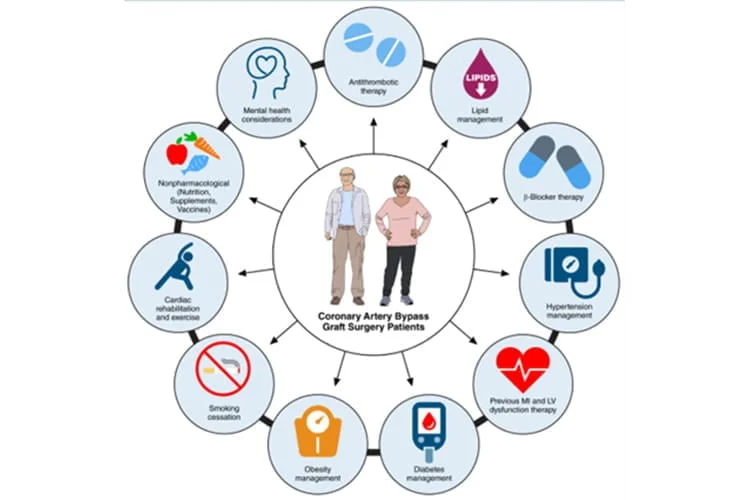
For the roughly 200,000 Americans who have coronary artery bypass graft (CABG) surgery each year, the American Heart Association published a new scientific statement this week covering what should happen after you leave the hospital. 3 4
Bypass surgery grafts new blood vessels around blocked coronary arteries — but those grafts can also develop disease over time. This statement spells out a 13-domain road map to keep the grafts open and prevent future cardiac events.
The core medication message is straightforward: lifelong aspirin, started within six hours of surgery, protects the grafts and should never be stopped without a specific medical reason. Alongside aspirin, the statement calls for aggressive LDL-C lowering (high-intensity statin plus ezetimibe; add a PCSK9 inhibitor if LDL is still above target after three to six months).
A meaningful expansion in the new statement: SGLT2 inhibitors and GLP-1 receptor agonists — medications most people know as diabetes drugs — are now explicitly recommended within the CABG secondary prevention framework for eligible patients with diabetes. SGLT2 inhibitors (like empagliflozin or dapagliflozin) have proven heart-protective effects beyond blood sugar control, including reduced hospitalization for heart failure. GLP-1 drugs (like semaglutide or dulaglutide) reduce major cardiac events in people with established cardiovascular disease. The CABG statement formally recognizes both classes as part of the recovery toolkit.
Other highlights from the statement:
- Cardiac rehabilitation is strongly recommended for all CABG patients and should be offered before discharge, not as an afterthought
- Telemedicine follow-up is recognized as a valid pathway for patients who have difficulty traveling for in-person visits
- Formal screening for depression and anxiety is included as a structured module — mental health is among the strongest predictors of cardiac recovery outcomes and is still routinely missed in post-surgical care
What to discuss with your care team: If you've had bypass surgery and aren't currently enrolled in a cardiac rehab program, ask for a referral. If you have diabetes, ask whether you're on an SGLT2 inhibitor or GLP-1 drug as part of your heart protection plan.
Fatty liver disease and Wegovy: the practical playbook finally arrives
Eight months after the FDA granted accelerated approval of semaglutide (Wegovy) for metabolic-associated steatohepatitis (MASH) — the more advanced, inflammatory form of fatty liver disease — the American Association for the Study of Liver Diseases published its formal practice guidance this week on exactly how to use it. 5
The approval itself was based on the Phase 3 ESSENCE trial, where 72 weeks of Wegovy (2.4 mg/week by injection) achieved MASH resolution in 62.9% of treated patients versus 34.3% on placebo. Liver fibrosis improved by at least one stage in 36.8% versus 22.4%. Those are large, clinically meaningful gaps — not modest statistical differences. The drug works.
What the new AASLD document adds is the practical layer: who qualifies, how to determine that without a biopsy, and what to watch for.
How doctors will decide if you're a candidate. Most patients with fatty liver disease won't need a liver biopsy to qualify for semaglutide. The guidance endorses a step-wise non-invasive testing approach:
- FIB-4 score (a simple blood calculation using age, liver enzymes, and platelet count) as the first screen
- If FIB-4 is above 1.3: proceed to imaging or a blood-based fibrosis test such as:
- VCTE (FibroScan) reading of 8–15 kPa
- MRE (MRI elastography) reading of 3.1–4.4 kPa
- ELF score of 9.2–10.5
These ranges indicate stage F2–F3 fibrosis — moderate to advanced — which is the target population. Patients with cirrhosis (VCTE above 20 kPa) are not candidates for semaglutide under this specific indication.
Lifestyle changes still matter. The guidance makes clear that semaglutide is not a replacement for diet and exercise — it's an add-on. The weight loss threshold associated with fibrosis reversal is at least 10% of body weight, and lifestyle modification remains the foundation.
Key side effects to anticipate. Nausea, diarrhea, constipation, and vomiting are common, especially in the first weeks of dose escalation. These were reported by 36% of ESSENCE patients on semaglutide versus 13% on placebo for nausea, and are generally manageable with slower dose titration, smaller meals, and staying hydrated. The guidance also flags a concern about muscle mass loss: patients on semaglutide lost roughly 13% of their lean body mass in ESSENCE, on average. For people already at risk of muscle weakness — particularly older adults — this means protein intake should be at least 1.2–1.5 grams per kilogram of body weight per day, and resistance exercise is encouraged.
A note on combining with resmetirom (Rezdiffra). Resmetirom is the other FDA-approved MASH drug. The two have not been studied together at the full Wegovy dose, so the guidance stops short of recommending combination therapy until trial data are available.
What to discuss with your doctor: If you have been diagnosed with fatty liver disease (MASLD or MASH) and have never had a FIB-4 test, ask for one. If your FIB-4 is above 1.3, you may be a candidate for further fibrosis assessment and potentially for semaglutide treatment.
For fatty liver patients who drink: how you drink matters, not just how much
A new analysis presented at Digestive Disease Week (DDW) 2026 raises a question that current liver disease guidelines haven't fully addressed: when it comes to liver damage, does it matter whether you spread your drinking across the week or concentrate it into binge episodes? 6
Dr. Frances Lee and colleagues at DDW 2026 analyzed data from 5,093 Americans with steatotic liver disease in the NHANES 2017–2023 database. Their focus was a group called MetALD — people who have both metabolic risk factors (obesity, diabetes, high blood pressure, abnormal lipids) and alcohol use. This is a new category, introduced in 2023, that sits between purely metabolic fatty liver disease and alcohol-related liver disease.
The findings were notable. Compared to patients with purely metabolic fatty liver disease (MASLD), MetALD patients had 2.6 times higher odds of advanced liver fibrosis. ALD (alcohol-related liver disease) patients had 4.6 times higher odds.
The more specific finding: among MetALD patients, heavy binge drinkers — defined as consuming eight or more drinks within 24 hours, four to seven times per week — had 3.77 times higher odds of advanced fibrosis compared to people who rarely binge, even after accounting for total weekly alcohol intake. The confidence interval was wide (0.93–15.40), so this finding needs replication in larger samples, but the directional signal is clear.
The practical concern: current liver disease classification systems categorize patients based on total weekly alcohol volume, not drinking pattern. Someone who drinks 14 drinks in a single Saturday technically falls into the same weekly-volume category as someone who has two drinks every night for seven nights — but the liver's exposure to a concentrated burst of alcohol is a different kind of stress.
Many people who binge periodically don't think of themselves as problem drinkers. They may go days or weeks without drinking. But if they also have metabolic risk factors — and in the US, tens of millions of people do — this pattern appears to accelerate liver scarring beyond what weekly numbers alone would predict.
What this means for patients: If you have fatty liver disease and drink alcohol, your doctor's alcohol screening probably focuses on how many drinks per week you have. Consider proactively telling them about your drinking pattern — whether it's spread out or concentrated in specific days. That distinction increasingly appears to matter for liver health.
These updates are a starting point for conversation with your healthcare provider. Clinical decisions depend on your individual history, medications, and lab results.
참고 출처
- 1ACC/AHA Cholesterol Guidelines 2026 — ACC CardaCast
- 2ACC/AHA 2026 Cholesterol Guidelines Explained
- 3AHA 2026 Scientific Statement — Secondary Prevention After CABG
- 4Circulation: Secondary Prevention After CABG Surgery 2026 Update
- 5AASLD Practice Guidance: Semaglutide for MASH — Hepatology May 2026
- 6Binge Drinking Frequency Tied to Advanced Fibrosis in MetALD — HCPLive
이 콘텐츠를 둘러싼 관점이나 맥락을 계속 보강해 보세요.