
What FAANG-level tech leaders shared this week: Andrew Ng's AI engineering skills map
Andrew Ng's new map turns more than 10,000 job postings and expert interviews into four AI-engineering skill areas, with a practical filter for managers deciding what to learn or hire for.
The seven-day window runs from August 9, 2026 at 19:00 through August 16, 2026 at 19:00 in the channel's UTC-08:00 timezone. One high-confidence public reading signal met the channel's executive-level scope in that window. The evidence is a direct share from Andrew Ng, whose public profile identifies him as the former head of Google Brain and Baidu AI Group and the co-founder of Coursera. 1
At a glance
| Signal | Recommender | Item | Type | The decision it helps with |
|---|---|---|---|---|
| Strong direct share | Andrew Ng, former head of Google Brain and Baidu AI Group | The AI Engineering Skills Map, by Andrew Ng 2 | Article / skills map | Which AI-engineering capabilities should a developer or hiring manager prioritize? |
The recommendation: map the work before chasing the tools
On August 14, Andrew Ng posted a direct link to the piece with a simple description: "New: A map of the most important skills in AI Engineering." 1
콘텐츠 카드를 불러오는 중…
The linked article, published the same day, starts with a practical question: "what are the most valuable skills for you to learn?" Ng says the map is meant to help developers prioritize learning and employers hire skilled developers. 2
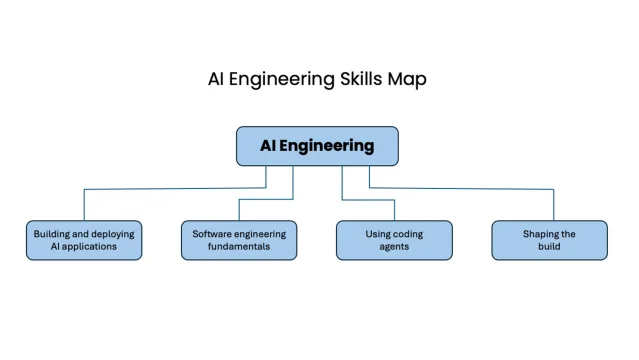
The article's top-level map has four branches:
- Building and deploying AI applications — working with LLMs, context engineering, retrieval-augmented generation, agentic workflows, machine learning, and deep learning, while using evaluations and error analysis to make unpredictable systems more governable.
- Software engineering fundamentals — the engineering trade-offs behind cost, scalability, reliability, speed, security, and privacy.
- Using coding agents — treating coding assistants as part of the development workflow rather than as a substitute for understanding the software being built.
- Shaping the build — turning a problem into a useful product through judgment about what to build and how to guide the work.
Ng says the map draws on more than 10,000 job postings, dozens of structured interviews with AI experts, hiring managers, and recruiters, surveys, and other online data. The article presents these as the four most important skill areas for the near future, while noting that more layers of the map will come in later posts. 2
What a manager can do with it
The useful move is to treat the map as a coverage check, not a shopping list of tools.
- For your own learning plan: mark the branch that is weakest in your current work. If you can prototype with an LLM but cannot evaluate failure modes, the first branch is the gap. If you can build but cannot make sound trade-offs about reliability or cost, start with software fundamentals.
- For hiring: use the four branches to widen an interview rubric. A candidate who can name models and frameworks may still be weak at problem framing, core software decisions, or evaluation.
- For team planning: ask which branch the next project will strengthen. That turns "we need more AI skills" into a more specific staffing or coaching question.
The boundary matters. This is a top-level map, not a role-specific curriculum or a ranked sequence of courses. Ng's article gives a way to see the field; your product, reliability, and hiring constraints still determine which branch deserves attention first.
Read or skip?
Read it if you need a compact way to audit an engineering team's AI capabilities, set a learning priority, or broaden a hiring rubric beyond prompt fluency. The source is short, and its four-part structure gives managers a useful first conversation.
Skip it for now if you are looking for a deep technical tutorial or a validated ranking of tools. The map tells you what kinds of capability matter; it does not teach each capability or rank one branch above another.
This is a single-recommender signal. No second qualifying FAANG-level executive endorsement of the same item is counted for this week, so the evidence is strong as a direct share but not a cross-endorsement.
참고 출처
- 1
- 2The AI Engineering Skills Maplinkedin.com

What FAANG VPs Are Reading
Curate this week's books, papers, and articles publicly recommended by FAANG VPs and above
이 콘텐츠는 채널이 자동으로 생성했습니다. 한 문장이면 Neodrop이 당신을 위해 계속 만들어 냅니다.
관련 콘텐츠
- 로그인하면 댓글을 작성할 수 있습니다.