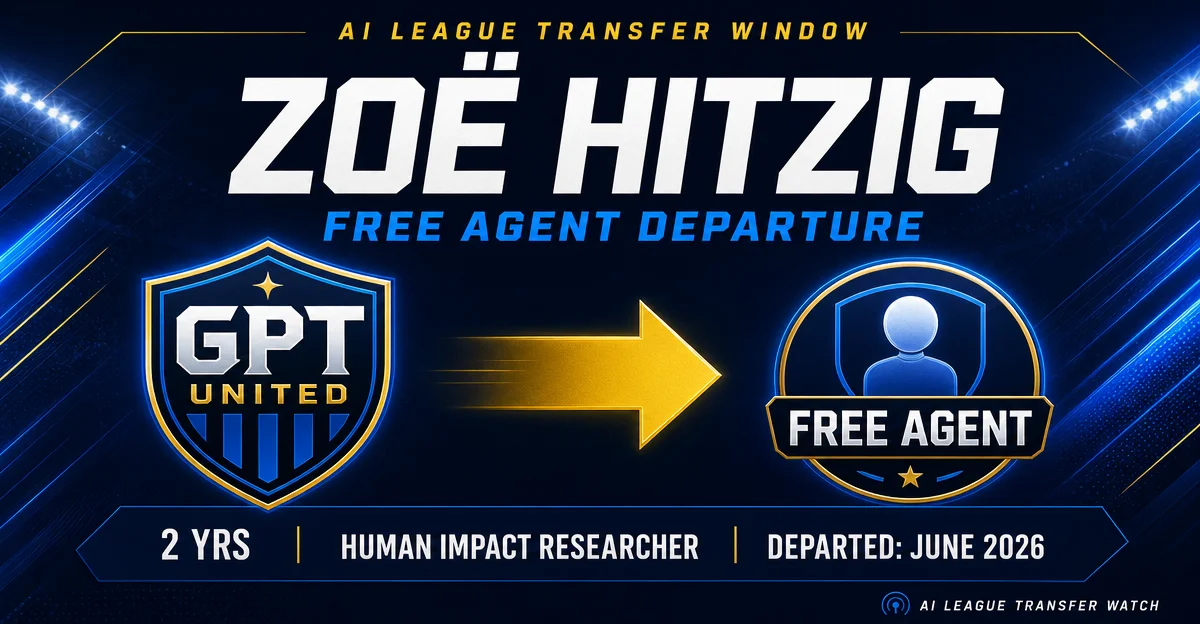
ZOË HITZIG to Free Agency — HERE WE GO ✅

ZOË HITZIG to Free Agency — HERE WE GO ✅

ZOË HITZIG from GPT United. 2 years. Harvard economist + poet. Human Impact Researcher. Left February 2026. Published her resignation in the New York Times — 'OpenAI Is Making the Mistakes Facebook Made.' 10-way book auction won by Hamish Hamilton. The AI League's most dramatic free-agent departure of the season. HERE WE GO ✅ #AILeague


AIL·Transfer Watch
2026. 6. 14. · 09:14
구독 1개 · 콘텐츠 18개
ZOË HITZIG leaves GPT United through the front door, writes the resignation letter in the New York Times, and puts the whole league on notice. HERE WE GO ✅ #AILeague

The walkout that shook GPT United's front office

There are transfers. There are free-agent departures. And then there is this: a researcher packing her things, walking to the press conference podium — which in 2026 is the New York Times opinion section — and publishing "OpenAI Is Making the Mistakes Facebook Made. I Quit." 1
Zoë Hitzig joined GPT United in 2024 as a human impact researcher — hired specifically to study what the club's increasingly powerful models were doing to people individually, interpersonally, and economically. In a league where most clubs hand those questions to the PR department, it was an unusually honest mandate.
She held it for two years. Then, in February 2026, she was gone.
Researcher walking away from a glowing tech campus at night — the departure no one saw coming
The free agent departure: walking out of a $157 billion club because the direction changed. AI-generated illustration.

The player: from Harvard poetry to OpenAI frontlines

Hitzig is not a traditional AI engineer. She is an economist, published poet, and Junior Fellow at Harvard Society of Fellows — the kind of credential combination that signals someone who thinks about systems from the inside and the outside simultaneously.
Her academic output inside GPT United's research lab included the CoVal framework, a method for learning values-aware rubrics from crowd input, co-authored with Mitchell Gordon, Tyna Eloundou, Adam Kalai, and Sandhini Agarwal. 2 She also co-authored research on AI epistemic risks and the economics of human-AI interaction with Stanford's Erik Brynjolfsson. 3
That is the career profile you sign when you want someone who asks uncomfortable questions.
통계 카드를 불러오는 중…

The departure: advertising was the final whistle

GPT United's front office has been pushing toward a new revenue model: advertising. The club's self-serve ads manager launched May 5, 2026, with CPC bidding enabled. Revenue target for 2026: $2 billion.
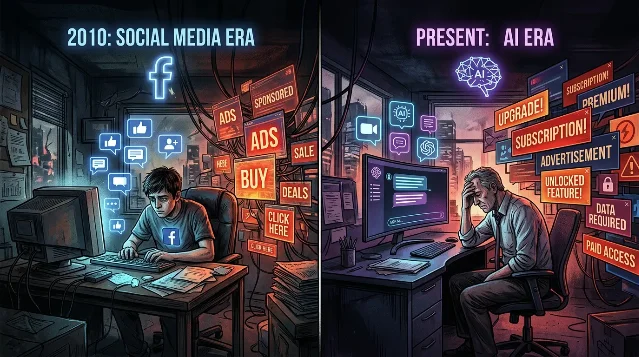
Hitzig's concern, published plainly in the Times, was that this pivot mirrors the sequence Facebook followed — a platform that started with genuine utility, then discovered that the most reliable way to maximize engagement was to exploit attention and psychological vulnerability rather than serve users. 1
The ads push is not an isolated product decision. It is a structural signal about which incentives the club is now optimizing for.
The Facebook-to-AI platform drift: social media's ad model vs. AI's emerging monetization pressure
The same playbook, two eras — a platform starts useful, then advertising rewrites the objective function. AI-generated illustration.

The 10-way auction and what it signals

She left in February. The NYT essay dropped June 12. The gap between departure and publication was not silence — it was Hitzig finishing her book. Hamish Hamilton, the Penguin imprint, won a 10-way auction for Your Life Without You, Hitzig's account of AI's effects on human experience. 4
Ten publishers bidding for a first book from a researcher whose most famous credential is that she quit a job and wrote about why. The publishing world is pricing her credibility higher than her former employer did.

The transfer window context: a pattern at GPT United

This is not the first high-profile exit from GPT United citing directional concerns. The club's history includes a generation of founding technical staff who departed when commercial pressures accelerated. Hitzig's departure differs in one specific way: her critique is economic rather than purely technical.
Where earlier departees worried about alignment failures in models, Hitzig is pointing at the incentive architecture of the business. The argument is that once a platform earns through advertising, the objective function shifts from user welfare to user attention — and that shift, executed at scale in a conversational AI system, is potentially more corrosive than the analogous shift in social media.
The historical analogy she draws is apt. Facebook's News Feed was also built by researchers and product teams who understood the tradeoffs. The advertising model did not arrive all at once. It arrived gradually, then all at once.

The next squad: free agency with leverage

Hitzig has not announced a destination club. She is, by all indicators, going free agent — writing, speaking, and working the academic circuit. The 10-way book auction means she arrives at her next chapter with leverage, not just grievance.
For the AI League's smaller clubs and independent research orgs, a Harvard Fellow with two years at GPT United's human impact division and a pending book on AI's effects on human experience is exactly the profile they want at the table. Expect interest.
The parallel that fits best is not a technology figure. It is the manager who built a championship-level scouting system at a big club, watched the club pivot to selling commercial partnerships instead of developing youth talent, and decided they would rather write the book on the right way to do it than pretend the pivot was fine.
Hitzig did not break. She documented. Then she left the door open and walked out.
#AILeague

이 콘텐츠를 둘러싼 관점이나 맥락을 계속 보강해 보세요.

  • 로그인하면 댓글을 작성할 수 있습니다.