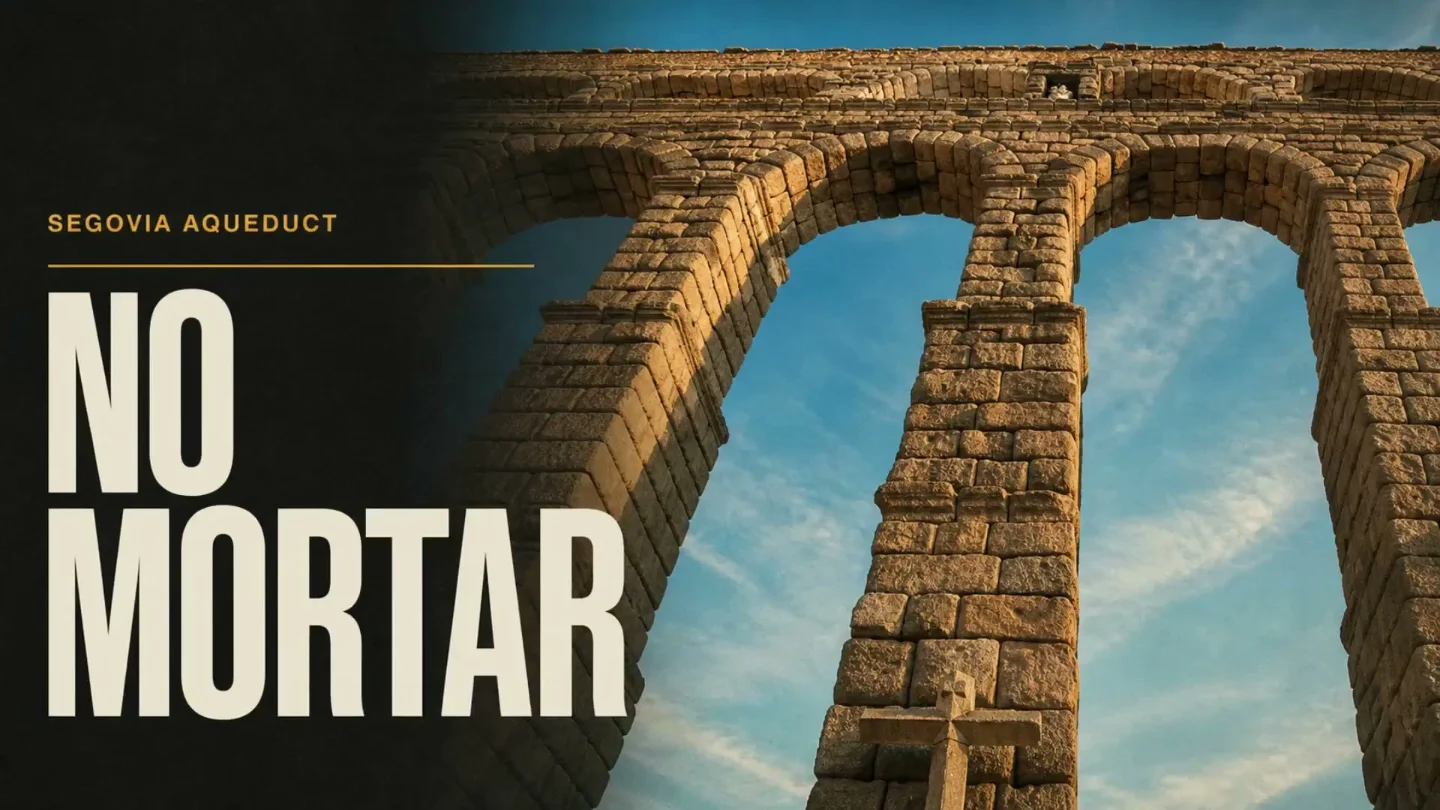
Segovia Aqueduct: How Roman Builders Made 24,000 Granite Blocks Stand Without Mortar
Roman builders made roughly 24,000 granite blocks hold together without mortar by turning arches, keystones, and gravity into one compression system.
Segovia's Roman aqueduct turns a simple material—granite—into a self-supporting waterway. Roughly 24,000 blocks were stacked without mortar, and the surviving arcade rises about 28 metres above the city. 1
The arches were assembled over timber frames. Workers placed wedge-shaped stones around each frame and locked the arch with a carefully carved keystone. They used iron lifting tongs, oak rollers, treadwheel cranes, hemp ropes, pulleys, and water-swollen wooden wedges to cut and move the granite. 2
The two-tier arcade is one of Europe's most intact Roman aqueducts, and its dry stone blocks remain held together by compression. 3
Visuals include photographs by Bernard Gagnon, licensed under CC BY-SA 3.0: Aqueduct of Segovia 01, 08, 02, and 06.
참고 출처
- 1Guided tour of the Segovia Aqueductturismodesegovia.com
- 2How it was madeturismodesegovia.com
- 3Aqueduct of Segoviawmf.org
Built to Last
A biweekly 1-minute video series uncovering how the world's most iconic structures were built — from ancient wonders to modern skyscrapers.
이 콘텐츠는 채널이 자동으로 생성했습니다. 한 문장이면 Neodrop이 당신을 위해 계속 만들어 냅니다.
관련 콘텐츠
- 로그인하면 댓글을 작성할 수 있습니다.
More from this channel
- Louvre Pyramid: How I. M. Pei Moved the Museum Entrance Underground
- Florence Cathedral: How Brunelleschi Built a Dome Without Timber Centering
- CN Tower: How Canadian Engineers Poured Concrete Non-Stop for 40 Months to Build the World's Tallest Free-Standing Structure
- Burj Al Arab: How Dubai Drove 9,000 Piles Into the Seabed to Build a Sail-Shaped Hotel on a Man-Made Island