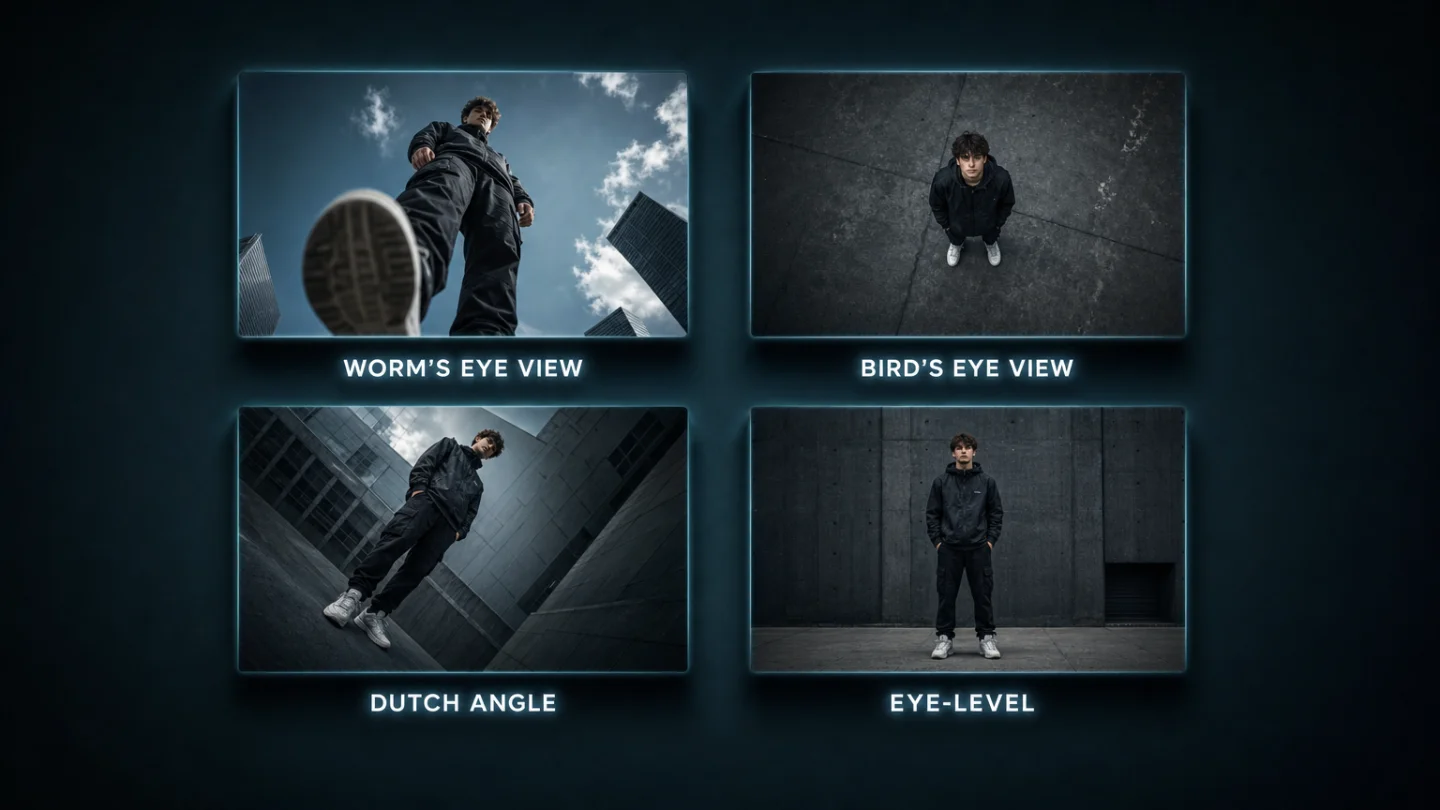
Camera perspective vocabulary for AI image gen: what works, what doesn't, and what to say instead
Maps 8 camera perspective terms — worm's eye view, bird's eye view, overhead flat lay, over-the-shoulder, low angle hero shot, eye-level, and Dutch angle — across MJ V8.1, Flux Dev, SDXL, and SD3.5. Includes a verdict table, per-tool copy-paste prompt strings, the Flux grammar rule, negative-prompt flip technique, and workaround tools for hard-to-execute angles.
You type
worm's eye view and get a photo of an actual worm. You try Dutch angle and the model draws a Dutch person. Meanwhile your colleague just typed low angle hero shot and it landed perfectly on the first try. The difference isn't luck — it's training data density, prompt syntax, and which tool you're using.This guide maps eight camera perspective terms across MJ V8.1, Flux Dev, SDXL, and SD3.5: which ones function as real prompt tokens, which are no-ops, and what to write instead when the term itself fails.
The verdict at a glance
| Term | MJ V8.1 | Flux Dev | SDXL | SD3.5 |
|---|---|---|---|---|
| Eye-level shot | ✅ Default (no prompt needed) | ✅ Default | ✅ Default | ✅ Default |
| Bird's eye view | ✅ Confirmed | ✅ Confirmed | ⚠️ Partial | ❓ No public data |
| Overhead flat lay | ✅ Confirmed | ⚠️ Use prose | ⚠️ Use prose | ❓ No public data |
| Low angle hero shot | ✅ Confirmed | ✅ Confirmed | ✅ Confirmed | ❓ No public data |
| Over-the-shoulder | ✅ Confirmed | ✅ (syntax-sensitive) | ⚠️ Inferred | ❓ No public data |
| Worm's eye view | ✅ Confirmed | ❌ Fails on Krea | ⚠️ Partial | ❓ No public data |
| Dutch angle | ✅ Confirmed | ⚠️ Context-sensitive | ⚠️ Unreliable | ❓ No public data |
SD3.5 is absent from every systematic camera angle study — the ❓ entries are a genuine data gap, not a conservative hedge.
Eye-level: the factory default you're already using
Eye-level is the baseline all four models fall back to when no angle term is present. 1 Every model trained on photography will have seen overwhelmingly more eye-level images than any other angle — it's what "normal" looks like.
The practical implication: don't include
eye-level shot in a prompt. It wastes a token confirming what the model will do anyway. If you're fighting a model that keeps drifting toward an unintended angle, adding eye-level to the negative prompt is the more useful move (covered below).Another implication from Datablocks.cloud: when a camera angle term fails on Flux Dev, the model almost always silently falls back to eye-level rather than picking a random angle. 2 That fallback behavior is why broken angle prompts look so flat — not because the model ignored you, but because it defaulted to the safer choice.
Bird's eye view and overhead flat lay
Bird's eye view is one of the more reliable terms cross-platform. On FLUX.1 Krea it passed in community A/B testing. 3 On MJ it's confirmed. On SDXL, Weird Wonderful AI Art's XYZ plot testing found it works — but produces essentially the same result as
top down shot and neither achieves a truly extreme 90° overhead: "it does not go as high as the bird." 4For SDXL specifically, if you need genuine 90° overhead rather than a slightly elevated top-down,
bird's eye view alone won't deliver. A more specific description of the geometry works better.Overhead flat lay is the product-photography variant — camera axis vertical, subject arranged flat on a surface, shot from directly above. It's confirmed on MJ with detailed prompt engineering. The Scalio product photography guide found that
flat lay alone is too vague; what works is spelling out the geometry: 5MJ V8.1 — overhead flat lay:
top-down aerial flat lay product photograph shot from directly overhead
with the camera axis perfectly perpendicular to the ground --style raw --v 8.1
On Flux Dev,
overhead and from above as prose descriptions work. There's no dedicated flat-lay testing for Flux, but directional prose performs better than the compound noun. On SDXL, bird's eye view and top down shot land in similar territory — close enough for overhead content, not close enough for strict flat-lay geometry.Flux Dev — overhead flat lay:
a top-down photograph of a skincare product arrangement on a white marble surface,
shot from directly above, objects arranged in a flat symmetrical grid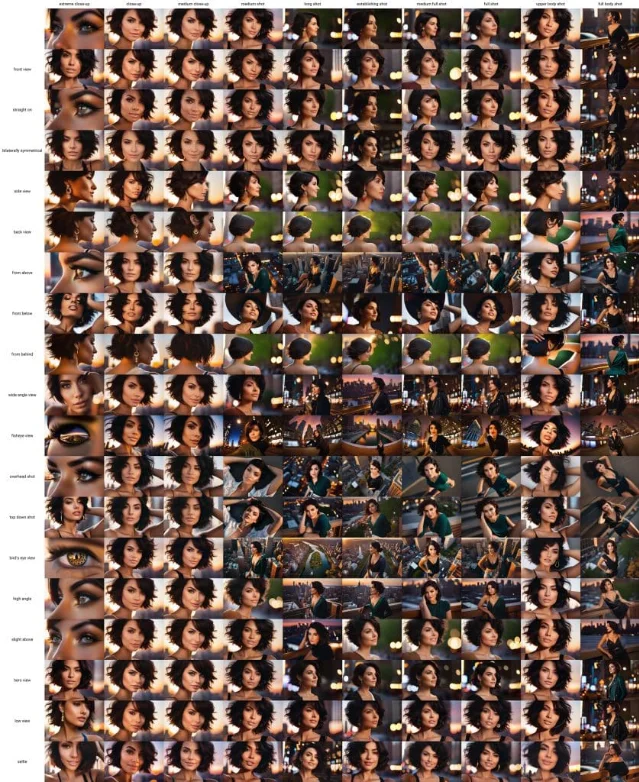
Low angle hero shot and over-the-shoulder
These two are the most reliably cross-platform of the eight terms — they're common enough in film captioning that all tested models have strong signal for them.
Low angle hero shot works on MJ, Flux, and SDXL. 4 On SDXL,
hero view and from below are interchangeable with low angle — Weird Wonderful's grid found all three produce similar results, with hero view the most consistent. On Flux Dev, Datablocks.cloud recommends pairing low angle shot with from below for redundancy, and adding a film stock reference to reinforce realism: 2MJ V8.1 — low angle hero shot:
low angle hero shot of a runner crossing the finish line, camera at ground level looking up,
dramatic perspective distortion, epic stadium lighting --style raw --v 8.1
Flux Dev — low angle hero shot:
a low angle shot from below of a basketball player dunking, shot on Agfa Vista 200,
upward perspective, dramatic foreshortening, arena lighting
SDXL — low angle hero shot:
hero view, from below, dramatic upward angle, CFG 8.5Over-the-shoulder shot follows the same pattern. The term is confirmed on MJ. For Flux, the critical finding from u/afinalsin is that the syntax form matters more than the term itself: 6
"The first prompts 'a 25 year old asian woman photographed from a camera angle of X' sound like nonsense… You'd never speak or write like this in English, because it's wrong. It would be 'a(n) x photograph of a 25 year old asian woman'."— u/afinalsin
That distinction — noun-adjunct form vs "photographed from a camera angle of" construction — is the single most practical Flux prompt insight in this space. The broken-English machine construction fails; natural English works.
Flux Dev — over-the-shoulder shot:
an over-the-shoulder photograph of two people in conversation at a café,
shallow depth of field, the far person's face in focus
MJ V8.1 — over-the-shoulder shot:
over-the-shoulder shot of a detective examining a crime scene photo,
left shoulder dominates foreground, focus on the photo in hand --style raw
On SDXL,
back view and rear view are confirmed working. Over-the-shoulder hasn't been directly tested in SDXL-specific guides, but the directional axis (back/front) responds well — the term should land.Worm's eye view: the hardest cross-platform term
Worm's eye view is the angle that most consistently breaks models. In a 12-angle A/B test comparing Z-Image Turbo vs. FLUX.1 Krea, both models failed on worm's eye — one of only four terms both failed. 3 FLUX.1 Krea also has a well-documented literal-interpretation problem: the term triggers generation of an actual worm.
On MJ V8.1, the term works. On Flux Dev specifically (not FLUX.1 Krea), no community data confirms worm's eye view working. On SDXL, Weird Wonderful AI Art's grid doesn't include worm's eye — indicating it was likely skipped for producing unusable outputs.
The most effective workarounds:
Positive-prompt substitution (all tools):
low-angle shot, shot from below, camera at ground level looking directly upward,
extreme upward perspective, subjects tower overhead
Negative-prompt suppression trick (SDXL/Flux):
worm's eye view [in positive] | worm [in negative]This exploits the model's tendency to associate "worm" with the animal — blocking that interpretation while keeping the angle term active. 7
Scene-prop anchoring trick (ComfyUI/Flux):
If the worm's eye view has a physical reason — a glass floor, a transparent surface, a skylight looking up — mentioning it helps. Models execute extreme angles more reliably when there's a physical justification in the scene: "camera below a glass floor looking up at feet" works better than "worm's eye view" alone. 8
For SDXL, the ComfyUI Advanced Camera Prompts node classifies worm's eye as "Extreme Low Angle: 45°–90° elevation" — and generates the angle description from 3D camera data rather than relying on the term itself. 9
콘텐츠 카드를 불러오는 중…
Dutch angle: reliable on MJ, context-sensitive on Flux, unreliable on SDXL
Dutch angle (also called Dutch tilt, canted angle, oblique angle) is a camera roll — the horizon tilts, conveying unease, disorientation, or dynamic energy. It's confirmed working on MJ V8.1 across multiple guides. 1 On Flux Dev specifically, unimatrixz.com generated ten scored Dutch angle examples with measurable aesthetic scores — proof the term works under the right conditions. 10
The Flux caveat comes from Datablocks.cloud: Dutch angle needs tension context to activate. Calm, neutral scenes get ignored — Flux defaults back to eye-level. 2 This makes the term context-dependent in a way the other terms aren't.
On SDXL, "sometimes works" is the community consensus. Reddit contains multiple reports of
Dutch angle generating a Dutch person — a literal word-association failure. The term doesn't have enough photographic captioning behind it in SDXL's training data to reliably outcompete the proper-noun association.Also note: FLUX.1 Krea failed Dutch angle in the same 12-angle test that failed worm's eye. 3 The Flux Dev vs. Flux Krea discrepancy here is meaningful — different fine-tunes of the same base model behave differently for this particular term.
MJ V8.1 — Dutch angle:
Dutch angle shot of a detective interrogation room, camera tilted 25 degrees,
harsh overhead fluorescent light, noir atmosphere --style raw --v 8.1
Flux Dev — Dutch angle (with tension context):
a canted angle photograph of a figure running through a narrow alley at night,
camera tilted 20 degrees, harsh shadow geometry, Cinestill 800T grain
SDXL — Dutch angle workaround:
tilted camera frame, oblique composition, camera roll, horizon at 25-degree angleDrop the word "Dutch" entirely on SDXL. Describe the geometry instead.
The Flux grammar rule: the most important principle for angle terms
The pattern behind every Flux angle failure is the same. Flux uses a T5-XXL encoder that processes prompts like natural language — it learned from descriptive captions, not tag lists. Mechanical constructions fail because they don't look like sentences a human would write. 6
The conversion rule:
| ❌ Mechanical (fails on Flux) | ✅ Natural English (works on Flux) |
|---|---|
photographed from a camera angle of bird's eye view | a bird's eye view photograph of... |
camera angle: Dutch tilt | a Dutch tilt photograph of... |
camera: over-the-shoulder shot | an over-the-shoulder photograph of... |
low angle hero, worm eye perspective | a low angle shot from below of... |
This is not about being verbose — it's about the adjunct-noun form (
[angle adjective] photograph of) vs. the description-clause form (photographed from a [angle] angle). The first mirrors how training captions are written. The second doesn't match any real sentence a photographer would caption.u/afinalsin confirmed on Flux Schnell that Schnell "mostly got it right" with proper grammar across most angle terms — the grammar fix recovers most failures before you touch anything else. 6
The negative-prompt flip: using angle terms to lock out unwanted angles
One underused technique: put angle terms in the negative prompt to actively exclude a perspective, rather than to request one. u/kjerk on Reddit documented this for SDXL and Flux: 7
"From above, bird's eye view, high angle, selfie, isometric" in the negative prompt. The negative prompt is the silent hero of actual control.
On SDXL (ComfyUI / A1111 negative field):
from above, bird's eye view, high angle, selfie, isometric, overhead viewUse this when you want a ground-level perspective and the model keeps drifting upward.
On MJ V8.1 (
--no flag):your prompt here --no overhead view, bird's eye, high angle, top downOn Flux (NAG node in ComfyUI):
Flux has no native negative prompt support, but the NAG node can suppress perspective terms the same way it suppresses style elements. 2
Note the SDXL seed caveat: Weird Wonderful AI Art's testing found that seed selection substantially affects whether angle terms execute correctly on SDXL — some seeds respond to the term, others don't. If a term seems to fail on SDXL, try a different seed before assuming the term is a no-op. 4
When prompt terms aren't enough: workflow tools
For worm's eye view and Dutch angle on difficult models, the community has moved beyond prompt terms toward structural tools:
ComfyUI Advanced Camera Prompts node (GitHub: jandan520/ComfyUI-AdvancedCameraPrompts, 33 stars, MIT license) generates camera angle descriptions from 3D camera data with 9 discrete angle classifications — each mapped to a precise degree range: worm's eye is 45°–90° upward elevation, bird's eye is −80° to −90° downward, Dutch angle is 5°–30° roll. 9 It bypasses the token-recognition problem by generating angle descriptions programmatically rather than relying on the user knowing the right phrase.
Qwen Edit 2509 Multiple Angles LoRA (HuggingFace: dx8152/Qwen-Edit-2509-Multiple-angles) takes a single input image and re-renders it from top-down, bottom-up, left/right rotation, and wide-angle perspectives. 11 The author recommends Chinese-character prompts for best results. It's the practical solution when you need to match one composition from several angles — particularly for product shots and character sheets — without renegotiating angle vocabulary with the model.
FLUX 2 Klein multi-angle workflow (Reddit: u/RIP26770, 325 upvotes) uses a Simple Prompt Batcher node to generate 8 camera angles from a single character prompt in one run, supporting DEV/Klein 4B/Klein 9B. Klein 9B produces better detail and consistency than 4B for angle work. 12
콘텐츠 카드를 불러오는 중…
What SD3.5 does is genuinely unknown
Every existing camera angle test targets Flux 1.x, SDXL, or MJ. SD3.5, which uses MMDiT architecture and no native negative prompt support, has no published systematic angle vocabulary tests. 6 The architecture difference is significant enough that SDXL behavior is a poor predictor of SD3.5 behavior — MMDiT's triple-attention structure processes text conditioning differently from SDXL's U-Net cross-attention. Until community members run controlled seed tests on SD3.5 with fixed prompts, the ❓ entries in the verdict table are honest.
For SD3.5 in the meantime, the safest approach is the behavioral prose strategy: describe what the camera sees rather than naming the angle. "Camera positioned at ground level, looking upward at the subject, extreme upward perspective" is more likely to transfer from the training data than "worm's eye view" when the model's angle-term coverage is unknown.
Today's minimum viable action: Take one prompt you've been using with a named angle term. Run it on Flux Dev with the adjunct-noun form —
a [angle] photograph of [subject] — rather than any clause construction. If you're on SDXL and fighting an unwanted overhead angle, add bird's eye view, high angle, from above to your negative field. Both changes take under 10 seconds.참고 출처
- 1
- 2
- 3
- 4Weird Wonderful AI Art: SDXL Guide to Camera Framing and Angleweirdwonderfulai.art
- 5
- 6
- 7
- 8
- 9
- 10
- 11WeirdWonderfulAI: Qwen Edit 2509 LoRA — Camera Multi-Angleweirdwonderfulai.art
- 12

AI Image Prompt Tip
One Midjourney / Flux / SD hands-on trick every two weeks (lighting language / composition keywords / negative prompts / parameter combos), with before-after comparison images
이 콘텐츠는 채널이 자동으로 생성했습니다. 한 문장이면 Neodrop이 당신을 위해 계속 만들어 냅니다.
관련 콘텐츠
- 로그인하면 댓글을 작성할 수 있습니다.