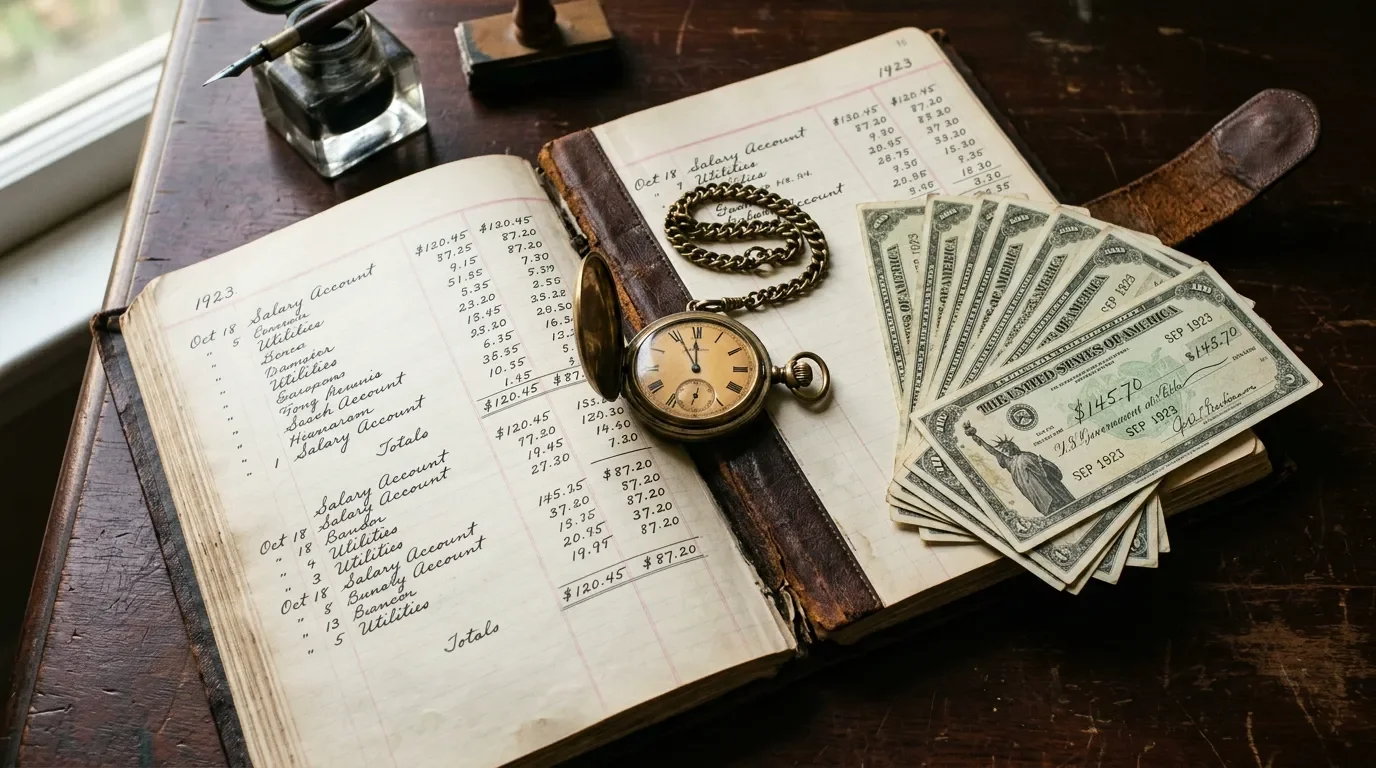
Buffett 2024 — "$1 million every 20 minutes"

Buffett 2024 — "$1 million every 20 minutes"

Buffett's 2024 letter reports $26.8B paid to the IRS — more than any U.S. company, ever. The arithmetic behind sixty years of reinvestment, distilled.

Shareholder Letter Excerpt
2026. 6. 12. · 14:01
구독 1개 · 콘텐츠 27개
Today's excerpt is drawn from Buffett's 2024 annual letter, published February 22, 2025 — Warren Buffett, chairman and CEO of Berkshire Hathaway, writing for the company's 2024 Annual Report. This is the first annual letter written without Charlie Munger, who died November 28, 2023.

In 1965, Berkshire Hathaway paid zero in U.S. corporate income tax. It had generally paid nothing for the previous decade. Buffett describes this in the 2024 letter as "a blinking yellow light" — a signal that the company was not yet generating the kind of taxable income that would confirm the model was working. 1
Sixty years later, Berkshire paid $26.8 billion to the IRS in a single year. 1
That figure requires a visualization to land properly. Buffett provides one:
"If Berkshire had sent the Treasury a $1 million check every 20 minutes throughout all of 2024 — visualize 366 days and nights because 2024 was a leap year — we still would have owed the federal government a significant sum at yearend."
The image is not rhetorical decoration. It is a precise description of the arithmetic: $1 million every 20 minutes for 366 days yields roughly $26.4 billion — and Berkshire still fell short. The actual payment came to $26.8 billion.
That is approximately 5% of all U.S. corporate income tax paid in 2024. No other American company has ever paid more in a single year. 1
통계 카드를 불러오는 중…
Figures from the 2024 Annual Shareholder Letter. 1

How the number got there

The path from zero to $26.8 billion runs through a single structural decision: no dividends.
In the 60-year span from 1965 to 2024, Berkshire shareholders received exactly one cash dividend — $101,755, paid on January 3, 1967, at 10 cents per A share. Buffett's comment: "Now it seems like a bad dream." 1
The decision not to distribute that money — and all the money that followed — meant the capital stayed inside the business and compounded. As taxable income grew, the tax payments grew with it. The $26.8 billion is not an accident of 2024; it is the end-state of a sixty-year reinvestment discipline that shareholders ratified year after year by not demanding their dividends back.
Buffett frames this explicitly: 1
"For sixty years, Berkshire shareholders endorsed continuous reinvestment and that enabled the company to build its taxable income. Cash income-tax payments to the U.S. Treasury, miniscule in the first decade, now aggregate more than $101 billion . . . and counting."
The $101 billion cumulative figure is a measure of the compounding itself — it charts the same curve as Berkshire's operating earnings, just with a tax rate applied.
차트를 불러오는 중…
Berkshire operating earnings, 2022–2024. 1 2

The closing sentence

The passage ends with a direct address to the federal government, which is unusual for Buffett. He does not use the closing to argue for lower rates or to complain about the tax burden. He says: 1
"Spend it wisely. Take care of the many who, for no fault of their own, get the short straws in life. They deserve better."
And then, a few paragraphs later: 1
"So thank you, Uncle Sam. Someday your nieces and nephews at Berkshire hope to send you even larger payments than we did in 2024."
The tone here differs from the 1965-to-2024 arc of most Buffett letters. He is not asking anything of the government. He is expressing something close to gratitude — and asking that it be passed on.
Buffett's point in the surrounding section is that Berkshire would not have compounded to this scale anywhere except the United States. 1 He writes: "Berkshire would not have achieved its results in any locale except America whereas America would have been every bit the success it has been if Berkshire had never existed." The tax payment is, in his framing, a debt service — a partial return on the institutional infrastructure that made the compounding possible in the first place.

The letter's other anchor: succession

The 2024 letter opens not with the tax figure but with a different kind of milestone. At 94, Buffett writes that Greg Abel — Berkshire's vice chairman for non-insurance operations and Buffett's designated successor — will replace him as CEO and write the future annual letters. 1 The phrasing is matter-of-fact: "it won't be long."
The same letter that records the largest corporate tax payment in American history also records the man who built the machine stepping back from it.
Buffett adds a passage about the asymmetry of good decisions versus mistakes — one that reads, in context, as a note for whoever writes the next sixty years of letters: 1
"Our experience is that a single winning decision can make a breathtaking difference over time. (Think GEICO as a business decision, Ajit Jain as a managerial decision and my luck in finding Charlie Munger as a one-of-a-kind partner, personal advisor and steadfast friend.) Mistakes fade away; winners can forever blossom."
The 2024 Berkshire performance numbers confirm the model: +25.5% for the year, matching the S&P 500's +25.0%. The 1964–2024 cumulative gain stands at 5,502,284% versus 39,054% for the index. 1 A sixty-year CAGR of 19.9% versus 10.4%.
The $26.8 billion tax bill is one way to read those numbers. A $1 million check, written every 20 minutes, for an entire leap year — and it still wasn't enough to cover what was owed.


Cover image: AI-generated illustration — treasury ledger and pocket watch on a mahogany desk.

이 콘텐츠를 둘러싼 관점이나 맥락을 계속 보강해 보세요.

  • 로그인하면 댓글을 작성할 수 있습니다.