XAUUSD Weekly Intel #17: Iran Deal Confirmed — Gold Up $88, But Warsh Decides Wednesday

XAUUSD Weekly Intel #17: Iran Deal Confirmed — Gold Up $88, But Warsh Decides Wednesday

Gold surged $88 to ~$4,307 on the confirmed US-Iran peace deal (Strait of Hormuz to reopen, signing expected Friday), while oil crashed 4.75% and the dollar slipped. But the deal hasn't been signed yet — and Warsh's FOMC dot plot Wednesday owns the rest of the week. This issue maps the full technical channel from $4,023 to $4,446 (MA200), five FOMC scenarios with probability estimates, the week's five-central-bank calendar, and long/short setups with defined invalidation levels.

XAUUSD Weekly Gold Trading Intelligence
2026. 6. 15. · 08:29
구독 2개 · 콘텐츠 17개

The setup entering Monday

Gold opened Monday at $4,219.32 — exactly where it closed Friday — and by late morning in Asia was trading near $4,307, up $88 or +2.1% on the session.1 The catalyst: the US and Iran announced a peace deal on Sunday June 14, confirming an end to nearly four months of military conflict.
The day range so far is $4,219.32–$4,308.93. Gold futures (August) are at $4,324.42.1 For context on why this move matters: last week, gold hit a six-month low of $4,023 on June 11, then surged $212 intraday on Thursday as the first Iran deal reports emerged, only to pull back as Tehran disputed the terms. Spot closed last week at $4,219, down 2.6% on the week.2
The macro scoreboard Monday morning:
통계 카드를 불러오는 중…
InstrumentLevelChange
XAUUSD spot~$4,307+$88 / +2.1%
Gold futures (Aug)$4,324+$86 / +2.0%
DXY (dollar index)~99.19−0.31%
US 10-yr yield4.418%−6.5bp
US 2-yr yield~4.09%
WTI crude$80.85−4.75%
Brent crude$83.79−4.05%
The dollar is slipping on the Iran deal. Yields are falling. Oil is collapsing. Gold is the one asset with a conflicted reaction — safe-haven premium coming out (deal = less fear), but dollar weakness and falling real yields providing support.

The Iran deal: what's confirmed, what's disputed, and why it still matters for gold

The WSJ confirmed Sunday June 14 that "Iran and the US have agreed on an interim peace deal."3 Pakistan's Prime Minister Shehbaz Sharif — chief mediator — said a "final, agreed upon text has been reached." Trump said the Strait of Hormuz will reopen and Iran "will never have a nuclear weapon." A signing ceremony is expected Friday June 20.
What remains unresolved: a formal signing has not yet occurred as of Monday morning. Iranian officials have been careful to say only that the text is agreed, not that it is signed. The WSJ separately reported that "Trump's Iran deal still has to get past the Revolutionary Guard" and that "the accord will kickstart the toughest phase of talks" — meaning the current framework is a ceasefire/MoU, not a final comprehensive settlement.
The gold/Iran paradox explained: Over recent weeks, Iran escalation lowered gold even though it raised geopolitical fear, because it drove oil higher, which pushed inflation higher, which increased rate-hike probability. A deal reverses that chain: oil falls, inflation pressure eases, rate-hike probability falls, real yields decline, and gold can rise on the macro reprieve. Monday's reaction — gold up $88, oil down 4.75% — fits this logic precisely.
The risk: this is at minimum the 40th time in the past four months that Trump has announced or implied an Iran deal. Each previous announcement was followed by Iranian contradictions, missed deadlines, or disputed terms. Traders pricing in a done deal are taking deal-failure risk. If signing fails or Iran's FM contradicts terms again, oil reverses and the gold/rate-hike logic flips back.
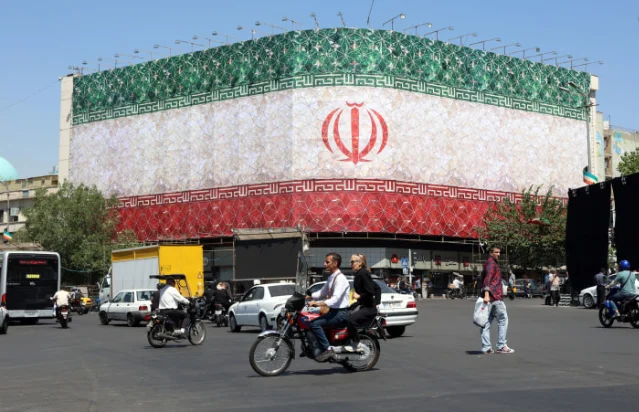
Tehran's Enqelab Square, the day the US-Iran deal was announced.
Tehran's Enqelab Square, June 14, 2026. 3

Price channel and technical structure

Friday's close at $4,219 established Monday's open as a hard support test. The Monday surge already puts gold through the first resistance level analysts had been watching.
Key levels this week:
ZoneLevelStatus
Resistance 1$4,235Tested Friday — failed; now attempting above
Resistance 2$4,300–$4,310Current zone — needs to hold and retest as support
Resistance 3$4,366–$4,400Major former support turned resistance
Resistance 4 / 200-day MA~$4,446Descending resistance trendline intersects here
Prior ATH zone$5,477–$5,595Long-term reference only
Support 1$4,219Monday open / Friday close — must hold on any pullback
Support 2$4,097–$4,098Last week's major swing low (March low)
Support 3$4,023June 11 six-month low
Psychological floor$4,000Line in the sand if $4,023 breaks
The technical read: gold broke below $4,098 last Thursday, nearly touched $4,000, then reversed sharply. FXEmpire's Bruce Powers noted a "failed breakdown" pattern as of Friday, which signals potential reversal.4 Forex.com's Fawad Razaqzada wrote that "$4,098 is now the first downside support — below that, $4,000 is the next key target" — and noted that "gold still needs to reclaim several broken support levels before the broader directional bias can be considered bullish again."5
The MA200 at ~$4,446 is the ceiling that defines the regime. A move above it — plus a clean break of $4,481 (last week's high) — is the line at which the current bearish structure breaks down. Until then, every rally is a potential short setup from resistance.
Trend indicators as of Friday's close: RSI ~59 (Buy), MACD +19.86 (Buy), but MA200 still Sell. Investing.com's automated technical summary: "Strong Buy" short-term.1

FOMC Wednesday: the week's single biggest catalyst for gold

This week is what KenMacro called "the biggest central bank week of the year" — five major rate decisions in three days.6 But for gold traders, only one truly matters: Wednesday June 17, 2PM ET — Kevin Warsh's first FOMC decision and press conference as Federal Reserve Chair.
What's priced: a hold at 3.50–3.75%, essentially fully. JPMorgan's Michael Feroli: "We expect no change in the fed funds target range... with no dissents."2 Reuters economists survey: no hike expected at this meeting.
What's not priced — and what will move gold: The dot plot and Warsh's tone at his 2:30PM press conference.
The FT reported that fed funds futures now price a single rate rise by year-end 2026.7 Raymond James: "The Fed's dot plot is likely to signal no rate cuts in 2026."8 Feroli noted: "Since the FOMC last met in late April, labor market data have firmed, and inflation has continued to run uncomfortably above the Fed's goal. These developments should push the committee in a more hawkish direction."2
The additional wildcard: Warsh has built his reputation as an inflation hawk who favors a leaner, less communicative Fed. WSJ's Alan Blinder wrote Saturday that Warsh will "move slowly" — but markets don't know if "slowly" means "cautious on hikes" or "cautious about pre-committing to cuts."9 Jerome Powell remains on the FOMC as an ordinary voting Governor, a historically unusual arrangement. Investopedia notes there is live speculation about whether Warsh scraps the dot plot entirely — something he has discussed publicly.10
The 2-year yield is the cleanest real-time tell: it reprices the rate path instantaneously. If it spikes Wednesday at 2PM, that's a hawkish dot shift. If it falls, the dots stayed benign.

Five FOMC scenarios with probability estimates and gold targets

This is a forecast, not a certainty. Probabilities are estimates based on current market pricing and analyst consensus; they will shift as Wednesday approaches.
ScenarioProbabilityDot plotWarsh toneGold reaction
Hold + status-quo dots + neutral tone~35%2026 cut survives in dotsBalanced, avoids hawkish pre-commitmentRally continues; $4,350–$4,400 attainable
Hold + hawkish dots (no 2026 cut) + hard Warsh tone~30%Cuts removed, hike language entersInaugural credibility play — tighter than PowellSharp reversal; $4,180–$4,220 retest
Hold + hawkish dots + dot plot scrapped~10%No dot plot; hawkish statement languageSignals major regime shiftDeep uncertainty, high volatility; could test $4,100 on fear
Hold + neutral dots but surprise dissent toward hike~15%Dots stable but 1–2 dissenters flag hikeChair accommodating, hawks restlessModerate pressure; $4,250–$4,270
Surprise hike~5%Irrelevant; decision speaksSevere collapse; $4,000–$4,050
Dovish surprise (cut language restored)~5%2026 cuts confirmedFull easing pivotSpike to $4,450+
Note: The Iran deal — if it holds — provides a secondary tailwind for the status-quo scenario by reducing oil-driven inflation pressure, giving Warsh more room to hold without sounding complacent.

Other central bank decisions and data this week

Beyond the Fed, this is a five-central-bank week.6
Date / Time (ET)EventConsensusGold relevance
Mon Jun 15Empire State Mfg (Jun)13.2 (prev 19.6)Low
Tue Jun 16Bank of Japan rate decisionHike to 1.00% expectedMedium: BOJ hike → yen rally → carry unwind → broad FX volatility
Tue Jun 16RBA (Australia) decisionHold at 4.35%Low direct
Wed Jun 17 8:30AM ETUS Retail Sales (May)+0.4% MoMMedium: prints same hour as FOMC day warm-up
Wed Jun 17 2PM ETFOMC rate decision + dot plotHold 3.50–3.75%HIGHEST
Wed Jun 17 2:30PM ETWarsh press conferenceHIGHEST
Thu Jun 18 8:30AM ETSwiss National Bank (SNB)Hold 0.00%Low
Thu Jun 18 noon ETBank of EnglandHold 3.75%Low–Medium
Fri Jun 19Juneteenth — US holidayThin liquidity; late FOMC repricing can run further than normal
The BOJ is worth watching as an indirect gold driver: a BOJ hike into a Fed hold narrows the US-Japan rate gap, squeezing yen carry trades. A sharp yen rally on Tuesday morning could trigger broad position unwinds across risk assets including gold. USD/JPY is currently near 159.94 — close to the 160 zone where Japan has intervened before.6

Gold ETF flows and institutional positioning

GLD ETF holdings and weekly flows for the week of June 13 are not yet available as of Monday morning. The prior reported data point: JPMorgan estimated approximately $20 billion in gold ETF outflows during the week of June 5 — a significant institutional move that aligned with gold's drop from $4,480 toward $4,023.1 Traders should watch for this week's GLD flows data mid-week: a reversal toward inflows alongside the Iran deal and a neutral FOMC would confirm the institutional bid is returning.

5-day price outlook: Monday–Friday, June 15–19

These are probability-weighted ranges, not guarantees. Each scenario assumes the facts stated.
차트를 불러오는 중…
Monday (today): Iran deal confirmation is driving the current +$88 move. Expect $4,270–$4,330 trading range if deal rhetoric holds. Watch $4,300–$4,310 as immediate resistance — a failure to hold above $4,300 into the NY close is early weakness.
Tuesday: BOJ decision overnight Asia-Pacific. A BOJ hike creates yen volatility, which can spill into gold. If no sign of FOMC surprise emerging, gold likely consolidates $4,250–$4,330.
Wednesday (FOMC day): Pre-decision drift possible. At 2PM ET, expect the largest intraday move of the week. A status-quo FOMC could push gold to $4,350–$4,400. A hawkish dot shift likely pulls gold back to $4,200–$4,250. The press conference (2:30PM) amplifies whichever direction the dots set.
Thursday: Post-FOMC digestion. BOE decision (noon ET) is secondary for gold. If FOMC was neutral, gold could grind toward $4,366–$4,400 resistance. If FOMC was hawkish, this is a potential oversold bounce opportunity near $4,200.
Friday: Juneteenth — US holiday. Thin liquidity. Any unfinished FOMC repricing can run further than it should. Avoid large positions Friday.

Trading strategy: long setup, short setup, and no-trade conditions

Long setup
  • Entry zone: $4,250–$4,280 on any pullback that holds above $4,219 (Monday's open)
  • Trigger: candle close above $4,310 on the 4H chart after FOMC confirms neutral/dovish
  • Targets: $4,360 (first), $4,400 (second), $4,446 (200-day MA, stretch)
  • Invalidation: close below $4,219 on the daily chart — that puts the $4,097–$4,100 range back in focus
Short setup
  • Entry zone: $4,360–$4,400 (prior support, now heavy resistance zone)
  • Trigger: clear rejection candle at resistance with 4H candle close below $4,340 after hawkish FOMC
  • Targets: $4,260 (first), $4,220 (second), $4,100 (third / full breakdown scenario)
  • Invalidation: daily close above $4,446 (200-day MA) — would shift the trend regime
No-trade conditions
  • Between FOMC statement (2PM ET Wed) and end of press conference (approx 3:30PM ET): spreads widen, slippage risk is highest
  • Any session where Iran deal is disputed or signing is delayed: gap risk is real in both directions
  • Friday, June 19 (Juneteenth): avoid adding new positions in thin liquidity

Risk warnings

Main risk: The Iran deal is unsigned as of Monday. Trump has made dozens of similar announcements over the past four months, most of which were disputed or walked back within 48 hours. A deal-failure headline while gold is up $88 could trigger a sharp reversal — potentially $100–$150 on the day.
Fake-move risk (both directions): Gold's Monday surge is driven by a single geopolitical catalyst. Until a deal is formally signed, it remains headline-driven. A spike above $4,310 that then fails to hold is a classic fake-out — wait for a confirmed close, not just an intraday print.
FOMC news risk: Wednesday 2PM ET. The Warsh press conference has no historical precedent — markets don't know his communication style under pressure. Any unexpected language shift (or the absence of the dot plot) can create outsized volatility. Do not hold large unhedged positions into the FOMC decision.
Juneteenth liquidity risk: Friday is a US federal holiday. Gold markets technically operate, but US participation drops sharply. Late FOMC repricing or any Friday Iran news can cause exaggerated moves.
Data gap notice: GLD ETF flows for the week ending June 13 and US Retail Sales (May, prints Wednesday) have not yet been released at the time of publication. These figures could materially change the macro context mid-week.

All price levels are based on data available Monday June 15, 2026 pre-market. Scenario probabilities are estimates. No trading decision should be made based solely on this analysis. Every setup above has a defined invalidation level — use it.

이 콘텐츠를 둘러싼 관점이나 맥락을 계속 보강해 보세요.

  • 로그인하면 댓글을 작성할 수 있습니다.