2026. 6. 21. · 20:21
LinkedIn Humble-Brag Hall of Fame, Issue #6
Issue #6: The "I almost didn't apply" formula reaches saturation — four specimens in one week, including a grant winner who hides the prize amount as a conversion tactic, and a Harvard MBA version where the institution's prestige does all the heavy lifting. Plus: the first confirmed "heads down working" sub-variant, a LinkedIn dinner announcement that accidentally became the column's most useful editorial instrument, and Reddit's forensic takedown of AI-generated motivational slop.
Six "I almost didn't apply" posts in one week. That's not a template anymore — that's wallpaper.
Issue #6 covers June 15–22, 2026. This week: a grant winner who won't tell you how much she won, the first confirmed specimen of a pattern this column has been watching since Issue #4, a Harvard graduate who almost didn't aim at Harvard, a one-paragraph satire that diagnosed the entire genre in the time it takes to describe a meal, and Reddit's ongoing project of making LinkedIn lunatics famous in the wrong direction.
The template ecology is maturing fast. Let's document it.
Specimen #1: You don't need to know the amount
Greatgoodness Nwigwe, Law Student and Founder of EcoRise Nexus (Nigeria), 12,887 followers. June 17, 2026. 481 likes, 102 comments. 1
"Funny enough, I almost didn't apply. A friend sent me a grant opportunity on the application deadline, and my first thought was, 'This thing has passed me by.' But I still decided to apply for EcoRise Nexus. A few days later, I got an email saying I had made it to the final stage and would be pitching live at the Hello Globe Conference the next day. Long story short, after the presentation and questions from the judges, EcoRise Nexus won the grant. Moral of the story? Apply for that opportunity. You never really know where one application can lead. P.s: You don't need to know the amount 🌚😸 We're still open to sponsorships and partnerships."
The template executes cleanly through paragraph four. Near-miss framing, deadline dramatics, surprise advancement, stage-fright pivot, win. Standard procedure.
The postscript is what makes this entry worth preserving.
"You don't need to know the amount 🌚😸" is the humble-brag equivalent of a casino card player flipping a chip between their fingers. It announces the existence of the prize while performing reluctance to disclose it. The information the reader would most like to have — the number — is withheld in a way that makes it impossible to forget you were close to it. The moon emoji and the cat emoji don't soften this. They italicize it.
This is a technically accomplished move. The explicit withholding converts a piece of missing information into a signal. If the grant were small, the postscript wouldn't be there — you don't make a joke about hiding $500. The coyness implies size. The size is the point. And all of this is accomplished with seven words and two emoji, after a post that began with an explicit disclaimer about near-misses.
The final sentence — "We're still open to sponsorships and partnerships" — recontextualizes everything before it as a pitch. The grant win establishes credibility. The philosophical reflection on opportunity establishes character. The coy postscript creates mystique. The sponsorship line is the ask. The whole post is a prospect funnel with a "moral of the story" wrapper.
At 481 likes and 102 comments, it's the highest-engagement post in this week's collection by a significant margin.
콘텐츠 카드를 불러오는 중…
Specimen #2: Pattern-Watch — "heads down working," first confirmed
Mandy O'Neill, Founder of Albeon Peak (UK), 15+ years in brand, strategy, and digital. June 19, 2026. 35 likes, 3 comments. 2
"I've spent most of my career heads down, working hard. Think it's now time you all got to know me a bit better! Cool, calm and collected until I meet the right person, then I become a total Duracell bunny 🤣 Mum to two girls and a St. Bernese who absolutely does not know his own size. My mum has always been a brilliant role model to me and I think about that a lot. Everything I am trying to build is with my girls watching (no pressure 🫠). 15+ years across brand, strategy and digital. Client side, agency side, all of it. I started Albeon Peak because I wanted to actually get on with the work I love for businesses that are ready to grow."
This is the first confirmed specimen of the "heads down working" sub-variant, which this column placed on Pattern Watch in Issue #4.
The sub-variant works like this: the poster claims to have been too busy doing real work to perform on LinkedIn — then performs on LinkedIn. The modesty is structural. "Heads down, working hard" positions the visibility of the post as an exception to a default of invisibility, which is itself a form of credential. I have been too productive to market myself. Now, briefly, I will market myself by telling you that I don't market myself.
O'Neill's execution is warm and genuinely readable. The detail about the St. Bernese who "absolutely does not know his own size" is specific enough to be human. The line about building something "with my girls watching" lands without straining. None of this feels manufactured.
And yet the architecture is still the "heads down" template. The opening line is the mechanism. Everything after is the personal brand reveal that the opening line creates permission for. The authenticity of the details doesn't change the function of the structure — it just makes the structure easier to receive.
The engagement (35 likes, 3 comments) reflects a founder-stage following rather than a media-optimized audience. That's actually worth noting: the "heads down" variant is most common among people who are genuinely new to visible LinkedIn presence, which is part of why it reads as more earnest than most templates. The person usually means it. The template just happens to be the mode they reach for when they decide to mean it publicly.
Specimen #3: The Harvard variant
Stanley Tong, recent Harvard Business School graduate, 1,477 followers. June 19, 2026. 330 likes, 37 comments. 3
"I almost didn't apply to this school because I thought I had no chance of getting in, and now I just graduated from Harvard Business School. If you told me ten years ago this is where I'd be right now, I wouldn't have believed you. Looking back, so many people along the way helped shape me into someone who could even consider this place a possibility. I've often described it as several years of personal growth crammed into two because this place truly pushed me in ways I'd never been pushed before. Excited for what comes next!"
The "I almost didn't apply" template has a tiered economy. At the bottom: internships and local grants, where the stakes are real but the brand equity is modest. At the top: elite institutions whose name alone does half the rhetorical work. Harvard Business School is the apex of this tier.
What the elite-institution variant adds to the formula is that "I almost didn't apply" becomes structurally different depending on what the "didn't apply" would have cost. For a local grant, the near-miss has texture — the deadline was real, the hesitation was a specific day. For HBS, the near-miss transforms into a counterfactual of considerable weight. The post is asking the reader to imagine a version of the author who never applied, which requires imagining all the things that wouldn't have happened. The institution's brand does that imaginative work automatically.
Tong's version runs clean and grateful and doesn't oversell. The "crammed into two" framing is specific enough to be useful. But the post's 330 likes register the name "Harvard Business School" as much as anything Tong personally says. The template is at its most efficient when the institution's prestige is larger than the author's current following (1,477 followers). The name provides the social proof. The formula provides the modesty wrapper.
Specimen #4: The genre eats itself
Iqbal Abdullah, "Always building or writing things" (Japan), 1,092 followers. June 17, 2026. 52 likes, 14 comments. 4
"I am thrilled and humbled to announce that I ate dinner today. The dinner today was an excellent experience in perseverence being steadfast and continuous striving for excellence between from lunch through tea and before supper. This experience has opened drawers for me allowing me to reach for success in spoons and the sink. I could not have washed all the plates and cups and cleaned up the table without the support of family and all of you. Thank you."
Abdullah posted this publicly on June 17 — the full post is one paragraph and one thank-you, and it completes the joke without editorializing.
콘텐츠 카드를 불러오는 중…
A template is fully crystallized when a parody of it requires no setup. Abdullah's post needs no label, no "imagine if LinkedIn sounded like this" framing. The reader parses it as satire from the first sentence. "Thrilled and humbled" is the trigger. Everything after is mechanical: the performative reflection on a routine activity, the vague abstract nouns pasted onto kitchen utensils ("success in spoons"), the mandatory acknowledgment section.
The craft here is restraint. Abdullah doesn't break into direct commentary or explain the joke. He maintains the register all the way through the thank-you, which is where the parody lands hardest. "I could not have washed all the plates and cups and cleaned up the table without the support of family and all of you" is precisely the scale inversion that makes the formula visible: the gratitude rituals that appear at the end of achievement announcements, applied to doing the washing-up.
"This experience has opened drawers for me" is a typo — the word is probably "doors" — and the typo is funnier than the word would have been. The accidental literalness of "drawers" in a kitchen context makes the absurdism more committed, not less.
What parody does that analysis can't is compress the diagnostic into a single readable minute. Readers who engage seriously with the LinkedIn formula will learn more from thirty seconds with this post than from most explainers. The genre has a weakness, Abdullah found the exact angle to apply pressure, and then — in the tradition of the best satire — stopped before it became a lecture.
The immune response
r/LinkedInLunatics (1,037,969 subscribers) had a strong week. Two threads are worth examining in sequence, because they catch the same phenomenon from different angles.
Thread 1: The $320K hardship post. June 15, 2026. 2,389 points, 368 comments, 97% upvoted. 5
A LinkedIn user posted about the grind: 7am meetings, emails as late as 10pm. The Reddit community did the math. At an hourly rate of approximately $102 per hour, the poster was describing a compensation package of around $320,000 per year. The complaint framing — the workload presented as a burden — was the tell. u/BlueJaek offered the class diagnosis succinctly: "This is the difference between someone who grew up poor or not." u/ElveTaz's response was briefer: "Thats light work for 320k lol."
The post is a structural variant of the "I almost didn't apply" formula's inverse: instead of masking a win behind hesitation, it masks a win behind suffering. The $320K is the achievement. The 7am meeting is the fake-modesty wrapper. The humble-brag machinery works the same way — one layer reveals, one layer conceals — but the reveal is a complaint rather than a near-miss.
콘텐츠 카드를 불러오는 중…
Thread 2: The AI image is cherry on top. June 21, 2026. 1,625 points, 645 comments — the highest comment count of the week in the subreddit. 6
A LinkedIn motivational post accompanied by an obviously AI-generated image. The community did what it has trained itself to do: forensic evaluation of the visual artifacts. Distorted figures, impossible hands, facial expressions that the commenter u/jshaver41122 described with memorable specificity. The OP u/Ooory flagged the image as "AI slop" that was "cherry on top" of already-standard LinkedIn cringe.
645 comments on an image post is a significant number. What drove the engagement wasn't the existence of AI content on LinkedIn — that's unremarkable now — but the combination of AI-generated imagery with grind-culture messaging. The community has developed a working theory: motivational posts on LinkedIn are already performing a fiction (the inspirational grind, the universal lesson, the effortless excellence), and AI-generated imagery is a second fiction layered on top of the first. Slop on slop. The community finds this particularly offensive, not because the fakery is new, but because it's lazy.
This is a new cringe subtype the column is tracking: AI-slopsplaining — AI-generated content used to illustrate motivational posts without the basic quality check of counting fingers. The community can spot it. The people posting apparently cannot.
The thread itself is worth reading for the forensic comments alone.
콘텐츠 카드를 불러오는 중…
What sincere looks like
This week's rewrite candidate is Specimen #1. Greatgoodness Nwigwe's EcoRise Nexus grant post is an interesting choice because it's the most technically skilled humble-brag of the week — and therefore the one with the most instructive rewrite.
The original's structure:
- Near-miss framing (almost didn't apply)
- Compressed narrative (deadline → finals → win)
- Philosophy (apply anyway, opportunities compound)
- Coy withholding (you don't need to know the amount)
- Business development ask (open to sponsorships)
The problem isn't the announcement — winning a grant for a sustainability startup is worth announcing. The problem is the performance of hesitation around information the reader can tell you've chosen to share. The coy postscript signals a number that's apparently large enough to advertise and small enough to hide. It doesn't build mystique. It builds suspicion.
Here is a more direct version:
EcoRise Nexus won a grant at the Hello Globe Conference last week. We pitched live with 24 hours of notice after making the finals. The award gives us real validation and some runway. If you're building in the sustainability space and want to compare notes, my inbox is open. We're also looking for partnerships and sponsorships — reach out if there's a fit.
The rewrite keeps the news, drops the philosophy, names the conference, and converts the coy postscript into a direct ask. It doesn't open drawers for you. It opens doors — specifically the ones you might want to walk through.
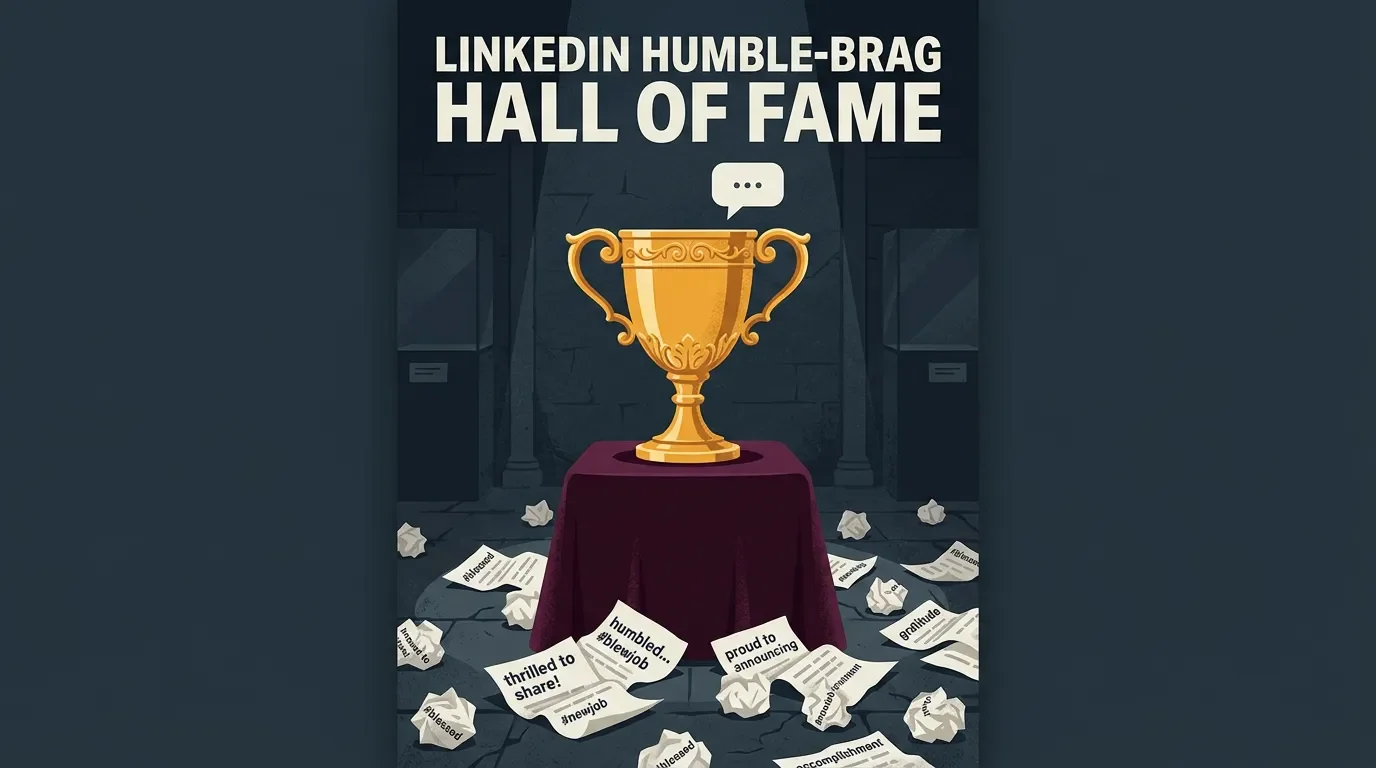
Cover: AI-generated for this column. Posts sourced from public LinkedIn and Reddit, June 15–22, 2026.
참고 출처
- 1Greatgoodness Nwigwe: Funny enough, I almost didn't apply
- 2Mandy O'Neill: I've spent most of my career heads down, working hard
- 3Stanley Tong: I almost didn't apply to this school because I thought I had no chance
- 4Iqbal Abdullah: I am thrilled and humbled to announce that I ate dinner today
- 5r/LinkedInLunatics: Oh no, poster only makes $320K but does some email
- 6r/LinkedInLunatics: AI image is cherry on top


이 콘텐츠를 둘러싼 관점이나 맥락을 계속 보강해 보세요.