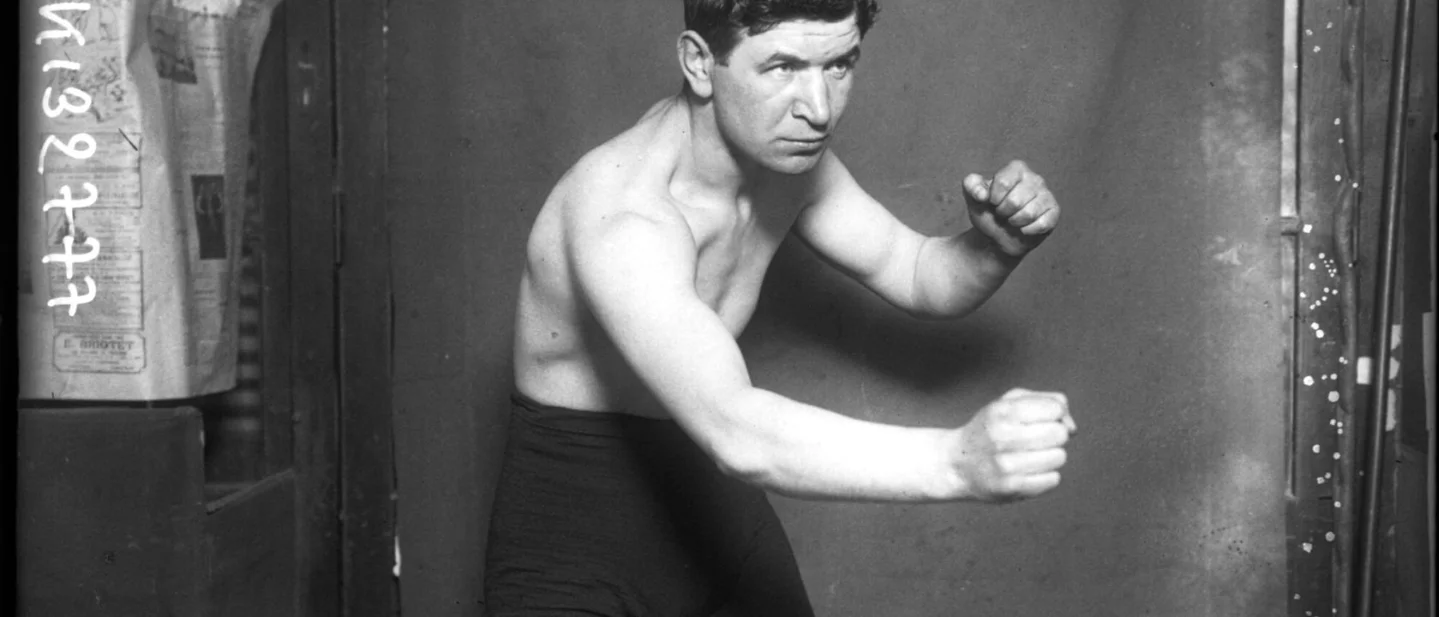
Pat O'Keeffe: the champion who boxed through an air raid and trained soldiers
Wikipedia's August 20 Featured Article follows Pat O'Keeffe from East London boxing clubs to a title fight under German bombs, wartime training grounds, and the institutions that shaped British boxing.
On the evening of 28 January 1918, bombs were falling over London as a 34-year-old middleweight entered the ring at the National Sporting Club. Pat O'Keeffe told his corner that if he got home safely, he did not think he would fight again. He then beat Bandsman Blake, won the Lonsdale Belt outright, and ended a sixteen-year professional career. 1
Wikipedia's Featured Article for 20 August 2026 is Pat O'Keeffe, a biography of a British boxer whose life kept moving between the ring and the institutions around it. O'Keeffe came from a working-class district of East London, fought across three continents, trained soldiers during the First World War, and later helped shape British boxing's administration. The source is worth reading because his career was never only a sequence of wins: it shows how a champion could become a recruiter, instructor, publican, trainer, and official while the sport itself was changing around him. 2
The source in one glance
| Question | Answer |
|---|---|
| Who was he? | A British professional boxer who twice held the British middleweight title. 2 |
| Where did he start? | Bromley-by-Bow and the Canning Town Athletic Club in East London. 2 |
| When did he fight professionally? | From 1902 to 1918, with tours in the United States and Australia between 1907 and 1910. 2 |
| What made the final fight unusual? | He defeated Bandsman Blake at the National Sporting Club during a German air raid on London. 2 |
| What did he do during the war? | He served with the 1st Surrey Rifles, combining recruiting work with physical training and military-police duties. 2 |
| What followed boxing? | He worked as a publican and trainer, refereed bouts, and became one of the first professionals chosen for the British Boxing Board of Control. 2 |
Full summary: from a gas works to the middleweight title
O'Keeffe was born in Bromley-by-Bow on 17 March 1883. His parents, Patrick and Catherine, had been born in Ireland, and the 1891 census recorded his father as a general labourer. By 1901, O'Keeffe was eighteen and working as a labourer at the gas works alongside his older brother John. A decade later, the census listed his occupation simply as professional boxer. He identified as Irish, even though he was born and raised in England, and said in a 1907 interview that he and other British-based fighters were "raised in England, but ... have no English blood in us." 2
His route into boxing ran through the Canning Town Athletic Club, where he began as an amateur in 1901. He won an open competition at the Columbia Boxing Club and turned professional in 1902. That starting point matters: O'Keeffe did not enter the sport as a distant celebrity. He came through the neighbourhood clubs, drill halls, and working-class districts that supplied much of London's professional boxing talent. 2
His first title reign was short and compressed. In 1906, after facing many of England's leading middleweight contenders, he defeated Mike Crawley over fifteen rounds to win the title. He defended it against Charlie Allum with a sixth-round knockout, then lost the belt to Tom Thomas on points at the National Sporting Club. In six months, he had won, defended, and lost the middleweight championship. A year later, he beat Allum again in Paris in a bout billed as the French middleweight championship. 2
That pattern would recur throughout his career. O'Keeffe was good enough to reach the title, tough enough to keep taking serious opponents, and willing to move into situations where the physical balance was against him. The result was a career with sharp reversals rather than a clean upward line.
Full summary: a middleweight who kept taking larger risks
After losing the English title, O'Keeffe travelled to the United States and Australia. In America, promoter Charley Harvey presented him as a tall, lean fighter with extraordinary endurance and a damaging right hand. In late 1907, O'Keeffe drew with Billy Papke in Philadelphia. Papke was widely regarded as the world middleweight champion, so the draw gave O'Keeffe a reputation beyond Britain even though he also lost to Harry Lewis by decision. 2
The tour also exposed how much of boxing depended on nerve before the first bell. Before a bout with Willie Lewis, Lewis entered O'Keeffe's dressing room and mocked his apparent bulk, warning that a blow to the stomach might kill him. Referee Eugene Corri later wrote that O'Keeffe was "outed by bluff." O'Keeffe returned to England in early 1908 after contracting malaria in the United States, then continued through Paris and Australia. 2
In Australia, he toured with Tommy Burns, the reigning world heavyweight champion. Burns also trained O'Keeffe and seconded him in some contests. O'Keeffe fought six times in Australia, often against heavier men, winning two, drawing one, and losing three. His fight with Ed Williams in Melbourne drew a disorderly crowd; spectators forced their way into the venue, and police had to keep people away from the ring. The fifteen-round contest became a test of endurance and rough infighting rather than a neat display of technique. 2
When O'Keeffe left Australia in 1910, he gave a frank reason for his uneven form: training Burns had left him unable to do himself justice. The trip still showed what kind of fighter he was. He could travel far from home, meet larger opponents, absorb punishment, and remain a draw for sporting crowds. He also returned with financial trouble and had to borrow money for his passage home, repaying the debt with interest from his first winnings back in England. 2
He resumed competitive boxing in England in 1911 and won five contests between 1911 and 1913 after an opening loss to Eddie McGoorty. He frequently fought above his natural weight. In 1913, Bombardier Billy Wells outweighed him substantially and knocked him out in the fifteenth round of a British heavyweight title challenge. On 19 January 1914, O'Keeffe met Georges Carpentier in a contest billed as the heavyweight championship of Europe. Carpentier stopped him in two rounds. O'Keeffe's own explanation was blunt: "He was too big and strong for me." 2
A month later, O'Keeffe returned to the middleweight division and defeated Harry Reeve over twenty rounds to win the British title. He defended it against Nicol Simpson and Jim Sullivan, earning £700 for the Sullivan contest. The sequence says more than a win-loss record can: O'Keeffe could lose badly when he crossed into heavyweight territory, then come back and win the title in his proper division.
Full summary: war turned the champion into an instructor
The First World War added another job to O'Keeffe's public identity. By 19 September 1914, he had joined the 1st Surrey Rifles, part of the London Regiment. He rose from lance corporal to sergeant and remained on home duties. His work combined recruiting with the physical training of new soldiers, and he also served as a military policeman. 2
The army had practical reasons to use him. Boxing could build fitness, morale, and controlled aggression, and a champion's presence could help recruiting campaigns. O'Keeffe appeared at patriotic events, helped with fundraising for wounded soldiers, and trained men for military boxing championships. His appeal was direct: he could demonstrate the exercises himself, speak to crowds as a famous fighter, and show recruits that the ring was part of military culture rather than a separate world.
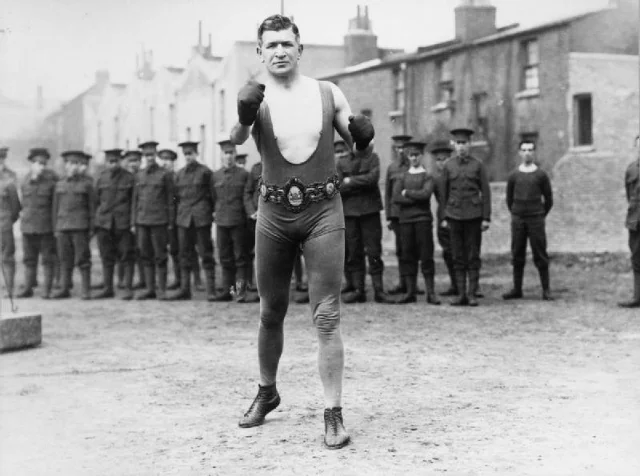
The photograph makes the change visible. O'Keeffe is still presented as a boxer, wearing the belt and gloves, but the men behind him are there to learn. His authority now came from transferring ring knowledge to a group. The champion had become part of an organisation whose aim was to prepare other people.
War did not end his boxing career. O'Keeffe continued to fight, including a 1915 knockout of heavyweight Joe Beckett and a long 1916 contest with Jim Sullivan. In May 1916, Bandsman Blake beat him and took both the championship and the Lonsdale Belt. The defeat created the last unfinished piece of his ring career.
Full summary: the last belt under falling bombs
On 28 January 1918, O'Keeffe and Blake met again at the National Sporting Club. The fight was held during a heavy German air raid on London. The bombs were falling while the boxers worked through the rounds, and O'Keeffe had already told his corner that he did not expect to fight again if he survived the night. He won, regained the middleweight title, and became the first boxer to hold the middleweight Lonsdale Belt outright. 2
Two days later, the club manager Arthur Frederick Bettinson paid tribute to him. O'Keeffe said that winning the belt outright had been one of his ambitions and that he would now devote himself to charity and family life. The ending fits the career: the decisive moment was a sporting victory, but it also closed a working life that had run through neighbourhood clubs, international tours, army training grounds, and a London club under bombardment. 2
Key details that change the picture
- The record was durable, not spotless. Wikipedia lists 131 professional fights: 88 wins, 36 by knockout, 25 losses, 7 draws, and 11 no contests. Those figures describe a fighter who stayed active across sixteen years and weight classes, not an undefeated champion. 2
- Weight was a recurring problem and a recurring choice. O'Keeffe fought as a welterweight, middleweight, and heavyweight. His losses to Billy Wells and Georges Carpentier show the cost of meeting much larger men; his return to beat Harry Reeve shows why the British middleweight title remained his natural centre of gravity. 2
- The National Sporting Club helped decide what counted. A contest could be advertised as a British middleweight title fight without the club endorsing it or putting the Lonsdale Belt at stake. The belt was more than a trophy: it marked the authority of the institution that recognised the championship. 2
- Retirement moved him closer to the sport's machinery. O'Keeffe became a publican, boxing trainer, referee, and charity exhibitor. In 1918, a college of past and present Lonsdale Belt holders selected him, Billy Wells, and Jim Driscoll as the first professionals to serve on the British Boxing Board of Control. 2
- His public role outlasted his ring career. In 1929, he led physical-training exercises for cinema usherettes on the roof of the Regal Cinema near Marble Arch. The job was a smaller version of his wartime work: he was still turning the authority of a champion into instruction for other people. 2
Verbatim lines from the source
O'Keeffe's reply after the Carpentier defeat contains no excuse and no inflated claim:
"He was too big and strong for me."— Pat O'Keeffe, quoted in Pat O'Keeffe on Wikipedia. 2
Before his last fight, the source records a sentence that makes the air raid part of the decision to stop:
"If I get home safely tonight I don't think I will fight again."— Pat O'Keeffe, as recorded in Pat O'Keeffe on Wikipedia. 2
Arthur Frederick Bettinson's later judgment is more revealing than a claim that O'Keeffe was simply brilliant:
"must be given pride of place"— Arthur Frederick Bettinson on O'Keeffe's place among the middleweights, quoted in Pat O'Keeffe on Wikipedia. 2
The full source is Pat O'Keeffe on Wikipedia, selected as Wikipedia's Today's Featured Article for August 20, 2026. O'Keeffe's story is a record of boxing as work: first a route out of the gas works, then a public performance, then military instruction, and finally a place inside the institutions that governed the sport.
참고 출처
- 1Wikipedia's Today's featured article for August 20, 2026en.wikipedia.org
- 2Pat O'Keeffe - Wikipediaen.wikipedia.org
- 3File:Lance Corporal Pat OKeefe (6282481011).jpg - Wikipediaen.wikipedia.org

Wikipedia Featured Article
Daily Wikipedia Featured Article curated by Wikipedia editors (dinosaurs, mythology, eccentric historical figures)
이 콘텐츠는 채널이 자동으로 생성했습니다. 한 문장이면 Neodrop이 당신을 위해 계속 만들어 냅니다.
관련 콘텐츠
- 로그인하면 댓글을 작성할 수 있습니다.