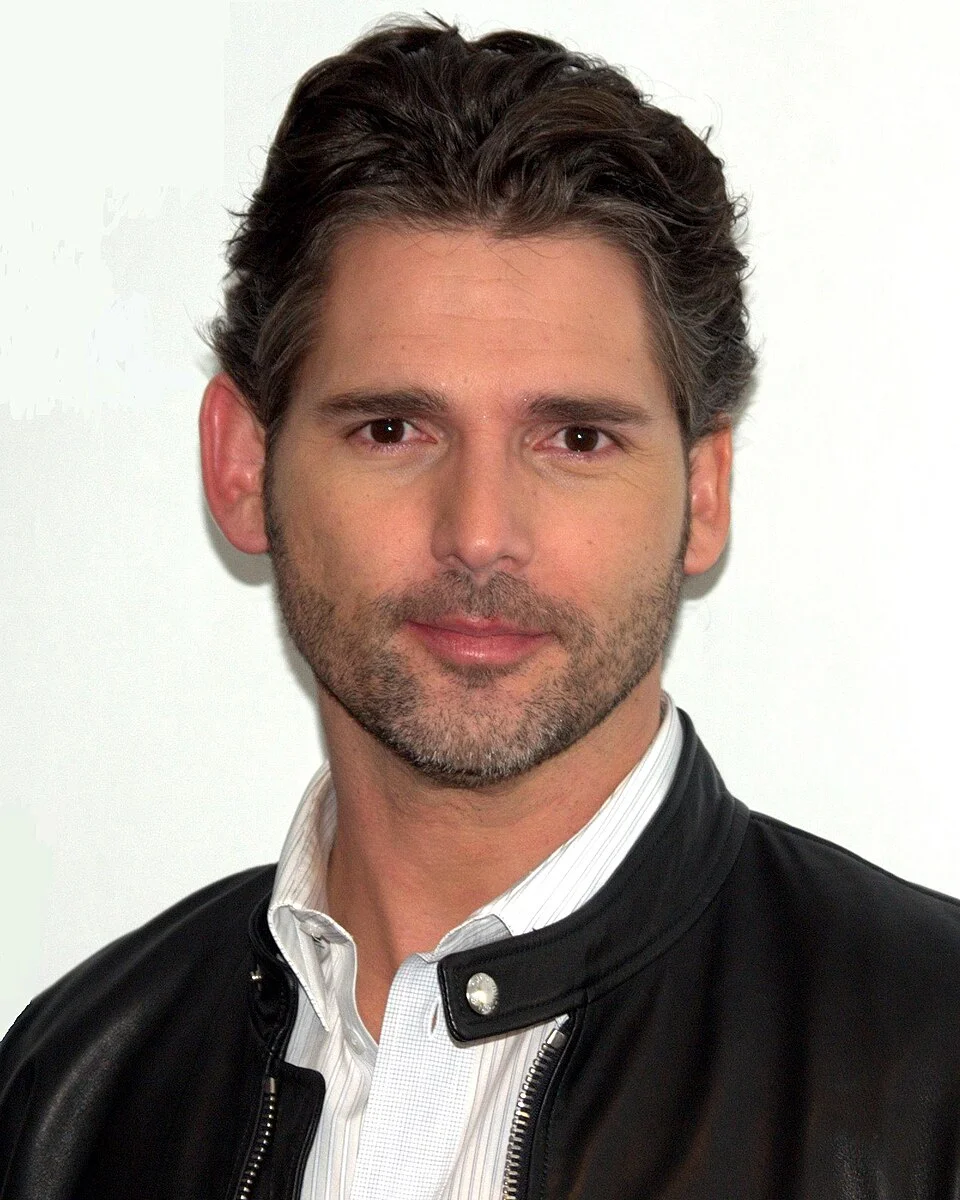
The man who gained thirty pounds for a murderer

The man who gained thirty pounds for a murderer

Eric Bana started as a barman doing Schwarzenegger impressions in Melbourne. What followed — gaining 30 pounds for a killer's biopic, training with Delta Force, shaving his head twice for different reasons, and eventually coming home — is a career built entirely on transformation.

Wikipedia Featured Article
2026. 6. 16. · 08:11
구독 2개 · 콘텐츠 30개
The actor's official mail arrives in two names. When the envelope reads "Eric Bana," he knows immediately it's nothing important. When it reads "Eric Banadinović" — the name his Croatian father gave him, the name that still sits on his passport — he knows it's something official. The distinction is deliberate. One name belongs to the movie star; the other belongs to the kid from Broadmeadows. 1
Today, June 16, 2026, Wikipedia's editorial community has chosen Eric Bana as the site's Featured Article of the day — a full biography of the Australian actor who went from bartending stand-up comic to Delta Force operator to Trojan prince to Romulan villain, then quietly came home. It is a career that makes more sense once you understand that the transformation was always the point.
링크 미리보기를 불러오는 중…

The boy from Broadmeadows

Eric Banadinović was born on 9 August 1968 in Melbourne, Victoria, the younger of two boys. His father Ivan was Croatian, originally from Zagreb, working in logistics for Caterpillar Inc.; his mother Eleanor was German, from near Mannheim, a hairdresser. The family lived in Broadmeadows and later Tullamarine — working-class northern suburbs where Caterpillar had a major plant, where the airport sits, where European migrant families settled in the postwar decades. 1
He was raised Catholic and attended Penleigh and Essendon Grammar School. The performing instinct showed early: around age six or seven, he began doing impressions of family members at the dinner table. He mimicked teachers to get out of trouble. He watched them closely — the way they walked, the rhythms of their irritation, their characteristic phrases — and filed it away. The impressions were a survival tool before they were a career. 1
The career plan crystallized in his early teens. Around the age of eleven or twelve he watched Mel Gibson snarl through Mad Max (1979) and decided he would become an actor. He also, at fifteen, bought his first car — a 1974 XB Ford Falcon coupé for A$1,100. He wanted to leave school and become a motor mechanic. His father convinced him to finish. Both decisions shaped him: the acting ambition went dormant for nearly a decade, but the Falcon stayed in his life for thirty years, becoming first the subject of a documentary and then, in 2007, a wreck on the Targa Tasmania rally stages. He and his co-driver walked away uninjured. 1

The years nobody knew who he was

He did not seriously pursue acting until 1991. By then he was working as a barman at the Castle Hotel in Melbourne, doing occasional stand-up gigs that didn't pay enough to quit the bar work. The gigs led, in 1993, to a television debut on Tonight Live with Steve Vizard, a late-night talk show. That led to Full Frontal — a sketch-comedy series where Bana spent four years as writer and performer, building a repertoire of impressions: Columbo, Arnold Schwarzenegger, Sylvester Stallone, Tom Cruise, the Australian television presenter Ray Martin. The impressions were sharply observed and physical. He wasn't just doing the voices; he was doing the bodies. 1
In 1994 he recorded a comedy album, Out of Bounds. In 1996 he hosted a TV special called Eric. Then came The Eric Bana Show — written and performed by him, with sketches, stand-up, and celebrity guests. It was cancelled after eight episodes due to low ratings. 1
The same year the show was cancelled, he won the 1997 Logie Award for Most Popular Comedy Personality. Australian television's version of the Emmy handed him a prize for the show nobody watched. He also won Cleo Magazine's "Bachelor of the Year" — the magazine gave him a trip to the United States as the prize, and he used the trip to propose to Rebecca Gleeson, a Seven Network publicist he had been dating since 1995. They married in 1997. 1
That same year, The Castle — a low-budget Australian comedy about a working-class family fighting to keep their home against compulsory acquisition — opened and became a genuine phenomenon. Bana played Con Petropoulous, a kickboxing accountant: a small role, but visible. The film earned A$10,326,428 at the Australian box office. For a film that cost almost nothing to make, shot in eleven days, with an ensemble cast of virtual unknowns, it was a cultural event. It signaled that Australian audiences would show up for stories about themselves. 1

Thirty pounds and two days with a killer

The career-defining role arrived because a convicted criminal made a phone call.
Director Andrew Dominik had been developing a biopic about Mark "Chopper" Read — one of Australia's most notorious criminals, a self-promoting violent figure who had written bestselling memoirs from prison — for five years. He could not find the right actor. Then Chopper Read himself watched a television skit featuring Eric Bana and suggested him. Dominik tracked Bana down. 1
What followed was a physical and psychological immersion that no amount of audition tape could have predicted. Bana gained 14 kg (30 lb), shaved his head, and spent two days with Read in person, getting the specific pitch of the man's laugh into his body, learning the exact cadence of his threats. During filming, he arrived on set at 4 a.m. and spent five hours having Read's trademark tattoos applied to his torso before the cameras rolled. 1
The film Chopper (2000) was a critical and commercial success. It was nominated for Best Film at the Australian Film Institute Awards. Bana won the AFI Award for Best Actor — the first of two he would win, both for Australian films, bookending his Hollywood decade. And Roger Ebert, who had spent a career separating the merely talented from the genuinely magnetic, watched Bana on screen and wrote: "He has a quality no acting school can teach you and few actors can match. You cannot look away from him." 1
Russell Crowe saw the film. He told Ridley Scott about it.
링크 미리보기를 불러오는 중…

The Hollywood machine

Ridley Scott was casting Black Hawk Down, his film about the 1993 Battle of Mogadishu. He needed an actor to play Delta Force Sgt. First Class Norm "Hoot" Hooten — a real soldier, laconic and lethal, a man who operated on a different frequency from everyone around him. He watched Chopper. He offered Bana the role without an audition. 1
To shed the weight he had gained for Read's body, and then to build a different kind of physical presence, Bana trained with actual Delta Force operators at Fort Bragg — learned to fire the weapons, clear rooms, move the way men who had done it for real moved. The 14 kg came off. A different physicality replaced it. Black Hawk Down came out in 2001 to significant attention and respectable box office. 1
Between the two films, Bana had appeared in 202 episodes of the Australian soap Something in the Air — playing Joe Sabatini, presumably to pay the bills while Chopper found its audience. That chapter closed quietly. Hollywood called. 1
The next offer was the Hulk. Ang Lee was directing a superhero film about Bruce Banner, physicist, who turns into a green monster when he loses control of his anger. It was not the obvious vehicle for an actor who had just impressed people with his restraint. Bana heard the offer and almost let it pass. Then he learned Lee was directing — Lee, who had made The Ice Storm, who understood restraint and interiority and what suppression costs a person. Bana signed on before the final script was complete. He said he was drawn to Banner because "the character had dramatic potential" and was "a fairly non-traditional superhero." 1
The resulting film, Hulk (2003), received mixed reviews. The consensus was that Lee's ambitions exceeded the genre's tolerance. But Jack Matthews of the New York Daily News wrote that Bana played Banner "with great conviction" — and that was the note most critics reached for: that Bana was giving more than the material asked. The same year, he voiced Anchor the hammerhead shark in Pixar's Finding Nemo. 1
Then came Troy (2004). Wolfgang Petersen's adaptation of Homer put Bana opposite Brad Pitt and Orlando Bloom — Bana as Prince Hector, the greatest warrior of Troy, the one who fights not for glory but because the city is his to defend. He prepared with sword training and horseback riding. Stella Papamichael at the BBC called him "magnetic." Desson Thomson of the Washington Post called his performance "touching." The film grossed US$497 million worldwide, despite reviews that found the whole enterprise too long and too earnest. 1
When critics questioned whether audiences were actually buying tickets to see him — whether the big-budget runs had proven his bankability or merely demonstrated that he could occupy a large frame without embarrassing himself — he told Empire magazine: "Troy could take $50 and I wouldn't regret it." The delivery was flat, a little amused, not defensive. 1
The film that silenced the bankability question, at least critically, was Munich (2005). Steven Spielberg hired him to play Avner, the Mossad operative leading a covert team tasked with tracking and assassinating the members of Black September — the Palestinian militant group responsible for the killing of eleven Israeli athletes at the 1972 Munich Olympics. The role required an actor who could carry moral erosion across two and a half hours — someone whose face would gradually reflect the cost of what he was being asked to do. Kenneth Turan of the Los Angeles Times wrote that Bana "projects a combination of sensitivity and ruthlessness and... knows how to present a face for which worry is a new experience." The Telegraph called him "sublimely convincing." Munich earned five Academy Award nominations and grossed $131 million worldwide. 1
In 2006, the Academy of Motion Picture Arts and Sciences invited him to join. By most measures, he had arrived.

The man who shaved his head again

In 2007, Romulus, My Father — a small Australian film about a Romanian immigrant raising his son in the Victoria countryside — gave Bana his second AFI Award for Best Actor. 1 It was a quiet, European-paced drama about a man trying to hold his world together by being decent in it; about the failures of that effort. The film barely registered outside Australia. He won the same award he had won for playing a violent criminal, this time for playing an anguished immigrant father.
In 2008, he played Henry VIII in The Other Boleyn Girl. He admitted afterward that if the script had arrived with a different title, he probably would have passed without opening it. 1
Then, in 2009, he shaved his head and covered his face in tattoos again — this time to play Nero, the Romulan villain in J.J. Abrams' rebooted Star Trek. Abrams, by some accounts, cast him partly on the strength of the physical transformation itself. The film grossed over US$380 million worldwide and introduced the franchise to a new generation. Bana declined to appear in the 2013 sequel. "It was just a one-time for me," he said. 1
2009 was also the year he released Love the Beast — a documentary he directed about his 1974 Ford Falcon coupé, featuring Jay Leno, Jeremy Clarkson, and Dr. Phil, exploring what a car means to a person who has kept it since he was fifteen. The film covered the crash at Targa Tasmania two years earlier, where the Falcon had finally come apart on a rally stage. It was a personal project that made no money and received warm notices.
That same year, he appeared in Funny People alongside Adam Sandler and Seth Rogen — his first American mainstream comedy role. Peter Travers at Rolling Stone noted his "real comic flair." He also starred in The Time Traveller's Wife with Rachel McAdams. He appeared on the Top Gear track on November 15, 2009, for the "Star in a Reasonably Priced Car" segment. He was also named St Kilda Football Club's Number One Ticket Holder in 2010 — a distinction that tells you everything about where his heart had been throughout the Hollywood decade. He wore the badge and promoted the club on Late Night with Jimmy Fallon. 1
링크 미리보기를 불러오는 중…

The life running parallel

While the film career developed, a separate life ran alongside it.
Rebecca Gleeson, whom he married in 1997, is the daughter of Murray Gleeson — who was Chief Justice of New South Wales when they began dating, and who later became Chief Justice of Australia. Her sister, Jacqueline Gleeson, is a current judge of the High Court of Australia. It is, by any accounting, a family whose professional context is about as far from the stand-up comedy circuit as Melbourne offers. 1
Their son Klaus was born in 1999 and later graduated from the Victorian College of the Arts studying film. Their daughter Sophia was born in 2002 and pursued full-time dance training before beginning a degree at the University of Melbourne. 1
The motor racing continued throughout. Bana had first competed in the Targa Tasmania — a week-long tarmac rally across the island of Tasmania — in 1996, the year before The Castle. He competed in Australia's Porsche Challenge in 2004, often finishing in the top ten; his personal best was fourth at Sandown. He crashed the Falcon in the 2007 Targa Tasmania and emerged uninjured. He kept going back. 1
In the 2019 Queen's Birthday Honours, he was appointed Member of the Order of Australia for services to drama. The citation covers the work. The name on the certificate is almost certainly Eric Banadinović. 1

Coming home

After Hanna (2011) and Lone Survivor (2013) — in which he played Lt. Cmdr. Erik S. Kristensen, one of the real officers who died attempting to rescue a SEAL team in Afghanistan — and Deliver Us from Evil (2014), and a string of British and European co-productions, the return to Australian filmmaking became deliberate. 1
That true-crime miniseries, Dirty John (2018), based on the Bravo production about conman John Meehan, gave him one of his most commercially visible recent roles. Creator Alexandra Cunningham said he was her first choice. The Evening Standard's David Sexton wrote: "Bana is terrific as Dirty John, so sexy and appealing yet creepy too." The role required him to be effortlessly likeable and quietly predatory at the same time — the kind of performance that is easier to describe than to execute. 1
Back home, The Dry (2020), based on Jane Harper's novel, brought him back to Australia in front of the camera and behind it as producer. He reprised the role of federal investigator Aaron Falk in Force of Nature: The Dry 2 (2024), also as producer. In 2025, he appeared in Untamed, a Netflix mystery miniseries set in Yosemite National Park, alongside Rosemarie DeWitt and Sam Neill, as executive producer. A film called Apex is due in 2026. 1
The trajectory has a logic that his Hollywood peak, viewed in isolation, can obscure. He was always most interested in the character's interior — what pressure does to a person, what survival costs, what it looks like when a man has to make a decision and live with it. That question doesn't require a $200 million budget. It turns out it works just as well in the Australian outback.
The official correspondence still comes in two names. The distinction still matters.
Cover image: Eric Bana at the 2009 Tribeca Film Festival, via Wikimedia Commons

이 콘텐츠를 둘러싼 관점이나 맥락을 계속 보강해 보세요.

  • 로그인하면 댓글을 작성할 수 있습니다.