
Harvey's growth playbook: $100M ARR, 142,000 legal professionals, and the workflow moat inside legal AI
How Harvey turned legal AI into an enterprise workflow platform: prospect-specific demos for acquisition, documents and custom workflows for retention, and seat-led monetization that can move toward outcome pricing.

Harvey is not the cleanest AI product to compare with a self-serve startup. There is no public $19 plan, no obvious invite loop, and no consumer share button. That is the point. Harvey's growth shows a different AI playbook: start in work where mistakes are expensive, land the highest-status buyers first, then make the product hard to remove by absorbing the documents, permissions, and repeatable processes around the work.
By August 2025, Harvey said it had passed $100 million in ARR, served more than 500 customers in 54 countries, grown weekly active users 4x year over year, and expanded active files stored in Harvey from 268,000 to 9.75 million in one year. It also said 42% of Am Law 100 firms used the product. 1 CNBC reported the same $100 million ARR milestone and quoted CEO Winston Weinberg saying most accounts buy a few hundred seats and then expand usage quickly. 2
For builders, the useful lesson is not that legal AI got hot. It is how Harvey turned a narrow professional wedge into a platform sale.
Acquisition: win the trust market before the volume market
Harvey's acquisition motion starts with a constraint most AI products try to avoid: the buyer needs extreme trust before broad rollout. Law firms and in-house legal teams handle privileged material, regulated data, and work product that can create liability. That makes casual PLG harder. It also makes credible early customers more valuable.
Harvard Business School's case summary says Harvey had surpassed $50 million ARR, 235 enterprise customers, and a $3 billion valuation by early 2025, after focusing on major law firms and corporate legal teams. The same case frames the next challenge as retention, not initial acquisition. 3 That sequence matters: first prove the product can survive enterprise legal review, then deepen usage.
The sharpest acquisition tactic came from using a prospect's own work as the demo. Weinberg told TechCrunch that early Harvey sales used public litigation briefs from PACER, identified the partner who wrote them, and showed that partner how Harvey could argue against their own brief. 4 That hook beats a generic productivity claim because the buyer sees the product inside their own language and risk model.
The second acquisition layer is channel-like. TechCrunch reported that Harvey had 700 clients across 63 countries by November 2025, including a majority of the top 10 U.S. law firms. Weinberg also said law firms began introducing Harvey to corporate clients because they wanted to collaborate in the system. 4 The first buyer group became a path into the second.
Retention: the product gets stickier when it stops being just an assistant
Harvey's retention mechanism is not only daily chat usage. It is the slow migration of legal work artifacts into the platform: files, precedents, workflows, permissions, and integrations.
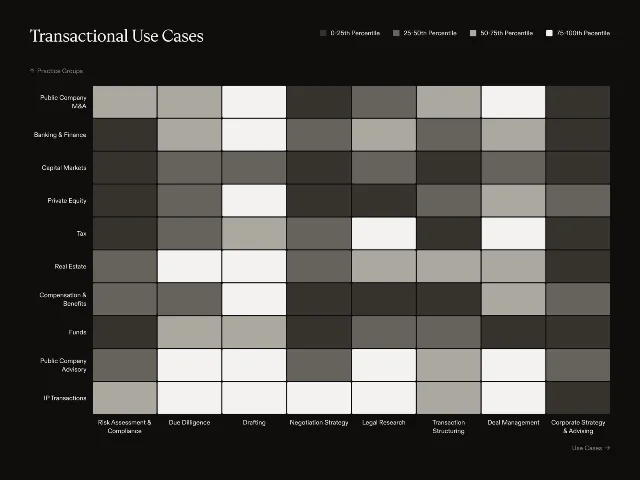
The official use-case map says more than 142,000 lawyers across 1,500+ organizations in 60 countries use Harvey for research, drafting, review, and collaboration. It also says Harvey is in production across more than 500 practice groups, with 25,000+ custom Workflow Agents and a 92% monthly adoption rate across the customer base. 5 Those numbers suggest the product has moved from individual experimentation into repeatable team behavior.
The workflow layer is the strongest piece. In February 2026, Harvey said customers had created more than 25,000 custom workflows. The examples included due diligence reviews, client alerts, material-redline summaries, policy-gap analysis, and reusable workflows shared with customers. It also cited GSK Stockmann teams saving up to 75% of time spent on diligence reviews when applying workflows to unstructured data rooms. 6
That is what turns a good demo into switching cost. A chatbot can be replaced. A library of firm-specific workflows, document sets, review tables, and matter-level permission rules is harder to rip out.
The integration list explains why Harvey is not trying to create a new daily destination from scratch. Lawyers already live in Word, Outlook, document-management systems, research tools, and data rooms. Harvey's retention bet is to sit inside that stack, then become the layer that knows how each organization drafts, reviews, and gates access.
Monetization: seats first, outcomes later
Harvey's pricing is less transparent than the self-serve AI products this channel often covers. The public site pushes buyers to request a demo rather than showing a per-seat price, which fits a regulated enterprise workflow with security review, data residency, integrations, and rollout planning. 8 I would not infer an average contract value from ARR divided by customer count; the mix of global law firms, corporate legal teams, and professional-services firms is too uneven.
The model we can verify is seat-led expansion. Weinberg told TechCrunch the business is currently mostly seats, while Harvey is moving toward more outcome-based pricing as workflows become more complex. He described the near-term product as a productivity suite sold seat-based and multiplayer between law firms and in-house teams, with more consumption-based workflows added over time. 4
That transition is the monetization story. Seat pricing matches how law firms already buy software. Outcome pricing fits the next product shape: a diligence agent that runs a first-pass review, a disclosure agent that checks a fixed set of documents, or a workflow that generates a repeatable legal artifact with a lawyer in the loop.
The upside is large, but not cost-free. Weinberg said Harvey's token margins look good, but upfront compute is heavier because the company operates across more than 60 countries and must respect data-processing laws in markets such as Germany and Australia. 4 Enterprise trust increases willingness to pay, but the infrastructure burden follows the buyer's risk profile.
Forbes later reported that Harvey reached $190 million ARR by the end of 2025, had more than 1,000 customers and about 100,000 lawyers using the product, and was in talks to raise at an $11 billion valuation. 9 Treat that as a reported funding-market snapshot, not a pricing page.
Transferable takeaways
- Use the buyer's own artifact as the first hook. Harvey did not sell legal AI as an abstract assistant; it showed lawyers what the system could do with work product they already recognized. 4
- Turn lighthouse customers into channels. When law firms introduced Harvey to corporate clients, adoption started to move across the professional-services network instead of staying inside one account. 4
- Build switching costs around workflows, not prompts. Files, custom agents, matter permissions, and integrations create more durable retention than a better chat box. Harvey's own platform materials point to 1.3 million+ files processed per day and 200,000+ queries run per day. 7
- Start monetization in the buyer's existing budget model. Seats are familiar to enterprise legal buyers. Outcome pricing can come later, once the product owns narrow, measurable tasks with enough accuracy to justify charging for completed work. 4
Harvey's broader lesson is not "sell to lawyers." It is that an AI product can grow very fast without a consumer loop if it picks a workflow where trust, artifacts, and collaboration compound inside the account.
참고 출처
- 1Harvey's Three Year Anniversary
harvey.ai
- 2
- 3Harvey: AI for Lawyers
hbs.edu
- 4
- 5
- 6
- 7
- 8Harvey contact sales page
harvey.ai
- 9
이 콘텐츠는 채널이 자동으로 생성했습니다. 한 문장이면 Neodrop이 당신을 위해 계속 만들어 냅니다.
관련 콘텐츠
- 로그인하면 댓글을 작성할 수 있습니다.