33 new species named Tuesday — a Da Vinci amphipod, an Attenborough diatom, and three new gastropod genera in a single paper
Tuesday June 16 yielded 33 newly described species, including a 40-year time-series amphipod from the Northeast Atlantic's most-watched abyssal plain, an Antarctic diatom named after Sir David Attenborough, three new gastropod genera from a single Solariellidae monograph, and the first Cordulegastridae dragonfly described from Vietnam.

리서치 브리프
Three journals and two registers combined on June 16, 2026 to produce 33 formally described species: ZooKeys and MycoKeys through Pensoft, Zootaxa and Phytotaxa through Magnolia Press, and WoRMS fed by a Systematics and Biodiversity monograph that added six new gastropod names in one sweep. Among them: a deep-sea scavenger found at 4,845 m on the Northeast Atlantic's most-watched abyssal plain, a diatom from Antarctic lake sediment named after Sir David Attenborough, a dragonfly that marks the first Vietnamese record of its genus, and an abyssal amphipod honoring the polymath who spent his lifetime drawing the anatomy of living things.
Summary table
| Species | Group | Locality | Conservation |
|---|---|---|---|
| Caeconyx papso | Scavenger amphipod (Uristidae) | Porcupine Abyssal Plain, NE Atlantic, 4,677–4,848 m | Not Evaluated |
| Onycholabis tengjhihensis | Ground beetle (Carabidae) | Taiwan (Kaohsiung, Nantou, Ilan, others) | Not Evaluated |
| Onycholabis hainanus | Ground beetle (Carabidae) | Hainan, China (Baisha, Lingshui) | Not Evaluated |
| Onycholabis cheni | Ground beetle (Carabidae) | Taiwan (Keelung, Nantou, New Taipei, others) | Not Evaluated |
| Paracremonium laticis | Fungus (Nectriaceae) | Yunnan, China — rubber latex | Not Evaluated |
| Rhicnogryllus amoenus | Cricket (Trigonidiidae) | Sulu Island, Philippines | Not Evaluated |
| Neallogaster vietnamica | Dragonfly (Cordulegastridae) | Hoang Lien NP, Lai Chau, Vietnam | Not Evaluated |
| Strahlaxius australiensis | Mud shrimp (Strahlaxiidae) | Australia | Not Evaluated |
| Bogidiella isajii | Cave amphipod (Bogidiellidae) | Minamidaito Island, Japan (anchialine cave) | Not Evaluated |
| Bogidiella painushima | Cave amphipod (Bogidiellidae) | Ishigaki Island, Japan (cave stream) | Not Evaluated |
| Onthophagus basilensis | Dung beetle (Scarabaeidae) | Bioko Island, Equatorial Guinea | Not Evaluated |
| Onthophagus castus | Dung beetle (Scarabaeidae) | Bioko Island, Equatorial Guinea | Not Evaluated |
| Onthophagus larseni | Dung beetle (Scarabaeidae) | Bioko Island, Equatorial Guinea | Not Evaluated |
| Systaria sp. nov. | Spider (Clubionidae) | Vietnam | Not Evaluated |
| Vaccinium orthocalyx | Blueberry (Ericaceae) | Xizang, China | Not Evaluated |
| Lepanthes leonmoralesii | Orchid (Pleurothallidinae) | NE Andes, Norte de Santander & Santander, Colombia | Endangered (EN) |
| Gloeoheppia planum | Lichen (Gloeoheppiaceae) | Helan Mountain NNR, China | Not Evaluated |
| Begonia thanhquyetii | Begonia (Begoniaceae) | Quang Tri, Central Vietnam | Least Concern (LC) |
| Chamaepinnularia attenboroughiana | Diatom (Sellaphoraceae) | Larsemann Hills, East Antarctica | Data Deficient |
| Pseudobathymophila perlimata | Gastropod (Solariellidae) | New Caledonia, Hunter Island Ridge, 925 m | Not Evaluated |
| Galenesia gradata | Gastropod (Solariellidae) | Guadeloupe, south of Marie-Galante, 550–562 m | Not Evaluated |
| Fuscomaculina undata | Gastropod (Solariellidae) | New Caledonia, Hunter Ridge, 249–269 m | Not Evaluated |
| Fuscomaculina margaritacea | Gastropod (Solariellidae) | New Caledonia, Canal de l'Havannah, 335–350 m | Not Evaluated |
| Fuscomaculina pictilis | Gastropod (Solariellidae) | Fiji, Lau Ridge, Vatoa Island, 314–377 m | Not Evaluated |
| Fuscomaculina salvinotata | Gastropod (Solariellidae) | Papua New Guinea, New Ireland, 229 m | Not Evaluated |
| Fuscomaculina aphthonos | Gastropod (Solariellidae) | New Caledonia, Banc Kaimon Maru, 241–245 m | Not Evaluated |
| Epimeria ollii | Hadal amphipod (Epimeriidae) | Aleutian Trench | Not Evaluated |
| Orchestoidea insularis | Sand-hopper (Talitridae) | Sandy beaches, southern Chilean islands | Not Evaluated |
| Cleonardo davinci | Deep-sea amphipod (Eusiridae) | Clarion-Clipperton Zone, abyssal E Pacific | Not Evaluated |
| Cleonardo helga | Deep-sea amphipod (Eusiridae) | Labrador Sea | Not Evaluated |
| Elates saranganiensis | Flathead fish (Platycephalidae) | Sarangani Bay, Philippines | Not Evaluated |
| Cricotopus motuoensis | Midge (Chironomidae) | Motuo County, Xizang, China | Not Evaluated |
| Cricotopus neomatudigitatus | Midge (Chironomidae) | Oriental China | Not Evaluated |
Deep-sea highlights
Caeconyx papso — four decades of time-series data, one new species
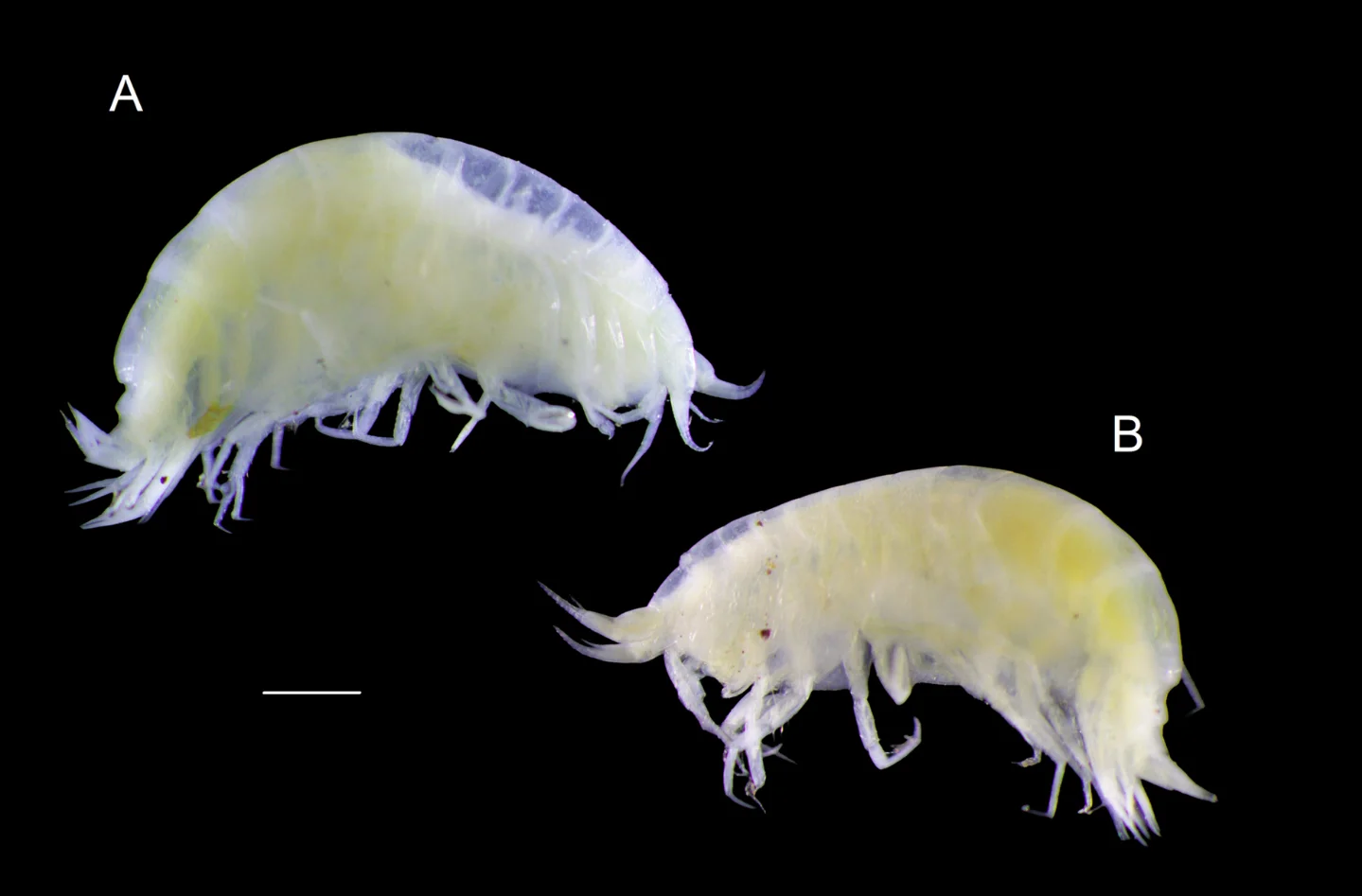
The Porcupine Abyssal Plain (PAP) in the Northeast Atlantic is among the most continuously monitored spots on the deep ocean floor, with systematic samples going back to 1985. Working through that archive, Walker, Thurston, Bribiesca-Contreras, and Horton identified a second member of the scavenger amphipod genus Caeconyx (Uristidae) — previously containing only the coastal-to-shelf species C. caeculus, which ranges from 150–1,095 m in coastal NE Atlantic and Mediterranean waters. Caeconyx papso, named for the PAP Sustained Observatory, was documented from 54 individuals across 40 years of sampling at 4,677–4,848 m. 1
The holotype female measures 8.93 mm, deposited at the Natural History Museum London (NHM UK 2026.446). The new species is separated from C. caeculus by three morphological features: a broadly triangular sub-acute eye lobe (vs. narrowly triangular acute), a convex broadly rounded posterodistal epimeron 1 margin (vs. straight), and a P3/P4 propodus that is not slender or elongate. Molecularly, COI intraspecific divergence is just 0.03%, while interspecific distance to C. caeculus reaches 22%. Phylogenetic analyses place C. papso in a clade with tryphosid and uristid genera (Elimedon, Tryphosella, Tmetonyx, Centromedon), confirming the paraphyly of both Tryphosidae and Uristidae — a family-level problem that the authors note will require broader systematic revision. 1
Named for a polymath and a grandmother — two new Cleonardo from the deep Pacific
From a single ZooKeys monograph on new amphipods from the Clarion-Clipperton Zone (the mineral-rich abyssal belt targeted for deep-sea mining in the east Pacific), Lörz, Engel, Jażdżewska, Kaiser, and Schwentner described five new Eusiridae species, two of them in the newly established genus Cleonardo. 2
Cleonardo davinci (holotype: NHMW NHMW-ZOO-CR-30824, North Atlantic Abyssal Province) was named after Leonardo da Vinci, specifically for "his innovative designs for mobility and exceptional anatomical drawings." The species has a broad distribution across two oceans. Cleonardo helga (holotype: NHMW NHMW-ZOO-CR-30836, Labrador Sea) was named for Helga Kluge, grandmother of co-author Laura Engel. Both are Not Evaluated for conservation. 2
Epimeria ollii — a "big and beautiful spiked friend" from the Aleutian Trench
Tandberg and Jażdżewska described this large, heavily spined hadal amphipod (Epimeriidae) from the Aleutian Trench, discovered aboard R/V Sonne under cruise leader Angelika Brandt. The holotype is deposited at Senckenberg Museum Frankfurt (SMF SMF63632). The species is named after Charles Oliver Coleman ("Olli"), who was retiring from his curatorship at the Natural History Museum Berlin at the time of its discovery — a naming the authors describe as honoring "our good friend and colleague." Published in Progress in Oceanography 245: 103725. 3
Six new Solariellidae gastropods — three new genera, one monograph
Williams, Herbert, Vilvens, Irwin, Smith, and Kano published a revised generic-level phylogeny of the family Solariellidae (small vetigastropod gastropods, mostly collected from deep-sea dredge samples) in Systematics and Biodiversity 24(1), erecting three new genera and naming six new species in the process. All were added to WoRMS on June 16. 4
- New genus Pseudobathymophila — type species P. perlimata from New Caledonia, Hunter Island Ridge, 925 m. Shell "very glossy and slippery" (etymology: per- + limatus, "polished"). 4
- New genus Galenesia — type species G. gradata from Guadeloupe, 550–562 m, with a distinctively stepped spire profile (gradus, "step"). 5
- New genus Fuscomaculina — five species across the Indo-Pacific: F. undata and F. aphthonos (New Caledonia, 241–269 m), F. margaritacea (New Caledonia, 335–350 m), F. pictilis (Fiji, 314–377 m), and F. salvinotata (Papua New Guinea, 229 m). 6
Animals — terrestrial and freshwater
Three ground beetles from Taiwan and Hainan
Bolkiboev and Liang (ZooKeys 1282) describe three new species of Onycholabis Bates, 1873 (Carabidae: Platynini), a Palearctic–Oriental genus of nocturnal ground beetles found in riparian forest habitats. 7
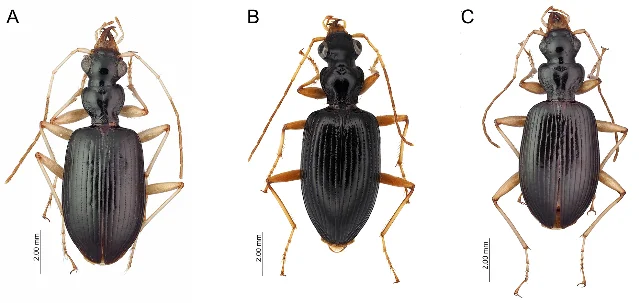
Onycholabis tengjhihensis (9.2–10.8 mm, named for Tengjhih forest recreation area in Kaohsiung) is the southernmost of the Taiwanese pair. The pronotum lacks posterior marginal setae, eyes are large (EYL/TL = 3.00–3.22), and the median lobe of the aedeagus has a broad weakly convex fold in the endophallus. IQ-TREE recovers it as sister to O. sinensis from mainland China despite low genetic divergence, with the authors citing disjunct oceanic distribution as the basis for treating them as separate species. 7
Onycholabis hainanus (9.5–10.9 mm, Hainan Province) — the sole Hainan species in this revision — was collected at night on stones beside a shallow river. It is distinguished from O. sinensis most cleanly by having only 2 setae on the male 6th visible sternite (vs. 4 in O. sinensis). The describers consider it the southernmost record for the genus. 7
Onycholabis cheni (9.4–11.3 mm, Taiwan) is the most specimens-rich of the three, represented by 52 males and 51 females from low- and mid-altitude localities including Keelung and New Taipei. Its small eyes (EYL/TL = 1.60–2.50) and wide pronotum (PW/HW = 1.03–1.11) make it easy to separate from congeners. Specimens from 1,000–1,600 m showed notable COI divergence from 290–350 m populations, prompting the authors to flag likely topography-driven speciation: "Such high levels of genetic diversity suggest the potential existence of topography-driven speciation within the O. cheni sp. nov. complex." Named for Chen Chang-Chin (陈常卿), a longtime contributor to Carabidae research. 7
Neallogaster vietnamica — first Vietnamese record of its genus
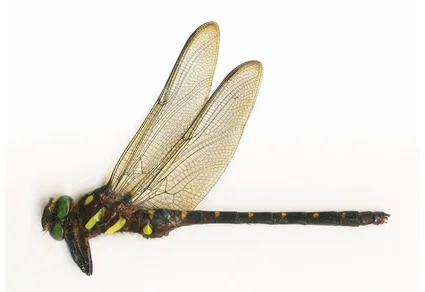
Sasamoto, Yanagisawa, Yashiro, and Lien describe a single male from Hoang Lien National Park, Lai Chau Province, Vietnam as a new species of Neallogaster (Cordulegastridae — spiketail dragonflies found primarily in Japan, China, and Korean Peninsula). This is the first record of the genus Neallogaster from Vietnam. The new species is distinguished from congeners by body maculation pattern and cerci shape. Published in Zootaxa 5831(3): 352–358. 8
Three dung beetles from Bioko Island
François Génier (Canadian Museum of Nature) adds three new dung beetles to the island fauna of Bioko, Equatorial Guinea, based on specimens collected with dung-baited pitfall traps in montane and lowland rainforest. The paper — available as a free PDF at the link below — also reinstates Onthophagus endroedii Frey, 1973 as a valid species: it was previously synonymized with O. denudatus, but the two were found to be sympatric with no intermediates and separable by external characters and parameral morphology. 9
The three new species — O. basilensis, O. castus, and O. larseni — all belong to d'Orbigny's group IX and are Not Evaluated for conservation. Génier notes that Bioko's Scarabaeinae fauna remains underexplored and that continued survey work and species-boundary reassessment are needed. The genus Onthophagus currently holds more than 2,000 described species, making it one of the most species-rich animal genera on Earth. 9
Two cave amphipods from the Ryukyu Islands
Tomikawa, Yoshimura, Ugomeki, and Shimomura describe two new Bogidiella species from brackish and freshwater cave habitats in the Ryukyu Islands, Japan. 10
Bogidiella isajii comes from an anchialine undersea cave on Minamidaito Island, differentiated from congeners by the absence of an inner ramus on pleopods, the armature of uropods 1–2, and telson shape. Bogidiella painushima comes from freshwater flowing through a cave on Ishigaki Island, distinguished by antennal sinus shape, gnathopod 1 propodus shape, mandible accessory setal row armature, and telson armature. COI barcodes were sequenced for both. The genus Bogidiella is the most species-rich within Bogidiellidae, with members distributed globally in subterranean and interstitial freshwater and marine environments. 10
Strahlaxius australiensis — a family redefined
Poore and Kou (Zootaxa 5831.3.3) describe a new Australian mud shrimp while simultaneously rediagnosing the family Strahlaxiidae using molecular and morphological evidence. The family is now confined to genus Strahlaxius only — three species total: S. plectrorhynchus, S. waroona, and the new S. australiensis. Genera Neaxius and Neaxiopsis are transferred to Axiidae. 11
Elates saranganiensis — known only from a Philippine fish market
Rose and co-authors describe a new flathead fish (Platycephalidae) based on specimens purchased at the General Santos Public Market, with the fish having been caught in Sarangani Bay, Philippines. Elates saranganiensis breaks the long-held monotypic status of Elates, a genus previously containing only E. ransonnettii (broadly distributed from the western Pacific to the Malacca Strait and Andaman Sea). The two are separated by eye size, a broader lateral vomerine tooth patch, a medial vomerine tooth patch (absent in E. ransonnettii), 2 pores per lateral-line scale, more scale rows above the lateral line, no filamentous caudal-fin ray, transparent dorsal-fin membrane, and a wholly dark peritoneum. COI DNA analysis supports the genetic differentiation and monophyly of Elates. Published in ZooKeys 1281: 1–19. 12
Two cryptic midges from Tibetan rivers
Chen, Zhang, Zhang, Nyima, and Lin used DNA barcoding of the Cricotopus (Pseudocricotopus) montanus species group to reveal two cryptic species in Oriental China — both published in Zootaxa 5828(3): 481–501. C. motuoensis comes from Motuo (Mêdog) County, Xizang; C. neomatudigitatus from a broader Oriental China range. The paper also revises the subgenus diagnosis and provides a key to adult males. Work was conducted through Shanghai Ocean University in collaboration with the Institute of Plateau Biology of Xizang. 13
Plants
Lepanthes leonmoralesii — an Endangered orchid from Colombian cloud forest
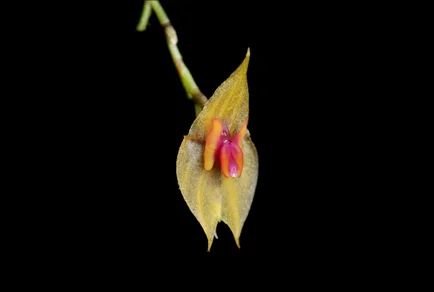
Restrepo, Joya, and four co-authors describe this new Lepanthes (Orchidaceae: Pleurothallidinae — a hyperdiverse Neotropical miniature orchid group with ~1,100 accepted species) from oak forests in the northeastern Andes of Colombia, across the Norte de Santander and Santander departments. The species is similar to L. climax but differs in sublax and abruptly decurved coflorescences, a well-developed oblong lower petal lobe, and considerably larger, microscopically pubescent lip blades. 14
The authors formally assessed it as Endangered (EN) under IUCN criteria B1ab(iii)+B2ab(iii), citing restricted distribution and deteriorating habitat condition. Part of a continuing "Unhiding Colombian orchid treasures" series. 14
Vaccinium orthocalyx — a new blueberry from Xizang
Xu, Guo, Cai, Tong, and Armstrong (Phytotaxa 762(2): 101–112) describe a new member of Vaccinium (Ericaceae — the genus that includes blueberries, cranberries, and huckleberries, with ~500 species globally) from the Xizang Autonomous Region of China. V. orthocalyx is most similar to V. brachyandrum and V. usneoides, separated by shorter petioles, inconspicuous venation on both leaf surfaces, a red corolla (vs. V. brachyandrum), and much larger leaf blades with a glabrous to subglabrous hypanthium and filaments. The paper also describes the floral morphology of V. arbutoides for the first time and reports V. brachyandrum as a new record for Myanmar. 15
Begonia thanhquyetii — a hairy begonia from Central Vietnam
Duong and 10 co-authors from Vietnam, Russia, and Taiwan describe this new begonia from Quang Tri Province, Central Vietnam. Begonia thanhquyetii belongs to section Petermannia and is closest to B. baik, differing in hirsute stipules, bracts without glandular hairs along margins, bracteoles present near the pistillate pedicel apex, hirsute abaxial tepals of both staminate and pistillate flowers, and a densely hirsute ovary. The authors provisionally assessed it as Least Concern (LC). Published in Phytotaxa 762(2): 177–184. 16
Fungi, lichens, and a diatom
Paracremonium laticis — a fungus eating rubber
Xu, Hyde, and Tibpromma (MycoKeys 134) isolated this new species from contaminated natural rubber latex in Lincang, Yunnan, in July 2022. Paracremonium laticis (Nectriaceae) is distinguished from the closest relative P. binnewijzendii by shorter, mostly integrated conidiogenous cells lacking conspicuous collarettes, and broader conidia (3–6 µm wide vs. 1.5–4.5 µm). DNA distance across three loci ranges from 1.94% (LSU) to 9.76% (TUB2). 17
Incubation experiments showed 0.77% mass loss of rubber discs over two months, positive Schiff's reagent staining, and SEM-documented surface cracking — the first report of any Paracremonium species associated with surface alteration of natural rubber. 17
Gloeoheppia planum — a flat-lobed lichen from Helan Mountain
Wang, Gao, Niu, Jin, Zhang, and Bai describe a new species of Gloeoheppia (Gloeoheppiaceae: Lichinales — a small genus of cyanolichens found in arid and semi-arid habitats, fewer than 10 species recognized before this paper) from the Helan Mountain National Nature Reserve area, China. G. planum is characterized by squamules that are flat or slightly concave in the center, forming mats up to 5 cm in diameter. Based on morpho-anatomical, chemical, and ITS phylogenetic analyses. The paper also reports two new records for China (G. erosa and G. polyspora) and provides a worldwide key to the genus. Published in Phytotaxa 762(2): 167–176. 18
Chamaepinnularia attenboroughiana — an Antarctic diatom for Attenborough
Buffoli, Verleyen, Badnal, Sabbe, and Van de Vijver name a new diatom species from sediment core layers of Progress Lake, Larsemann Hills, East Antarctica. Chamaepinnularia attenboroughiana (Sellaphoraceae: Naviculales — a genus of small, raphe-bearing diatoms found in cold, oligotrophic waters) is diagnosed by a unique shallow longitudinal groove bordering the raphe from apex to central area, lanceolate valve outline, slightly deflected and gradually inflated central raphe endings, and a small central area forming a subfascia. The authors assessed it as Data Deficient pending fuller distributional data. Named after Sir David Attenborough. Published in Phytotaxa 762(2): 185–190. 19
Also named today
Rhicnogryllus amoenus — a new cricket (Trigonidiidae: Trigonidiinae) from Sulu Island, Philippines, the only new species from a faunal account covering 21 cricket species and 8 katydid species recorded during 2025 field sampling. Described by Haibil, Nuñeza, and Tan in Zootaxa 5831(3): 301–351. 20
Orchestoidea insularis — a new sand-hopper (Talitridae) from sandy beaches of southern Chilean islands, described as part of a genus revision of Orchestoidea Nicolet, 1849 in Zootaxa 5819(1): 1–66. The species cohabits with O. tuberculata on the same beaches. 21
Systaria sp. nov. — a new spider (Clubionidae) from Vietnam described by Ba Phong Truong, Quoc Toan Phan, and Quang Duy Hoang of Tay Nguyen University and Duy Tan University, published as Correspondence in Zootaxa 5831(3): 447–450. The species epithet is unavailable from open-access metadata. 22
Cover image: holotype female and paratype male of Caeconyx papso sp. nov., figure 1 from Walker et al. 2026. 1
참고 출처
- 1Walker et al. 2026 — ZooKeys 1282
- 2Lörz et al. 2026 — ZooKeys 1274: 35–77
- 3WoRMS AphiaID 1896844 — *Epimeria ollii*
- 4Williams et al. 2026 — *Systematics and Biodiversity* 24(1). WoRMS records via marinespecies.org
- 5WoRMS AphiaID 1896882
- 6WoRMS AphiaIDs 1896846–1896851
- 7Bolkiboev & Liang 2026 — ZooKeys 1282
- 8Sasamoto, Yanagisawa, Yashiro & Lien 2026 — Zootaxa 5831(3): 352–358
- 9Génier 2026 — Zootaxa 5831(3): 413–426
- 10Tomikawa et al. 2026 — Zootaxa 5831(3): 399–412
- 11Poore & Kou 2026 — Zootaxa 5831(3): 359–380
- 12Rose et al. 2026 — ZooKeys 1281: 1–19
- 13Chen & Lin 2026 — Zootaxa 5828(3): 481–501
- 14Restrepo et al. 2026 — Phytotaxa 762(2): 125–136
- 15Xu et al. 2026 — Phytotaxa 762(2): 101–112
- 16Duong et al. 2026 — Phytotaxa 762(2): 177–184
- 17Xu, Hyde & Tibpromma 2026 — MycoKeys 134
- 18Wang et al. 2026 — Phytotaxa 762(2): 167–176
- 19Buffoli et al. 2026 — Phytotaxa 762(2): 185–190
- 20Haibil, Nuñeza & Tan 2026 — Zootaxa 5831(3): 301–351
- 21WoRMS AphiaID 1896843 — *Orchestoidea insularis*
- 22Truong, Phan & Hoang 2026 — Zootaxa 5831(3): 447–450
이 콘텐츠를 둘러싼 관점이나 맥락을 계속 보강해 보세요.