The Queen's Champion: How George Clifford's Tournament Armor Encoded a Tudor Devotion in Fire-Gilded Steel
In 1586, Jacob Halder and the Royal Workshops at Greenwich produced a tournament garniture for George Clifford, 3rd Earl of Cumberland — Elizabeth I's appointed Champion — covering every plate of blued steel with fire-gilded Tudor roses, fleurs-de-lis, and the queen's doubled "E" cipher. This article traces the armor's creation and decorative logic, Clifford's dual life as tournament star and Elizabethan privateer, the modular garniture structure, Halder's Almain Armourer's Album at the V&A, and the armor's 300-year custody at Appleby Castle before its acquisition by the Metropolitan Museum in 1932. Today it stands in Gallery 371, the finest surviving Tudor garniture in the world.

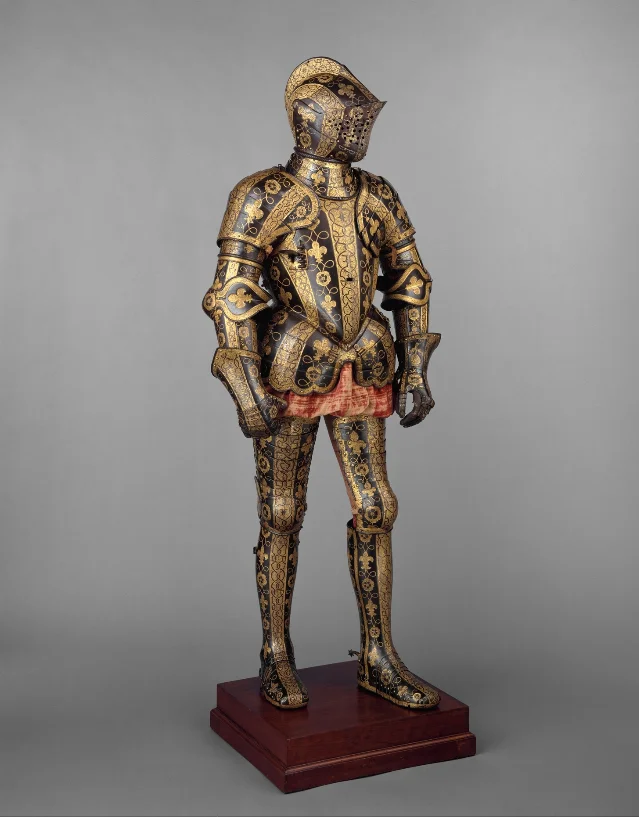
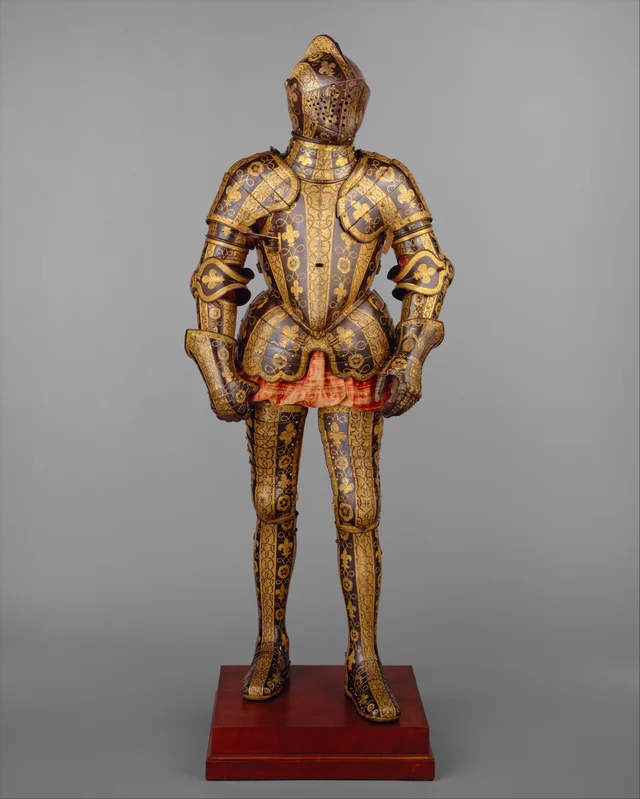
In Gallery 371 of the Metropolitan Museum of Art, among the lances and longbows and pitted iron sallets, one suit of armor refuses to recede into the background. It is 69.5 inches tall, weighs 60 pounds, and is covered — every articulated plate, every overlapping lame (the hinged steel strip connecting one section to the next), from the pointed steel sabaton (foot armor) at the foot to the visor-slots of the close helmet above — in a dense program of fire-gilded decoration that was not purely decorative. The Tudor rose, the French fleur-de-lis, and a doubled letter "E" repeat in gleaming columns across a deep blue-black steel ground, from the neck to the knees and back again. That "E" was not for the Earl who wore it. 1
It was for Elizabeth.
The armor belonged to George Clifford, 3rd Earl of Cumberland (1558–1605), and it was made in 1586 at the Royal Workshops at Greenwich — the Tudor equivalent of a custom coachbuilder, staffed by German craftsmen and patronized by the English crown. 2 Clifford wore it to joust at the tilts held every November 17th at Whitehall Palace, where the Elizabethan court spent an entire afternoon staging elaborate chivalric theater in honor of the queen's accession. He was, by the 1590s, the man at the center of that theater — Elizabeth I's own appointed Champion, the lord required to ride out on horseback and publicly defend her honor against all challengers. The armor was his professional costume, his oath of fealty hammered flat.
Today, it is accession number 32.130.6a–y, and the Met's curatorial description calls it without qualification "the best preserved armor garniture from the royal workshops at Greenwich." 1 It spent approximately 300 years in a castle in northern England, barely used, slowly becoming the finest surviving monument to a workshop that closed nearly four centuries ago.
The workshop at the bend in the Thames
To understand why the Cumberland armor looks the way it does, you need to understand the place that made it — and the particular moment in that place's history when it was made.
The Royal Workshops at Greenwich were founded by Henry VIII around 1514–1515, on the south bank of the Thames adjacent to Greenwich Palace. 3 Henry had watched Italian and German princes wearing the finest plate armor in Europe and wanted the same capability on English soil, in English hands. He imported it: the first staff included Italian masters and Flemish craftsmen, but Henry quickly consolidated around German specialists, known in England as "Almains." The word came from "Allemand" — French for German — and the Greenwich armorers were sometimes called the "Almain Armoury" accordingly.
For its first decades, the workshop produced armor of excellent quality but conventional aesthetics. What transformed it, in the 1570s, was a shift in the English court's entire conception of what armor was for. Under Elizabeth, who ascended in 1558 and never led armies into battle, the old function of armor — to keep the wearer alive in combat — gradually gave way to a newer function: to communicate, to perform, to display loyalty in a form the queen could admire from a gallery.
The man who ran the workshop during this transformation was Jacob Halder, a German armorer who arrived in England around 1555 and served as Master Workman at Greenwich from 1576 to 1607. 4 These were, by common agreement, the workshop's peak years. Under Halder, Greenwich developed a signature style: blued steel ground — the metal heated to around 250°C until it turned an iridescent dark blue-black — overlaid with etched and fire-gilded decoration in the vivid, swirling vocabulary of Elizabethan ornament. The Victoria and Albert Museum, which holds Halder's design book, says his "contribution to the history of English armour cannot be overemphasised. He led the workshop at the peak of its creativity." 5
The gilding was done by mercury gilding — also called fire gilding, a process as dangerous as it was beautiful. Artisans mixed powdered gold with liquid mercury to form an amalgam paste, painted this onto the areas to be gilded, and then applied heat. The mercury vaporized — poisoning the air in the workshop — while the gold fused permanently to the steel surface. 6 The result was durable, rich, and could be worked at a detail level that painted gold could never match. Edward Hunter, writing for the Met's Heilbrunn Timeline, described the outcome in the Cumberland armor specifically: "Equally impressive is the combination of bluing and gilding shown in the armor of George Clifford, with its distinctive contrasting patterns of gold and heat-blued steel." 6
The etching was acid work: the steel surface coated with a wax resist, the pattern scratched through to expose the metal, the piece immersed in dilute acid until the exposed areas were bitten down to form shallow channels. 7 These channels were then filled with the amalgam and fired. Every inch of the Cumberland armor went through this sequence.
Greenwich's other defining innovation was the peascod cuirass — the breastplate shaped to imitate the fashionable civilian doublet of the 1560s and '70s, which puffed outward at the belly in an exaggerated curve ending in a small forward projection at the groin. 3 Elizabethan men's fashion and Elizabethan armor were deliberately legible to the same audience; a courtier's breastplate announced that he was current, stylish, worth watching. Horizontal bands of gilded steel running across the pauldrons (shoulder guards) echoed the embroidered cloth strips on fashionable sleeves. The armor was dressing like a man, in the most literal sense possible.
A garniture: the Swiss Army knife of combat
The Cumberland armor is not just a suit — it is a garniture, a modular combat system that could be reconfigured for different types of fighting. 8 The concept was one of the later sixteenth century's more ingenious inventions: rather than commissioning separate armor for the tournament, the field, and the parade, a nobleman could purchase one carefully designed base harness and a set of "pieces of exchange" — supplementary plates that, added or swapped in, converted the armor for each function.
The Cumberland garniture originally comprised approximately 48 pieces. The base harness — a full cap-à-pie suit covering the wearer from head to foot — could be supplemented with:
- A grandguard: a reinforcing plate covering the lower face and upper left torso, bolted on for mounted jousting (tilting) to protect the side facing the opponent's lance
- A passguard: additional defense for the left elbow, which bore the brunt of a lance-strike
- Four vamplates: steel guards fitted over the grip of the jousting lance itself, protecting the hand from a glancing blow
- A close helmet with a detachable visor reinforce: for combat on foot in the tournament barrier, where opponents met face to face with blunted weapons
- A chanfron (horse-head defense) and saddle plates: for the mounted cavalry display, where the horse itself became part of the visual statement
The only piece now missing from the Met's collection is the left gauntlet, replaced by a similar Greenwich gauntlet of the period. 9 Everything else — all 25 sub-components recorded in accession numbers 32.130.6a through 32.130.6y — survived. Google Arts & Culture describes it, using the Met's own language, as "the best preserved, most extensive armor garniture from the Royal Workshops at Greenwich." 9
George Clifford: the man with Elizabeth's glove in his hat
The man this armor was built around was not the kind of person you'd expect to find in a suit of defensive metalwork. George Clifford succeeded his father as 3rd Earl of Cumberland at age twelve, in 1570. 10 He grew up at court, became an exceptionally accomplished jouster, and by the 1580s had established himself as one of the more conspicuous personalities in an era that rewarded conspicuousness. A contemporary described him as "a man of great personal beauty, strong and active, accomplished in all knightly exercises, splendid in his dress, and of romantic valour." 10
He was made a Knight of the Garter in 1592 — the highest order of English chivalry — and two years earlier had been appointed Queen's Champion, succeeding Sir Henry Lee of Ditchley, who had held the role since devising the tournament structure in the 1570s. 1 As Champion, Clifford was required to appear at the annual Accession Day tilts — held at the Whitehall tiltyard every November 17th, the anniversary of Elizabeth's accession — in full armor, with all the theatrical accompaniment the occasion demanded. He had also sat as a peer at the 1586 trial of Mary, Queen of Scots, and was involved in the early formation of the East India Company. 10
The Accession Day tilts were a sustained piece of theater unlike anything else in the Tudor calendar. 11 Knights arrived in allegorical pageant cars, or on horseback in costumes representing heroic or romantic characters drawn from Arthurian legend and Italian romance. Squires presented the queen with decorated pasteboard shields explaining each knight's allegorical identity and the conceit behind his costume. Thousands attended — the public was admitted for a shilling — and the whole spectacle lasted most of the day, a combination of genuine athletic competition and elaborate courtly performance. The German traveler Lupold von Wedel attended the tilt of 1584 and wrote a vivid account in which some servants appeared "disguised like savages, or like Irishmen, with the hair hanging down to the girdle like women." 11
For Clifford, the 1586 garniture was both working equipment and a specific political statement. The Met's curatorial description notes that "he chose for the decoration of this armor the Tudor rose, the French fleur-de-lis (then part of the English arms), and the cipher of Elizabeth, two E's back to back." 1 These were not generic ornaments. The Tudor rose was the royal dynasty's own emblem. The fleur-de-lis appeared in the English arms as a claim to the French throne that English monarchs had maintained since Edward III in 1340. And the doubled "E" cipher was purely personal devotion made visible — the same letter that appeared in Elizabeth's correspondence, on her seals, on the emblems her favorites wore. The armor announced, to anyone watching from the gallery: this man is the queen's, entirely.
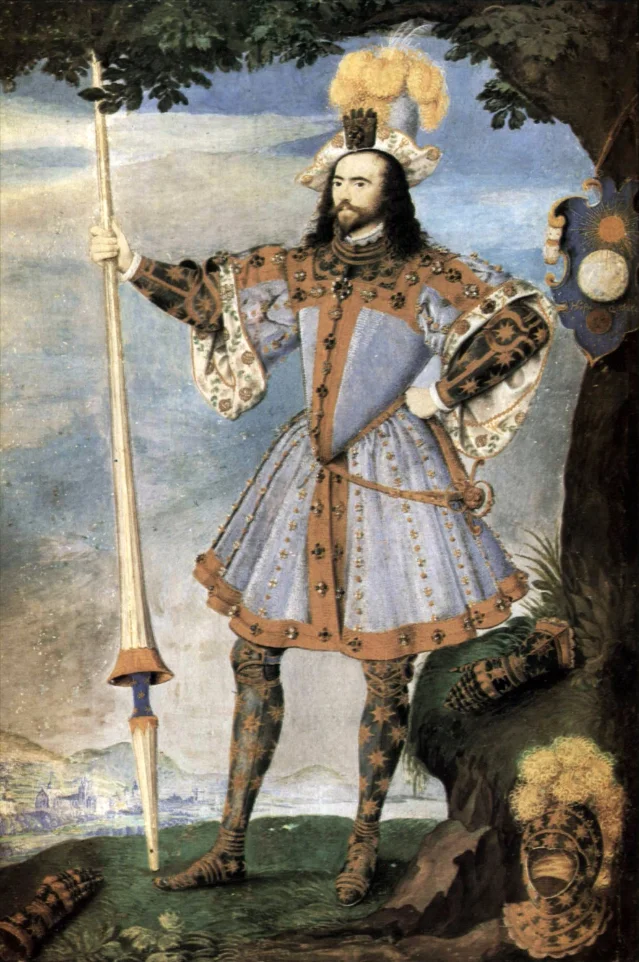
Nicholas Hilliard — the greatest miniaturist of the Elizabethan age — painted Clifford around 1590, in the year he assumed the Champion's role. The portrait is the largest Hilliard miniature to survive, now in the National Maritime Museum at Greenwich (MNT0193). 12 It shows Clifford standing under an oak tree, holding a tilting lance, wearing Elizabeth's glove pinned to his plumed hat — her "favor," the token a lady granted a champion before combat. The armor in the miniature is decorated with a star pattern and bears armillary spheres on the surcoat; it is an entirely different design from the Met armor, and scholars believe Hilliard may have invented it wholesale for the composition. 3 The real armor — the blued and gilded garniture — was too complex to render in watercolor on vellum at portrait scale. Hilliard gave his patron something more symbolically appropriate instead.
Off the tiltyard: Clifford at sea
The full portrait of Clifford requires an adjustment. He was not only, or even primarily, a tournament knight. He was also an Elizabethan privateer — a licensed freebooter, funding his naval expeditions through personal debt and hoping to recover the cost in captured prizes. In 1588, he commanded the galleon Elizabeth Bonaventure in the campaign against the Spanish Armada. 10 The following years saw him lead expeditions to the Azores (where he participated in the capture of the richly laden Portuguese carrack Madre de Deus in 1592) and commission his own 38-gun warship, the Scourge of Malice, later renamed Red Dragon.
His greatest military achievement came in June 1598, when his forces took Fort San Felipe del Morro, the massive stone citadel protecting San Juan, Puerto Rico. He served briefly as the first English governor of Puerto Rico from June 21 to August 13, 1598 — until dysentery forced his withdrawal and the Spanish returned to reclaim the island. 10
The naval career was expensive. Clifford invested heavily and won large prizes — the Madre de Deus alone yielded enormous Spanish and Portuguese cargo — but lost most of it in jousting and gambling. The Dictionary of National Biography described him as "a sort of nautical Quixote," and by the end of his life he had been "obliged to sell his inherited lands." He died in London on October 30, 1605, at age forty-seven. 10
His sole surviving child was a daughter: Lady Anne Clifford (1590–1676), 14th Baroness de Clifford in her own right, who became one of the more remarkable figures of seventeenth-century England. She spent decades fighting to reclaim her father's estates, eventually succeeding, and lived to be eighty-six. She placed her father's armor, along with many of his possessions, at Appleby Castle in Westmorland — one of the Clifford family's inherited properties in what is now Cumbria. 13
Halder's book, and what it recorded
Before the armor left Greenwich in 1586, Jacob Halder drew it in his design book.
The Almain Armourer's Album — also called the Jacob Album, or the Jacobe Album — survives at the Victoria and Albert Museum in London, classified among that museum's Elizabethan treasures. 5 It is a manuscript of 56 sheets compiled between 1557 and 1587, containing 29 designs for armor executed in pen, ink, and watercolor. Each design shows a mounted figure in full armor on one page, and the supplementary exchange pieces on the facing page. The first two designs are marked "MR" for Mary Tudor; the rest are marked "ER" for Elizabeth Regina. Among the ER designs are commissions for Robert Dudley, Earl of Leicester; Sir Christopher Hatton; Sir Henry Lee; Sir James Scudamore; Thomas Sackville, Lord Buckhurst; and George Clifford, Earl of Cumberland.
Clifford's design in the album corresponds closely to the surviving armor at the Met — the gilded columns of alternating fleurs-de-lis and Tudor roses, the doubled "E" ciphers, the characteristic composition of bands and ornamental zones that covers every plate. 5 The album functioned as both a pattern book and a record — a directory of the workshop's commissions, annotated with the client's identity, kept as a reference for future orders and as evidence of the shop's capabilities. That it survived intact across five centuries is improbable. The V&A notes that some designs are lost, leaving only their imprints on adjacent sheets — ghost images of armor no longer traceable.
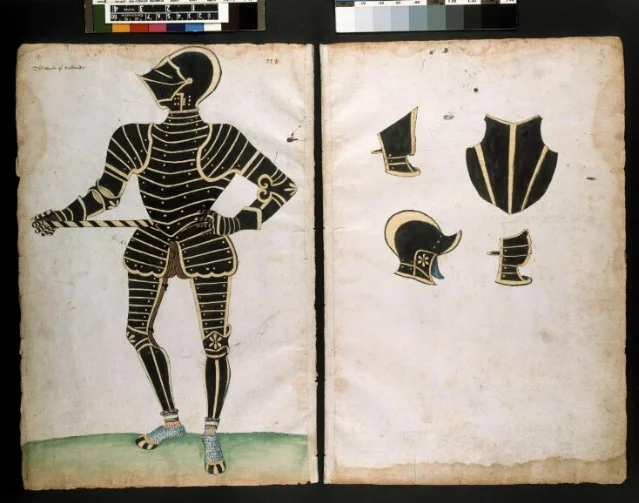
The armor for Sir James Scudamore, also recorded in the album, stands in the Met's Gallery 371 directly adjacent to the Cumberland garniture. Scudamore (1568–1619) was a gentleman usher and tournament competitor at Elizabeth's court — immortalized as "Sir Scudamour" in Book Four of Edmund Spenser's The Faerie Queene — who at age eighteen had carried the pennant of Sir Philip Sidney's arms. 3 His two surviving armors, displayed nearby, use a different decorative program (an S-band pattern over russeted steel) but were made by the same hands, in the same workshop, in the same years. The Met's Gallery 371 has, in effect, reconstructed a small part of the Greenwich workshop's output in a single room.
Three hundred years in a northern castle
After Lady Anne Clifford died in 1676, the armor passed through Appleby Castle to her descendants through the Tufton family — the Earls of Thanet — and their successors. 10 The Google Arts & Culture provenance record for the armor lists its pre-Met history simply as: "Ex coll.: Lord Hothfield, Appleby Castle, Westmorland." 9 Lord Hothfield was a Tufton descendant — the family connection running through Anne Clifford's daughter Margaret Sackville — who held Appleby Castle into the early twentieth century.
For approximately 300 years, then, the Cumberland garniture sat in a castle in Westmorland that had once belonged to the Clifford family, in a county now called Cumbria, on England's northwestern border with Scotland. Nobody was jousting with it. Nobody was attacking anyone at the Whitehall tiltyard. The Elizabethan court had dissolved, the tilts had ended with the Queen's death in 1603, and the workshop at Greenwich had closed sometime around 1630 when a royal commission declared it redundant and the remaining armor was moved to the Tower of London. 3 The Cumberland armor, sealed in its northern castle, simply waited.
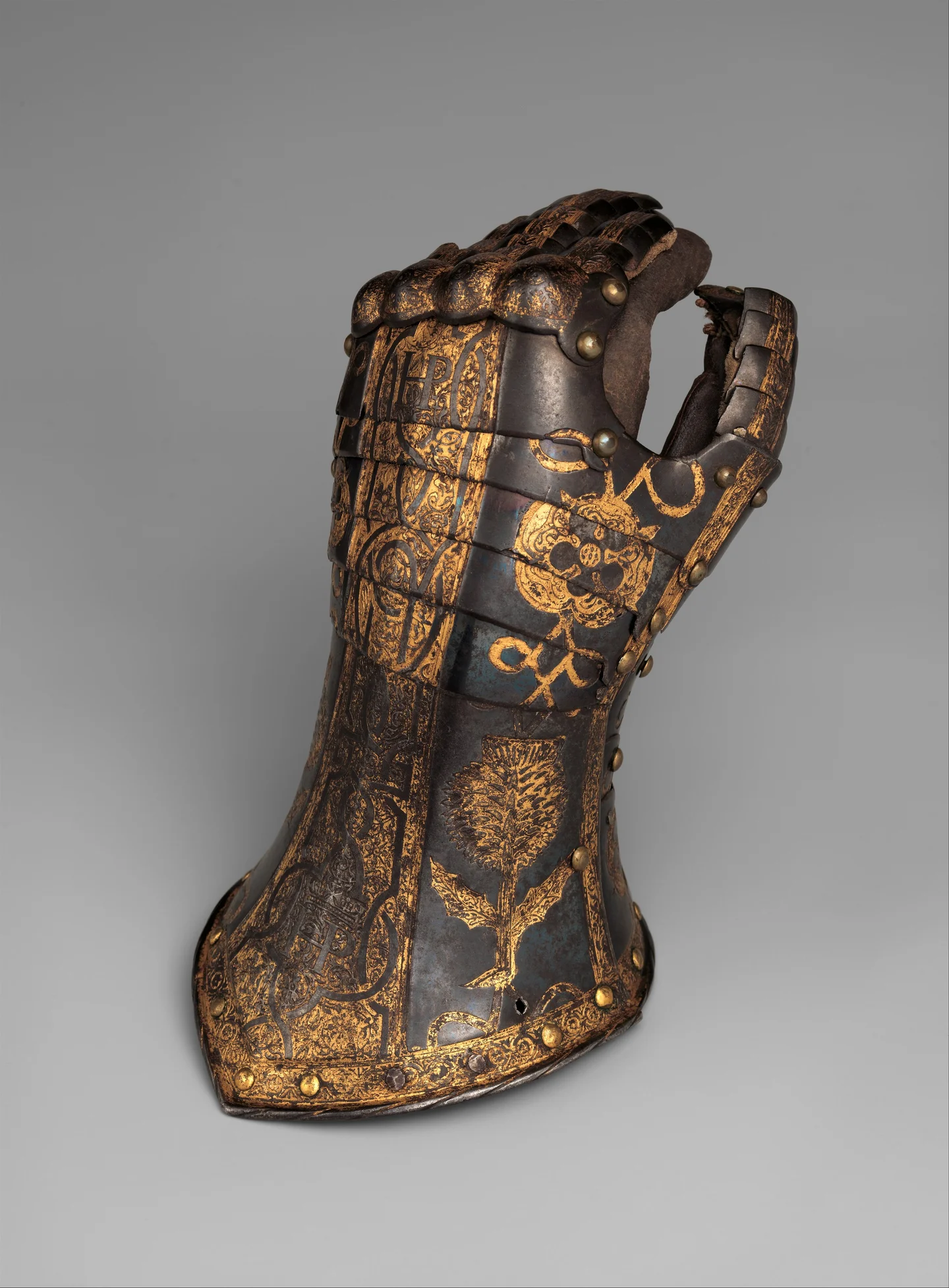
A gilded gauntlet detail
What kept the armor intact through those three centuries is a reasonable question without a certain answer. The Greenwich workshop, during Halder's tenure, produced armor of exceptional quality — the steel alloy was medium-carbon, hardened through a technique known as "slack quenching" developed by an earlier master, Erasmus Kirkenar — and the bluing and gilding were unusually durable surface treatments. 3 But physical durability alone doesn't explain 300 years of survival in a castle that changed hands, weathered the English Civil War, and passed through generations of owners who had no particular reason to curate it. The answer is probably simpler: someone knew what it was, or recognized it as too significant to discard, and that recognition — transmitted across generations — held until an American collector arrived to take it off their hands.
Clarence Mackay and the Harbor Hill collection
In 1923, Lord Hothfield sold the Cumberland garniture to Clarence H. Mackay (1874–1938), an American financier and collector based at Harbor Hill, his estate in Roslyn, Long Island. 13 Mackay was the son of John William Mackay, one of the bonanza silver kings of the Nevada Comstock Lode, and had built the family's telegraph and cable interests into a substantial fortune. He was also a trustee of the Metropolitan Museum of Art — which mattered for what happened nine years later.
Harbor Hill itself was one of the great Gilded Age estates, designed by McKim, Mead & White in the manner of a French château, with a great hall large enough to display Mackay's collection of arms and armor. The Cumberland garniture stood in that hall alongside other pieces from the finest European collections, where it had moved from a border castle to a Long Island palazzo without losing any of its original strangeness. A medieval tournament garniture, designed for a specific political moment in a specific court, now functioned as a trophy — evidence that America's wealthiest families could acquire the physical relics of European nobility.
The Munsey Fund and a Depression-era acquisition
Clarence Mackay died in 1938, but the Met acquired the Cumberland armor before that — in 1932, during the depths of the Great Depression, using the Munsey Fund. 2 The Munsey Fund was established from the estate of Frank Andrew Munsey (1854–1925), an American newspaper and magazine publisher who left the bulk of a fortune estimated at $20–40 million to the Metropolitan Museum of Art at his death. 14 Munsey had pioneered pulp magazine publishing and consolidated numerous American newspapers through aggressive mergers; he was known in press circles as the "Dealer in Dailies." He died childless, and the Met was his primary beneficiary.
The fund gave the museum purchasing power at precisely the moment when major collections were coming to market. The Met's Bulletin noted, looking back from 1991: "Glorious armors from Trustee Clarence Mackay's fabled collection were purchased during the depths of the Depression." 13 The accession number — 32.130.6a–y — records the transaction: 1932, the 130th acquisition of that year, object 6, sub-components a through y. The terminal lame of the grandguard came separately in 1936, through the Rogers Fund (accession 36.98.1). 2
The Met placed the armor in Gallery 371 — the Arms and Armor Court on the first floor of the Fifth Avenue building — where it has remained. It has been exhibited internationally, including appearances in London in 1890, 1934, and 1951, and in New York in 1967 and 1970–71. Most recently, it was included in "The Tudors: Art and Majesty in Renaissance England," which traveled between October 2022 and September 2023 to the Met Fifth Avenue, the Cleveland Museum of Art, and the Legion of Honor in San Francisco. 1
What the decoration said, and to whom
The Met's curatorial note about the decorative program — Tudor roses, fleurs-de-lis, doubled "E" ciphers — frames it as Clifford's deliberate political expression, but it's worth dwelling on the mechanics of how this communication worked.
The Accession Day tilts happened in a tiltyard. Elizabeth watched from a gallery above. The combatants were armored, moving, at distance. To read the decoration on a piece of armor in motion, you needed either very good eyesight or prior knowledge of what to expect — and at a court where the whole point was elaborate, legible allegory, prior knowledge was exactly what the audience possessed. Knights announced their allegorical identities in advance; the decorative programs of their armor were discussed and recognized before the tilt began. A squire presented the queen with a pasteboard shield explaining each knight's conceit, so that when the armored figure rode out, the embroidered "E" on his breastplate and the gilded roses on his tassets (the articulated plates hanging below the waist to protect the thighs) were already contextually readable. 11
This was not private devotion encoded in steel. It was public devotion performed in steel, for an audience that had been prepared to receive it. The armor was Clifford's argument — made in gold on black, hammered, etched, and fire-fused across 60 pounds of metal — that he was the queen's man utterly and by choice.
Wikipedia summarizes the scholarly consensus on the object's place in the historical record: "George Clifford's tournament armour survives and is considered the finest surviving garniture of the Tudor period. As Queen's Champion, Clifford's armour has been unrivalled in beauty." 4 The armor specialist website myArmoury.com, citing physical examination of the piece, calls it "arguably the finest example of surviving English Greenwich armour." 13
Gallery 371, and what survives
Stand in front of the Cumberland garniture today and you are looking at something that has survived two queens, a civil war, the dissolution of the workshop that made it, the death of the man who wore it, and the estate sales of two aristocratic families. It has been in New York for 93 years — longer than it spent in the active Elizabethan court for which it was made.
The armor weighs 60 pounds, stands 69.5 inches tall, and carries accession numbers that run from 32.130.6a to 32.130.6y — twenty-five components, each tracked. 2 The left gauntlet is a replacement. Every other piece is original. The blued steel has held its color across 440 years; the gold has not faded. The overlapping lames at the elbow and knee still articulate — the sliding rivets and leather straps replaced but the steel itself unchanged. The close helmet, fitted with its extra visor reinforce for foot combat, still closes. The grandguard still bolts on.
In the 1580s, when Jacob Halder designed this garniture and his craftsmen heated the steel to 250°C to achieve that blue-black ground, then painted mercury-gold amalgam onto the etched surfaces and heated it again until the mercury burned off and the gold locked in — nobody was building something for the ages. They were building something for the next November 17th, when George Clifford would ride out at Whitehall with Elizabeth's cipher on his chest, and the queen would watch from above, and the whole court would understand what the armor was saying.
The November 17ths ended with Elizabeth's death on March 24, 1603. The last Elizabethan tilt had been held in November 1602, and the queen was visibly unwell by then. The tilts were never revived with the same scale or commitment under James I. Clifford died two years later, in 1605, at forty-seven, having spent his fortune on ships and gambling and lost most of it. The armor was laid up at Appleby Castle and left there.
It is, in the Met's Gallery 371, surrounded by the other surviving objects of the same world — Sir James Scudamore's armor directly adjacent, the two figures standing in the quiet of the Arms and Armor Court like the last two guests at a party that ended four centuries ago. The tournament culture they were built for is entirely gone. The queen they were built to honor is a figure in history books. But the armor is present, intact, still legible: the Tudor rose, the fleur-de-lis, the doubled "E" on every surface, still saying, across 440 years, exactly what George Clifford intended it to say.
Cover image: Armor Garniture of George Clifford, 3rd Earl of Cumberland (acc. 32.130.6a–y), Jacob Halder, Royal Workshops at Greenwich, 1586. The Metropolitan Museum of Art, Munsey Fund, 1932. CC0, Metropolitan Museum of Art
참고 출처
- 1Metropolitan Museum of Art: Armor Garniture of George Clifford
- 2Metropolitan Museum of Art Collection API: Object 23939
- 3Wikipedia: Greenwich armour
- 4Wikipedia: George Clifford, 3rd Earl of Cumberland
- 5Victoria and Albert Museum: The Almain Armourer's Album
- 6Metropolitan Museum of Art: Fire Gilding of Arms and Armor
- 7Metropolitan Museum of Art: Techniques of Decoration on Arms and Armor
- 8Metropolitan Museum of Art: Arms and Armor in Renaissance Europe
- 9Google Arts & Culture: Armor of George Clifford, Third Earl of Cumberland
- 10Wikipedia: George Clifford, 3rd Earl of Cumberland
- 11Wikipedia: Accession Day tilt
- 12Royal Museums Greenwich: George Clifford, 3rd Earl of Cumberland
- 13myArmoury.com: Sir George Clifford
- 14Wikipedia: Frank Munsey
이 콘텐츠를 둘러싼 관점이나 맥락을 계속 보강해 보세요.