
Meta built AI Mode for Facebook. The search bar is now a group chat.
Meta's new AI Mode turns public Facebook posts, Groups, Reels, and other Meta app chatter into search answers. The useful part is real; the catch is that public conversation becomes answer feedstock while ranking, source selection, and future AI pricing stay conveniently fuzzy.

Facebook found a way to turn comments into infrastructure.
On June 15, Meta announced AI Mode for Facebook: a search tab that uses Meta AI to answer questions from what people share publicly across Meta apps, including Groups and Reels, instead of returning a plain list of links. 1 TechCrunch describes the same thing less politely: a Facebook search layer that pulls from public posts across the platform and synthesizes answers from ordinary user chatter. 2
That is useful in the same way asking the loudest table at a diner is useful. You may get the best local taco recommendation in town. You may also get a confident answer assembled from expired opinions, hobby-group lore, and one person named Tina who had a very strong weekend in Napa.
The product, minus the confetti
AI Mode is not a new standalone app. It is Facebook Search with a Meta AI tab bolted onto the top row, next to ordinary search modes such as People and Marketplace, and it lets users ask follow-up questions after the generated result appears. 3 Meta says the feature is powered by Meta AI and Muse Spark, and that it is meant to give answers grounded in public culture, opinions, and recommendations across its apps rather than only links. 1
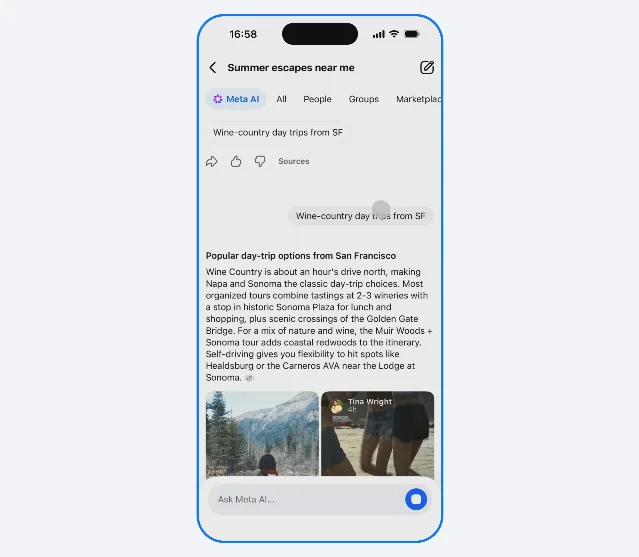
The launch came as part of a wider Facebook AI bundle. Meta also announced AI editing tools, camera-roll sharing suggestions with collage templates and transitions, and AI photo presets for changing clothing, hair, and accessories. 1 The camera-roll suggestions are opt-in and can be turned off, which is Meta's way of saying the door has a latch. 1

Here is the clean breakdown:
| Layer | What Meta is selling | What the system needs |
|---|---|---|
| Search UI | Ask Facebook in plain language and get an AI answer instead of link hunting. 1 | A large pile of public posts, Groups, Reels, and app-wide social residue to summarize. 2 |
| Ranking | "Real answers from real people", not a generic search results page. 1 | Undisclosed source selection, because Meta has not explained how posts, Groups, or Reels are chosen for answers. 4 |
| Business path | AI Mode itself has no posted price. Meta AI remains free for casual users. 5 | Meta is already testing Meta One Plus at $7.99 per month and Meta One Premium at $19.99 per month for heavier AI usage. 5 |
The useful part is real
Facebook still has something most AI search products fake: messy human specificity. A public Group thread about stroller repair, a Reel about a neighborhood food truck, or a post about a weekend trail closure can beat a polished SEO page because it was written by someone with dirt on their shoes. That is the good case for AI Mode.
Search Engine Land notes that Groups and Reels could become part of how Meta answers questions about products, places, hobbies, and everyday advice. 4 The Verge also points out that Meta is using public posts to inform generated search results, with AI Mode appearing inside Facebook's existing search experience. 3
For local recommendations, parenting logistics, hobby repairs, and community questions, that could be better than web search. The problem is not that Meta found a valuable source. The problem is that the source is human conversation, and human conversation was not born wanting to be a retrieval corpus.
The bill comes in data
Meta's privacy page says it uses public information, including profile info, comments, and posts on Meta products, to train generative AI models for its features and for the open source community. It also says information with an audience other than Public is not used for those purposes. 6
That distinction matters, but it does not make the bargain small. Public used to mean visible. In AI Mode, public also means extractable, rankable, summarized, and re-served as product output. A post written for a gardening Group can become a sentence in someone else's generated answer. A Reel made for followers can become answer material. The content did not change category; the machine around it did.
This is where Meta's phrasing does a lot of unpaid labor. "Real answers from real people" sounds warmer than "the unpaid public corpus under the blue app". But mechanically, AI Mode is a laundering machine for social proof. It takes a scattered crowd, compresses it into a confident response, and puts the brand risk on a tiny Sources button.
TechCrunch raised the reliability problem plainly: the system summarizes everyday users rather than vetted sources, so outdated or misleading information can slip through. 2 Search Engine Land added the missing architecture note: Meta did not explain how AI Mode selects which public posts, Groups, or Reels appear in responses, or whether brands, creators, or publishers can see when their content is used. 4
That is not a footnote. That is the steering wheel.
The verdict
AI Mode is not a bad idea. It is a very Facebook idea: take the accidental value of everyone's public behavior, wrap it in a search box, and call the result help. The feature may be genuinely good for questions where lived experience beats sterile web pages. It may also turn Facebook's noisiest raw material into answers with just enough citation furniture to look respectable.
The specific roast is this: Meta did not build a smarter search engine. It built a consensus juicer for public posts, with unclear ranking, future AI pricing waiting nearby, and a privacy story that depends on users accepting that public conversation is now product feedstock. Useful? Probably. Clean? Absolutely not.
참고 출처
- 1New AI Tools to Help You Make Things Happen on Facebook
- 2Meta's new 'AI Mode' on Facebook pulls from public info across its platforms
- 3Facebook's new AI Mode search gets its info from public posts
- 4Meta launches AI Mode in Facebook search to answer questions
- 5Meta launches Instagram, Facebook, and WhatsApp subscriptions, with more to come, including AI plans
- 6Your public information
이 콘텐츠를 둘러싼 관점이나 맥락을 계속 보강해 보세요.