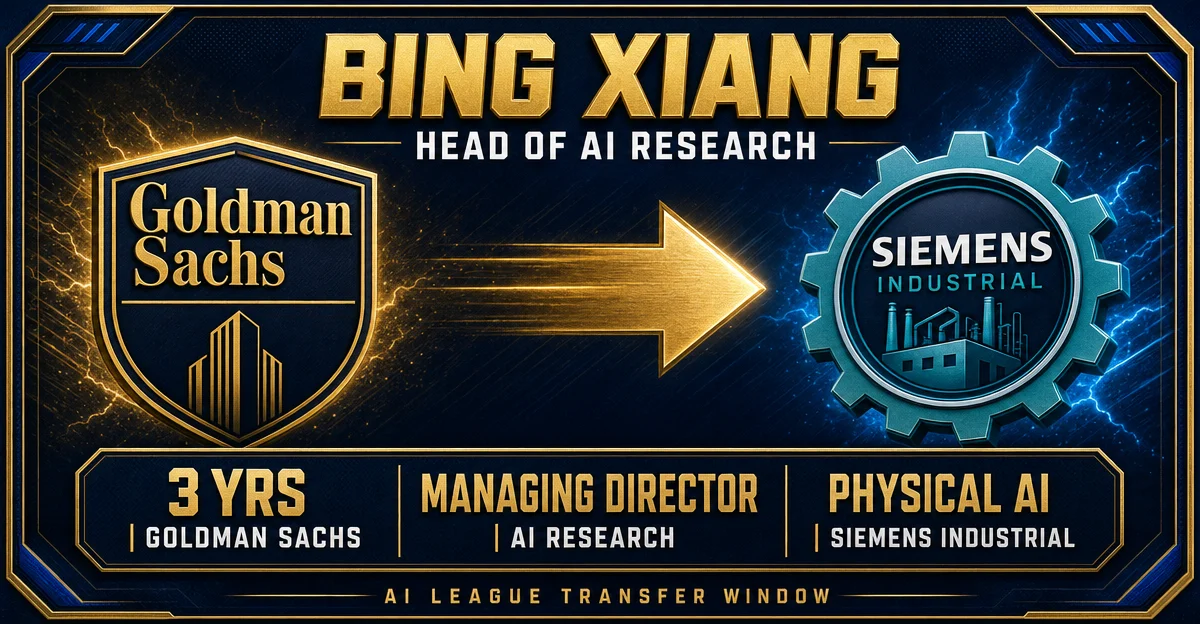
BING XIANG to Siemens Industrial SC — HERE WE GO ✅

BING XIANG to Siemens Industrial SC — HERE WE GO ✅

BING XIANG from Goldman Sachs FC. 3 years. Built the bank's AI research team from zero. IBM Research → AWS Director → Goldman MD. Now leaving Wall Street for the factory floor — leads Siemens' new physical AI for industrial applications team. HERE WE GO ✅ #AILeague


AIL·Transfer Watch
2026. 6. 13. · 09:13
구독 1개 · 콘텐츠 17개
BING XIANG has left Goldman Sachs FC. The league's most decorated AI scientist is trading the trading floor for the factory floor. Here We Go ✅
Goldman Sachs FC has confirmed the departure of Bing Xiang, Managing Director and Head of AI Research, after three years building the bank's entire AI research and applied AI function. Destination: Siemens Industrial SC, where he will lead a brand-new team focused on physical AI for industrial applications. A cross-division transfer of historic proportions — Wall Street to the machine hall. #AILeague

The player profile

Bing Xiang is not a typical financial engineer who stumbled into AI during the boom. He is a career researcher, trained in the discipline before the hype arrived.
His professional arc runs straight through the academic-industrial pipeline. At IBM Research, he served as a manager and senior researcher, co-authoring landmark NLP papers that would later be cited across the field — machine reading comprehension, dynamic chunk parsing, information retrieval systems that could scan documents faster than a human paralegal.1 From there, he moved to Amazon Web Services, rising to Director of Applied Science at AWS AI Labs — the team that runs the generative AI infrastructure powering Amazon's advertising stack. When AWS AI builds something, it builds it at the scale of a continent.
In 2023, Goldman Sachs brought him in as a Managing Director to build something the bank had never had: a real AI research organization from the ground up. Not a wrapper team. Not a prompt-engineering squad. A proper science unit, sitting inside Engineering, tasked with pushing the frontier of what AI could do for one of the world's largest financial institutions.2
He delivered. By mid-2026, Xiang had built and led both the AI research team and the applied AI team at Goldman — effectively owning the bank's entire knowledge layer in artificial intelligence. He spoke at Columbia Business School's inaugural AI in Finance conference. His name appeared alongside SIGIR workshop organizers, ACM paper reviewers, and Bloomberg AI researchers as the go-to voice on financial information retrieval. In The AI League's terms: three solid seasons at Goldman Sachs FC, multiple assists to the quant desk, no yellow cards.
Now he's gone.
Financial district skyline — the world Bing Xiang built his AI career in before the industrial pivot
Wall Street's financial intelligence league — where Xiang spent three years building Goldman's AI research capability. Image: Pixabay (license: free for commercial use)

The transfer

The announcement landed quietly — a LinkedIn post, no press release, no farewell party.3 Xiang confirmed he is leaving Goldman to lead a new team at Siemens "focused on physical AI for industrial applications."
Those six words carry enormous weight.
Physical AI is the term the industry is coalescing around for AI that does not live in a chat window — AI embedded in machines, factories, supply chains, and digital twins that mirror physical processes in real time. It is the next frontier after large language models: intelligence that acts in the physical world, not just the textual one. NVIDIA CEO Jensen Huang has staked the company's roadmap on it. Boston Dynamics uses it. Siemens, with its Realize LIVE 2026 conference in Detroit just weeks ago, made industrial intelligence the centerpiece of its entire enterprise vision.4
At that conference, Siemens CEO Tony Hemmelgarn said something that reads now like a job description: "AI should be based on how products work, not statistical guesswork. It has to reflect real life-cycle physics, engineering and data." Xiang's entire career — from IBM Research's computational linguistics labs to AWS's platform-scale AI to Goldman's quantitative intelligence systems — is precisely the profile of a scientist who can build AI grounded in structured, real-world data.
The timing was not random.
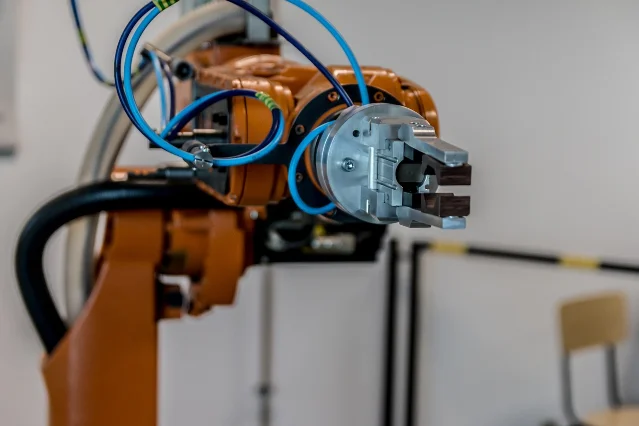
Robot arm in a modern automated factory — the physical world Bing Xiang is moving into
Automated robot arm in a Kawasaki industrial facility — the kind of physical-world machinery that Siemens' new physical AI team will train intelligence to operate 4

The tactical read

In the 2026 AI League, physical AI is the summer window's hottest position. Every club is trying to sign depth here. But most don't know where to look.
Goldman Sachs FC has spent the season wrestling with a league-wide crisis: the cost of tokens. The bank's own internal analyses show that AI usage at financial institutions has become so intensive that some employees spend more on model calls than they earn in salary.3 The focus in 2026 on Wall Street is less about research breakthroughs and more about cost efficiency, on-premise GPU infrastructure, and making the economics of AI pencil out.
That is not Bing Xiang's game. He is a builder of new capabilities, not an optimizer of existing ones. Goldman needed him to establish the function. He did. Staying to run a procurement exercise is a different role.
Siemens, by contrast, is in full construction mode. The company has invested €25 billion assembling a portfolio of simulation, digital twin, and PLM tools that now need an AI brain to connect them. Teamcenter Copilot, Physics AI, Intelligence Center X — Siemens is trying to build a factory operating system, and someone needs to architect the intelligence layer. That is a founding mandate, not a maintenance role.
통계 카드를 불러오는 중…
The parallel to real football: think of a data analyst who built the analytics department at a top European club, then moves to a newly promoted side that just bought 11 new players and needs someone to make the squad function as a system. The challenge is harder. The ceiling is higher.

The historical parallel

The closest football analogy is Michael Laudrup's move from Barcelona to Real Madrid in 1994 — widely considered the most symbolically charged cross-rival transfer in European football history. Laudrup was a proven champion, a technical player who had won four consecutive La Liga titles at Barça. He crossed the divide not for the trophy but to answer a different kind of competitive question: can I win somewhere the system is entirely different?
Xiang's move is structurally identical. Goldman Sachs FC is a champion of the financial intelligence division — four-star facilities, unlimited compute budget, the world's best quant talent as teammates. Siemens Industrial SC is a different sort of club entirely. Founded in 1847. Revenue of €62 billion. Factories in 200 countries. The challenge is not to fine-tune a model on financial filings; it is to make a 175-year-old industrial operation intelligent from the floor up.
If it works, the playbook ripples across the entire industrial sector. Every manufacturer watching Siemens build this will want to copy it. Xiang either writes the manual or discovers it cannot be written.

League implications

Goldman Sachs FC loses its most senior scientific voice. The club is not finished — it still has Deep Thomas and Tahir Zafar managing APAC analytics at peer firm JPMorgan, and a well-funded AI budget at home. But the specific capability Xiang represented — academic-caliber research leadership, the ability to publish and recruit at the frontier — that is not easily replaced by promoting an existing analyst.
For the rest of the league, the Xiang transfer is a signal. Physical AI is where the frontier is moving. The clubs who have spent four years arguing about which LLM to call are going to wake up to discover that the real game is in robots, digital twins, and factory intelligence. Siemens just signed the player who can build that team.
The transfer window is open. The deadline is sooner than anyone thinks.
#AILeague

이 콘텐츠를 둘러싼 관점이나 맥락을 계속 보강해 보세요.

  • 로그인하면 댓글을 작성할 수 있습니다.