The Painting That Fits in Your Hands — and Cannot Be Imagined Twice
A deep-dive narrative tracing Vermeer's The Lacemaker (Louvre MI 1448, c. 1669–70) — at 24 cm wide, the smallest painting he ever made — from its 28-guilder sale at the 1696 Dissius auction through 174 years of Dutch private hands, Thoré-Bürger's 1860s rediscovery of Vermeer, Rotterdam's fatal refusal, the Louvre's 7,500-franc purchase in 1870, the 1921 theft and recovery, and Salvador Dalí's rhinoceros-horn obsession. The article foregrounds Vermeer's audacious technique: the near-abstract foreground threads that anticipate Impressionism, the deliberate rightward light, and the 2006 discovery that its canvas was cut from the same bolt as a Leiden Collection painting.

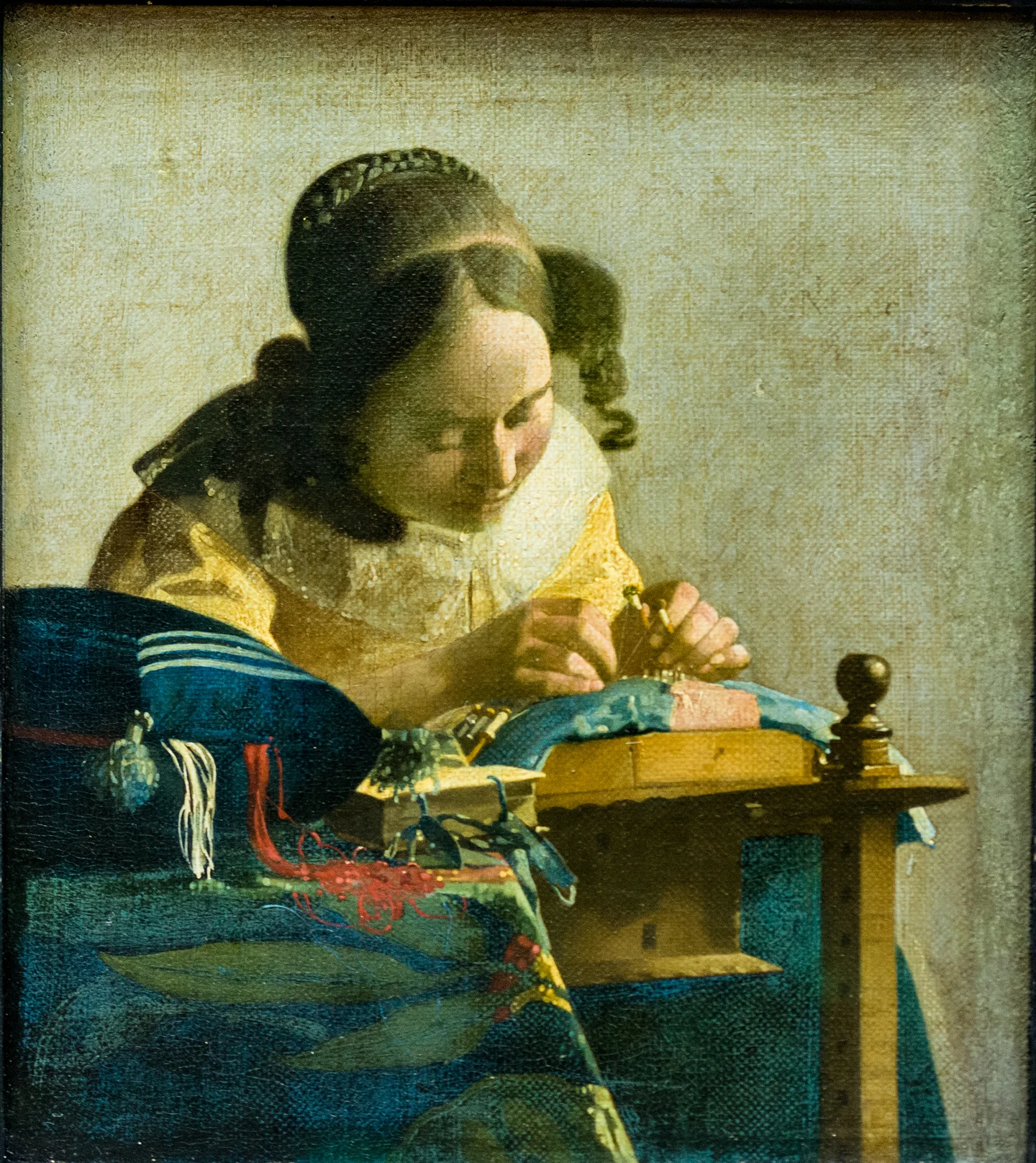
You could hold it. That is the first thing to understand about The Lacemaker — not as a figure of speech but as a physical fact. At 24 centimeters high and 21 centimeters wide, Vermeer's panel fits within a standard sheet of printer paper, with room to spare on all sides. 1 In Salle 837 of the Louvre's Richelieu wing, where it currently hangs among Dutch landscape paintings on the second floor, the painting sits within a carved wooden frame larger than the canvas itself — the frame nearly three times the width of the picture. Visitors who have crossed an ocean to see it frequently stop short and look around, certain they have the wrong painting.
They do not. The Lacemaker (accession MI 1448, c. 1669–1670, oil on canvas glued to oak panel) is the smallest painting Johannes Vermeer ever made, and it is the one that the art historian Lawrence Gowing, in 1952, concluded cannot be improved on or extended. "There is only one 'Lacemaker,'" Gowing wrote, "we cannot imagine another. It is a complete and single definition." 2 Auguste Renoir, for his part, called it one of the most beautiful paintings in the world. 3 The two judgments — one from a mid-century art historian, one from an Impressionist painter a generation earlier — point at the same thing: that this small picture does something most large ones cannot.
What it does, and how it got here, is one of the richer stories in the history of Western painting.
A woman in yellow, and what she is not
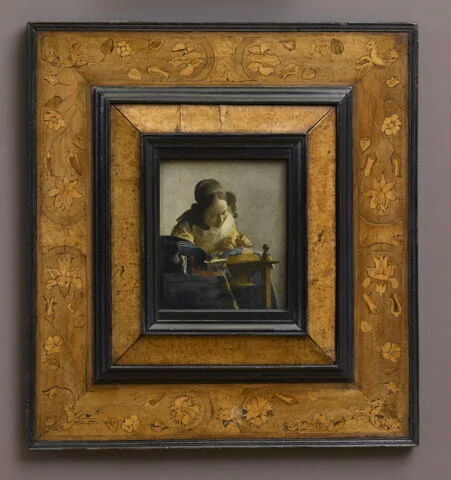
She is not a lacemaker. That is the second thing to understand. The woman in the yellow satin bodice, her head bent over the lace pillow, her fingers guiding a pin into the parchment pattern card (patroon) with the precision of a surgeon, is not a working-class girl grinding out yardage in a damp Amsterdam basement. The details of the painting place her precisely in Delft's prosperous bourgeoisie: the satin jacket is the same yellow silk Vermeer painted across multiple canvases — Lady Writing a Letter with her Maid, A Lady Writing, Woman with a Lute — a garment circulating through the studio as prop and social signal simultaneously. 2 The hairstyle — tightly pinned on top with a single loose ringlet falling beside her cheek — was in fashion for only a handful of years in Delft in the late 1660s, helping confirm the dating of c. 1669–1670 that Arthur K. Wheelock Jr. and Walter Liedtke both settled on. 1
The Louvre's own catalog entry is blunt about the iconography: "Le motif de la dentellière au travail est traditionnellement un signe de vertu domestique, teintée de moralisme religieux" — the lacemaking woman is traditionally a sign of domestic virtue tinged with religious moralism. 1 The small parchment-covered book resting on the table beside her almost certainly a Bible or prayer book. The blank whitewashed wall behind her — deliberately emptied of every distraction — may speak simultaneously to the 17th-century Dutch civic obsession with cleanliness, Calvinist aesthetic austerity, and Vermeer's compositional instinct to concentrate the eye.
Lacemaking in Delft occupied two entirely different social registers. In the orphanages and klopjes schools — like Haarlem's "De Hoek" — girls were taught the craft as a trade skill, a route out of poverty. 4 In the prosperous households of the Markt district, it was something else entirely: a performance of the diligent, virtuous femininity that Dutch civil society held as an explicit ideal. The costume specialist Bianca M. Du Mortier traced how the naaikussen — the sewing cushion, that blue fringed object in the painting's foreground — became, from the 16th century onward, an emblem of exactly this virtue. 2 The 17th-century poet Jacob van Eyck celebrated the lacemaker as the woman who "flashes the smooth balls and thousand threads into the circle... and no maiden ever complains, at even, of the length of the day." 4
Vermeer painted all of this — the virtue, the craft, the class signal — and then, characteristically, went further. Arthur K. Wheelock Jr. concluded that the moralizing program, though present, "seems secondary in this small but dynamic image. The concerns here are far more with the craft of lacemaking, and, even more broadly, with the human capacity to create." 5 What holds the viewer is not a sermon but a moment of absolute concentration — a mind entirely present in its work — rendered in the smallest canvas Vermeer ever completed.
What he painted, and how
The painting's technique is where its real strangeness lives.
Light enters from the right. Vermeer painted almost all his interiors from the left — the window on the left wall was so consistent a device that it became a signature element, as recognizable as his signature. Here, for reasons no one has satisfactorily explained, the light comes from the other direction. 1 One possible explanation: if Vermeer set up his scene in front of a camera obscura — a dark box with a small lens that projects an inverted image of a scene onto a surface inside — and the real model sat with her right side facing the window, the projected image inside the box would show the light coming from the left. To paint the projected image directly, a painter traces what he sees; to match the real scene, he must mentally mirror it. A painter working hastily, or one who felt the projected arrangement was visually superior, might simply paint the projected image — producing a mirror reversal of the real scene, which would explain the anomalous rightward light.
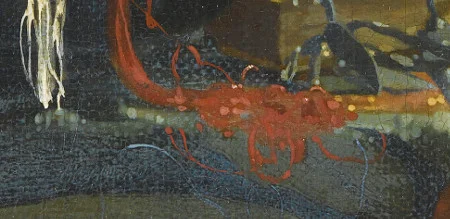
The foreground threads are the passage every scholar eventually stops at. They spill from the blue naaikussen in loose, near-liquid smears of red and white — out of context, they would be unidentifiable as thread. They represent the painting's most deliberate anomaly: sharp focus in the middle ground, where the lacemaker's hands and pin work are rendered with exquisite precision, and radical blur in the foreground. The physical tapestry covering the table is clearly defined. The woman's face is clear. The lace pillow and the parchment pattern card are legible. But the closest objects in the scene — the threads cascading from the cushion toward the viewer — dissolve into something more like Franz Kline's abstract expressionism than 17th-century Delft illusionism, nearly two centuries before Impressionism made such dissolution acceptable.
This was deliberate. The camera obscura, when focused on the middle ground, produces exactly this effect: objects in the extreme foreground fall outside the lens's focal plane and become luminous, colored blobs. Charles Seymour Jr. tested this in 1964 with a 19th-century camera obscura and found that the resulting image closely matched Vermeer's painted effects. 6 Philip Steadman, in his 2001 book Vermeer's Camera, used reverse perspective geometry to argue that at least six Vermeer interiors were traced from a booth-type camera, with the projected image landing on the back wall at exactly the canvas's dimensions. 6 The debate remains genuinely open: Walter Liedtke found pinholes at the vanishing points of 13 Vermeer canvases, evidence of the traditional perspective-string method rather than optics. 6 Wheelock, who originally accepted the camera thesis, later concluded that Vermeer "admired certain effects of color, light and focus in a camera obscura, but persistently departed from what he actually saw." 6
The best rebuttal to any mechanical reading of the technique is one specific detail: a single thin blue thread rests on the tapestry-covered table at the painting's very front, and it is in perfect, sharp focus — though it sits closer to the viewer than the blurred red and white threads behind it. Vermeer did not mechanically copy optical blur; he chose which objects to blur and which to sharpen, making aesthetic decisions that no lens makes on its own. 6 As Walter Liedtke put it, with an honesty rare in art scholarship: "That much was learning. The rest of it — genius — cannot be explained." 6
X-radiography has added one further detail: underneath the current composition, Vermeer originally placed the woman's knee lower, exposing a triangle of wall beneath the tabletop. He raised it, tightening the composition further, eliminating the last unnecessary gap. The ground beneath the painted surface is a thin gray-brown layer of chalk, lead white, and umber. Red, pink, and light blue areas were worked wet-in-wet. 2 And the canvas itself — 12 × 12 threads per centimeter, plain weave — turns out, when subjected to computer-assisted thread-count matching by Sheldon and Costaras in 2006, to come from the same bolt of fabric as a painting now in the Leiden Collection: A Young Woman Seated at the Virginals. 7 Two Vermeers, cut from the same cloth — a material intimacy between two masterworks that no one knew about for three hundred and thirty years.
Twenty-one Vermeers under one roof
Vermeer died in Delft in December 1675, at 43, leaving his wife Catharina Bolnes and eleven children in debt. The paintings were scattered.
His primary patron — the man most scholars believe owned The Lacemaker from shortly after its creation — was Pieter Claesz. van Ruijven (1624–1674), a wealthy Delft burgher who had loaned Vermeer 200 guilders in 1657 and whose wife, Maria de Knuijt, left the painter a conditional bequest of 500 guilders in her will — an arrangement without precedent in Dutch patronage records. 8 The relationship, as John Michael Montias noted in 1989, "went clearly beyond the routine contacts of an artist with a client." 8 Van Ruijven died the year before Vermeer. His collection passed to his widow, then to their daughter Magdalena, who married a Delft bookseller named Jacob Dissius in April 1680. Magdalena died two years later, possibly in childbirth. Dissius inherited. He died in October 1695.
Six months after Dissius's death, on Wednesday, 16 May 1696, an auctioneer at the Oude Heeren Logement in Amsterdam offered 21 paintings described in the Amsterdamsche Courant as "most powerfully and splendidly painted by the late Vermeer of Delft... the best he has ever made." 9 This was, by a substantial margin, the largest assembly of Vermeer's work ever placed in a single sale. The 21 canvases together fetched 1,503 guilders and 10 stuivers — enough to buy a comfortable house in Amsterdam, which is to say a reasonable sum for minor Dutch masters but not yet the recognition a later age would insist upon. A View of Delft sold for 200 guilders. The Milkmaid went for 175. 9

Lot 12 was listed as "Een juffertje dat speldewerkt, van den zelven" — a young lady doing needlework, by the same [artist]. It sold for 28 guilders. 9 This was among the lowest prices in the sale, reflecting the 17th-century art market's preference for larger, multi-figure compositions. The small panel that is now one of the most visited paintings in the Louvre changed hands that day for less than a laborer's monthly wage.
The painting then spent 174 years passing through Amsterdam and Hague collections, accumulating a chain of names that reads like a Dutch property register: Crammer Simonsz (1778), Nijman (1792), Wubbels, Spaan, Muilman (1813), Coclers, Lapeyrière (1817), van Nagell van Ampsen (1851). 10 Each transfer recorded a transaction; none appeared to have recognized what was being transferred.
The man who called Vermeer "the Sphinx of Delft"
The critical shift came in the 1840s, and it is due almost entirely to a single French journalist with an unlikely obsession.
Étienne Joseph Théophile Thoré (1807–1869) was a republican art critic who had been exiled from France for his political activities and wrote under the Dutch-sounding pseudonym "Willem Bürger" — a deliberate act of identification with a country whose art he had come to love while living there as a refugee. Around 1842, visiting the Mauritshuis in The Hague, he stood before a large canvas: a panoramic view of Delft, its rooftops and harbor caught in afternoon light, the sky reflected in still water. He consulted the catalogue. "Jan van der Meer of Delft," the label said. "Amazing!" he wrote later. "Here is someone of whom we know nothing in France, and who deserves to be known!" 11
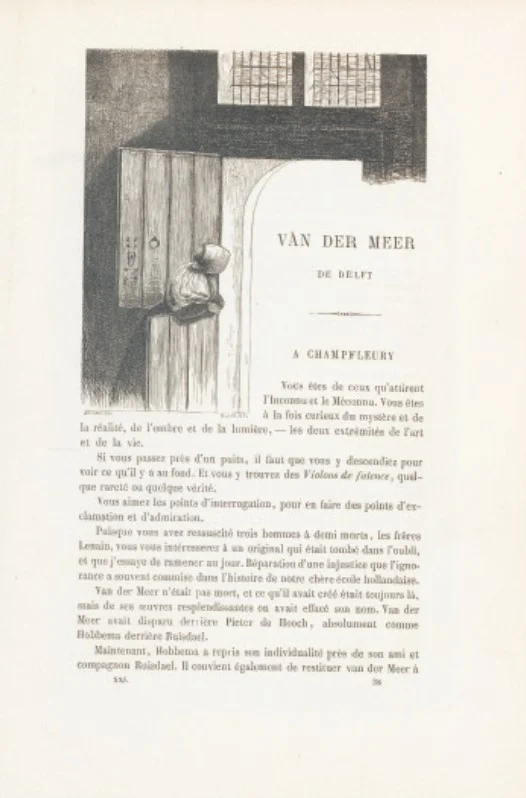
He spent the next twenty years hunting Vermeer across Europe. He wrote, with something close to extravagance: "To see one picture by van der Meer, I traveled hundreds of miles: to obtain a photograph of another van der Meer, I was madly extravagant." 11 In three landmark articles published in the Gazette des Beaux-Arts in October, November, and December of 1866, Thoré catalogued 66 paintings he attributed to Vermeer — too many, as later scholarship established, but the essential foundation of everything that followed. He called Vermeer "the Sphinx of Delft," a nickname that has never been fully retired. 11
By 1860 Thoré had already seen The Lacemaker. He cited it in the second volume of his Musées de la Hollande, locating it in the Rotterdam collection of Dirk Vis Blokhuyzen (1799–1869), a collector who had acquired the painting in 1851 at the sale of Baron van Nagell van Ampsen's estate. 11 In 1861, the Goncourt brothers — Edmond and Jules, the most discerning art connoisseurs of Second Empire Paris — visited Vis Blokhuyzen and admired the canvas in his home. 1 It was, at that point, the only Vermeer still in private hands in the Netherlands.
Thoré died on 30 April 1869, buried at Père-Lachaise — one year before the painting he had helped make famous entered the collection of France's greatest museum.
Rotterdam's refusal, and a purchase on the eve of war
When Dirk Vis Blokhuyzen died in 1869, he left his entire collection to the city of Rotterdam. Rotterdam refused. 10 The Louvre's provenance record states the reason with bureaucratic precision: "laquelle refuse le legs pour des raisons financières, ne voulant pas dédommager les héritiers" — the city refused the bequest for financial reasons, unwilling to compensate the heirs. 1 Wilhelm Bode, who would later become director of the Berlin Gemäldegalerie and was already a formidable figure in the art world, had tried to acquire the Blokhuyzen collection for Berlin. He also failed.
The refusal forced a Paris auction. On 1 April 1870, Lot 40 of the Vis Blokhuyzen sale was purchased by a Paris art dealer named Léon Gauchez. It passed quickly to a painter and expert called Eugène Féral. Two months later, in June 1870, the French State bought it directly from Féral — accession number MI 1448, "MI" for Musées Impériaux, a designation of the Second Empire under Napoleon III. 1 The purchase price was 7,500 francs — roughly the annual salary of a mid-level Paris clerk, for what the Dissius auction had sold seventy-four years earlier for 28 guilders.
The timing is vertiginous. Seven weeks after the Louvre acquired The Lacemaker, France declared war on Prussia (19 July 1870). Napoleon III was captured at Sedan in September. The Second Empire collapsed. Paris was besieged. The painting had arrived just in time.
What Salvador Dalí understood, and what he got wrong
In 1955, Salvador Dalí asked the Louvre's curators for permission to bring his painting materials into the museum and copy The Lacemaker directly on the spot. 2 The request was granted. Dalí had been fixated on the painting since childhood — a reproduction had hung in his father's office — and by the mid-1950s his obsession had found its theoretical form in his Paranoiac-Critical method: the idea that by deliberately inducing hallucinatory states, a painter could access hidden structural truths in existing images.
What Dalí saw in The Lacemaker was rhinoceros horns. He said so directly: "the first time I saw a photograph of [Vermeer's] Lacemaker and a live rhinoceros together, I realized that if there should be a battle, The Lacemaker would win, because The Lacemaker is morphologically a rhinoceros horn." 2 He also declared the painting "possessed by the most violent aesthetic power, to which only the recently discovered antiproton can be compared." 2
The rhinoceros-horn theory is absurd, in the way that Dalí's best pronouncements were always absurd — absurd and also somehow pointed. What he was reacting to, under the surrealist theater, was the painting's concentrated formal tension: the way a composition with almost no movement or drama produces an almost physical pressure on the viewer. He made two works directly from it: The Paranoiac-Critical Study of Vermeer's Lacemaker (1954–1955, 27.1 × 22.1 cm, Solomon R. Guggenheim Museum, New York) and The Lacemaker (after Vermeer) (1955, 23.5 × 19.7 cm, commissioned by Robert Lehman, now at the Metropolitan Museum of Art, accession 461684). 2 Both are unsettling objects — evidence of an artist trying to dissolve a 280-year-old painting into his own visual vocabulary, and not quite succeeding, which may be the point.
A robbery that went nowhere, and what the painting survived
The painting was stolen from the Louvre in 1921 and recovered shortly afterward. 7 The theft generated headlines; the quick recovery suppressed them. No lasting damage was recorded. The theft is a footnote now — less remembered than the 1911 theft of the Mona Lisa, but part of the Louvre's long catalog of paintings tested by crisis.
The Lacemaker emerged undamaged from the decades of institutional upheaval that followed the 1870 acquisition and found its current home in Salle 837, among the Dutch landscape painters of the Golden Age. The wall it shares with Jacob van Ruisdael's panoramic skies is an odd fit for Vermeer's smallest, most compressed canvas — a painting that has no landscape, no sky, no horizon at all. Only the blank wall, the woman, and her work.
The painting that almost never left the Netherlands — and what that means
There is a counterfactual history of The Lacemaker in which Rotterdam accepted the Blokhuyzen bequest in 1869, the city compensated the heirs, and the painting went to the Boymans Museum on the Maasboulevard. In that history, the Louvre never acquires it, France has no Vermeer in its national collection, and Thoré's campaign to rehabilitate Dutch 17th-century naturalism finds its most celebrated visual proof twenty kilometers from where Vermeer painted it, rather than in Paris.
Rotterdam's refusal was not principled — it was cheap. The city's finance committee saw a bill it didn't want to pay. The art market sent the painting to Paris, and Paris paid 7,500 francs for something that had cost 28 guilders in 1696. The gap between those two numbers is partly Thoré's achievement: twenty years of criticism and catalog-making that transformed an obscure Dutch painter into a European figure worth serious money.
Thoré did not live to see any of it. He died fourteen months before the purchase. His name appears in no acquisition document. But without his work, the Louvre's curators almost certainly would not have known what Féral was offering them.
Gowing's judgment, and what the painting still holds
The 2023 Rijksmuseum retrospective — the largest Vermeer exhibition ever mounted, with 28 of roughly 35 known paintings assembled in Amsterdam — attracted approximately 650,000 visitors from 113 countries. 12 Tickets sold out on the second day; a pair of e-tickets sold on eBay for $2,724. 12 The Lacemaker was exhibit number 27.
The critics competed for superlatives. Laura Cumming in The Guardian called it "one of the most thrilling exhibitions ever conceived." 12 Waldemar Januszczak in The Times called it "the exhibition of the century." 12 None of this would have surprised Thoré-Bürger, who died in 1869 knowing he had found something important but unable to prove it at quite this scale.
What those 650,000 visitors stood before — and what visitors to Salle 837 today stand before — is a painting that fits in your hands and has somehow outlasted every attempt to explain it. The canvas came from the same bolt of fabric as another Vermeer 250 miles away. The artist revised one knee and then stopped. The threads in the foreground dissolve into abstraction while a single blue thread nearby remains sharp, as if Vermeer wanted one last proof that the blur was chosen, not accidental.
Gowing's verdict holds: there is only one Lacemaker. Rotterdam didn't want it. Amsterdam sold it for 28 guilders. The Louvre bought it on the eve of a war. Salvador Dalí saw rhinoceros horns in it. And then it went back to the blank wall it has occupied, in various cities and frames, for three and a half centuries — the smallest painting Vermeer ever made, still holding more than any single reading of it can account for.
Cover image: Johannes Vermeer, The Lacemaker (La Dentellière), c. 1669–1670, oil on canvas glued to oak panel, 24 × 21 cm, Musée du Louvre, MI 1448. Public domain.
참고 출처
- 1Musée du Louvre: La Dentellière
- 2Essential Vermeer: The Lacemaker — Interactive Catalogue
- 3Barnebys Magazine: Did Vermeer Use a Camera Obscura?
- 4Essential Vermeer: Lace and Lacemaking in the Time of Vermeer
- 5Essential Vermeer: Understanding The Lacemaker
- 6Essential Vermeer: Vermeer and the Camera Obscura, Part Two
- 7Wikipedia: The Lacemaker (Vermeer)
- 8Essential Vermeer: Vermeer's Clients and Patrons
- 9Essential Vermeer: The Dissius Auction
- 10Essential Vermeer: The Provenance of Vermeer's Paintings
- 11Essential Vermeer: Thoré-Bürger and the Rediscovery of Johannes Vermeer
- 12Essential Vermeer: The Retrospective — Rijksmuseum, Amsterdam
이 콘텐츠를 둘러싼 관점이나 맥락을 계속 보강해 보세요.