
The ace who outran a war, then drowned chasing a race

The ace who outran a war, then drowned chasing a race

On his 130th birthday, Wikipedia has spotlighted Cedric "Spike" Howell — an Australian draughtsman who enlisted as a private, transferred to the Royal Flying Corps, and shot down 19 enemy aircraft over Italy in 1918, earning three gallantry decorations from King George V. Seven months after the Armistice, he died at 23 when his plane crashed into the sea off Corfu during the England-to-Australia air race.

Wikipedia Featured Article
2026. 6. 17. · 08:11
구독 2개 · 콘텐츠 30개
At 11:40 on a June morning in 1918, a Sopwith Camel touched down at a Royal Flying Corps airfield in northern Italy. The pilot climbed out and delivered a report: the Central Powers had just launched a major offensive across the Piave River. He was the first Allied airman to bring the news back to base. Within the hour, he was airborne again — leading his flight on four consecutive sorties against the crossing Austrian forces. By that evening, his squadron had destroyed a pontoon bridge, a boat, and a trench full of soldiers, and inflicted at least 100 casualties with machine-gun fire. 1
The pilot's name was Cedric Ernest Howell. He was 21 years old, a former draughtsman from Adelaide, and he had been flying fighters for eight months. By the time he left Italy that summer, he had shot down 19 enemy aircraft — the second-highest tally of any pilot in his squadron — and earned three separate gallantry decorations from the British Crown. He was 22.
Today, June 17, 2026, is the 130th anniversary of his birth. Wikipedia's editorial community has chosen Howell as its Featured Article of the day — a recognition that his life, compressed into 23 years and ending in a Greek bay, is dense enough to reward a full reckoning.
링크 미리보기를 불러오는 중…

The boy who enlisted as a private

Cedric Howell was born on 17 June 1896 in Adelaide, South Australia, the son of Ernest Howell, an accountant, and Ida Caroline (née Hasch). 1 He attended Melbourne Church of England Grammar School from 1909 to 1913, where he was active in the school's Cadet unit, and after graduation took work as a draughtsman. By 1914, he held a commission as second lieutenant in the 49th (Prahran) Cadet Battalion of the Citizens Military Force — Australia's part-time reserve.
When Britain declared war on Germany in August 1914, he tried to enlist in the Australian Imperial Force. He was rejected. The AIF had its own officer class, its own standards, and its own pace of recruitment; a young reserve officer from the suburbs of Melbourne did not automatically make the cut. He resigned his Citizens Military Force commission, reapplied, and on 1 January 1916 was accepted — but because of his age, he was ineligible for a commission. He went in as a private. 1
He embarked from Melbourne aboard HMAT Anchises on 14 March 1916, part of the 16th Reinforcements of the 14th Battalion. Posted to the 46th Battalion on the Western Front on 20 May 1916, he was promoted to corporal four days later. That summer, he served through the Battle of the Somme and the Battle of Pozières — the grinding attritional combat that defined the Western Front in 1916 and killed Australians at a rate that shocked even seasoned commanders. Somewhere in that, he trained as a sniper and was considered an expert shot. 1

Malaria, marriage, and a nickname

In November 1916, he was selected for transfer to the Royal Flying Corps — one of approximately 200 Australian applicants accepted for pilot training. He traveled to England, trained at No. 1 Royal Flying Officers' Cadet Battalion in Durham, and on 16 March 1917 was formally discharged from the AIF. The next day he was commissioned probationary second lieutenant in the RFC. 1
While training in England, he contracted malaria. The disease left him with what a contemporary account described as a "tall, thin and dismal looking" appearance — and that description, apparently, was how the nickname "Spike" stuck. 1 He was posted to No. 17 Reserve Squadron in April 1917 and appointed flight officer in July, then attached to the Central Flying School. On 12 September 1917, he married Cicely Elizabeth Hallam Kilby at St Stephen's Anglican Church in Bush Hill Park, London — a wedding in a city that had been at war for three years.
In October 1917, he was posted to No. 45 Squadron RFC in France, flying Sopwith Camels. Two months later, the squadron transferred to the Italian theatre.
링크 미리보기를 불러오는 중…

Five in a day

The Sopwith Camel was a notoriously demanding aircraft — its rotary engine torqued so hard to the right that inexperienced pilots often crashed on takeoff, and its controls required constant attention. Skilled pilots, however, used that torque as a weapon, pulling it into turns that no German or Austrian machine could follow. Howell became skilled at it.
Over eight months of operations on the Italian Front — a theatre that receives far less historical attention than the Western Front but saw intense aerial combat over the Alps and the Piave River valley — he built a methodical record of confirmed kills. The numbers, extracted from official citations and squadron logs, are worth slowing down on.
On 13 May 1918, patrolling with two other squadron members, he intercepted 12 enemy aircraft. Despite "frequent jams in both of his machine guns," he personally destroyed three and drove one down out of control. The subsequent citation used the phrase "most dashing attack." 1 He was awarded the Military Cross (MC) for "conspicuous gallantry and devotion to duty," gazetted on 16 September 1918.
On 8 June 1918, leading a three-aircraft patrol, he encountered six Austrian scout planes and shot down two. The Distinguished Flying Cross (DFC) followed — gazetted 21 September 1918 — for destroying five aircraft during that June. 1
The defining engagement came on 12 July 1918. With a single wingman, Lieutenant Alan Rice-Oxley, he attacked a formation of between 10 and 15 Central Powers aircraft. Howell personally destroyed four and drove one down out of control — five victories in a single engagement. Two days later, on the 14th, he shot down another and crash-landed in Allied territory. On the 15th, leading three Camels against 16 enemy scouts, he destroyed two more. 1 Those were his final aerial victories. His confirmed total stood at 19 — 15 destroyed, three driven down out of control, one captured. He was the second-highest-scoring ace in No. 45 Squadron, behind only Matthew Frew.
Some sources put his real total considerably higher. The historians Grinnell-Milne and Driggs estimated as many as 30 aerial victories, suggesting that not all of his combat actions were submitted or officially confirmed. 1 The discrepancy remains unresolved; 19 is the number the record can prove.
The Distinguished Service Order (DSO) citation, gazetted on 2 November 1918, put it plainly: "Captain Howell is a very gallant and determined fighter, who takes no account of the enemy's superior numbers in his battles." 1

Three decorations and a king

He was pulled off operational flying in late July 1918 — after ten months of active flying across France and Italy — and sent back to England to serve as a flight instructor for the remainder of the war. The DSO, MC, and DFC had all been gazetted. A fourth recognition followed: he was Mentioned in Despatches by General Rudolph Lambart, 10th Earl of Cavan, on 26 October 1918. 1
On 13 December 1918 — five weeks after the Armistice — he attended an investiture at Buckingham Palace and received his DSO and MC from King George V in person. He was 22. He was discharged from the Royal Air Force on 31 July 1919. The war was over and he was intact. Not many men with his record could say that.

The race

The Australian Government had offered a prize of £10,000 to the first crew flying a British-built aircraft from England to Australia within 30 consecutive days. The race attracted serious aviators and desperate ones; the money and the glory were equally real. Howell was approached on 15 August 1919 by the Martinsyde Aircraft Company, which wanted him to pilot their Type A Mk.I — a single-engine biplane powered by a Rolls-Royce engine, adapted for long-range flight. 1
His navigator and engineer was Lieutenant George Henry Fraser, a veteran of the Australian Flying Corps and a qualified navigator. They took off from Hounslow Heath Aerodrome on 4 December 1919.
The first leg went wrong almost immediately. Bad weather forced them down at Dijon on the same day they departed. From there they pressed south: Pisa on 5 December (where they had a tail skid replaced), Naples on the 6th, Taranto — the heel of Italy's boot — on the 10th. 1
On the afternoon of 10 December 1919, they took off from Taranto fully fuelled, intending to make for Africa. The weather across the Mediterranean forced a course change. They turned toward Crete. The Martinsyde was reported flying over St George's Bay, Corfu at 8 p.m. that evening. Howell attempted an emergency landing. The aircraft could not reach the coast. It came down in the sea. 1
Residents onshore reported hearing cries for help. The sea was too rough to mount a rescue. Both Howell and Fraser drowned. The exact reason for the emergency landing attempt — mechanical failure, fuel exhaustion, disorientation in the dark — was never established. 1
Howell was 23 years old.
링크 미리보기를 불러오는 중…

What remained

Howell's body was recovered and returned to Australia. George Henry Fraser's remains were never found.
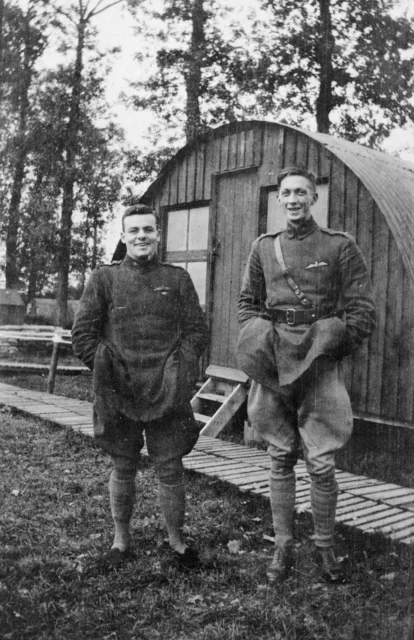
On 22 April 1920, a full military honours funeral was held at Warringal Cemetery in Heidelberg, Victoria. Several hundred mourners attended — his widow Cicely, his parents, his sister among them. The gun carriage was led by a firing party from the Royal Australian Garrison Artillery. The pallbearers included Captain Adrian Cole, Captain Frank Lukis, and Captain Raymond Brownell — Brownell being the man who had stood beside Howell in France in that photograph taken three years earlier — along with five other officers from the Royal and Australian Flying Corps. 1
On 12 February 1923, a stained-glass memorial window was dedicated to Howell at St. Anselm's Church of England in Middle Park, Victoria, unveiled by General Sir Harry Chauvel. 1 When St. Anselm's closed in 2001, the window was carefully removed and transferred to St. Silas's Church in Albert Park, where it still stands.
The window is not famous. Very few people outside a narrow corridor of military aviation history know Howell's name at all. This is typical of men who fought with extraordinary skill in theatres — the Italian Front, the Adriatic — that the dominant narrative of the First World War has largely left behind. The Western Front has its poets and its centennial commemorations; the Italian campaign produced some of the war's most technically accomplished aerial combat and almost none of its remembered mythology.
What the record preserves is specific: 19 confirmed kills, three gallantry decorations, one first-to-report moment on the morning the Piave battle began, and a crash into the Ionian Sea six months after the war ended. He had survived everything the Italian Front could send at him. The Mediterranean, in peacetime, was another matter.
Cover image: Cedric Howell (right) with Raymond Brownell, France, c. 1917. Australian War Memorial collection, via Wikimedia Commons (public domain).

이 콘텐츠를 둘러싼 관점이나 맥락을 계속 보강해 보세요.

  • 로그인하면 댓글을 작성할 수 있습니다.