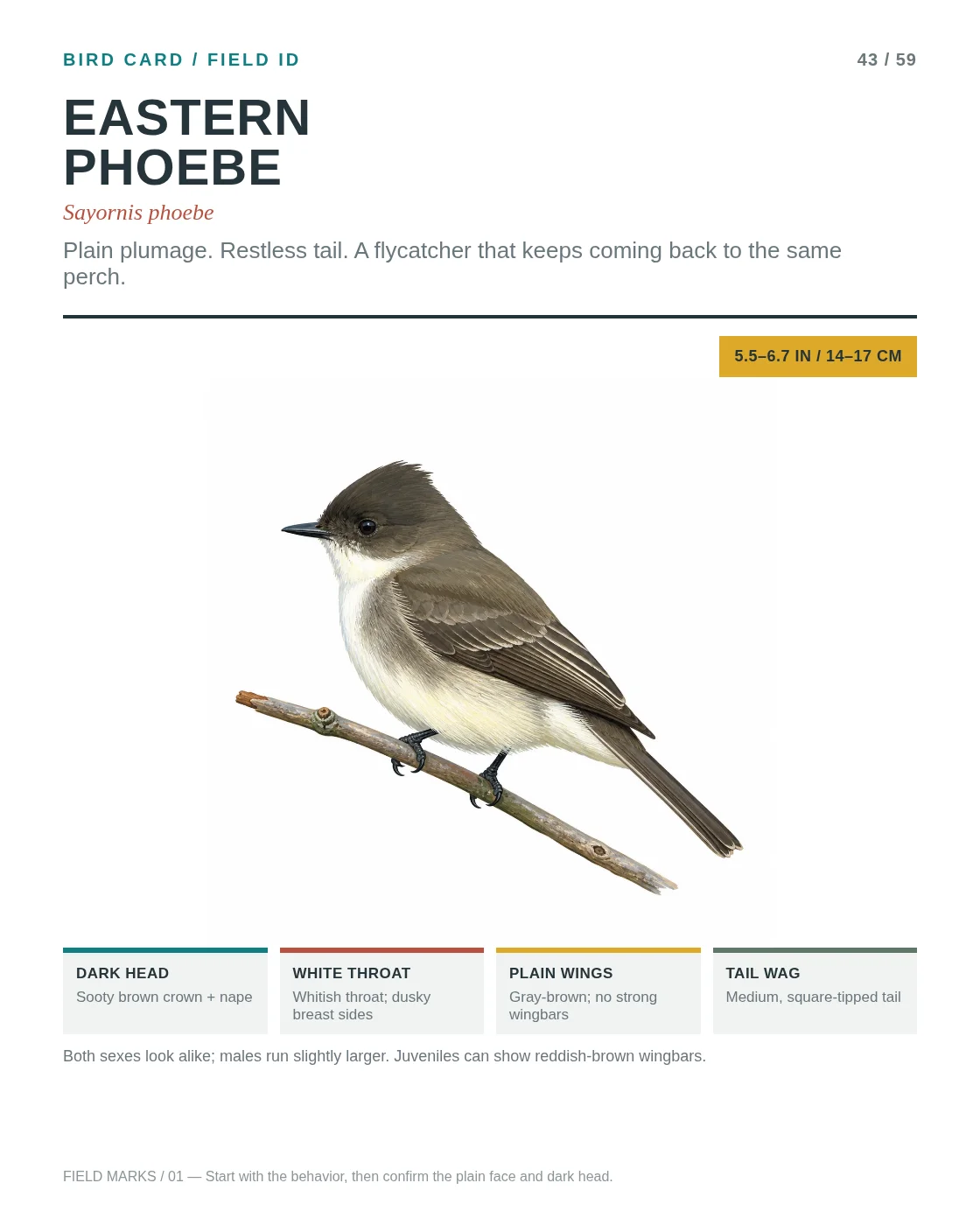
Start with the behavior: an upright, brown-gray flycatcher that pumps its tail down and up from a low perch. The face stays plain; the dark head contrasts with the whitish throat, while the back and wings stay gray-brown and usually lack strong wingbars. Both sexes look alike, though males are slightly larger; juveniles can show reddish-brown wingbars and a paler head. 12
At 5.5–6.7 inches (14–17 cm), 0.6–0.7 ounces (16–21 g), and 10.2–11.0 inches (26–28 cm) across the wings, it is a compact, plump songbird with a large-looking head and medium-length square-tipped tail. It favors yards, parks, open woods, and woodland edges, often nesting under an eave or ledge. 12
In flight, look for rounded wings and a plain gray-brown upperwing rather than a bright patch. The bird makes short direct sallies to catch insects, may hover, and often returns to the same perch. 12
The song is a raspy, two-part “fee-bee” lasting about half a second; the second syllable can be higher or lower than the first. A stuttered version is more common during or after aggressive interactions. Both sexes use a soft chip for communication, and males may give nasal chatter while showing a possible nest site. 3
For look-alikes, Willow Flycatcher shows prominent wingbars and a grayish head; Eastern Wood-Pewee has stronger wingbars, perches much higher, and rarely wags its tail. Say’s Phoebe is the regional check: peachy belly and gray throat instead of Eastern Phoebe’s white belly and whitish throat. 4
참고 출처
- 1Eastern Phoebe Identification, Cornell Lab of Ornithologyallaboutbirds.org
- 2Eastern Phoebe, Audubon Field Guideaudubon.org
- 3Eastern Phoebe Sounds, Cornell Lab of Ornithologyallaboutbirds.org
- 4Eastern Phoebe Similar Species, Cornell Lab of Ornithologyallaboutbirds.org
댓글
로그인하면 댓글을 작성할 수 있습니다.