June 19 in business history: the FCC, the 73-27 vote, the patent treaty, and Curt Flood's losing case
On June 19, 1934, FDR signed the Communications Act creating the FCC — a classification framework that still governs broadband debates today. On June 19, 1964, the Senate passed the Civil Rights Act 73-27, breaking the longest civil rights filibuster in history; the business community's doomsday predictions proved wrong. On June 19, 1970, 36 nations signed the Patent Cooperation Treaty, creating a 30-month option window that now routes 57% of all cross-border patent filings. And on June 19, 1972, the Supreme Court ruled 5-3 against Curt Flood — upholding baseball's antitrust exemption as an 'aberration' — and inadvertently started a three-year countdown to free agency, $5M average salaries, and $765M contracts.

Four dates that moved on June 19 — 1934, 1964, 1970, 1972 — all share a structure that practitioners encounter more than they realize: the moment a rule gets written, the map of who wins permanently shifts. The Communications Act handed a single agency the keys to the entire spectrum. The Senate's 73-27 vote turned employment law into a live compliance constraint for every business with fifteen or more workers. A diplomatic conference in Washington gave inventors a single filing that works in 159 countries. And the Supreme Court's ruling on a baseball player's letter to his commissioner told labor markets everywhere that change doesn't require winning in court — it only requires making the cost of losing too obvious to ignore.
1934 — FCC created: when classification became destiny
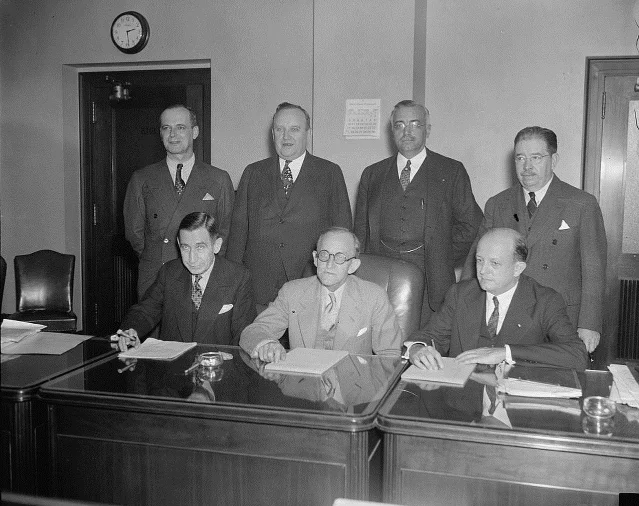
On June 19, 1934, President Franklin D. Roosevelt signed the Communications Act (Public Law 73-416) into law, creating the Federal Communications Commission to replace the seven-year-old Federal Radio Commission and absorbing telephone regulation from the Interstate Commerce Commission in a single stroke. 1 The bill had moved fast: FDR sent his special message to Congress on February 26; Senator Clarence Dill of Washington and Representative Sam Rayburn of Texas introduced enabling legislation the next day; the Senate bill passed the House on June 1; the conference report cleared both chambers eight days later. 2
The Act's stated purpose was straightforward: "to make available, so far as possible to all the people of the United States, a rapid, efficient, Nation-wide, and world-wide wire and radio communication service with adequate facilities at reasonable charges." 1 The constitutional grounding was the Commerce Clause; communications technology was declared interstate commerce, following precedents from railroad regulation. The FCC's original seven commissioners (reduced to five in 1983, with no more than three from any one party) were independent in name — though in December 2025, FCC Chairman Brendan Carr told a Senate committee "The FCC is not formally an independent agency," and all references to independence subsequently disappeared from fcc.gov. 3
What the Act actually set in motion was a durable pattern: how you classify a technology determines everything that happens to it.
The FCC's first consequential exercise of that power came in 1941, when it issued its Report on Chain Broadcasting and ordered NBC to divest one of its two national networks. NBC sold the Blue Network. The buyer eventually renamed it the American Broadcasting Company — ABC. 1 Spectrum allocation froze the TV landscape for a generation: the FCC's 1948 license freeze, which lasted nearly four years instead of the promised six months, killed the DuMont network, nearly strangled ABC, and locked CBS and NBC into a dominance they held for four decades. 3
The same dynamic resurfaced 80 years later when broadband Internet access was classified as a Title I "information service" rather than a Title II "telecommunications service." That binary — drawn from a 1934 statute written for radio and telephones — determined whether ISPs could throttle or block traffic. The FCC reclassified broadband as Title II in February 2015 under Chairman Tom Wheeler, reversed that in December 2017 under Chairman Ajit Pai, re-adopted net neutrality in April 2024, and watched the Sixth Circuit strike the rules down on January 2, 2025, ruling the FCC lacked statutory authority to impose them on an "information service." 3 The agency was trying to fit Internet regulation into categories Congress wrote when no one had conceived of the commercial web.
University of Illinois professor Dan Schiller, in an interview on the FCC's regulatory history, offered a useful frame for what the 1934 Act actually created: "After the 1934 Communications Act imposed meaningful regulation on AT&T, both its scale of investment and its role in pioneering innovations actually accelerated." 4 AT&T under Title II common carrier regulation went on to produce the transistor, fiber optics, the first mobile phone systems, and early satellite communications. The Bell System's regulated monopoly status was the price; Bell Labs was partly what that price bought. The breakup on January 1, 1984 — splitting AT&T into seven regional Baby Bells and reducing AT&T's book value by roughly 70% — came not from the 1934 Act failing but from a 1982 Department of Justice antitrust settlement after decades of creeping competition the FCC had gradually allowed. 3
The FCC now has a FY2026 budget of $416 million, funded entirely by regulatory fees since 2009. Wireless carriers have invested an average of $54 billion per year in infrastructure between 2020 and 2024. 2 The agency's "public interest" mandate has never been defined in concrete statutory terms — Congress left that ambiguity intentionally, the Congressional Research Service noted: "Neither Congress nor the agency has defined [the public interest] in concrete terms." 2 That vagueness is the feature that lets the FCC survive technological change across nine decades. It is also the variable that swings most dramatically when administrations change.
Decision mirror. Any executive who operates in a regulated industry faces a version of the 1934 Act problem: the statutory category you are placed in determines your cost structure, your competitive constraints, and which regulators have jurisdiction. That classification rarely changes because the underlying technology changes; it changes because someone — a company, a lobby, an agency, a court — successfully argues that the category fits. Net neutrality was a classification fight, not a technology fight. The companies that understood this competed for classification; the ones that missed it competed on technology.
1964 — Civil Rights Act passes Senate: the regulation that expanded the labor market
At 7:40 PM Eastern on June 19, 1964, the U.S. Senate voted 73-27 on H.R. 7152 — the Civil Rights Act of 1964. Forty-six Democrats and 27 Republicans voted yes. Twenty-one Democrats and 6 Republicans voted no. Senator Ralph Yarborough of Texas was the only Southern senator to vote in favor. 5 The vote came nine days after cloture was invoked 71-29 on June 10 — the first time in Senate history that a filibuster on a civil rights bill had been broken. The filibuster itself had run 83 calendar days, making it the longest in Senate history at the time. 6
The opposition had been organized and explicit. Senator Richard Russell of Georgia led the 18 Southern Democrats in three rotating platoons of six, each speaking four hours per day while the other two rested — designed to exhaust the bill's supporters. Senator Robert Byrd of West Virginia delivered the longest single speech of the filibuster at 14 hours and 13 minutes, ending on the morning of June 10. 6 The business community's opposition was framed in property rights terms. Senator Mechem of New Mexico called the bill something that "could assure the greatest assault on property ownership and private enterprise this country has known." 7 The owner of the Heart of Atlanta Motel, Moreton Rolleston, put the argument more plainly: "The fundamental question ... is whether or not Congress has the power to take away the liberty of an individual to run his business as he sees fit in the selection and choice of his customers." 6
The Supreme Court answered that question within months. Heart of Atlanta Motel v. United States, decided in December 1964, unanimously upheld Title II: Congress could prohibit discrimination in private businesses affecting interstate commerce under the Commerce Clause. 8
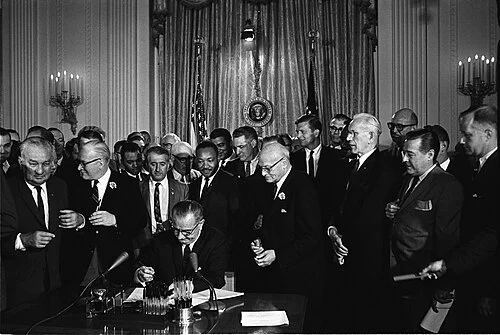
Title VII — the employment discrimination title — was the provision business owners feared most. It prohibited discrimination in hiring, wages, assignment, promotion, benefits, and termination based on race, color, religion, sex, and national origin, and applied to any private employer with 25 or more employees (phased down to 15 by 1972). 9 It created the Equal Employment Opportunity Commission (EEOC), though without litigation authority — the original EEOC could only investigate, conciliate, and refer cases to the Department of Justice. 10
The "sex" provision deserves a separate note. It was added on February 8, 1964, on the House floor by Rules Committee Chairman Howard W. Smith of Virginia — a segregationist who had authored the Smith Act targeting Communists and who many historians believed was trying to kill the entire bill by making it ridiculous. The amendment passed 168-133. 6 Representative Carl Elliott of Alabama later said of Smith: "He didn't give a damn about women's rights... he was trying to knock off votes." 6 The wrecking amendment became, through Meritor Savings Bank v. Vinson (1986), Oncale v. Sundowner (1998), and Bostock v. Clayton County (2020), the legal basis for sexual harassment law, pregnancy discrimination protection, and LGBTQ+ workplace rights. Justice William Rehnquist acknowledged in Meritor that the sex provision was added "at the last minute" with almost no legislative history to guide interpretation. 6
What happened to the doomsday predictions? The EEOC opened on July 2, 1965, expecting roughly 2,000 charges in its first year and received 8,854. 10 The 1966 Newport News Shipbuilding conciliation agreement — the most far-reaching of the early settlements — delivered equal pay to 5,000 Black workers and 3,200 promotions. 10 The 1972 Equal Employment Opportunity Act gave the EEOC independent litigation authority and extended coverage to state and local governments, adding an estimated 10 million workers. 11 In FY2023, the EEOC received 81,055 charges — a 10% increase from the prior year, the highest since FY2017 — and secured over $484 million for workers in FY2021. 6
Senator Everett Dirksen of Illinois, the Republican minority leader without whose support the cloture vote would have been impossible, argued on the Senate floor that charges of unconstitutionality were predictable and temporary: legislation once condemned as illegal was "a forward thrust in the whole effort of mankind" that courts and markets eventually absorbed. 7 Senate Majority Leader Mike Mansfield called the cloture vote Dirksen's "finest hour." 7
Decision mirror. The 1964 opposition argument — "you can't legislate morality" — was factually wrong about outcomes. The compliance costs businesses feared in 1964 proved negligible compared to the economic expansion that followed integrating the labor supply. A 2024 NIH-published study found the 1963 Equal Pay Act and 1964 Civil Rights Act together reduced the within-job gender pay gap by approximately 58%. 6 The lesson for practitioners is not political; it is predictive. When legislation survives a constitutional challenge and an enforcement agency accumulates case history, the cost of non-compliance tends to compound over time, while the cost of early compliance tends to become a competitive norm. Companies that built diverse hiring pipelines in the late 1960s and early 1970s had 20 years of organizational practice by the time peers were scrambling to catch up in the 1990s.
1970 — Patent Cooperation Treaty signed: the infrastructure play
On June 19, 1970, at the close of a three-week diplomatic conference in Washington, 36 states signed the Patent Cooperation Treaty (PCT). 12 The treaty entered into force on January 24, 1978, with 18 initial contracting states; the first international applications were filed on June 1, 1978. 13
The problem the PCT solved was bureaucratic friction at a specific scale: an inventor who wanted protection in multiple countries had to file separate applications in each jurisdiction, pay separate fees, arrange translations into each language, and retain local patent agents in each country — all within the 12-month Paris Convention priority window. For a startup with a single invention that might matter in six markets, that meant potentially six simultaneous prosecution tracks with different procedural deadlines. The development work had started in 1966, when the Executive Committee of the International (Paris) Union recognized the need for "more economical, quicker and more effective protection for inventions throughout the world." 12
The PCT's design reflects a deliberate choice about where international agreement was possible and where it was not. Article 27(5) states explicitly: "Nothing in this Treaty and the Regulations is intended to be construed as prescribing anything that would limit the freedom of each contracting state to prescribe such substantive conditions of patentability as it desires." 14 Countries could join without changing what they considered patentable. What the treaty standardized was the procedure: one application, one language, one receiving office, one search report, one publication, and a 30-month window before applicants had to commit to individual national prosecution and pay local fees.
That procedural standardization turned out to be consequential. The PCT route has grown at 3.4% annually since 2009, versus 2.1% for the older Paris Convention route. 15 By 2023, the PCT accounted for 57.4% of all non-resident patent applications globally — 591,100 national phase entries via the PCT route versus 438,000 via Paris. 15 In 2024, approximately 273,900 PCT applications were filed worldwide (+0.5% from 2023), with China leading at 70,160 filings, followed by the US at 54,087 and Japan at 48,397. 15 The 5 millionth PCT application was published in 2024. 13
The current leading filer is Huawei Technologies, the top PCT applicant for the eighth consecutive year, with 6,600 published applications in 2024. Samsung Electronics ranked second with 4,640. 15 Asia's share of global PCT filings climbed to 56.3% in 2024, up from 40.6% a decade earlier, driven by China's volume growth since it became the largest PCT filer in 2019. 15
The PCT's 159 contracting states (the Bahamas joined as the 159th on May 19, 2026, effective August 19, 2026) include virtually every significant innovation economy. 16 The countries still outside the PCT include Argentina, Venezuela, and Pakistan. 13
Decision mirror. The PCT is a study in what international standards can actually achieve when they address process rather than substance. The treaty did not tell member states what to patent. It told them how to route the paperwork. The 30-month deferral window it created is worth something specific and calculable for early-stage companies: it lets a startup file once, defer translation costs and national fees by two and a half years, raise a funding round, validate product-market fit, and then decide which jurisdictions matter before committing to prosecution in each. That optionality has dollar value. The companies that treat IP strategy as a later-stage concern — "we'll file internationally when we have revenue" — routinely find that the 12-month Paris Convention priority window has closed before they've finished their first financing. The PCT exists precisely to extend that window affordably.
1972 — Flood v. Kuhn: how losing a case wins a war
On June 19, 1972, the U.S. Supreme Court ruled 5-3 in Flood v. Kuhn, 407 U.S. 258, upholding Major League Baseball's antitrust exemption. 17 Justice Harry Blackmun wrote the majority opinion. Justice Lewis Powell had recused himself because he owned stock in Anheuser-Busch, the parent company of the St. Louis Cardinals, removing any possibility of a 4-4 deadlock. 18
The backstory starts in October 1969, when the Cardinals traded Curt Flood — a three-time All-Star, seven-time Gold Glove center fielder with a career .293 batting average over 12 seasons — to the Philadelphia Phillies in a seven-player deal. Flood was not consulted. A sportswriter called him before the team did; he later received a one-sentence letter from Cardinals general manager Bing Devine. The Phillies offered $100,000 for 1970. Flood refused to report. 18
On Christmas Eve 1969, Flood wrote to Commissioner Bowie Kuhn: "After twelve years in the major leagues, I do not feel that I am a piece of property to be bought and sold irrespective of my wishes." 17 Kuhn denied the request. In December 1969, the MLBPA executive board voted unanimously 25-0 to fund the lawsuit in San Juan, Puerto Rico; Marvin Miller retained former Supreme Court Justice Arthur Goldberg as Flood's attorney. 19
When ABC broadcaster Howard Cosell asked Flood on air, "What's wrong with a guy making $90,000 being traded from one team to another?" Flood replied: "A well-paid slave is nonetheless a slave." 18
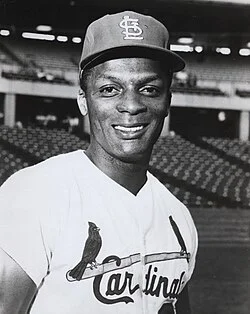
The reserve clause Flood challenged had originated in 1879, when National League owners secretly agreed not to raid each other's rosters. By 1890 it covered every player. Under the Uniform Player's Contract, a team could unilaterally renew a player's contract for "one year" at no less than 80% of his prior salary — and owners interpreted that renewal as perpetual. Once signed, a player was bound to one team for his entire career: he could be traded without consent, sold, or released, but could not negotiate with another team. 19
The Court's ruling upheld the exemption on grounds that read more like institutional fatigue than legal logic. Blackmun acknowledged that "Professional baseball is a business, and it is engaged in interstate commerce. With its reserve system enjoying exemption from the federal antitrust laws, baseball is, in a very distinct sense, an exception and an anomaly. Federal Baseball and Toolson have become an aberration confined to baseball." 17 His conclusion: Congress, not the Court, should fix it. Justice William O. Douglas — who had himself voted with the majority in the 1953 Toolson case — dissented: "This Court's decision in Federal Baseball Club v. National League, made in 1922, is a derelict in the stream of the law that we, its creator, should remove." Douglas explicitly wrote that he had "lived to regret" joining Toolson. 17 Justice Thurgood Marshall dissented as well: "The importance of the antitrust laws to every citizen must not be minimized. They are as important to baseball players as they are to football players, lawyers, doctors, or members of any other class of workers." 17
Flood lost. He sat out 1970, played 13 games for Washington in 1971 batting .200, and retired at 33 — giving up what might have been several more prime seasons. But MLBPA executive director Marvin Miller had told Flood before the lawsuit that he would lose his case and still win the larger fight. The exposure generated by the ruling made the reserve system's absurdity politically indefensible. On December 23, 1975, three years after the Supreme Court's ruling, arbitrator Peter Seitz read the reserve clause literally: the standard contract renewed a player for one year, not perpetually. Two pitchers — Andy Messersmith of the Dodgers and Dave McNally of the Expos — had played the 1975 season without signing new contracts. Seitz declared them free agents. 20 MLB owners fired Seitz that afternoon, but federal courts upheld the ruling in February 1976, and the Eighth Circuit affirmed in March. On July 12, 1976, MLB and the MLBPA agreed to a collective bargaining agreement establishing free agency eligibility after six years of major league service — a structure that remains in place today. 19
The numbers are specific. The MLB average salary was $44,676 in 1975. By 1983, eight years after free agency began, it had reached $289,000 — a 6.5-fold increase. By 2002 the average stood at approximately $2.39 million. By 2025 it reached approximately $5 million, a 112-fold increase from 1975. 21 In December 2024, outfielder Juan Soto signed a $765 million, 15-year deal with the New York Mets. 21 Marvin Miller had inherited the MLBPA in 1966 with $5,700 in assets. By the time he retired in 1982, player salaries had risen by nearly 2,000 percent. MLBPA general counsel Dick Moss later reflected: "The difference between winning and losing was billions and billions of dollars, maybe tens of billions of dollars." 21
Congress eventually did what the Court said it should: the Curt Flood Act of 1998, signed by President Bill Clinton, formally ended baseball's antitrust exemption as it applied to labor relations — 26 years after the Court punted. 18
Decision mirror. Flood v. Kuhn is the case study for understanding how entrenched labor arrangements break. The direct legal challenge lost, but it converted a private grievance into a public record of what the reserve clause actually was. The system that followed — free agency after six years of service — came through collective bargaining, not litigation. The lesson extends beyond sports: when a structural constraint is indefensible on the merits but legally protected, the faster path to change is usually making the constraint's costs visible enough that the beneficiaries negotiate rather than fight. Baseball's owners thought they had won in 1972. They had actually started a three-year countdown to losing everything they'd been defending for 93 years.
Four decisions, all signed or issued on June 19, each the product of years of prior pressure. The FCC's regulatory categories were written for radio and telephone; they now govern the most contested frontier of digital commerce. The Civil Rights Act faced business opposition that predicted catastrophe and instead produced a structural expansion of the American workforce. The PCT gave inventors a 30-month option window that didn't exist before 1970 and now routes more than half the world's cross-border patent filings. And the Flood decision gave MLB owners a five-year period in which they believed they had won, followed by $5-million average salaries and $765-million contracts.
The pattern across all four: the apparent winner at the moment of the decision did not hold that position for long.
참고 출처
- 1Wikipedia: Communications Act of 1934
- 2Congress.gov CRS Report R45699: The FCC — Structure, Operations, and Budget
- 3Wikipedia: Federal Communications Commission
- 4University of Illinois News Bureau: The historical context behind the FCC's net neutrality decision
- 5GovTrack.us: HR 7152, Senate Vote #409
- 6Wikipedia: Civil Rights Act of 1964
- 7New York Times archive: Civil Rights Bill Passed, 73-27
- 8Library of Congress: The Civil Rights Act of 1964
- 9EEOC: Title VII of the Civil Rights Act of 1964
- 10EEOC History: 1964–1969
- 11EEOC History: The Law
- 12WIPO: 50 years since Patent Cooperation Treaty Diplomatic Conference
- 13Wikipedia: Patent Cooperation Treaty
- 14USPTO: Patent Cooperation Treaty (Appendix T)
- 15WIPO: PCT Yearly Review 2025 — Executive Summary
- 16WIPO: PCT Contracting States
- 17Justia: Flood v. Kuhn, 407 U.S. 258 (1972)
- 18Wikipedia: Flood v. Kuhn
- 19SABR: Flood v. Kuhn, by Robert Elias
- 20Wikipedia: Seitz decision
- 21FOX Sports / AP: 50 years since Seitz decision
이 콘텐츠를 둘러싼 관점이나 맥락을 계속 보강해 보세요.