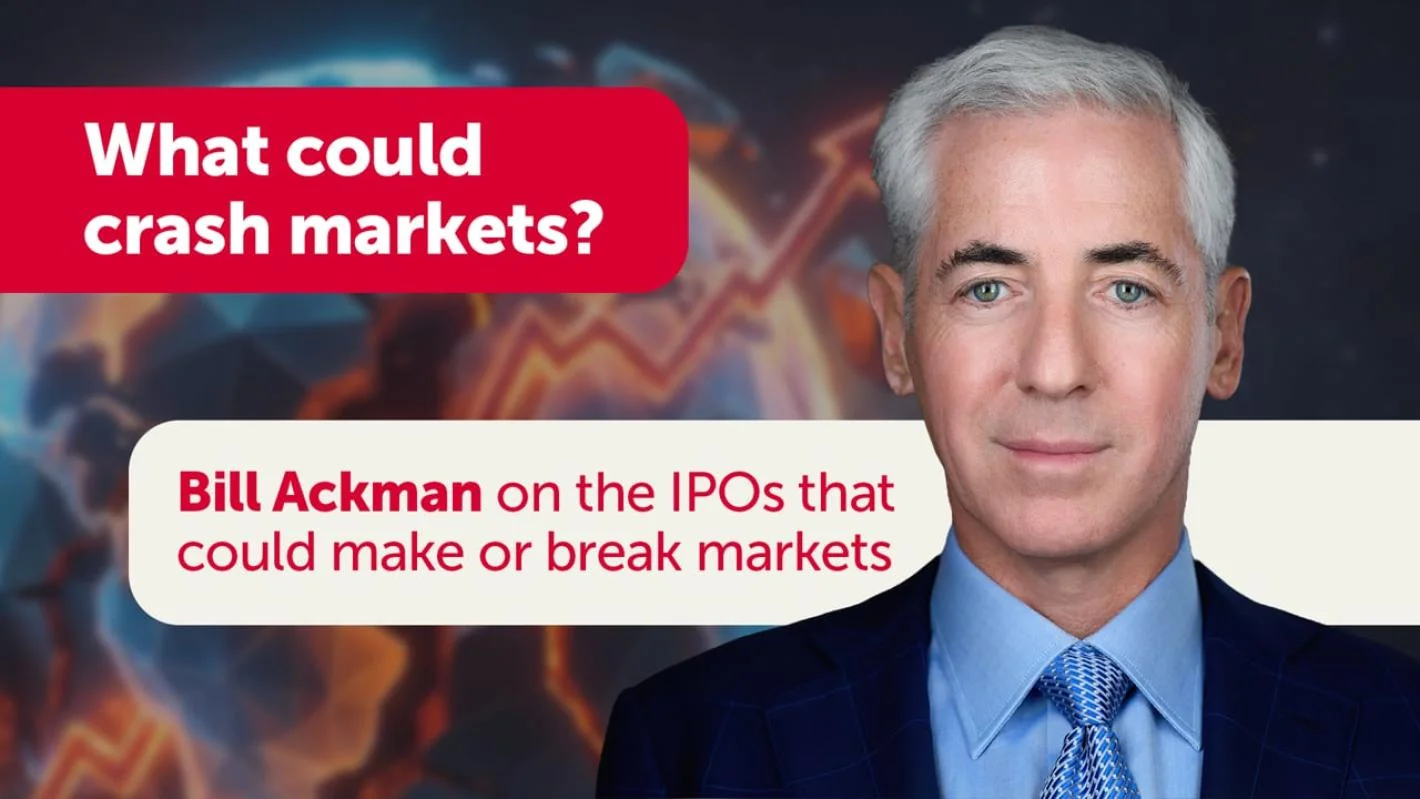
Ackman: A failed SpaceX IPO could crack the market
Bill Ackman told AJ Bell on June 16 that SpaceX's IPO is a market-level mood test — a failure would be "very disappointing for markets" and could cascade into dampening AI investment broadly. Unusually, he's running Pershing Square's most defensive portfolio in years with no hedge in place at all, arguing the structural safety comes from owning balance-sheet-strong, capital-independent businesses. His current opportunity set: Microsoft at 21x earnings and Uber at 17x, which he calls "extraordinary cheap prices." He won't invest in the Anthropic IPO because open-source models are already better than closed models from six months ago.

Bill Ackman, founder of Pershing Square Capital Management (the activist fund known for concentrated, long-duration bets on dominant businesses), sat down with AJ Bell market editor Dan Coatsworth on June 16 for roughly ten minutes and delivered the clearest summary of his current market read in months. 1
콘텐츠 카드를 불러오는 중…
The core argument is narrower and more specific than most macro warnings: Ackman doesn't think the economy is about to crack, he doesn't see a credit blow-up, and he isn't running a hedge. What he does think is that market sentiment has become hostage to a handful of IPOs — and SpaceX is first in line.
SpaceX as a potential trigger
Ackman was direct when Coatsworth asked whether a correction is possible this year.
"For sure. It's absolutely possible. Look, there's a lot of expectation and hype in some of the names you mentioned, companies going public, etc. SpaceX, if that's an unsuccessful IPO, I think it will be very disappointing for markets." 1
He went further on the cascade logic: if SpaceX stumbles and Anthropic and OpenAI follow with their own listings, the damage isn't confined to those three companies.
"If one of them fails, or one of the early ones fail, it's going to have an impact on those businesses, it's going to have an impact on AI investment, and it could have an impact on the economy." 1
That framing puts SpaceX's IPO outcome in an unusual category: not just a company event but a mood barometer for a whole investment cycle. Ackman's summary — "it's actually important for markets that SpaceX is a successful IPO" — reads less like endorsement than like a vulnerability assessment. 1
The same day, Ackman posted on X about SpaceX's $60 billion all-stock acquisition of Cursor, the AI coding tool, noting that its $2.75 trillion market cap makes equity a cheap acquisition currency — "the Cursor acquisition costs materially less in dilution because of SpaceX's high valuation." 2
콘텐츠 카드를 불러오는 중…
Defensive but hedgeless — for the first time
What makes Ackman's positioning unusual is the gap between his cautious IPO read and his decision to carry no downside protection at all. Pershing Square has run explicit hedges through each of its three major crisis periods — credit-default swaps on individual names during the 2008 financial crisis, investment-grade CDS during the COVID collapse, and interest-rate swaps when the Fed pivoted to aggressive tightening in 2022. Right now, nothing.
"Today we don't have a hedge in place. And we only hedge if we can — one, there's a risk we perceive that we think is material. And two, we can find an instrument where the payoff characteristics are such that they're sufficiently asymmetric to justify the investment." 1
His explanation for the gap: he hasn't identified a specific black-swan risk where options pricing gives you genuinely asymmetric payoff, and elevated volatility has made that harder to find. The "hedge" is structural — the companies he owns.
Pershing Square holds no banks, no businesses that depend on continuous capital-markets access. The portfolio's free cash flow is large enough that companies can buy back their own shares — which means a market decline actually improves the economics of those buybacks.
"If the stock market shut for 10 years, let alone crashed, we'd do fine 10 years from now." 1
By contrast, Ackman identified the companies most at risk: businesses that need to raise capital regularly to survive. He put SpaceX, Anthropic, and OpenAI in this category — "the big risk to companies today are businesses that are dependent on constant access to the capital markets." 1
The "incredibly cheap" stocks everyone is ignoring
On the same day markets were absorbed with SPCX, Ackman made an unusual observation: the most reliably compounding businesses in the world are trading at valuations that look like 2020 lows.
He named three specific stocks:
- Microsoft — 21x earnings, which he described as "kind of COVID levels in terms of its valuation." 1
- Uber — 17x earnings, with earnings compounding around 35% annually. If the stock sits flat for 12 months, the forward multiple automatically compresses to roughly 12–13x. 1
- Meta — listed alongside the above two without a specific multiple, described as part of the same opportunity set. 1
"Microsoft at 21 times earnings, Uber at 17 times earnings, it's hard to imagine those stocks getting materially cheaper on a sustained basis... Extraordinary cheap prices." 1
His explanation for the discount: capital has chased semiconductors, AI infrastructure, and pre-IPO hype stocks, leaving what he called "old-fashioned" businesses trading near multi-year valuation lows despite compound earnings growth. He also disclosed in a separate X post that Pershing Square initiated four new positions in Q2 — names he won't reveal until the 13F filing. 3
Separately, he confirmed he sold Alphabet last quarter — bought at 15x earnings, exited at 30x — and read the company's recent equity raise as a management signal that the stock "is not cheap." 1 When a company with Alphabet's profile issues stock to fund AI capex, Ackman's framework treats that as the CFO's own fair-value admission.
Why he won't touch the Anthropic IPO
Ackman acknowledged Pershing Square uses Anthropic's Claude as a business tool and considers it "the leading model." Despite that, he said Pershing Square has no plans to invest in the Anthropic IPO, and his reasoning landed on a single structural concern.
"We're at a place where the open source models are better than models of 6 months ago. And for the vast majority of use cases for many people, a free open source model to plan their next vacation or what restaurant they want to go to or even to look up symptoms of some problem is sufficient." 1
That's not a claim that Anthropic's technology is weak — it's a claim that the pricing power of any closed-source model is harder to defend when open-source alternatives improve fast enough to satisfy most demand. He added that Anthropic "apparently reached the place where they're even positive" on a cash-flow basis, calling its growth rate the fastest he's ever seen. But fast growth into a shrinking addressable price point is a different story than fast growth into a widening moat. 1
The full interview is available at AJ Bell's site and on YouTube at the link above.
Cover image: AJ Bell / YouTube — Bill Ackman interview thumbnail, June 16, 2026.
이 콘텐츠를 둘러싼 관점이나 맥락을 계속 보강해 보세요.