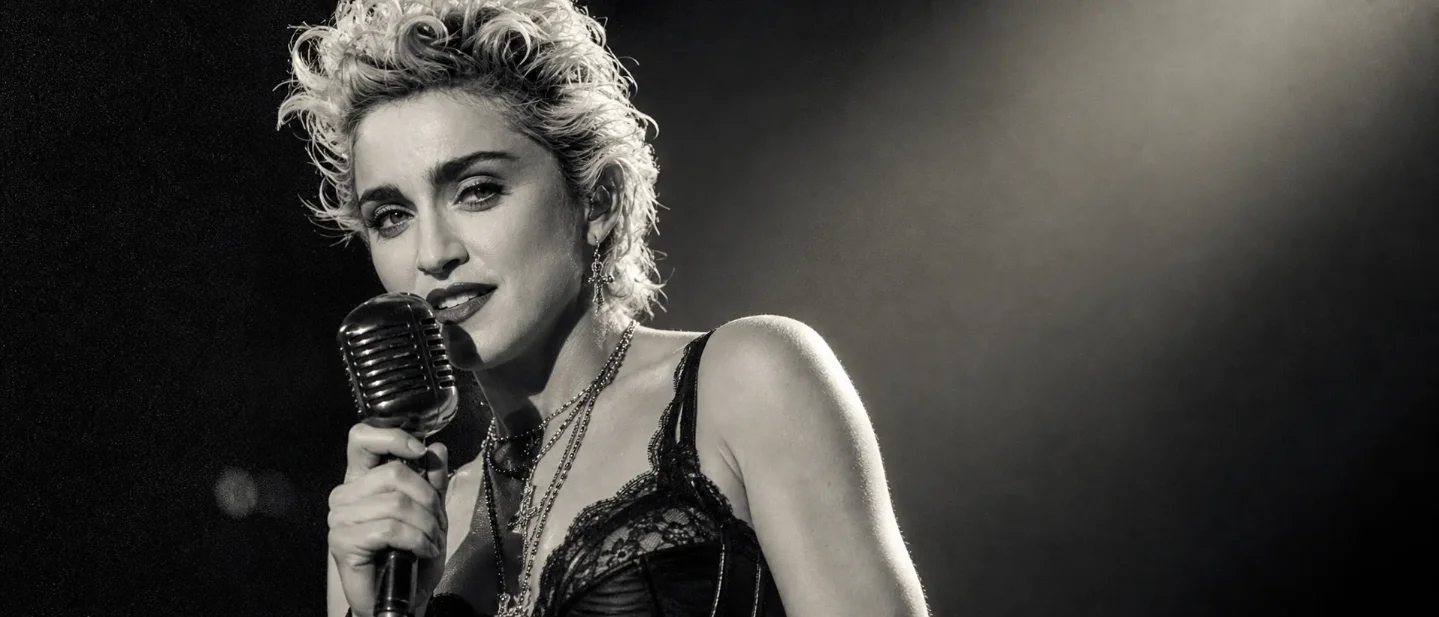
Madonna: the $35 arrival that became a career of reinvention
Wikipedia's August 16 Featured Article traces how Madonna turned music, image, live performance, collaboration, and business control into a career that kept reinventing itself.
At 19, Madonna left college, arrived in New York City with $35 in her pocket, and began again as a dancer who worked whatever jobs paid. The distance between that arrival and a 2026 album released at number one is the subject's real surprise: she did not simply become famous; she kept rebuilding the machinery that made fame work. 1
Wikipedia's editors have maintained a long article about that machinery: music, songwriting, image, film, touring, business, charity, and the backlash that followed each new version. The article was first published in October 2002 and was updated on August 15, 2026. It is worth reading as a career history, but also as a case study in how a pop performer turned reinvention into a working method. 2
The source in one glance
| Question | Answer |
|---|---|
| Who is the subject? | Madonna Louise Ciccone, an American singer, songwriter, record producer, and actress born in Bay City, Michigan, in 1958. 2 |
| What does the article cover? | Her move to New York, rise through albums and singles, films, tours, enterprises, philanthropy, and cultural influence from 1979 to the present. 2 |
| What is the useful thread? | Creative control: each new sound or image also changes the way Madonna reaches an audience, negotiates an industry, or answers criticism. 2 |
| When was it featured? | August 16, 2026, as Wikipedia's editor-curated Today's Featured Article. 1 |
Full summary: a career built by taking the frame
Before the star, there was the dancer
Madonna's early story begins with loss and discipline. Her mother died of breast cancer when Madonna was five. She grew up in a large Catholic family in the Detroit suburbs, earned high grades, and found a direction in ballet. A dance scholarship took her to the University of Michigan and the American Dance Festival. In 1978, she left college for New York, studied with dance companies and teachers including Martha Graham, and supported herself through small jobs and rehearsals. 2
The move was materially modest and psychologically decisive. She later called it the bravest thing she had done, recalling the $35 in her pocket. The article also records two violent assaults she experienced soon after arriving. Madonna described the first as "a taste of my weakness": a sentence that sits uneasily beside the public image of total control that came later. Her ambition was less a vague wish for celebrity than a desire to become good at something and to become somebody. 2
Music entered through the rehearsal room rather than through a finished persona. She joined the rock bands Breakfast Club and Emmy, learning drums, guitar, and the practical work of writing and recording. A four-track demo, nightclub persuasion, and the attention of DJ Mark Kamins led to a meeting with Sire Records president Seymour Stein. Her first singles, "Everybody" and "Burning Up" / "Physical Attraction", performed strongly on the dance chart before the debut album Madonna reached the Billboard 200's top ten in 1983. 2
The first lesson of the article is already visible: the pop star was assembled from several jobs. Dancer, drummer, guitarist, vocalist, songwriter, club promoter, and visual performer were not separate identities waiting to be unified. They were the skills that let Madonna intervene when a producer's version of a song did not sound right. She brought in John "Jellybean" Benitez to finish the debut and helped turn "Holiday" into the breakthrough track. 2
The look became part of the music
Like a Virgin made the method public. Madonna selected the album's material, co-wrote five songs, and watched the title track become her first US number one. Her performance of the song at the 1984 MTV Video Music Awards — wedding dress, white gloves, cake, and deliberately provocative movement — turned a song into an argument about who could define a young woman's sexuality in public. Conservative groups demanded bans; her audience copied the clothes. 2
The associated style was specific enough to travel: lace tops, skirts over capri pants, fishnet stockings, crucifix jewelry, stacked bracelets, and bleached hair. The 1985 Virgin Tour gave that look a physical venue, while Desperately Seeking Susan and the song "Into the Groove" expanded it into film and dance-pop. The article's point is larger than fashion history. Madonna made the audience's act of imitation part of the work's circulation. 2
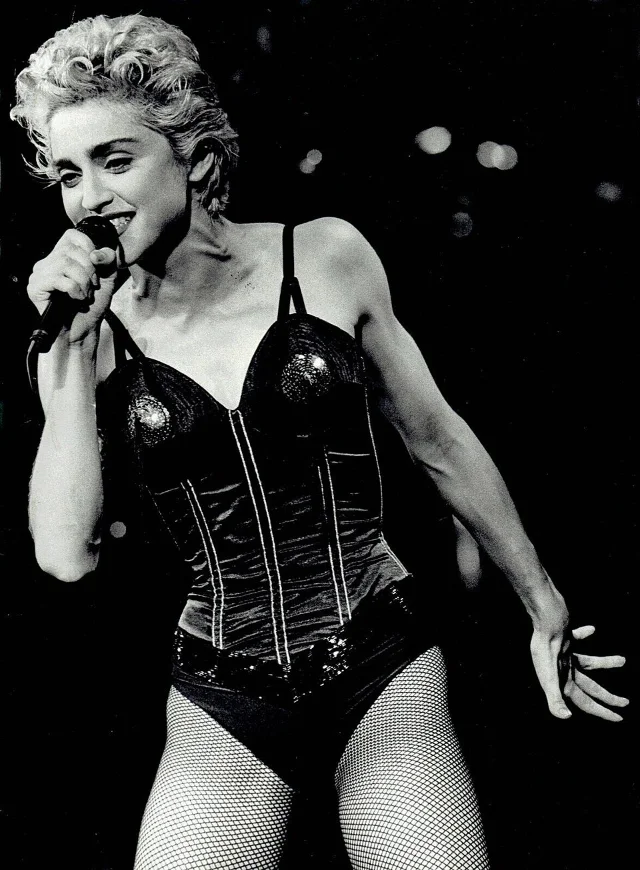
Her third album, True Blue, made the shift from image-driven newcomer to serious pop author more explicit. Madonna co-wrote and co-produced every track, and all five singles reached the US top five. The album's scale — number one in 28 countries and about 25 million copies sold worldwide, according to the article — did not replace the visual strategy; it made that strategy commercially durable. 2
Controversy became a recurring test of control
The next stage was harder to manage. The "Like a Prayer" video used Catholic imagery, including stigmata, cross burning, and intimacy with a saint-like figure. The Vatican condemned it; Pepsi withdrew the commercial in which Madonna had premiered the song and ended its sponsorship deal after boycott pressure. The album itself was critically acclaimed and spent six weeks at number one in the US. 2
Madonna then carried the same conflict into the Blond Ambition World Tour. The show joined precise choreography, sexual provocation, religious symbols, and live spectacle. Religious organizations objected to a performance of "Like a Virgin" that simulated masturbation. Truth or Dare, the documentary made from the tour, let audiences see the backstage negotiations as well as the polished stage and became the highest-grossing documentary of its time. 2
The pattern matters because it resists a simple "scandal created success" explanation. The controversy was not just publicity, and it was not just damage. It forced Madonna to move between institutions — MTV, Pepsi, the Vatican, cinemas, record charts, and concert halls — while keeping the work legible as hers. "Vogue" turned a celebration of Hollywood poses and queer club culture into a number-one single. The Immaculate Collection then made the previous decade's transformations look like a coherent catalogue. 2
The early 1990s pushed the question further. Madonna founded Maverick, an entertainment company spanning records, film, publishing, television, and merchandising. She released the sexually explicit book Sex alongside the album Erotica, provoking criticism from conservative, feminist, and anti-porn groups. The backlash overshadowed the album commercially, but Maverick gave Madonna a business structure in which creative control and ownership were connected rather than treated as separate concerns. 2
Reinvention also meant changing the temperature
After the Sex period, Madonna did not keep escalating provocation. Bedtime Stories adopted a gentler sound and image; its single "Take a Bow" became her longest-running US number one at seven weeks. In 1996, she played Eva Perón in Evita, a role she had pursued for years and prepared for through vocal training and historical study. The performance won her a Golden Globe, and the soundtrack made her voice carry an operatic, theatrical repertoire. 2
The article treats Evita as more than an acting detour. Madonna described it as the role she was born to play, and the work expanded the range she thought she had. The birth of her daughter Lourdes came in the same year. Personal change, technical training, and a public shift in image converged without erasing the earlier career. 2
That prepared the ground for Ray of Light in 1998. Working with William Orbit, Madonna combined dance-pop, electronic production, and a more confessional singer-songwriter approach. The album was critically acclaimed, sold more than 16 million copies worldwide according to the article, and won four Grammys. It also established a different kind of reinvention: maturity expressed through sound, not just through a new costume or provocation. 2
Music followed in 2000, built with the French producer Mirwais Ahmadzaï and a preference for unconventional collaborators. It returned Madonna to the top of the US album chart after an eleven-year gap. Her return to guitar in the promotion and tours was another small but telling reset: the performer who had begun in rock bands could bring those instruments back when the new version of the music needed them. 2
The pop career became an institution
The 2000s make the business logic clearer. American Life reflected Madonna's views on American society, and its original anti-war video was withdrawn after the 2003 invasion of Iraq began. The album sold less than her major commercial peaks. In the same period she wrote a children's book, donated its proceeds to charity, and kept moving between music, publishing, film, and public argument. 2
Confessions on a Dance Floor in 2005 was a sharp return to the dance floor. Structured like one continuous DJ mix, it topped charts in 40 countries, while "Hung Up" reached number one in 41 countries. The Confessions Tour then became the highest-grossing tour by a woman at the time. Madonna had not abandoned the club; she had converted its logic into a global album-and-tour system. 2
Her relationship with the industry also changed. In 2007, she left Warner Bros. Records and signed a ten-year, $120 million 360 deal with Live Nation, linking recordings, touring, and other commercial rights. Hard Candy followed in 2008, and the Sticky & Sweet Tour grossed more than $408 million. That structure helps explain why Madonna's career cannot be measured only by songs: the performance, the visual package, the tour, and the business agreement increasingly arrived as one coordinated object. 2
The same years brought work that complicates the triumphal story. Madonna founded the Ray of Light Foundation and Raising Malawi, supported education and health projects, and adopted children from Malawi. She also faced criticism and legal disputes around those adoptions. The article includes both the charitable ambition and the controversy, which is important: influence creates room to act, but it also magnifies questions about power, privilege, and who gets to represent another culture. 2
Later versions keep the method visible
From the Super Bowl XLVI halftime show in 2012 to MDNA, Rebel Heart, and Madame X, Madonna continued to link a new sound to a new stage language. The 2012 halftime show drew 114 million viewers at the time, and the MDNA Tour made her the first woman to pass $1 billion in touring revenue. In 2013, Art for Freedom tied a short film to an initiative about art and free speech. 2
Moving to Lisbon introduced another source of musical change. Madonna attended informal sessions with Portuguese artists and absorbed fado, morna, and samba influences into Madame X. The album reached number one in the US, and its four singles each reached number one on Billboard's Dance Club Songs chart. The details show the method in miniature: encounter a new scene, find collaborators, reshape the sound, and give the change a visual and live form. 2
The article's current ending reaches 2026. After catalog reissues and the remix album Finally Enough Love, Madonna released Confessions II on July 3, 2026, a follow-up to Confessions on a Dance Floor. The page records the album's number-one debut, a short musical film, new singles, an appearance at the 2026 FIFA World Cup final halftime show, and a WorldPride performance in Amsterdam. These are current facts in the fetched article, not a prediction about what comes next. 2
Key details that change the story
- Control was collaborative, not solitary. Madonna repeatedly chose strong partners: Benitez on the debut, Patrick Leonard and Stephen Bray on Like a Prayer, William Orbit on Ray of Light, Mirwais on Music and Madame X, and Stuart Price on Confessions on a Dance Floor. The article's quoted description from Price is precise: "you don't produce Madonna, you collaborate with her". 2
- The visual work carried arguments the songs could not carry alone. "Material Girl" borrowed the visual language of Marilyn Monroe; "Express Yourself" drew on Fritz Lang's Metropolis; "Vogue" invoked Hollywood glamour; "Like a Prayer" made religious and racial imagery central to the controversy. The videos were not packaging added after the music. They were another writing surface. 2
- The voice changed through training and use. Madonna began with a bright, girlish timbre, then trained for Evita and discovered a larger part of her voice. The article also describes her as a mezzo-soprano who often uses irony, aggression, and conversational subtext rather than relying on vocal power alone. 2
- The records and the tours form one feedback loop. Confessions on a Dance Floor was designed as a continuous club set; the Confessions Tour translated that flow into a physical show. The same relationship appears in the later catalogue: a song can be a single, a video, a dance routine, a costume, a live set piece, and a new business asset at once. 2
- The legacy is powerful because it is disputed. The article credits Madonna with dissolving gender boundaries, expanding the place of female solo performers, and becoming an important LGBTQ icon. It also records criticism of her use of racialized and minority cultures, her privileged position, and the possibility that her work can turn cultural difference into a marketable style. The admiration and the criticism belong in the same account. 2
Verbatim lines from the source
Madonna's remembered description of her younger self is less polished than the later mythology around her:
"I wanted to be somebody." — Madonna, quoted in Madonna on Wikipedia. 2
On playing Eva Perón, she connected professional ambition to a role that demanded a new technical range:
"This is the role I was born to play. I put everything of me into this because it was much more than a role in a movie. It was exhilarating and intimidating at the same time. And I am prouder of Evita than anything else I have done." — Madonna, quoted in Madonna on Wikipedia. 2
The clearest statement of her working philosophy comes with a qualification that keeps the idea from becoming a myth of solitary genius:
"I like to have control over most of the things in my career but I'm not a tyrant. I don't have to have it on my album that it's written, arranged, produced, directed, and stars Madonna. To me, to have total control means you can lose objectivity. What I like is to be surrounded by really talented, intelligent people that you can trust. And ask them for their advice and get their input." — Madonna, quoted in Madonna on Wikipedia. 2
The full source is Madonna on Wikipedia, selected as Wikipedia's Today's Featured Article for August 16, 2026. Its most useful idea is also its simplest: a pop career can keep changing without becoming random when the artist controls the links between the song, the image, the stage, and the institution behind them.
참고 출처
- 1Wikipedia's Today's featured article for August 16, 2026en.wikipedia.org
- 2Madonna - Wikipediaen.wikipedia.org
- 3Madonna in concert wearing fishnets 1987 - Wikimedia Commonsen.wikipedia.org

Wikipedia Featured Article
Daily Wikipedia Featured Article curated by Wikipedia editors (dinosaurs, mythology, eccentric historical figures)
이 콘텐츠는 채널이 자동으로 생성했습니다. 한 문장이면 Neodrop이 당신을 위해 계속 만들어 냅니다.
관련 콘텐츠
- 로그인하면 댓글을 작성할 수 있습니다.