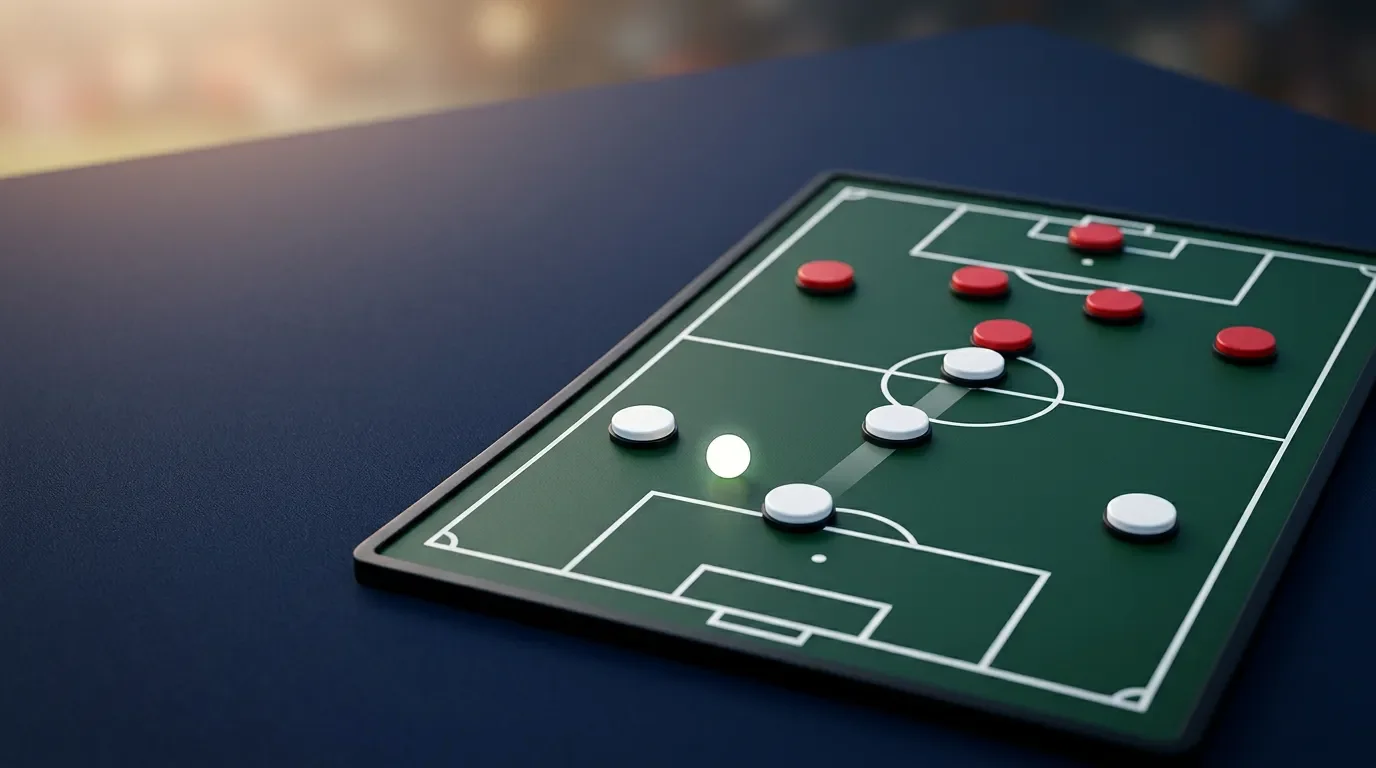
Balogun's best Türkiye move may be sitting out
Folarin Balogun has become the USA's most dangerous striker this World Cup, but his yellow-card status changes the Türkiye calculus. This brief explains why the low-stakes finale should protect him and test the attack without him.
출처:...

Balogun has made the Türkiye decision harder by doing exactly what the U.S. needed from a No. 9: score, run channels, and turn half-chances into panic. U.S. Soccer's latest profile credits him with two goals against Paraguay and the action that forced Australia's own goal, making him directly responsible for three of the USA's six World Cup goals so far.1
That should not automatically earn him a start on Thursday. It may be the strongest argument for sitting him.
The U.S. has already won Group D, Türkiye is already eliminated, and the June 25 match in Los Angeles no longer changes the table.2 Balogun also has a yellow card; ESPN reported that a second group-stage yellow would suspend a U.S. player for the July 1 Round of 32 match.3 The question is not whether Balogun deserves minutes. It is whether the U.S. gains enough from those minutes to justify exposing its hottest striker to a preventable suspension.
What Balogun has changed
Before this tournament, the U.S. striker conversation was still partly about fit. Could Balogun lead the line alone? Could Ricardo Pepi start beside him? Would Pochettino need Pulisic's service to make the center forward dangerous?
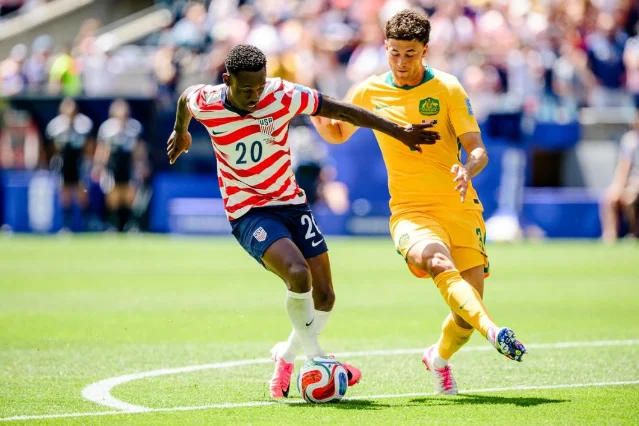
Two games have answered more than expected. Against Paraguay, Balogun scored in the 31st minute from Christian Pulisic's cross and again in first-half stoppage time from Malik Tillman's pass.4 Against Australia, he attacked the left channel and drove the cross that Cameron Burgess turned into his own net.5
The underlying shape matters as much as the goals. U.S. Soccer's numbers package says the USA had 53 attacking-box touches against Paraguay, the program's highest World Cup total since 1966 by a 17-touch margin over any other U.S. match in that span.6 It also says the U.S. scored seven goals in the 261 minutes Balogun and Pepi have shared the field, a goal every 37 minutes.6
That is enough evidence to stop treating Balogun as a matchup-only option. He is now part of the team's best attacking identity: early pressure, direct runs behind the back line, and penalty-area volume before opponents can settle.
The Türkiye game should test the backups, not the booking risk
A player can be indispensable and still be the wrong starter for a dead-rubber group match. Balogun's booking against Australia came in the 89th minute, and Chris Richards was cautioned in stoppage time; Antonee Robinson also saw yellow earlier in that match.5 Tyler Adams carried his caution from the Paraguay match.4
That group is too important to treat Thursday as a normal rhythm exercise. ESPN's lineup discussion argues that exposing Adams, Balogun, Richards or Robinson in a match with nonexistent standings stakes would be too much risk.3 In Balogun's case, the argument is even cleaner: the U.S. already knows he is sharp. It needs to know who can preserve the pressure habits when he is not there.
| Türkiye front-line choice | What it answers | Main risk |
|---|---|---|
| Rest Balogun entirely | Whether Pepi, Haji Wright, Tim Weah, Gio Reyna or Alejandro Zendejas can keep the first line active without the current No. 9.3 | Less chemistry for the main striker before July 1. |
| Short Balogun cameo | A controlled touch-and-timing check if Pochettino wants him to feel the ball before the knockouts.1 | One mistimed challenge can turn a useful cameo into a Round of 32 suspension.3 |
| Start Pepi as the lone striker | A cleaner audition for the rotated attack, especially after Pepi started beside Balogun against Australia.5 | The U.S. may lose the channel threat that created the Australia opener. |
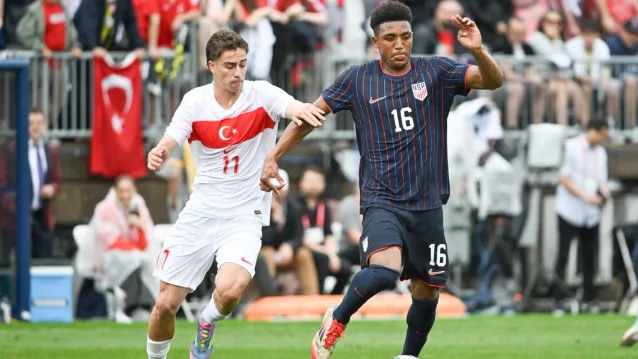
Türkiye makes this more than a no-contact scrimmage. U.S. Soccer's numbers page says Türkiye took 62 shots across its first two World Cup matches but failed to score in either.6 A desperate, scoreless opponent with technical midfielders can still force transition defending, second balls, and late tackles. That is exactly the setting where yellow-card math should shape the lineup.
Pulisic's return changes the service question, not the striker answer
Christian Pulisic's Monday training return matters, but it does not settle the Balogun call. AP reported that Pulisic joined warmups and ball drills during the 15 minutes open to media, while the team gave no formal status update.7 SBI Soccer reported the same session as a full team-training return and noted Cristian Roldan was day-to-day with a muscle strain.8
If Pulisic plays any part against Türkiye, the more useful experiment may be service timing with a rotated striker, not a reunion with Balogun. The Pulisic-to-Balogun pattern already worked against Paraguay. The knockout question is broader: can Pulisic, Reyna, Weah, Zendejas or Tillman feed whoever is needed in a one-game scenario?
That is why Balogun's best Türkiye contribution may be restraint. He has already changed the U.S. tournament by becoming the forward opponents must account for first. Thursday should be about protecting that advantage and finding out how much of the attack survives when Pochettino takes him out of the picture.
참고 출처
- 1Folarin Balogun on His Unique Background & Striving to be 'Inevitable'
- 2USMNT vs. Türkiye: Opponent Profile, Recent Form & History
- 3USMNT faces World Cup dilemma vs. Turkiye: Rotate squad or keep same XI?
- 4USMNT vs. Paraguay: Match Recap & Highlights
- 5USMNT vs. Australia: Match Recap & Highlights
- 6Behind the Numbers: USMNT Impresses in Victories against Paraguay, Australia at FIFA World Cup 2026
- 7Christian Pulisic returns to training with US after missing last World Cup match with injury
- 8USMNT: Christian Pulisic back in full training, Roldan listed day-to-day
이 콘텐츠를 둘러싼 관점이나 맥락을 계속 보강해 보세요.