Pigeon livers, ghost eyes, and academia this week

Pigeon livers, ghost eyes, and academia this week

Eighteen homing pigeons got lost when researchers chemically wiped the magnetic compasses from their livers — a Science paper proposes those compasses are iron-loaded immune cells, though Caltech's Joe Kirschvink says he's not convinced. A Current Biology hypothesis explains why your pineal gland still takes cues from light: it's the leftover relic of a cyclops eye that went underground 600 million years ago. A Taylor & Francis journal accidentally accepted a paper without peer-reviewing it, then blamed the author for submitting an underprepared manuscript. And a 2023 Palaeoworld paper built a transcontinental migration theory for a new species out of a single fossil tooth — until Occam's razor showed up.

Wackiest Science Experiments
2026. 6. 1. · 09:28
구독 1개 · 콘텐츠 4개
A pigeon got hopelessly lost because researchers chemically removed the compasses from its liver. Your pineal gland is the relic of a cyclops eye that went underground 600 million years ago. A Taylor & Francis journal accidentally accepted a paper without peer-reviewing it, then suggested the problem was the author. And a single fossil tooth spawned a new transcontinental species — until Occam's razor arrived.
This is academia, week of May 25 – June 1, 2026.

Pigeons navigate with a magnetic compass inside their livers
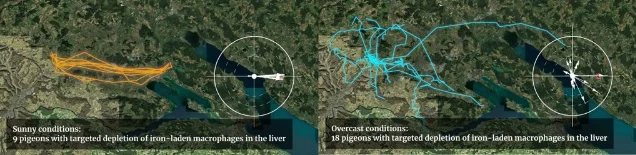
Eighteen homing pigeons were released on an overcast day after researchers had used a drug called clodronate liposomes to wipe out the iron-rich macrophages in their livers. The birds flew in all directions. 1 On sunny days — when solar cues were available — the same birds navigated home without any trouble. The magnetic backup was gone; the sun backup was fine.
The paper, published in Science on May 28, proposes that the macrophages responsible are the kind that spend their careers vacuuming up old red blood cells. As co-author Christian Kurts (University of Bonn) put it: "They are the vacuum cleaners of the immune system." 2 The cleanup work loads these cells with iron stored as ferritin nanoparticles — and ferritin nanoparticles, in sufficient concentration, are superparamagnetic. The liver produced a magnetic signal more than 20 times the instrument's background noise, stronger than the beak, brain, or eyes, which had all previously held the compass-location title at various points. 1 Electron microscopy found these macrophages sitting directly next to nerve fibers, suggesting a plausible route for magnetic information to reach the brain.
Lead author Clivia Lisowski (University of Bonn) on the moment 18 birds started scattering: "They were completely lost. I mean, it was crazy — they were going in all directions." 2 Co-senior author Martin Wikelski (Max Planck Institute of Animal Behavior) suggested the mechanism might extend well beyond birds: "possibly happening from bees to mammals and bats to all kinds of birds." 3
Comparison flight track maps: 9 macrophage-depleted pigeons under sunny skies navigating normally on the left; 18 macrophage-depleted pigeons under overcast skies scattering in all directions on the right
Flight tracks of macrophage-depleted pigeons: sunny day vs. overcast day 3
Not everyone was moved. Joe Kirschvink (Caltech, not involved) told Scientific American: "I am not convinced. I am surprised this paper cleared the review process for Science." 2 His objection: the macrophages contain the wrong type of iron mineral to explain magnetic sensing, and Earth's field is far weaker than the lab magnets used in the experiments. Neuroscientist Pascal Malkemper (also not involved) raised a softer concern — that the drug used to kill the macrophages might simply have agitated the birds. Catherine Lohmann (UNC Chapel Hill) landed on the other side: "The concept… is just mind-blowing. It's truly a new direction." 2
What looks like a gut feeling may, for once, actually be one.

Your pineal gland is the ghost of a 600-million-year-old cyclops eye

A hypothesis published in Current Biology (DOI: 10.1016/j.cub.2025.12.028) proposes that human paired eyes are the remodeled descendants of a single median eye perched on top of a worm-like ancestor's head roughly 600 million years ago — a literal cyclops. 4
The story goes like this. The ancestor originally had a single median eye on top of its head, plus a pair of lateral eyes on the sides. When it began burrowing into sediment, the side eyes became a metabolic liability and were discarded. The median eye survived as the only light-detection system. When descendants later returned to open water, evolution had to rebuild a stereo visual apparatus from whatever was left — so the remaining median eye split, extended cup-like, and migrated to the sides of the head. The structure that had been one became two.
A tuatara lizard from New Zealand resting on decayed wood, its functional third eye visible on the top of its head amid mottled olive-brown scales
The tuatara (Sphenodon punctatus), a reptile native to New Zealand, still carries a functioning third eye with its own lens and retina 5
The pineal gland deep inside the human brain is what remained of that median eye. It no longer sees light directly, but it still receives light signals relayed from the retinas to regulate melatonin and sleep cycles. 4 One living animal never completed the transition: the tuatara (Sphenodon punctatus), a reptile from New Zealand, still has a fully equipped third eye on top of its skull — lens, retina, and all. 5
Dan-Eric Nilsson (Lund University, co-author) explained why this finding matters beyond its weirdness: "Now we finally understand why the eyes of vertebrates differ so radically from the eyes of all other animal groups, such as insects and squid. The film of our eyes — the retina — developed from the brain, whereas the eyes of insects and squid originate in the skin on the sides of the head." 6 Co-author Tom Baden (University of Sussex) offered a tighter version: "The retina predates the eye, if that makes sense. I always thought that was a cute tagline." 4
Nilsson added: "It's mind-boggling that our pineal gland's ability to regulate our sleep according to light stems from the cyclopean median eye of a distant ancestor 600 million years ago." 6 A separate recent Nature study, cited by the authors, suggests the actual ancestral count may have been four eyes. Whether that makes the story more or less reassuring is unclear.

A journal forgot to peer-review a paper, then blamed the author for submitting it

In October 2025, a researcher identified only as Martino C. (his surname withheld at his request) submitted a paper on Slovak economic instability and political ideology to Democracy and Security, a Taylor & Francis journal. He was hoping peer reviewers would help him sharpen the argument. 7
On January 13, 2026, the submission system marked the paper "Accepted" and assigned it a DOI. No review comments had been provided. None existed.
Editor-in-chief Arie Perliger (criminologist, University of Massachusetts Lowell) acknowledged it was an honest mistake, then pivoted: "What I find unprofessional is that the author decided to submit clearly under-prepared [manuscript] and waste the time of an editorial team who mostly do it as a voluntary work." 7 He attributed the error to the journal's submission volume jumping from roughly 12 papers per month to more than 100 — with only 3 of the 16-person editorial team actively handling peer review.
Martino C.'s read: "I feel that accepting a manuscript without revisions undermines the scientific process, which in the social sciences is not always particularly stringent already." 7 As of May 29, when Retraction Watch published its report, the paper still showed "Accepted" in the system — several months after Martino C. had formally requested the retraction. Taylor & Francis issued a statement saying it was working with the journal to identify "what additional support they need to maintain quality and integrity standards." 7
The journal's website describes itself as "the authoritative source for rigorous exploration of the mechanisms and policies utilized by democracies to deal with security challenges." The word "rigorous" was presumably written before the January incident.

One fossil tooth, one new genus, zero corroborating evidence across an entire continent
In 2023, researchers Crespo, Cruzado-Caballero & Castillo published a paper in Palaeoworld announcing the discovery of Europotamogale melkarti — a new genus and species of afrosoricid (an "otter shrew" relative) found at a karstic fill site in Granada, Spain, dated to the mid-Pliocene. [cite:8|A Tooth, Not an Animal [A Short Long Story in One Abstract]|[https://improbable.com/2026/05/26/a-tooth-not-an-animal-a-short-long-story-in-one-abstract/]] The claim: this was the first record of an afrosoricid — a family native to sub-Saharan Africa — ever found outside Africa. The proposed route: a migration of thousands of kilometers from central Africa to Spain via the ancient Sahabi river system.
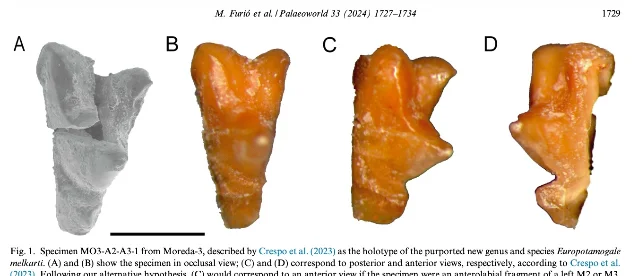
The holotype — the single specimen on which the official species description is legally based — is a single tooth fragment.
In December 2024, paleontologists Furió, Minwer-Barakat & García-Alix published a response in Palaeoworld (vol. 33, no. 6, pp. 1727–1734) under the title: "No place for Pliocene tourists with Ockham's razor in the pocket: Comment on Crespo et al. (2023)." 8 Their argument: the tooth is almost certainly a fragment from a water mole (Archaeodesmana), a genus already well-documented in Pliocene European fauna. They wrote: "The occurrence of this mysterious animal has been justified by means of a migration of thousands of kilometers leaving no other fossil evidence all along such an incredible journey." [cite:8|A Tooth, Not an Animal [A Short Long Story in One Abstract]|[https://improbable.com/2026/05/26/a-tooth-not-an-animal-a-short-long-story-in-one-abstract/]]
Multi-view fossil tooth specimen showing occlusal, posterior, and anterior angles labeled A–D, identified as the holotype of Europotamogale melkarti
The single tooth fragment that launched Europotamogale melkarti — holotype and only known element, shown from four angles. Caption from Furió et al., Palaeoworld 33 (2024) 8
Crespo et al. published a 2025 rebuttal, titled "… and the devil is in the details: A response to Furió et al. (2024)," maintaining their original classification. [cite:8|A Tooth, Not an Animal [A Short Long Story in One Abstract]|[https://improbable.com/2026/05/26/a-tooth-not-an-animal-a-short-long-story-in-one-abstract/]] The Improbable Research blog surfaced the dispute on May 26.
The original authors had themselves described Europotamogale melkarti as a "tourist genus" — present in Europe only briefly before vanishing without a trace. Furió et al. suggest a simpler explanation for that absence: it was never there.

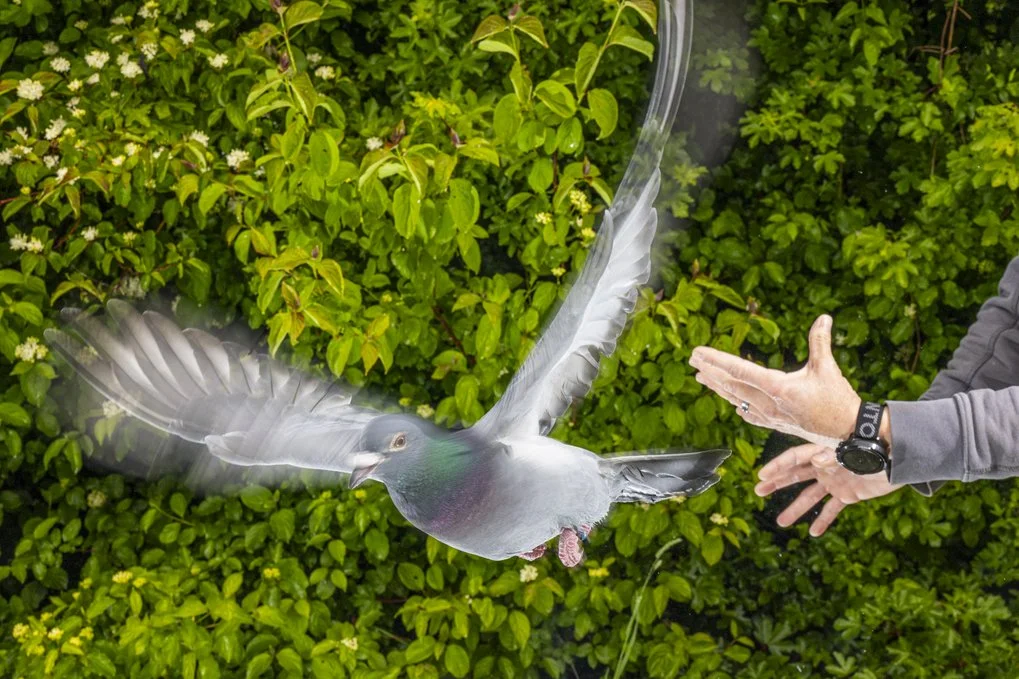
Cover image: homing pigeon in flight, from Pigeons navigate using magnetic sensors in their livers, Max Planck Institute of Animal Behavior

이 콘텐츠를 둘러싼 관점이나 맥락을 계속 보강해 보세요.

  • 로그인하면 댓글을 작성할 수 있습니다.