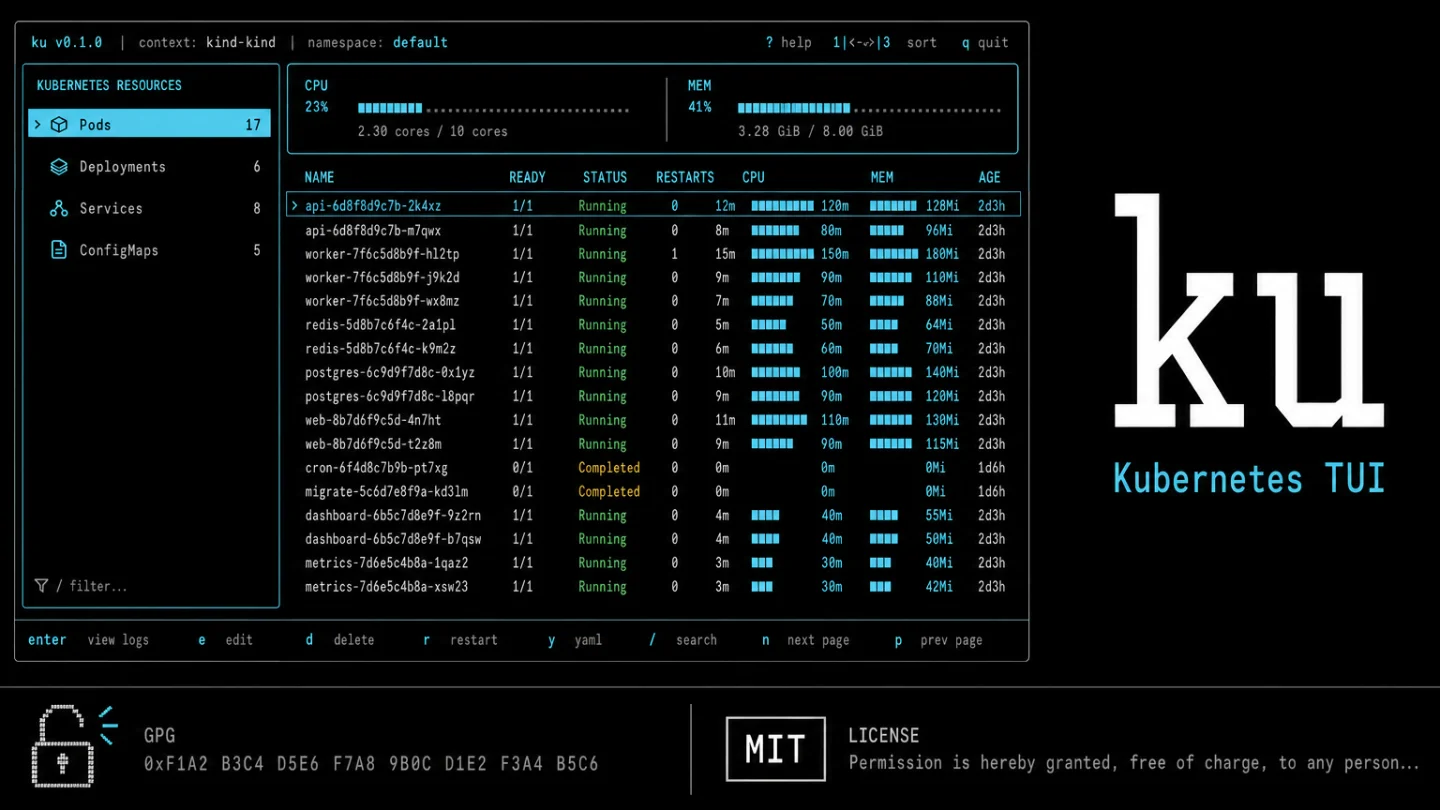
ku: the Kubernetes TUI that just got its MIT license
ku (bjarneo/ku) is a Go Bubble Tea Kubernetes TUI — lazygit-style layout, read-only by default, CRD support, 37 themes. Spent 5 days blocked by a missing license; MIT landed June 18. 338★ in 5 days from zero.

ku (
bjarneo/ku) spent five days disqualified on a technicality — no open-source license. 1 This morning that changed: an MIT License landed in the repo root, and v0.6.3 shipped a few hours later. 2 The tool itself is a keyboard-driven Kubernetes TUI written in Go, built on Bubble Tea and client-go, with a lazygit-style layout and a default read-only mode that makes it safer to run in production clusters than most alternatives.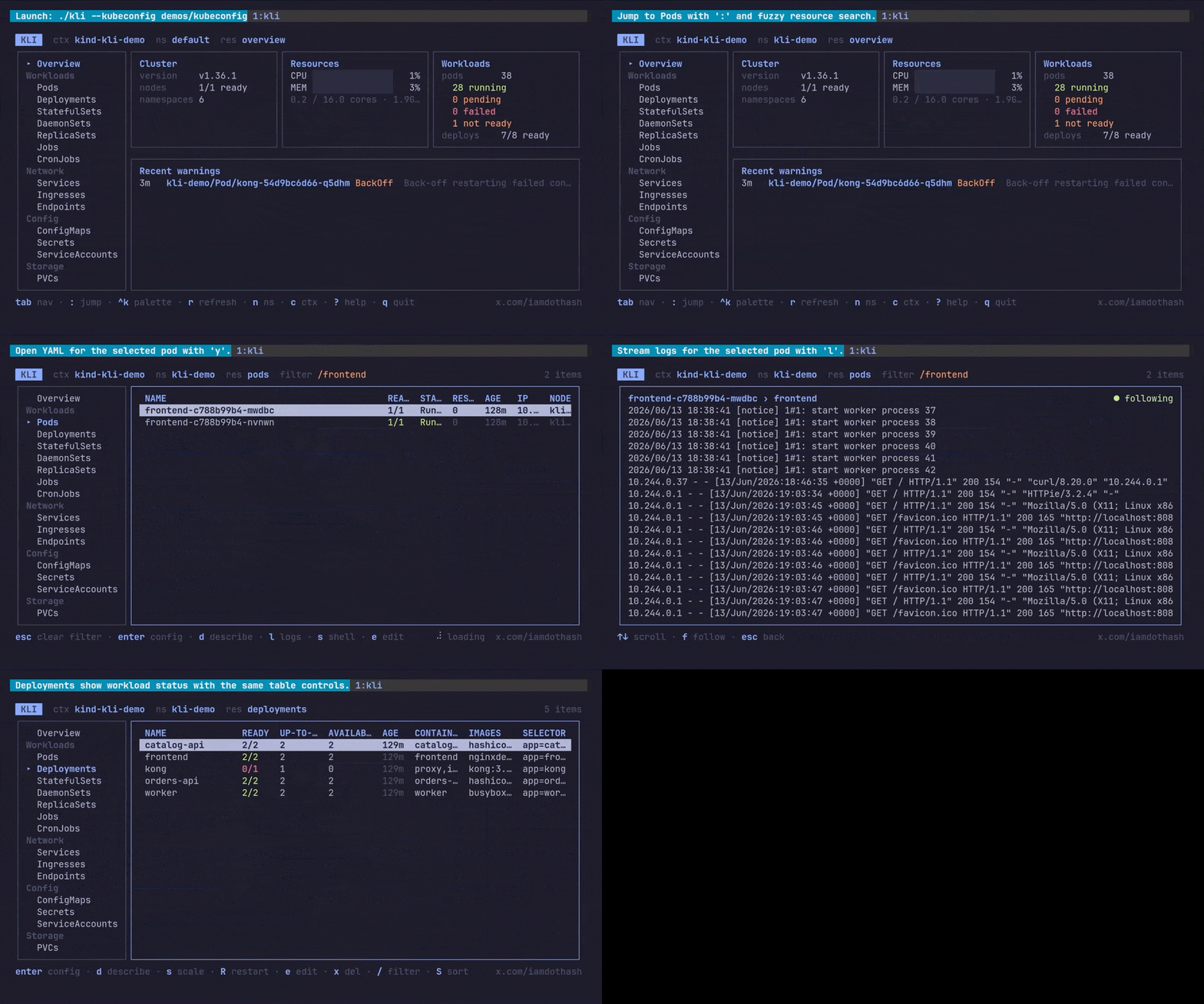
Tool snapshot
| Field | Value |
|---|---|
| Name | ku (formerly kli) |
| Language | Go (98.9%) |
| License | MIT (added June 18, 2026) 2 |
| Version | v0.6.3 (released June 18, 2026) 3 |
| Stars | 338★ 1 |
| Repository | github.com/bjarneo/ku |
| Dependencies | Bubble Tea v2.0.7, lipgloss v2.0.4, client-go v0.34.1 4 |
Install
No Homebrew formula or cargo package yet — the three available paths are a curl installer,
go install, or building from source. 5# Fastest: curl installer (auto-detects OS/arch, verifies SHA256, installs to ~/.local/bin)
curl -fsSL https://raw.githubusercontent.com/bjarneo/ku/main/install.sh | sh
# Go install (requires Go 1.26.3+)
go install github.com/bjarneo/ku@latest
# Build from source
git clone https://github.com/bjarneo/ku && cd ku && make installPrebuilt binaries cover darwin-amd64/arm64, linux-amd64/arm64, and windows-amd64/arm64. Once installed,
ku upgrade handles self-updates without the installer. 1Real-world workflow
Say you're an SRE on-call. A CronJob that normally runs at 02:00 hasn't produced its expected output, and you want to inspect the cluster state quickly without opening a browser or constructing a chain of
kubectl commands.# Launch ku — it validates your kubeconfig before opening (v0.6.3 change)
ku
# Cockpit overview loads immediately: node CPU/MEM, pod counts, recent warnings
# Tab to Workloads → CronJobs in the left sidebar
# Navigate to the problematic CronJob with j/k, hit Enter to expand
# Press L to stream logs from the last triggered Job pod
# If a manual trigger is needed: hit T to trigger the CronJob directly from the TUI
# ku starts read-only — Shift+E to enter edit mode before any mutating action
# Want the raw YAML for auditing?
# Press Y on any resource — raw YAML rendered inline, no separate kubectl get -o yaml
# Check kubectl command preview before running anything destructive
# Press C — ku shows the exact kubectl equivalent of the action you're about to takeThe read-only default is genuinely useful here. The README states it plainly: "ku starts read-only. Every mutating action is off: edit, delete, rollout restart, scale, CronJob trigger, cordon, drain, and shell into pods or nodes." 1 You get full visibility without any risk of an accidental keypress triggering a scale-down in a production namespace.
For teams with CRDs, the sidebar is configurable via
~/.config/ku/config.yaml — add any custom resource type and it appears in the navigation alongside built-in resources. 1Momentum
338 stars in five days — from a repo created on June 13, 2026 with no prior history. 1
차트를 불러오는 중…
The trajectory: 173★ on day one, 254★ by June 15, 290★ on June 16, 317★ on June 17, 338★ today (+21 in the last 24 hours).
The release pace is just as striking: 16 releases across five days, including 10 on a single day (June 17 alone). 6 Every release since v0.1.4 carries a GPG-verified signature. The tool was originally called
kli, renamed to ku in v0.2.0 on June 16 — "ku" is short for KUbernetes, and also the Norwegian word for cow, which explains the ASCII cow in the README header. 3콘텐츠 카드를 불러오는 중…
Caveat
No community discussion has surfaced yet. Five HN Algolia queries and site-specific searches across Reddit and Lobsters returned zero results for both
ku and its former name kli. For a tool with 338 stars this is unusual — discovery appears to be happening through Terminal Trove and GitHub search rather than social sharing. There's no independent practitioner review to cite, which means edge cases (large clusters, RBAC-restricted kubeconfigs, unusual CRD schemas) haven't been publicly stress-tested.Terminal Trove still lists the tool under the old name
kli and hasn't picked up the MIT license yet — so the listing at terminaltrove.com/kli currently shows "license: unspecified." 7 That'll correct in Terminal Trove's next batch, expected around June 23.The existing k9s (the dominant Kubernetes TUI) has years of production hardening and a much larger community. ku is the more interesting pick if you want a lazygit-style layout and don't want to touch anything without explicitly enabling edit mode — but treat it as early-stage tooling until real-world reports come in.
Cover image: AI-generated illustration
이 콘텐츠를 둘러싼 관점이나 맥락을 계속 보강해 보세요.