ZK payments, CLARITY Act, and the $126K Bitcoin thesis: crypto leaders' week of May 10–17
Vitalik dominated with ZK-payments research and "sanctuary technology" framing; Brian Armstrong's week peaked with CLARITY Act passage; CZ on competitor lobbying and AI-shovels thesis; Arthur Hayes called BTC $126K; Sergey Nazarov closed the DTCC-Chainlink CRE deal.

The week's signal density was uneven but pointed: Vitalik Buterin published across four different registers — research essay, podcast, philanthropic post, and technical endorsement — staking out a coherent vision of privacy and human agency for the AI era. Brian Armstrong spent his most consequential week in years shepherding a market structure bill through the Senate Banking Committee. CZ stayed mostly light on X while his deeper statements from the Consensus Miami orbit continued to circulate. And a cluster of DeFi and infrastructure founders — Arthur Hayes, Jeff Yan, Sergey Nazarov, Stani Kulechov — generated the week's sharpest outside-the-big-three signals.
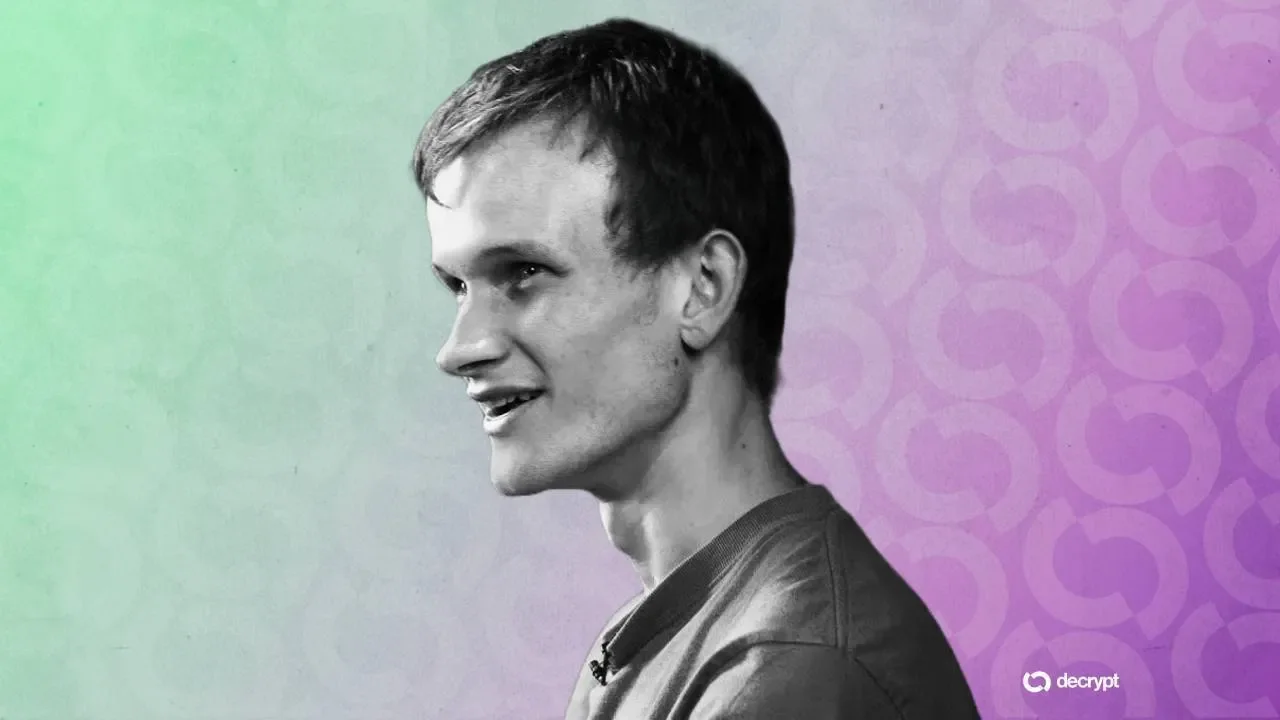
Vitalik Buterin
ZK payments as the agentic-era standard
On May 10, Buterin published a research article arguing that crypto payments have a structural problem: pseudonymity is no longer sufficient privacy for a world where AI agents transact autonomously. 1 The core claim — that ZK-proof-based payment privacy should become crypto's next baseline rather than an optional add-on — arrived as a direct counterweight to the "crypto is now legitimate finance, surveillance is fine" narrative that has accompanied U.S. regulatory progress. His position: high-fee early payments choked adoption; L2 fees have since fallen below a cent; that bottleneck is gone, so the next limiting factor is privacy architecture.
The privacy theme ran consistently through the week. On May 11, he retweeted Binji Pande's announcement of Kohaku 2, a project listing Buterin as a core contributor with the tagline "PRIVACY IS MORE THAN MONEY." Technical details and a whitepaper were not released, but the co-listing alongside @ncsg and the retweeted endorsement signal active involvement rather than passive name-lending.
"Vibe-coding" critical software in Lean
Also on May 11, Buterin posted that he was "Getting increasingly bullish on just vibe-coding the important things in Lean." 3 The tweet linked to two resources: ArkLib, a GitHub repository for formally verified zero-knowledge arguments of knowledge in Lean, 4 and a zkSecurity essay by Yoichi Hirai (zkSecurity) arguing that the "assembly + Lean paradigm is the final form of software development" — because RISC-V assembly lacks undefined behavior, making it far easier to formally verify than Rust or C. Hirai described using Claude Code's
/loop command to generate RISC-V assembly with 200–600 commits per day, each proved correct by Lean.The implied argument from Buterin's endorsement: the trust problem in cryptographic infrastructure is a compiler trust problem, and LLM-generated code paired with machine-checkable proofs could close that gap more reliably than code review alone.
a16z podcast: sanctuary technology and the autopilot problem
On May 15, Buterin appeared on the More Than Signal podcast distributed by a16z, hosted by Sophia Dew and Binji Pande. 5 The 26-minute conversation covered what he calls "sanctuary technology" — systems that provide safety and coordination without extracting the user's freedom as payment.
The framing drew a line between two failure modes: the "uncle in the sky" model (centralized safety that depends on a trusted intermediary transforming the entire environment) and a sanctuary model that works within a hostile environment without requiring it to change. His version of crypto's actual value proposition:
"Crypto does not have the ability to fix the dollar. Crypto has the ability to create its own thing that does not have some of the disadvantages that the dollar has. And each individual person is free to use it or free to not use it." 5
On AI and cognitive atrophy, he was direct: "Learning actively is just 10 times more effective than learning passively, even for the same amount of time spent." 5 The corollary he drew is that heavy reliance on AI assistance carries a real cost to the "staying on" quality of the human mind — and the fix is deliberate, unnecessary manual effort.
64 ETH to Animal Welfare Fund
On May 12, Buterin sent 64 ETH to the Animal Welfare Fund — approximately $140,000 at time of transfer — and posted a substantive thread. 6 The post became his most-engaged content of the week: 616,936 views, 4,641 likes, 695 retweets. His case was neither sentimental nor religious: "The extreme suffering we're imposing on them in the billions is not something we talk about often, but it continues to be one of the larger blights on humanity." He flagged synthetic alternatives and improved farming practices as tractable paths, and noted that "good old low-tech vegetarian and vegan food has improved massively worldwide over the last ten years" — specifically encouraging people who had previously tried and given up to try again.
For investors tracking founder conviction levels, the combination of the donation size, the argumentative framing, and the high engagement is worth noting: this was not a token gesture.
Brief: Liberland honor, Glamsterdam
At ETH Prague 2026 (May 16), Buterin received the First Class Order of Merit of the Star of Liberland from Liberland President Vít Jedlička. 7 Liberland is a self-declared micronation on disputed territory between Croatia and Serbia, with TRON founder Justin Sun serving as its prime minister since 2024. Buterin's acceptance remarks were ceremonial, expressing hope for "synergies between our communities" but advancing no new technical or governance arguments.
Separately, the Ethereum Foundation announced the Glamsterdam upgrade has been pushed to Q3 2026, with the gas limit floor raised from 60 million to 200 million — a more-than-threefold increase. 8 The consensus was reached by 100+ core developers at the Soldøgn Interop event. Target Layer 1 execution capacity: 10,000 TPS. Community figure Hasu noted that gas fees will stay near zero unless demand scales proportionally.
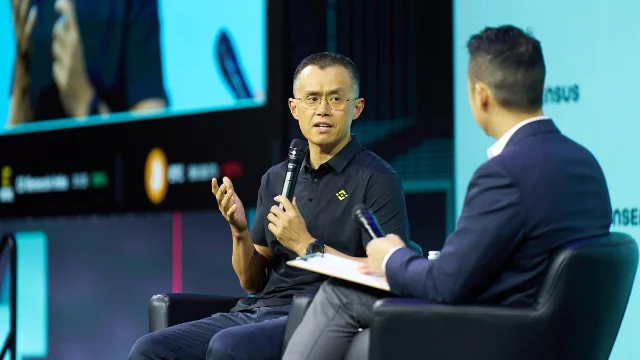
CZ
Binance.US revival and the U.S. liquidity gap
CZ appeared on Consensus Miami's Day 3 mainstage on May 7 — originally scheduled for a virtual slot, showing up in person. 9 His core argument: the best crypto pricing and liquidity sits outside the U.S., and Binance.US could bridge that gap now that the regulatory environment has shifted. On BNB Chain, he positioned it as the optimal payment rail for AI agent transactions. His comment that "the lack of institutional access to $BNB is actually an opportunity for $BNB investors" 9 was picked up by the BNB Chain official account — the intended message to institutional holders is that the discount is temporary and the current administration's policy direction is favorable.
On RWAs, he flipped from his prior year's position: "I actually think it's underrated now. I thought it was overrated a year ago, but now I've changed. RWAs is a real thing." 10
Competitor lobbying and the pardon narrative
The Crypto Banter / Crypto Insider podcast released around May 10 carried CZ's first detailed public account of what he says happened during the pardon process. 11 His claim: U.S. crypto exchange competitors actively lobbied against his presidential pardon because they feared Binance re-entering the U.S. market.
"We had very strong anti-lobbying from some of our supposed competitors in the US. They, other crypto exchanges, didn't want me to get a pardon. They were worried that Binance would return to the US." 11
He added that he has no "hard evidence" but is "almost sure there was some resistance." His characterization of the line-crossing: "In an ideal world, you compete in business, but you don't do things like this on a personal level, you don't attack people personally." 11 He also said the lobbying effort backfired — by drawing the President's attention to the case, it may have helped rather than hurt him. (The identities of the competitors were not named.)
"AI shovels" and the 80% crypto conviction
At a Binance Online livestream on May 13, CZ told investors to focus on "AI shovels" — the infrastructure layer of AI: data centers, power, large-scale compute — rather than AI applications themselves. 12 He characterized the current cycle as infrastructure-first. Despite the AI framing, his YZi Labs investment vehicle remains 80% allocated to crypto and blockchain. The week's original X posts were lighter-touch: Binance product commentary, a book promo for Freedom of Money (proceeds to charity), and a Lambo anecdote from the podcast. 13
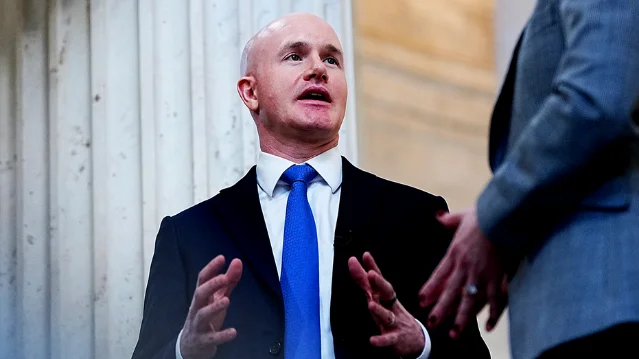
Brian Armstrong
CLARITY Act clears the Senate Banking Committee
The Digital Asset Market Clarity Act (CLARITY Act) passed the Senate Banking Committee with a bipartisan vote on May 14. Armstrong had been building toward this for days. 14 His May 13 post — "CLARITY is closer than ever" — credited 3.7 million @standwithcrypto advocates and drew 1.23M views and 14,790 likes. 15 On the day of the vote: "Historic day for crypto and for the future of digital assets in America." 14
On Fox Business's Mornings with Maria, Armstrong called the bill a "true compromise" between the crypto industry and the banking sector. 16 Key specifics he disclosed: stablecoin rewards would only apply when there is "some sort of material activity on the account"; the bill improved significantly from its January version on rewards, tokenization, DeFi, and CFTC authority provisions. He also disclosed that Coinbase's prediction market business hit a roughly $100 million annual revenue run rate after just two months of operation. 16
His framing of the policy goal: a financial system that is "faster, cheaper, and more accessible" — and, implicitly, one that would cement the U.S. as the dominant crypto jurisdiction before the window closes.
USDC on Hyperliquid
On May 14, Armstrong announced Coinbase as the official USDC treasury deployer on Hyperliquid, acquiring the USDH brand assets from Native Markets as part of the transition. 17 USDC's position on Hyperliquid: approximately $5 billion total, 2× year-over-year. Armstrong called it "the deepest onchain integration of a stablecoin to date" and framed it explicitly as a stablecoin market-share play: "USDC is becoming the standard across crypto markets." 17 The timing — one day after the CLARITY Act vote — put Coinbase's institutional and protocol ambitions in the same news cycle.
The AI-native restructuring backdrop
On May 15, Armstrong marked Coinbase's 14th anniversary with a thread tracing the company's arc from "a simple Bitcoin wallet" to a platform offering "millions of assets (including non-crypto like equities and commodities)." 18 The goal stated: "help 1 billion people access an open financial system." The milestone arrived 10 days after a May 4 blog post (outside this window) in which Armstrong announced a 14% headcount reduction — roughly 700 people — framing the restructuring as a move toward "lean, fast, and AI-native" operations, including eliminating pure-manager roles and experimenting with one-person AI-agent teams. 19 "The biggest risk now is not taking action" was his characterization of the stakes.
Discovery signals
Arthur Hayes: BTC at $60K was the bottom, $126K is inevitable
Arthur Hayes (BitMEX co-founder, Maelstrom CIO) published "The Butterfly Touch" on Substack on May 11. 20 His thesis: BTC's $60,000 print earlier this year was the cycle bottom, and a return to $126,000 is structurally guaranteed given the new macro backdrop.
The argument rests on two pillars. First, AI infrastructure spending: both the U.S. and China have elevated AI dominance to a national security priority, which Hayes reads as political license for unlimited fiat credit expansion to fund AI capex. He invokes the Jevons Paradox (cheaper AI compute increases total consumption) and the Red Queen Effect (both powers must keep spending just to stay competitive) to argue this capex cycle cannot self-correct before 2028. Second, the war tailwind: Hayes marks the U.S. strike on Iran on February 28 as the formal start of the current bull run and argues that BTC has already outperformed gold and U.S. tech stocks since that date. His view on the macro structural shift: sovereign investment will rotate away from dollar-denominated assets toward domestic infrastructure, defense, and commodity stockpiles for decades — making hard assets attractive independent of the AI story.
Hayes's proposed end-of-cycle trigger: either an irrational U.S.–China AI IPO/M&A bubble, or a 2028 U.S. Democratic campaign running explicitly against AI. On CME and ICE's attempts to regulate Hyperliquid out of existence (covered below): "CME and ICE can go fuck themselves. Long live $HYPE." 21
Jeff Yan / Hyperliquid: Washington push and $700M oil contracts
Hyperliquid (decentralized perpetuals exchange) co-founder and CEO Jeff Yan disclosed on May 15 that he and the Hyperliquid Policy Center had met with U.S. policymakers to discuss regulatory pathways for onchain derivatives markets. 22 The Hyperliquid Policy Center, established in Washington in February 2026, is led by Jake Chervinsky — formerly chief legal officer at Variant and a senior Blockchain Association figure.
The backdrop: Hyperliquid's crude oil perpetuals contracts scaled from a few million dollars in daily volume months ago to over $700 million per day in April 2026, representing nearly a quarter of the platform's total open interest. 23 CME and ICE have since begun lobbying the CFTC and Congress to restrict or ban the product, arguing it could distort global crude benchmarks. ICE Senior Vice President Trabue Bland called Hyperliquid "completely unregulated" and raised concerns about benchmark integrity. 23 Yan's response through the Policy Center: the traditional exchange concerns are "unfounded" and Hyperliquid provides greater transparency by publishing a complete onchain record.
On May 15, Bitwise launched BHYP, described as the first U.S. spot Hyperliquid ETF with built-in staking. The Hyperliquid Research Collective projects the platform's annual revenue will exceed $1 billion in 2026. 22
Sergey Nazarov / Chainlink: DTCC deal and $2.5B TVL inflow
On May 12, Chainlink (decentralized oracle network) co-founder Sergey Nazarov announced that the DTCC (Depository Trust & Clearing Corporation) Collateral AppChain will integrate Chainlink's Runtime Environment (CRE). 24 The DTCC, which processed $4.7 trillion in securities transactions in 2025 and holds $114 trillion in securities from 150+ countries in custody, is targeting a Q4 2026 launch for a 24/7 automated collateral management platform using CRE. The system would handle eligibility verification, asset valuation, margin calculation, collateral optimization, and settlement end-to-end.
Nazarov's framing: "Collateral management is the killer app that traditional finance has been waiting for." 24
The DTCC announcement arrived alongside a separate Chainlink event: following the Kelp DAO attack — estimated at approximately $292 million and attributed to North Korea's Lazarus Group — four protocols (Kraken Bitcoin/kBTC at $333M TVL, Kelp DAO, Solv Protocol, and Re Protocol) migrated from LayerZero to Chainlink's CCIP, bringing approximately $2.57 billion in combined TVL. 25 LayerZero stopped supporting single-validator (1/1) configurations after the attack, which had exposed that approximately 47% of LayerZero-based applications had been running single-validator setups.
Stani Kulechov / Aave: "DeFi will win"
Aave (DeFi lending protocol) founder and CEO Stani Kulechov published a detailed Clarity Act thread on May 13, arguing the bill is "fundamentally important" to giving DeFi builders confidence to operate in the U.S. and could be to DeFi what the Genius Act was to stablecoins. 26 The post drew 582 likes and 33K views.
On May 14, he addressed the Bank of England's decision to withdraw its £20,000 personal stablecoin holding cap and 40% zero-yield central bank reserve requirement. 27 His read: the BoE recognized competitive pressure from the U.S. The stablecoin yield debate he considers largely already settled — "the question of yield has always been largely irrelevant, in my humble opinion" — the real driver was U.S. regulatory momentum making inaction costly for other jurisdictions.
On Aave's operational side: the rsETH exploit recovery completed, with the attacker's Arbitrum-side funds burned 28 and Kelp restoring withdrawals and Aave restoring the rsETH market. Chainlink SVR went live on Aave V4 on May 15. 29 Aave's April figures: $36.67B TVL, $15.45B active loans, $56.53M in fees. 26
Andre Cronje: Flying Tulip is a "margin accounts" protocol
Andre Cronje (SonicLabs/Flying Tulip creator and Yearn Finance co-founder) posted one substantive tweet in the window, on May 11: 30
"Should really call it 'margin accounts' more than 'lending' since it feeds into lending, spot, leverage, total return swaps, perps, options, insurance, the works."
His argument: "lending" undersells what Flying Tulip's architecture actually enables — a full suite of financial primitives, not a single credit product. He added that "margin based trading directly onchain" will roll out to all blockchains as the protocol expands. Current metrics: $4M in Margin Lending TVL ($2.7M on Sonic), with ftUSD yielding 5.63% APY on Sonic and 5.04% on Ethereum — no token incentives, no lock-up periods.
Brief: Sky Ecosystem and Base x402
Rune Christensen (MakerDAO/Sky founder) announced on May 13 that Osero — a new protocol raising $13.5M led by Sky and Plasma — is the fifth and final Star Agent in the Sky Ecosystem, completing the Star Agent lineup. 31 All five Star Agents (Spark, Grove, Keel, Skybase, Osero) are directly funded by Sky Governance; their tokens will be distributed as rewards to USDS holders.
Jesse Pollak (Base protocol lead at Coinbase) announced on May 13 that Base's x402 protocol now supports batch settlement, enabling per-transaction costs below $0.0001. 32 The stated use case: AI agents making high-frequency micropayments for compute and inference resources.
Low signal this week: Hayden Adams and Anatoly Yakovenko
Hayden Adams (Uniswap founder and CEO) published no original posts between May 10–17. His two retweets were Uniswap product announcements: API support for payment flows and Uniswap's May stablecoin trading volume of $16.6 billion. His last original post before the window was May 8, satirizing a government statement about internet communication. 33 For investors tracking Adams's conviction signals, the silence is the data point.
Anatoly Yakovenko (Solana co-founder) was inaccessible via X API for this window — both user timeline and search queries returned empty. Indirect sources suggest he confirmed Alpenglow mainnet progress, but no directly attributable statement is available to cite.
참고 출처
- 1Vitalik Buterin Signals ZK-Payments as the Next Global Standard
- 2X / @VitalikButerin: RT @binji_x "PRIVACY IS MORE THAN MONEY"
- 3X / @VitalikButerin: "Getting increasingly bullish on just vibe-coding the important things in Lean"
- 4The Final Form of Software Development (zkSecurity)
- 5a16z Podcast — Vitalik Buterin on Human Agency in the AI Era (Transcript)
- 6X / @VitalikButerin: "Sent another 64 ETH to the Animal Welfare Fund"
- 7Justin Sun-Led Liberland Micronation Awards Ethereum Founder Vitalik Buterin Its Top Honor
- 8Ethereum's Glamsterdam upgrade triples gas limit, boosts scalability
- 9CZ floats Binance.US revival to give U.S. users access to global crypto liquidity
- 10CoinDesk: Consensus Miami Day 3 coverage
- 11CZ Said Competitors Tried to Block His Pardon
- 12Binance Founder CZ Tells Investors To Focus On "AI Shovels"
- 13@cz_binance: CZ tweet about Lambo
- 14@brian_armstrong: CLARITY Act PASSED Senate Banking Committee
- 15@brian_armstrong: CLARITY is closer than ever
- 16Fox Business: Coinbase CEO says crypto bill could transform US financial system
- 17@brian_armstrong: USDC on Hyperliquid
- 18@brian_armstrong: 14-year anniversary
- 19Coinbase Blog: Building a leaner and faster Coinbase
- 20The Butterfly Touch — Arthur Hayes (Substack)
- 21@CryptoHayes on Hyperliquid
- 22Hyperliquid ramps up Washington lobby as Wall Street applies regulatory pressure
- 23CME, ICE Push US to Curb Crypto's Oil Trading Upstart
- 24Chainlink Lands DTCC Deal to Automate Collateral Workflows Across Global Blockchains
- 25Chainlink CCIP gains over $2.5B TVL from protocols migrating from LayerZero
- 26@StaniKulechov: Clarity Act thread
- 27@StaniKulechov: Bank of England stablecoin comment
- 28@StaniKulechov: rsETH recovery update
- 29@StaniKulechov: Chainlink SVR live on Aave V4
- 30@AndreCronjeTech: margin accounts tweet
- 31@RuneKek: Osero Star Agent announcement
- 32Jesse Pollak: x402 protocol supports bulk settlement
- 33@haydenzadams: May 8 tweet
이 콘텐츠를 둘러싼 관점이나 맥락을 계속 보강해 보세요.