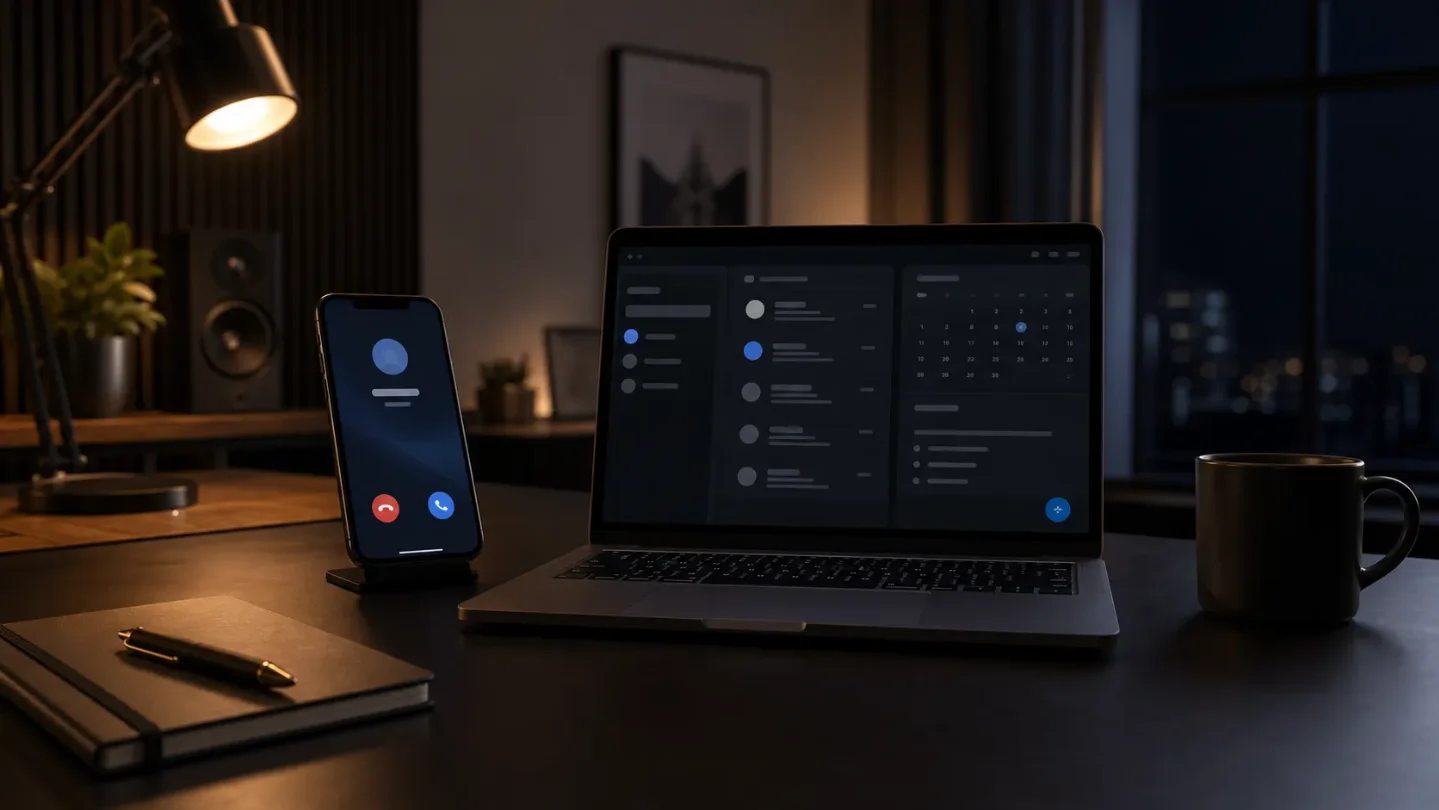
Zinley gives your AI agent a phone number and inbox, but every task spends credits
Zinley is a new Product Hunt launch that gives an AI agent its own phone number, inbox, and computer for creator operations, but its credit-based limits make it a bounded trial rather than an unattended assistant.

Product Hunt currently labels Zinley "Launching today." Its pitch is easy to summarize and harder to place: the AI gets its own phone number, inbox, and computer, then handles calls, email, and tasks within rules you set. 1
For a content creator, that puts Zinley before the script and after the upload. It is aimed at the work that arrives as a sponsor email, a scheduling request, a vendor question, or a half-finished operational task. The useful question is not whether it can sound like you. It is whether you are willing to let it represent you when the cost of a wrong move is higher than the time saved.
The new thing is the identity
Most AI assistants wait inside a chat window. Zinley gives the agent a separate email address and phone number, remembers people and open loops, and reports completed work in plain language. The company also says the agent can operate its own computer and only the devices the user approves. 2
That changes the handoff. A creator does not have to paste a brand thread into a chatbot and then copy the answer back. The official example is simpler: add Zinley to an email, let it work through dates and follow-ups in your tone, and receive the calendar invite when the group agrees. 2
The product is therefore closer to a junior operations representative than to a content model. It can sit in the communication channel where the work already happens. That is the launch's real distinction, and it is also where the risk begins.
Where a creator could use it
The official site lists research and synthesis, data and operations, documents and files, agentic voicemail, personal customer service, and a shared number and inbox as example workflows. 2 Translated into a creator's week, those capabilities map to a few concrete jobs:
- Sponsor and collaboration intake: answer routine questions, gather availability, and keep a thread moving until the creator needs to decide on terms.
- Scheduling and follow-up: handle the back-and-forth around an interview, shoot, guest appearance, or team meeting, then return a clean result instead of another chat transcript.
- Research and production operations: collect sources, compare claims, update a sheet, or prepare a document while leaving judgment calls and final approval with the creator.
- Small-team coordination: give an editor, assistant, or vendor one number and inbox to contact without giving that person access to the creator's main mailbox. 2
The first three are useful because they remove waiting, not because they produce a finished piece of content. If the creator's bottleneck is weak ideas, poor writing, or an unresolved creative direction, Zinley is aimed at the wrong layer of the workflow.
What the workflow actually looks like
Zinley's design has three linked parts.
First, it keeps context about the user and their contacts. The company describes this as remembering how you work, who matters to you, shared history, and open loops. 2 That memory is meant to reduce the repeated briefing that makes ordinary assistants brittle.
Second, the agent represents the user through its own communication surfaces. It can take and make calls, book and follow up, wait on hold, and join an email thread. The site says it brings the user in when the decision belongs to them. 2 For a creator, that suggests a useful boundary: let the agent handle logistics and questions with known answers, then escalate pricing, rights, deadlines, or editorial commitments.
Third, it acts through a computer and approved integrations. The official page names Gmail, Slack, Google Calendar, Notion, Linear, GitHub, Drive, Figma, Stripe, iMessage, and Discord. 2 The exact value is not the number of logos. It is that the agent can carry a task across communication, documents, and scheduling instead of stopping at a draft.
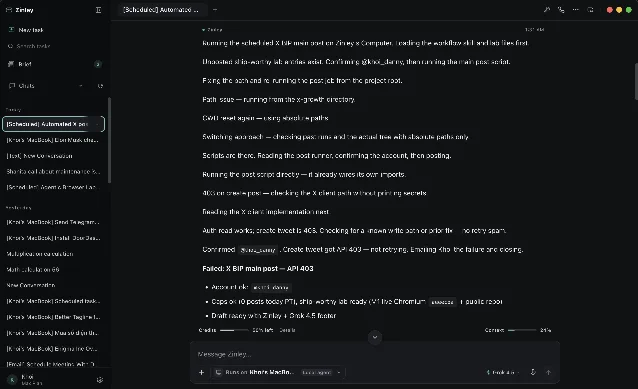
That screenshot is more revealing than a polished success story. The agent can report what it tried and why the task stopped, but a connected service can still reject the action. The creator remains responsible for deciding whether to retry, change the workflow, or do the action manually.
The design choice: representation with handoffs
Giving an agent its own identity solves a practical problem: a third party can interact with it without receiving access to the creator's primary inbox or personal number. Zinley says its own number, inbox, and computer are private to the user, and that the agent follows user rules. 2
The same choice creates a social problem. A recipient may think they are speaking to the creator unless the interaction makes the agent's role clear. A representative can also use the wrong context, misread a relationship, or make a promise that sounded harmless in a routine thread. The product's handoff model acknowledges this by bringing the user back for decisions, but the user still has to define those decisions before the first live conversation arrives.
This is why Zinley is more interesting as an operating model than as another chatbot. The chain is explicit:
- A creator delegates a bounded task, such as collecting meeting times.
- Zinley uses remembered context and its own inbox or number to carry the conversation.
- It returns a result or escalates when a judgment call appears.
- The creator checks the record and owns the consequence.
The model works best when the task has a clear finish line. It is much harder to trust with ambiguous relationship management, a sensitive sponsor negotiation, or an editorial message where tone is part of the product.
The free tier is a real boundary
Zinley does not meter only phone calls. Its usage page says every agent action spends credits, including email composition and sending, scheduled tasks, web search and reading, memory, voice, and media generation. The page was last updated July 25, 2026, so the following figures are a current launch-period snapshot rather than a permanent price promise. 3
The free plan includes 10 daily credits and 2,000 base subscription credits per month. It allows three active scheduled tasks, keeps email and call history for three days, and supports one concurrent real phone call with a 15-minute maximum. The first phone number is free to claim, but the page describes phone numbers as a subscription and bills call minutes from credits. 3
The page does not turn those allocations into a simple "one email equals X credits" price. It says the charge reflects the real cost of the work, with light tasks costing less than heavy ones. When the daily, subscription, and wallet balances reach zero, Zinley pauses new work if pay-as-you-go is off; auto top-up is also off by default. 3
That makes the free tier good for a bounded trial, not a promise of an unattended employee. A creator can test one scheduling loop, one research task, and a small set of routine inquiries. A workflow that reads long pages, uses tools, and handles multiple calls may consume the budget faster than the headline monthly allowance suggests.
What has not been proven
Zinley's public material shows the intended workflow, not an independent reliability study. There is no evidence in the launch material that the agent can preserve a creator's voice across every relationship, distinguish a safe routine reply from a commercial commitment, or recover cleanly from every third-party API failure. The desktop example itself includes a failed X post, which is a reminder that acting through a computer does not remove the rules of the service being controlled. 2
The product also does not remove the need for disclosure and review. Before using it with sponsors, guests, or clients, a creator has to decide when the other person should know they are speaking with an AI representative, what kinds of commitments are forbidden, and which messages require approval. Those are operating rules the user must supply; the public launch page cannot supply them for a particular business.
Who should try it first
Zinley is a sensible early test for an independent creator who already has a steady stream of email, calls, scheduling, and research work, and who can define a narrow delegation boundary. Start free, give it one low-risk task with a clear completion condition, and inspect both the action log and the final handoff. The official page provides the signup path and says "Start free." 2
It is a poor fit if the main need is generating a script, image, or finished video. It is also a poor fit if the creator cannot afford a wrong reply, cannot review a representative's work, or needs predictable costs for every interaction. Zinley's most interesting promise is that an agent can occupy a real operational identity. Its most important limit is that identity makes delegation consequential: every useful shortcut still needs a rule, a budget, and a human owner.
Try Zinley or see its Product Hunt launch page.
참고 출처
- 1Zinley on Product Huntproducthunt.com
- 2Zinley | Your Personal Extensionzinley.com
- 3Understanding Usage and Limits | Zinleyzinley.com
관련 콘텐츠
- 로그인하면 댓글을 작성할 수 있습니다.