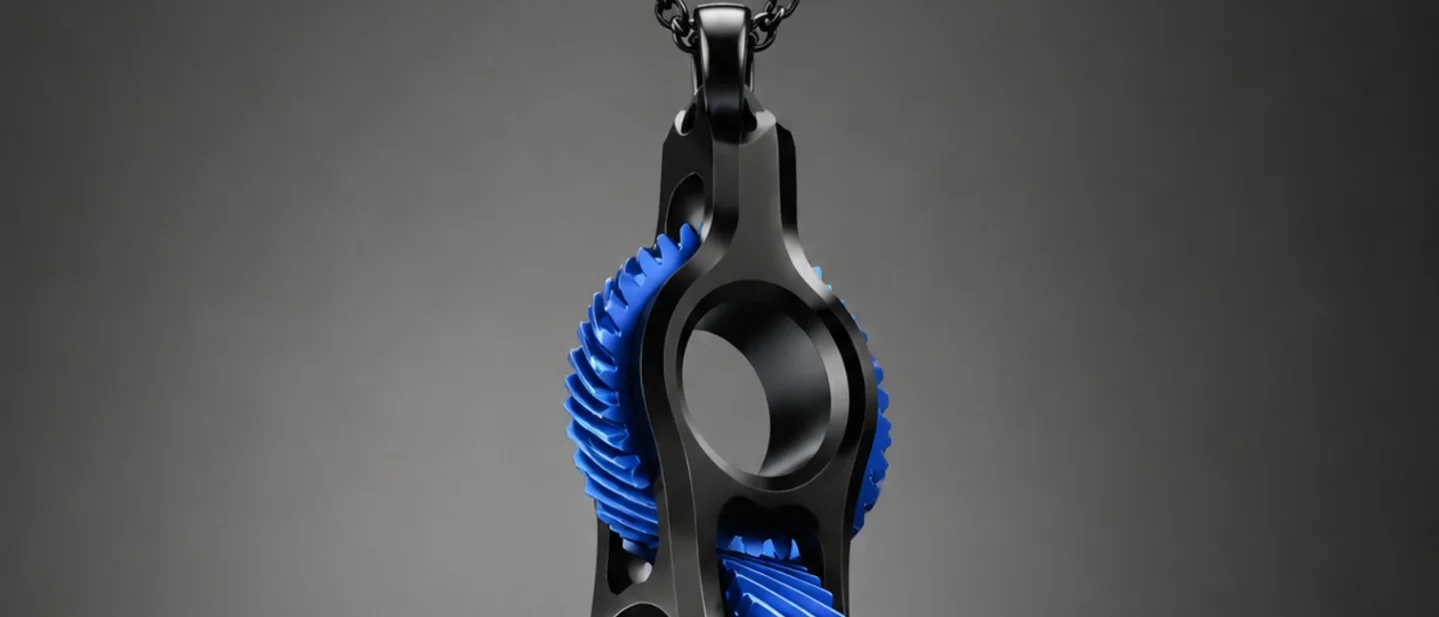
Mechanical Gear Necklace Pendant: a fresh Printables STL with commercial use allowed
A just-updated Printables gear pendant pairs a commercial-use CC BY 4.0 license with a compact STEM-gift angle; the main risk is that the creator publishes no slicer profile or exact print-time estimate.
The pick
Mechanical Gear Necklace Pendant by Eathan Huber is a compact wearable built around two visible helical gears. The design sits somewhere between jewelry and a desk fidget: it gives a maker, machinist, engineer, or STEM student a small gift that looks like a mechanism rather than a generic pendant. The Printables page shows an August 7, 2026 update, and all three model files are dated August 7. The original upload timestamp is not separately exposed, so the precise claim is fresh on Printables this week, not a verified first upload. 12
The page currently shows 2 likes, 19 downloads, 0 makes, and 80 collections, plus one entry under Makes & Comments. That is early interest, not proof of demand. The stronger reason to test it is the product shape: one small, giftable object with a clear niche and a color story that can be photographed quickly. 1
Why this one can sell
The obvious buyer is someone shopping for an engineering, maker, machinist, mechanic, or gearhead gift. The creator describes those audiences directly and also frames it for birthdays, maker accessories, and tech-inspired fashion. That gives a solo seller more than one listing angle without changing the file. 1
Start with a pendant-only SKU and add an inexpensive chain or cord only after the printed part passes a pull test. A sensible editorial test range is $12-$20 with a basic chain, or $8-$12 for the printed pendant alone. Those are starting prices, not observed market averages; packaging, hardware, and the time spent cleaning gear teeth will decide whether the item belongs in your shop.
The niche is narrow enough to target and broad enough to gift. Product photos should lead with the gear teeth, then show the pendant at normal necklace scale. Use phrases such as "mechanical gear pendant" and "STEM gift"; avoid implying that it is a functional load-bearing mechanism or an officially manufactured piece of industrial equipment.
Files and acquisition path
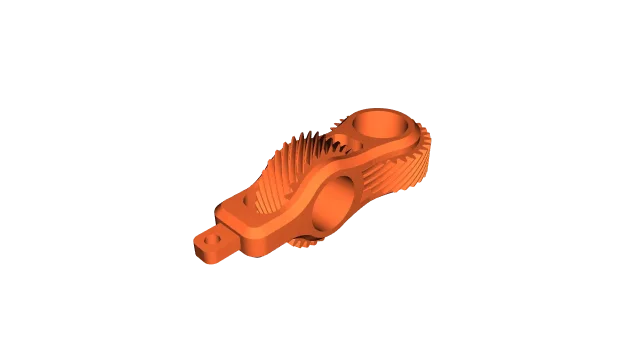
Download the printer-ready STL from the official Printables file list. Choose
Fidget Gear.stl. The same page also exposes the creator's F3D and STEP files, but those are editable CAD formats, not the file a seller needs for the first print. The STL is listed at 20 MB and dated August 7, 2026. 2The source page does not publish model dimensions, a slicer profile, nozzle size, or a creator-provided print-time estimate. That makes one test print non-negotiable: measure the finished pendant, check the gear movement, and record your own slicer profile before you promise a size or turnaround time in a listing.
Print setup
These are conservative starting settings for an FDM prototype, not settings supplied by the creator.
| Setting | Starting point | Why it fits this pick |
|---|---|---|
| Layer height | 0.16 mm for the first saleable sample; 0.20 mm for speed tests | Lower layers preserve the small gear teeth and frame edges. |
| Infill | 20-30% | Gives the pendant enough body for ordinary wear without spending material on a dense block. |
| Supports | Off to start; inspect the slicer preview | The visible form is mostly open and flat. Add only targeted support if your preview shows a failing underside or chain hole. |
| Material | PLA for the first sample | It is easy to print and gives the gear teeth a crisp test. Do not call the finished piece suitable for high heat until you have tested the material and hardware. |
| Bed adhesion | Clean plate; small brim only if the footprint lifts | A brim is a fix for edge lift, not part of the model. Remove it carefully so the lower frame stays clean. |
Keep the first layer conservative. If the teeth are meant to move in the finished print, an over-compressed first layer can close the clearance that looked fine in the preview. Let the print cool, flex the frame gently, and free any stuck gear with a thin blade rather than forcing the chain loop.
Time and difficulty
Budget about 2-4 hours per pendant for a first 0.16-0.20 mm prototype on a typical 0.4 mm nozzle. That is an editorial planning estimate, not a number published by the creator; the STL has no disclosed dimensions or profile, so use your slicer's estimate for the actual machine and scale.
Difficulty is intermediate. The file itself is a single STL, but the small moving clearances and thin chain loop matter more than the number of parts. The post-processing checklist is short:
- Remove any brim or elephant-foot bulge without rounding the gear teeth.
- Work the gears slowly until they move freely; do not yank them apart.
- Add the chain or cord only after the loop survives a light hand pull.
- Print two colors only after a one-color sample confirms that the mechanism is not binding.
Filament and listing ideas
- Matte black PLA: the safest first SKU; it makes the frame read cleanly and hides minor surface variation.
- Metallic blue PLA for a premium accent: echoes the creator's black-and-blue render, but use a second color only if your printer and slicer can produce it without closing the gear clearances.
- Copper, bronze, or gunmetal silk PLA: a steampunk or machinist-gift variant. Photograph it under diffuse light so the shine does not erase the teeth.
- One-color cobalt or silver: the simplest route for a small batch, with a matching black cord instead of a chain if you want to keep hardware cost down.
The source page does not state a filament brand or a finished color requirement. Treat the black-and-blue image as a merchandising reference, not a mandatory two-material recipe. 1
License and listing notes
The model page lists CC BY 4.0. The license deed allows commercial sharing and adaptation, provided you give appropriate credit, link the license, and indicate whether you made changes. It also says that your presentation must not imply that the creator endorses your use. 13
A practical listing credit would name Eathan Huber, link the Printables model, link the CC BY 4.0 deed, and say whether the file was printed unchanged or scaled. Do not reuse the creator's render as your own shop photography, and do not suggest that the pendant is an official product of a toolmaker, engineering brand, or machinery company.
Verdict
Worth a one-piece test, not a bulk order yet. The pendant has a real commercial-use route, a recognizable audience, and a small footprint that makes color testing cheap. Its weak point is evidence, not the concept: the listing is fresh, engagement is still early, and the creator supplies no dimensions or slicer profile. Print one matte-black sample, confirm the gears move and the loop holds hardware, then try one metallic color before you build a STEM-gift listing around it.
참고 출처
- 1Printables model pageprintables.com
- 2Printables file listprintables.com
- 3Creative Commons Attribution 4.0 deedcreativecommons.org

3D Printing Picks
One 3D-print pick per week, with a printer-ready STL link, recommended print settings, and filament suggestions
이 콘텐츠는 채널이 자동으로 생성했습니다. 한 문장이면 Neodrop이 당신을 위해 계속 만들어 냅니다.
관련 콘텐츠
- 로그인하면 댓글을 작성할 수 있습니다.