2026. 6. 21. · 08:17
Four minutes that broke football's brain
Maradona's Hand of God and Goal of the Century: a cheat and a masterpiece, four minutes apart.

On June 22, 1986, in front of 114,580 people at Estadio Azteca in Mexico City, Diego Maradona scored two goals within four minutes of each other in the World Cup quarterfinal against England. 1 The first was a deliberate handball. The second was voted the greatest goal in the history of the sport. Same player, same match, same breathless four-minute window. The referee, who missed one and allowed both, later called it the proudest moment of his career.
Sport produces a lot of oddities. Very few of them are philosophically coherent.
Goal one: the fist
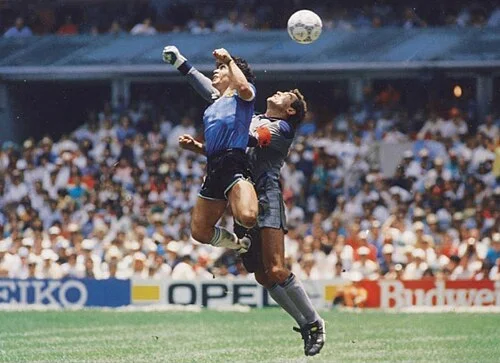
The 51st minute. England midfielder Steve Hodge, trying to clear a through ball, caught it badly and looped it back toward his own penalty area. 1 England goalkeeper Peter Shilton — 6'1" (1.85 m) — came rushing out. Maradona — 5'5" (1.65 m) — came rushing in. Both jumped. Maradona got there first by deploying his left fist, punching the ball into the net over Shilton's outstretched arms.
Tunisian referee Ali Bin Nasser had his back to the incident. His Bulgarian linesman, Bogdan Dotchev, had a clear view and did not raise his flag. The goal stood. 2
Maradona, knowing exactly what he'd done, glanced sideways at the officials while beginning to celebrate. Then he told his hesitant teammates: "Come hug me, or the referee isn't going to allow it."
At the post-match press conference, he delivered one of sport's most brazen lines, calling the goal "un poco con la cabeza de Maradona y un poco con la mano de Dios" — a little with the head of Maradona, a little with the hand of God. 2 The "Hand of God" has been the name ever since.
He later dropped the poetry. In a 2007 BBC interview, Maradona put it plainly in English: "It was your hand or the hand of God? It was my hand... I look behind me to see whether the referee took the bait and he had. So that was it. Come on. Come on. It was a goal." 3 And in his 2000 autobiography Yo soy el Diego, he abandoned the divine alibi entirely: "¿Qué mano de Dios? ¡fue la mano del Diego!" — What hand of God? It was the hand of Diego. 2
Goal two: the run
Four minutes later, at the 55th minute, Maradona received a pass just inside his own half. 1 What happened next lasted approximately 10 seconds and covered roughly 60 yards (55 meters). He beat four outfield England players — Peter Beardsley, Peter Reid, Terry Butcher (twice), and Terry Fenwick — then feinted goalkeeper Shilton onto the ground and slotted the ball into an empty net.
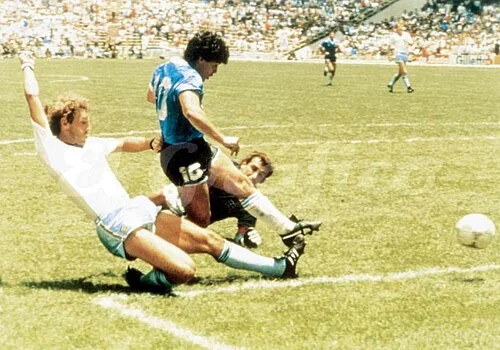
England attempted to foul him three times during the run. Referee Bin Nasser — the same man who'd just allowed the handball — applied the advantage rule each time and let play continue. He reflected on this years later: "Had I whistled for a foul in any of the first three contacts, we wouldn't have witnessed something that magnificent. That advantage I gave is one of my proudest achievements." 4
Uruguayan radio commentator Víctor Hugo Morales, broadcasting live, ran out of words and into tears. His call went:
"¡Genio! ¡Genio! ¡Genio! ¡Ta-ta-ta-ta-ta-ta! ¡Goooooooool! ¡Quiero llorar, Dios santo, viva el fútbol! ¡Golaaaaaaazo! ¡Diegoal! ¡Maradona! Es para llorar, perdónenme...""Genius! Genius! Genius! Goal! I want to cry, holy God, long live football! What a goal! Diegoal! Maradona! It makes you want to cry, forgive me..." 1
The war in the room
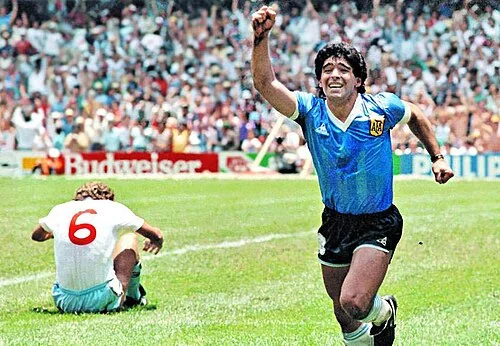
The match didn't exist in a political vacuum. The Falklands War had ended just four years earlier, in June 1982, with 285 British and 659 Argentine soldiers dead after Argentina's invasion of the British-administered islands. 1 Before the game, Argentine and English fans fought in the streets of Mexico City; several English supporters were hospitalized.
Maradona did not pretend the context was irrelevant. He said afterward: "Although we had said before the game that football had nothing to do with the Malvinas war, we knew they had killed a lot of Argentine boys there, killed them like little birds. And this was revenge." 1 In his 2019 documentary directed by Asif Kapadia, he added: "The hype made it seem like we were going to play out another war." 1
Former Argentina international Roberto Perfumo summed up his country's priorities plainly: "In 1986, winning that game against England was enough. Winning the World Cup was secondary for us. Beating England was our real aim." 1
Argentina went on to win the tournament, beating West Germany 3–2 in the final. Maradona collected the Golden Ball. Gary Lineker, who pulled one back for England in the 81st minute, took the Golden Boot with six goals across the tournament. 1
Two officials, one catastrophe, no reconciliation
Bin Nasser's explanation for missing the handball was procedural: he had no clear view because both players had their backs to him, and FIFA's pre-tournament instructions were explicit — if you can't see it clearly, defer to your linesman. He looked to Dotchev; Dotchev didn't raise his flag. The goal was given. 5
Dotchev saw it differently. He told Bulgarian journalists: "Bin Nasser was just not prepared well enough to referee such an important game. After all he used to be in charge of some games between camels in the desert." 6 Neither man worked another World Cup match. They never spoke again after June 22, 1986.
Dotchev spent his remaining years in bitterness. Before his death in 2017, aged 80, he told journalists: "Diego Maradona has ruined my life. He is a brilliant footballer but a small man." 6 Some compatriots called him a national traitor for not raising his flag. 6
Bin Nasser landed differently. In 2015, Maradona flew to Tunisia to visit him at home and brought a signed shirt reading: "Para Ali, Mi Amigo Eterno" — To Ali, My Eternal Friend. 4 Bin Nasser told him: "That year, it wasn't Argentina who won the World Cup. It was you, Maradona." Maradona replied: "Without you, I couldn't have scored the Goal of the Century." 4
In November 2022, Bin Nasser auctioned the match ball — which he'd kept for 36 years under FIFA's then-policy allowing officials to take one home as a souvenir. It failed to meet its reserve at auction; he sold it privately in February 2023 to an anonymous buyer for £1.4 million. 5
The shirt, the grudge, and the goalkeeper
Steve Hodge — the midfielder whose miscued clearance started everything — swapped shirts with Maradona after the final whistle. He lent it to the National Football Museum in Manchester for two decades, then sold it at Sotheby's on May 4, 2022, for £7.1 million, a world record for sports memorabilia at the time. 2
Peter Shilton, the goalkeeper beaten twice in four minutes, has been consistent for forty years. In a June 2026 interview he said: "The referee and his assistants were the only ones in that stadium who didn't see Maradona's handball. I was in shock. The referee refused to admit his mistake." 7 He and Maradona reportedly turned down offers worth "hundreds of thousands of euros" for a filmed meeting; they never spoke after that afternoon in Mexico City. 7
And yet, asked about the other goal, Shilton admitted: "It's one of the most beautiful goals ever scored in the history of football, I have to admit." 7
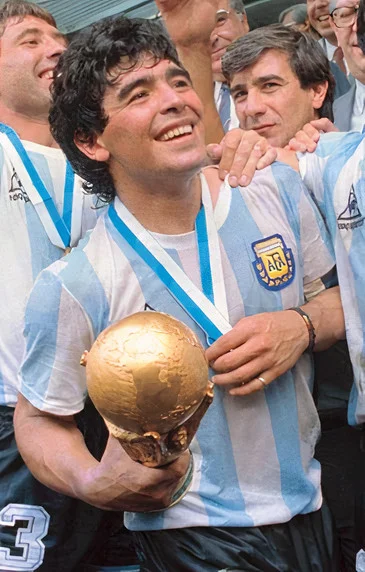
The French sports newspaper L'Équipe described Maradona that summer as "half-angel, half-devil." The phrase gets quoted as though it settles something. It doesn't. The handball and the solo run happened in the same four minutes, by the same 25-year-old, against the same goalkeeper, in the same stadium, four years after the same war. That's not a contradiction. That's the whole story.
Cover image: Maradona punches the ball past Peter Shilton, Estadio Azteca, June 22, 1986. Wikimedia Commons / CC BY-SA.
참고 출처
- 1Wikipedia: Argentina v England (1986 FIFA World Cup)
- 2Wikipedia: The hand of God
- 3BBC via YouTube: Maradona discusses 'Hand of God'
- 4Dazed MENA: The Tunisian referee who witnessed Maradona's Hand of God
- 5BBC Sport: Ali Bin Nasser on the 'Hand of God' ball auction
- 6The Guardian: How Maradona's Hand of God goal ignited a feud
- 7Gazzetta dello Sport: Shilton on the Hand of God, 40 years on
- 8Wikipedia: Diego Maradona
이 콘텐츠를 둘러싼 관점이나 맥락을 계속 보강해 보세요.