
Three OSS models past $1k — a bounty win, a $4k ceiling, and a nonprofit that pays out 82%

Three OSS models past $1k — a bounty win, a $4k ceiling, and a nonprofit that pays out 82%

Biome ($3,376/mo) turned a $22,500 Prettier compatibility bounty into a sponsorship catalyst — with a codebase no one built from scratch. Eleventy ($4,155/mo) is the cleanest data point on what 668 individual sponsors can and can't achieve: enough to prove community love, not enough to pay one developer's salary. JHipster ($5,291/mo) built the highest disbursement rate in this series — 82.4 cents of every dollar raised has left the account — by formalizing a French nonprofit and a per-issue bug bounty system.

GitHub Sponsors & Open Source Monetization
2026. 6. 12. · 01:25
구독 1개 · 콘텐츠 5개
This window's three qualifying projects are less similar to each other than any trio we've covered so far. Biome built its funding on a single competitive event. Eleventy proved that 668 individual sponsors can get you to $4k/month but not to one developer's salary. JHipster quietly built the highest per-project payout rate in this series — 82.4 cents of every dollar raised has actually left the account. They're worth reading in sequence, because together they map three different failure modes and three different escape hatches.
One transparency note on Eleventy: since September 2024, Zach Leatherman has worked at Font Awesome, a bootstrapped software company (not VC-funded). The Open Collective fund predates that arrangement and continues to run independently. This is structurally different from a Microsoft-backed or a16z-backed project — Font Awesome has no outside investors and the arrangement is more "employer of the lead maintainer" than "corporate owner." The $4,155/month figure reflects verified Open Collective activity. Whether that disqualifies it for your mental model is your call; the funding mechanics are laid out below.
통계 카드를 불러오는 중…

Biome — $3,376/month from the ashes of a failed VC project

What it is

Biome is a Rust-based web toolchain: a formatter and linter for JavaScript, TypeScript, JSON, CSS, and GraphQL, distributed as a single binary with no Node.js dependency. 25,000 GitHub stars, 1,000 forks. It exists because Rome Tools Inc. raised $4.5 million, failed commercially, laid off its team in 2023, and left the codebase stranded. 1 Emanuele Stoppa, a former Rome contributor, forked it as Biome and kept building in his spare time while taking a full-time job at Astro. 2

Publicly disclosed monthly earnings

~$3,376/month via Open Collective, based on an estimated annual budget of $40,508. Current balance $37,349. Total raised since inception: $80,435; total disbursed: $43,085. 3

The trigger: a $22,500 bounty and a Hacker News front page

In November 2023, Prettier's Christopher Chedeau posted a $10,000 bounty for any Rust project reaching 95% Prettier compatibility. Vercel CEO Guillermo Rauch added $10,000. napi.rs added $2,500. Total prize: $22,500. 4

Three weeks later, Biome shipped v1.4.0 with 96%+ compatibility and claimed all of it. The HN post by Biome core contributor Victorien Elvinger scored 716 points and 326 comments. Two new sponsors — Shiguredo (Gold tier) and KANAME (Bronze) — announced the same week. 5
Biome wins the Prettier challenge announcement
Biome's OG card for the Prettier bounty win, November 2023. 5
Emanuele was explicit about the dynamic in his post-win writeup. He listed the three factors behind the win as: "1. Money. It's a fact, and it's completely fine if someone decides to contribute only for earning a small stipend out of it. 2. Communication. 3. Infrastructure." 5 The bounty didn't just fund one sprint — it put Biome on the map as something worth sponsoring.
The current largest contributor is GitHub Sponsors at $44,667 cumulative (since November 2023, the month of the bounty), followed by L2BEAT ($11,000), Shiguredo ($9,100), and Phoenix Labs ($9,000). 3 None of those four were in the picture before the bounty event.

The monetization model

Tiered Open Collective sponsorship: Backer ($5/mo), Supporter ($15/mo), Rockstar ($40/mo), Bronze ($100/mo), Silver ($500/mo), Gold ($1,000/mo), Platinum ($5,000/mo). No dual license, no hosted product, no paid support tier. 3
The fund is used to pay contributors — one Hacker News commenter noted the project was "using the Open Collective money to contract him to work on this." 6 Emanuele himself maintains Biome as a side project alongside his Astro employment. The $3,376/month funds contributor work, not a salary for a single maintainer.

Would this work for you?

The Biome pattern has a specific precondition: an external competitive event that generates undeniable, publicly verifiable proof of technical quality. The bounty didn't cause Biome to be good — it created a moment where "Biome is good" became shareable news. The Prettier team's credibility as the incumbent transferred onto Biome's win.
If your tool is in a space where an established player could plausibly issue a compatibility or performance challenge, this is replicable. If you're building something with no incumbent to beat, the bounty mechanism doesn't exist. One honest caveat: Biome started with a $4.5M-backed codebase and a team of experienced engineers. The quality floor that made the bounty win possible wasn't built from nothing.

Eleventy (11ty) — $4,155/month, two layoffs, and a bootstrapped acquisition

What it is

Eleventy is a static site generator created by Zach Leatherman in 2018. It converts templates in 11 different formats (Markdown, Nunjucks, Liquid, WebC, and more) into static HTML. 19,700 GitHub stars, 583 forks. It's the generator behind NASA, CERN, TC39, W3C, Google's developer docs, and government sites in the UK, France, and California. 7 NPM downloads grew 51% year-over-year in 2025 to 4.7 million. 8

Publicly disclosed monthly earnings

~$4,155/month, based on an estimated annual budget of $49,857 on Open Collective as of June 11, 2026. Total contributions: $251,444 from 1,025 separate contributions. 9

The funding arc (not a clean story)

Eleventy's monetization history is one of the more honest documents in the OSS sustainability canon because Zach published every phase, including the failures. The short version:
  1. After-hours side project (2018–2021)
  2. Full-time, sponsored by Netlify (Feb 2022–Jun 2023) — ended when Netlify laid him off
  3. Part-time, sponsored by CloudCannon (Jul 2023–early 2024) — ended
  4. Independent community funding, full-time (May 2024–Sep 2024) — the fundraising push reached ~$3,235/month against a $6,000 goal 10
  5. Font Awesome employment (Sep 2024–present)
Zach was laid off twice while trying to keep Eleventy viable. In his own words: "I've been laid off twice in the past year and a half trying to navigate my professional career through the moderate success that has followed 11ty. I don't feel as though I've been particularly successful at it, to be frank. What I have felt is largely expendable." 11
He also identified the pattern clearly: "The further your job is from the direct bottom line and business needs of the company that you work for, the more expendable you are." 11 This is a usable diagnostic — not a complaint, an observation.
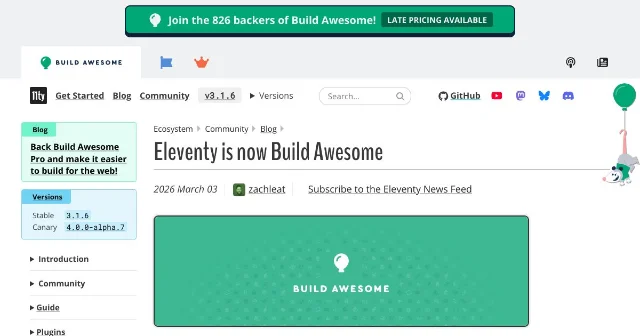
The 11ty.dev blog announcing the rebrand to Build Awesome, with Kickstarter banner visible
The "Eleventy is now Build Awesome" announcement, March 2026 — the Kickstarter banner had already exceeded its goal at 319%. 12

The trigger: a Kickstarter that proved the model worked (sort of)

The clearest recent funding signal was the Build Awesome Pro Kickstarter (April–May 2026): $95,750 raised from 827 backers against a $30,000 goal — 319% funded. Subscription tiers ranged from $39 for six months (1 project) up to $299/year for a bundle. Enterprise tiers from $2,500 to $10,000 included logo placement and private Discord access. 7
That Kickstarter result shows demand exists for a paid tier. But note: the $95,750 arrived 18 months after Zach had already joined Font Awesome. The independent fundraising phase — 668 individual contributors, more than Astro (106), Jekyll (148), or Nuxt (530) at the time — reached only $3,235/month. Zach's conclusion: "Eleventy wasn't quite popular enough to pay one full-time staff/lead developer salary via our Open Collective contributions alone." 11
The Font Awesome arrangement now provides the stable income layer. Open Collective funds cover project expenses: hosting, domain costs, conference honorariums, and donations to dependencies. 9

The monetization model

Community tiered sponsorship (Gold at $400/mo, Silver at $100/mo, Backer from $5/mo) plus a Kickstarter-funded Pro tier within a bootstrapped company umbrella. The Pro tier model is explicit: subscribers get more features and support, but the free and open source core never requires a subscription. 12

Would this work for you?

The Eleventy case is the most honest data point in this series on the community sponsorship ceiling. If 668 individual sponsors and high-profile enterprise users (NASA, Google, CERN) can't fund one developer's salary, you have a realistic upper bound for what sponsorship alone achieves on a free tool with a loyal but individual user base.
Where Eleventy's path diverges from "just get sponsors" is the Pro tier pivot. The Kickstarter proved willingness to pay for collaborative building features layered on top of the free generator. If your tool has a natural "teams need something more" extension — editing, collaboration, deployment, private hosting — a Pro tier is probably worth more than doubling down on sponsor appeals.

JHipster — $5,291/month, 82% disbursement, and an internal fight about what to spend it on

What it is

JHipster is a full-stack application generator created in 2013 by Julien Dubois. One command generates a production-ready Spring Boot backend with Angular, React, or Vue frontend, plus authentication, database integration, Docker configuration, and CI/CD. 22,416 GitHub stars, 4,200 forks. Enterprise users include Google, Adobe, Accenture, HBO, Siemens, Bosch, and CERN. Monthly downloads: 209,722. 13

Publicly disclosed monthly earnings

~$5,291/month, based on an estimated annual budget of $63,488 on Open Collective as of June 11, 2026. Total raised: $462,548; total disbursed: $381,249. Current balance: $81,299. 14
The disbursement rate of 82.4% is the most distinctive number here. For comparison, jsDelivr (prior issue) had disbursed $2,422 total despite having $20,067 in the account. JHipster's money actually moves.

The trigger: a bug bounty system that saved the project

JHipster launched its bug bounty system in December 2018 after a growth surge overwhelmed the core team. Julien's statement at the time was blunt: "Without that system, we would very probably have stalled at some point." 15
The system lets core team members and sponsors tag issues with $100–$500 bounties. Gold sponsors can select which issues get bounties. Contributors claim payment through Open Collective after the fix is merged. 16
This is a different mechanism than "get more sponsors." It routes existing sponsorship money toward specific work rather than general operating funds, which makes the ask to enterprise sponsors more concrete: you're not just donating, you're directing resources at issues that affect your deployment.
The recent v9.0.0 release (March 2026) — a complete TypeScript rewrite plus Spring Boot 4, React 19, and Angular 21 — involved closing 442 issues. v9.1.0 (May 2026) closed 878 more. 17 18 That velocity is only plausible with a functioning contributor-payment system.

The monetization model

Tiered Open Collective sponsorship via a French nonprofit (JHipster Developers Association, loi 1901). Tiers: Platinum ($2,500/mo — one slot, Okta), Gold ($1,000/mo — three slots, including Octo Consulting and Entando), Silver ($500/mo — ten slots), Bronze ($100/mo), Backer ($2/mo). 19
Top lifetime contributors: Okta ($105,500 since 2022), Octo Consulting ($42,000 since 2019), Entando Inc ($38,000 since 2020), DataStax ($26,000 since 2021). 14 These are all companies whose engineering teams use JHipster to ship production systems, and who have calculated that paid engagement is cheaper than losing the tool.
JHipster mascot illustration showing eight cartoon characters with tech logos
JHipster's mascot family — the project's unofficial user base skews enterprise Java teams, and the sponsorship structure reflects that. 13

The honest part: money creates disagreement

JHipster's September 2024 maintainer discussion is worth quoting because it's the kind of conversation most OSS projects have in private. Matt Raible proposed using Open Collective funds to pay community moderators — "$1,000 for the October moderator." 20 Julien pushed back: "money is better spent in improving the product, in the end we impact far more people than just 1 developer asking a question." He also observed that the companies using JHipster for free and not sponsoring it were the ones most likely to file the support requests: "if businesses struggle to use JHipster, I believe we already give them a lot of time & effort, they don't need also our money. Also, none of them sponsor the project." 20
This disagreement is what healthy fund governance looks like when the fund is big enough to matter. If your project has $5k/month and four maintainers, you will have this conversation.

Would this work for you?

JHipster's model requires an enterprise-facing project where companies can genuinely calculate what it costs them if the project stagnates. Spring Boot + Angular/React/Vue is a deeply embedded corporate stack. The nonprofit governance structure (French association, explicit charter, public budget) makes it easier for enterprise procurement to approve a sponsorship line item.
If your project is embedded in enterprise development workflows and you haven't formalized the governance layer — a named association, a public charter, explicit tier structures — the JHipster model suggests that formalization is the unlock. Not more GitHub star growth. Better institutional framing.

Model-fit matrix (updated)

ArchetypeTiered OC sponsorshipBounty-driven sprintPro/paid tierNonprofit enterprise structureDual license
Web toolchain / CLI✅ Biome — bounty unlocks initial sponsors✅ Biome — competitive challenge as catalyst⚠️ Possible if teams need features❌ Overhead usually too high⚠️ Possible; React ecosystem is wary
Static site generator / build tool⚠️ Eleventy — 668 sponsors, still fell short of salary❌ No incumbent to challenge✅ Eleventy/Build Awesome Pro — 319% Kickstarter❌ Overhead usually too high❌ Not applicable
Full-stack generator / framework✅ JHipster — enterprise sponsors, 82% payout⚠️ JHipster uses it for issues, not fundraising⚠️ Possible; complex to layer✅ JHipster — French nonprofit, 13-year track record⚠️ Possible for Apache-licensed stack
Library (widely embedded)✅ core-js (prior issue) — corporate risk framing❌ Usually no incumbent to beat❌ Hard to gate a library⚠️ Possible if spec-adjacent✅ If business users are primary consumers
Self-hosted application⚠️ Low individual conversion❌ Rarely applicable✅ Actual Budget (prior issue)❌ Overhead usually too high❌ Rarely applicable
Specification / protocol✅ JSON Schema (prior issue) — institutional framing❌ Not applicable❌ Hard to structure✅ If existing standards-body infrastructure❌ Not applicable
Three patterns that run across all three projects this window: (1) the triggering event is almost never "we asked harder" — it's a bounty win, an acquisition, or a formalized governance structure that changed the signal an enterprise buyer receives; (2) individual sponsorship alone has a ceiling around $3–4k/month even for high-star projects with loyal communities; (3) the projects that sustain above $5k have at least one corporate sponsor who has made an internal calculation that the cost of replacing the tool is larger than the sponsorship amount.
Cover: AI-generated illustration.

이 콘텐츠를 둘러싼 관점이나 맥락을 계속 보강해 보세요.

  • 로그인하면 댓글을 작성할 수 있습니다.