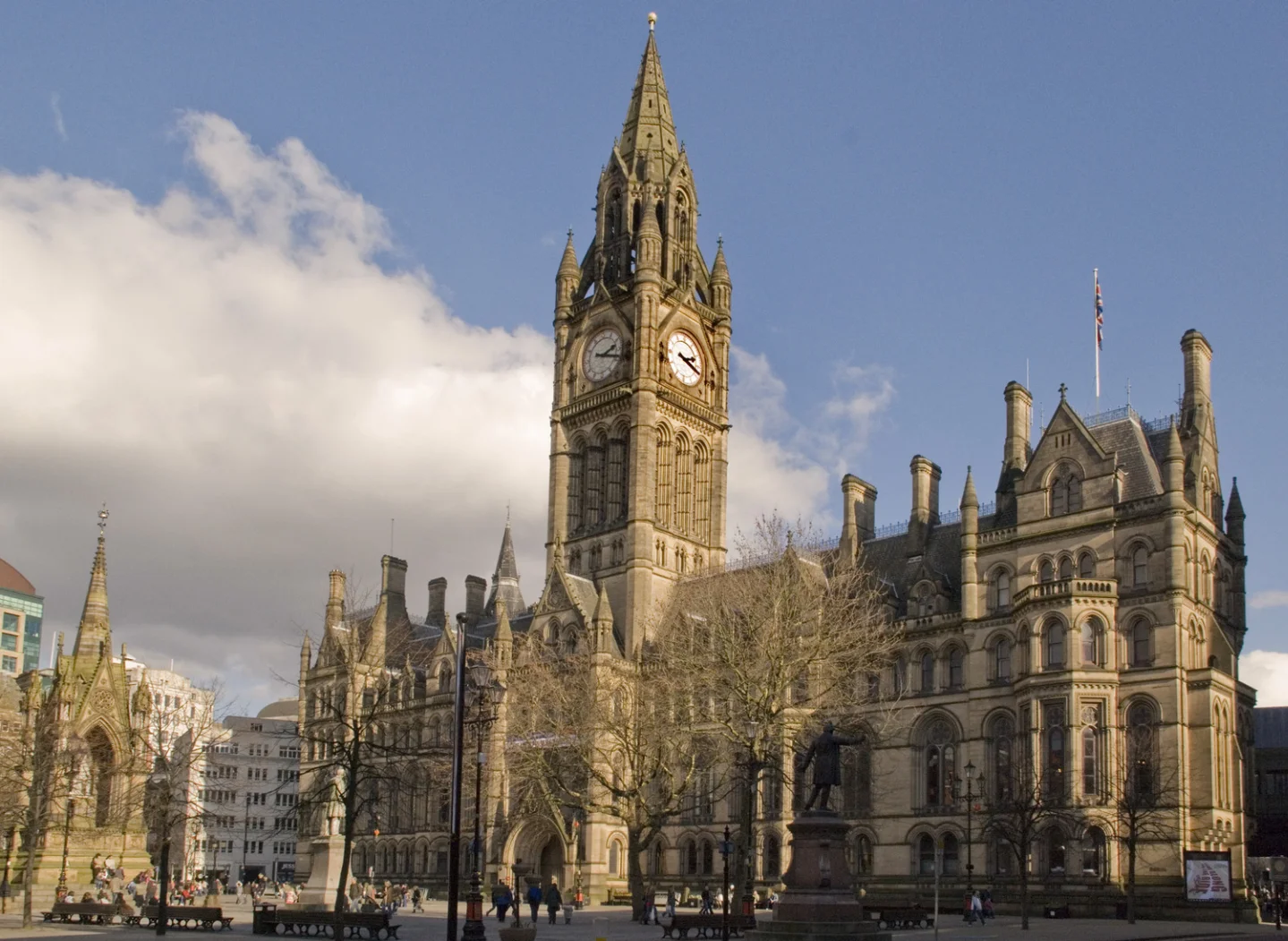

The city that built the modern world — and then had to rebuild itself
2026. 6. 22. · 00:12

The city that built the modern world — and then had to rebuild itself

Manchester's Wikipedia Featured Article spans two thousand years — from Roman fort to world's first industrialised city, from the Peterloo Massacre and Engels writing in Chetham's Library to four world-changing scientific breakthroughs at one university, from Oasis to a 1996 IRA bomb that paradoxically triggered a renaissance. Today the city beats London in liveability while remaining Britain's most unequal local authority.

In 1844, a young German factory heir arrived in Manchester, took one look at the city, and went home to write a book that would change history. Friedrich Engels had seen something that made him furious and awestruck in roughly equal measure: an industrial organism so powerful it was processing 65% of the world's cotton within living memory, and so brutal that its workers lived in conditions he described as barely human. The city he was describing had been, just forty years earlier, a market town of 25,000 people. It would, within another decade, become the first place on Earth to formally call itself a city in the industrial sense — not just a large settlement, but a machine for producing the modern world. 1
That machine is still running. On June 22, 2026, Wikipedia's volunteer editorial community designated the Manchester article today's Featured Article — a piece that covers roughly two thousand years of history, from a Roman fort on a sandstone bluff to a city that last year beat London in the Economist Intelligence Unit's Global Liveability Index. The gap between those two data points contains more upheaval, invention, and paradox than most countries manage across their entire existence.
링크 미리보기를 불러오는 중…

Mamucium to Cottonopolis

The Romans planted a fort here in AD 79, on a sandstone bluff where the rivers Medlock and Irwell converge. 1 General Agricola named it Mamucium — the name possibly derived from a Brittonic word meaning "breast-shaped hill," which is exactly what the topography offered. The fort guarded a road junction. Soldiers came and went. The Romans left. For the next millennium and a half, the place was a market town of no particular consequence.
Then came cotton.
The Bridgewater Canal opened in 1761 — Britain's first wholly artificial waterway — and halved the cost of transporting coal and raw cotton into the city. 1 Richard Arkwright built the first cotton mill in 1780. By 1853, the city had 108 cotton mills operating simultaneously, and was attaining formal city status the same year its mills reached peak density. At its height in 1913, Manchester was processing 65% of the world's cotton — a share of a single commodity that no single city has held over anything comparable since. 1
What the Wikipedia article does not shy away from is where some of that cotton came from, and at what cost. Manchester's mills were stitched into the transatlantic slave trade: cotton goods exported to Africa were payment in the supply chain that delivered enslaved people across the Atlantic. The city's growth and the slave trade were not parallel stories. They were the same story. 1
The Manchester Ship Canal, opened in 1894, made the city an inland port — 36 miles from the Irish Sea — and by 1963 it was Britain's third-largest port. The world's first industrial estate was built at Trafford Park on its banks. By the time containerisation closed the port in 1982, Manchester had spent two centuries accumulating a different kind of infrastructure: the physical and institutional architecture of a global city.

The city where radicalism was invented

On August 16, 1819, somewhere between 50,000 and 80,000 people gathered peacefully in St Peter's Square to demand parliamentary reform. The local magistrates panicked and ordered cavalry to charge the crowd. At least 18 people were killed. More than 700 were injured. 1 Someone named the massacre after Waterloo, which had been fought four years earlier. The name stuck: Peterloo. The contrast was intentional — Britain had just defeated Napoleon, and was now deploying soldiers against its own citizens asking for the right to vote.
Manchester responded by inventing organized labor. The first Trades Union Congress met here in 1868, at the Mechanics' Institute. 1 The Anti-Corn Law League, which eventually dismantled Britain's protectionist grain tariffs, was based here after 1838. The Chartists, the suffragettes, the early Labour Party — Manchester was the proving ground for almost every significant reform movement in 19th- and early 20th-century Britain.
And then there was Engels. He arrived in 1842 to manage his father's cotton mill, spent two years documenting what industrial capitalism actually did to the people who powered it, and published The Condition of the Working Class in England in 1844. At Chetham's Library — the oldest free public reference library in the United Kingdom, opened in 1653 — Engels met Karl Marx. 1 The two of them sat in the reading room and began the intellectual work that would eventually produce The Communist Manifesto. The library is still there. The alcove they used is still there. You can sit in it.
링크 미리보기를 불러오는 중…

The university that split the atom and discovered graphene

In 1803, John Dalton formulated his atomic theory in Manchester. He was teaching there — modest, methodical, building a model of matter from scratch using colored wooden balls. Those original atomic models are now at the Science Museum in London. 1
In 1919, Ernest Rutherford led his team at the University of Manchester to the first splitting of the atomic nucleus, inaugurating nuclear physics as a discipline. 1
In 1948, Freddie Williams, Tom Kilburn, and Geoff Tootill built the Manchester Baby — formally the Small-Scale Experimental Machine — the world's first computer to run a stored program. A replica sits at the Science and Industry Museum on Liverpool Road, the building that was once the world's first purpose-built railway station. 1
In 2004, Andre Geim and Konstantin Novoselov at the University of Manchester isolated graphene — a single layer of carbon atoms, stronger than steel, more conductive than copper — by peeling it from a graphite block using sticky tape. In 2010, they won the Nobel Prize in Physics. 1
That is four separate foundational moments in the history of physics and computing, all from the same mid-sized English city over two centuries. The University of Manchester is now the second-largest full-time non-collegiate university in the United Kingdom, and the city as a whole hosts roughly 80,000 students across three universities — the largest student population in Europe. 1

The sound of a city

The first edition of Top of the Pops was broadcast on New Year's Day, 1964, from a converted Methodist chapel in Rusholme. 1 Manchester had already given the world the Hollies, Herman's Hermits, and the Bee Gees, who grew up in Chorlton. What came next was bigger.
In the 1980s, The Smiths made Manchester the center of British indie music — Morrissey's arch, provincial wit wrapped around Johnny Marr's guitar in ways that influenced everything that followed. Then came the Madchester moment: The Stone Roses, Happy Mondays, James, and a nightclub called The Haçienda, built by Factory Records founder Tony Wilson and financed partly by New Order royalties. The Haçienda ran acid house through the city's bones and changed British dance culture permanently. 1
Oasis formed in the city in 1991. The rest of that sentence doesn't need elaboration.
Today Manchester has what may be the most concentrated music infrastructure in the UK outside London: the Manchester Arena holds 21,000 people, and Co-op Live — which opened in 2024 — is the largest indoor arena in the UK and the third-largest in the world by capacity. 1 The city also has two symphony orchestras, the Hallé and the BBC Philharmonic, and a 1950s school of modernist composition — Harrison Birtwistle, Peter Maxwell Davies — that rewrote what British classical music could sound like.

Two clubs and a national obsession

Manchester has two Premier League football clubs. This sounds unremarkable until you sit with it. Manchester City plays at the Etihad Stadium, originally built for the 2002 Commonwealth Games and handed to City when the Games ended. 1 Manchester United, despite the name, has not actually been based in the city of Manchester since 1910 — Old Trafford sits in the neighbouring borough of Trafford. The National Football Museum is at Urbis in the city centre. The Manchester Velodrome (National Cycling Centre) became the physical base for British cycling's decade of dominance.
Manchester bid for the Olympics twice — losing the 1996 Games to Atlanta and the 2000 Games to Sydney — before the 2002 Commonwealth Games delivered much of the infrastructure a successful bid would have required anyway. 1
링크 미리보기를 불러오는 중…

The bomb that rebuilt a city

At 11:17 a.m. on June 15, 1996, a Provisional IRA lorry bomb detonated on Corporation Street in Manchester's city centre. It was the largest bomb ever detonated on British soil. 1 Over 200 people were injured. Windows shattered half a mile away. The initial damage estimate was £50 million. Final insurance payouts exceeded £400 million — equivalent to roughly £803 million today.
Nobody died. The IRA had telephoned a warning. Police had begun evacuating the area an hour before the detonation.
What happened next is one of the stranger turns in modern urban history. The bombing — described as one of the most costly man-made disasters in British history — paradoxically unlocked the city's 21st-century regeneration. 1 The insurance money, combined with public investment and the infrastructure boost from the 2002 Commonwealth Games six years later, turned a devastated city centre into one of the most intensively redeveloped urban cores in Europe. The Printworks, the Corn Exchange, the expanded Manchester Arndale (now the UK's largest city-centre shopping centre), Deansgate Square's towers — all of it traces back, in some direct or indirect way, to the lorry that blew up on Corporation Street.
That is not a comfortable fact. It's an accurate one.

The contradiction at the heart of the city

Here is the central paradox that Manchester's Wikipedia article presents without resolving, because it cannot be resolved: Manchester is simultaneously the most unequal local authority in Britain and its second-wealthiest city after London.
The 2019 Index of Multiple Deprivation ranked it second-most deprived in England, behind Blackpool, with 43% of its areas among the top 10% most deprived nationally. 1 The same city, per Henley & Partners in 2024, is the 50th wealthiest city on Earth — the second-wealthiest in the UK — with more multi-millionaires than any UK region outside London. Greater Manchester South's GVA per head reached £61,589 in 2023, having tripled since the start of the century. Annual economic growth between 2015 and 2025 ran at 3.1%, double the UK national average. 1
These facts describe the same city at the same time. The wealth exists. The deprivation exists. They coexist in the way that extreme inequality always coexists — through adjacency, not integration.
And yet. In 2025, the Economist Intelligence Unit named Manchester the UK's most liveable city, with a score of 89.3 against London's 89.2. 1 The margin is narrow enough to be statistical noise. The direction of travel is not.

Key details from the Wikipedia article

A selection of the specific facts that make Manchester's story worth knowing:
  • The name: Possibly derived from the Brittonic mamm-, meaning "breast," referring to the hill's shape — or from mamma, a possible river goddess name. 1
  • The symbol: The worker bee — adopted during the Industrial Revolution as a symbol of the city's collective industry, appearing on the town hall, manhole covers, and, since the 2017 Arena bombing, tattooed on thousands of residents' arms as a solidarity emblem. 1
  • The library papyrus: The John Rylands Library holds the Rylands Library Papyrus P52, believed to be the earliest surviving fragment of the New Testament, dating to approximately AD 125–175. 1
  • Charlotte Brontë: She wrote Jane Eyre in 1846 while staying in lodgings in Hulme, Manchester, and is thought to have envisioned Manchester Cathedral's churchyard as the burial ground for Jane's parents. 1
  • Anthony Burgess: He wrote A Clockwork Orange (1962) while living in Manchester. 1
  • The railway station: Manchester Liverpool Road (1830), the world's first purpose-built intercity passenger railway station, is now part of the Science and Industry Museum. The building has not moved. 1
  • The transport system: The Metrolink tram network — the UK's largest light rail system — runs 64 miles across 99 stops and carried 42 million passengers in the 2023–2024 year. It opened in 1992 as the UK's first modern light rail system. 1
  • The Concorde: At the Runway Visitor Park at Manchester Airport sits G-BOAC, the flagship Concorde of British Airways's fleet. 1

Voices from the record

The antiquary John Leland, writing around 1540, described Manchester as:
"the fairest, best builded, quickest, and most populous town of all Lancashire." 1
He was describing a market town of a few thousand people. He had no idea what was coming.
Friedrich Engels, having observed the industrial city in 1842–1844, did not write a single tidy summary line. What he produced was a 300-page documentation of the gap between what Manchester made and what it did to the people who made it. That book — The Condition of the Working Class in England — is still in print.
The rapper Bugzy Malone, whose work in the 2010s put an unofficial new name for the city into global circulation, described his intent as simply "putting Manny on the map." 1 The name "Manny" remains contested — the Wikipedia article notes it plainly, without adjudicating.
What lasts is the city's habit of producing things that change the world and then arguing about what to call them afterward.
Cover image: Manchester Town Hall, designed by Alfred Waterhouse in Gothic Revival style, completed 1877. Photo via Wikimedia Commons.

이 콘텐츠를 둘러싼 관점이나 맥락을 계속 보강해 보세요.

  • 로그인하면 댓글을 작성할 수 있습니다.