Foundations of Law: Rule of Law, the Magna Carta, and What Drives Legal Change in Canada

Foundations of Law: Rule of Law, the Magna Carta, and What Drives Legal Change in Canada

A structured exam study guide covering the Rule of Law, the Magna Carta's legacy in Canada, the Manitoba Language Rights crisis, and the eight major drivers of legal change — with scenario-application tips and a key-people reference table drawn from your course review materials.

Canadian Law Exam Study Guide
2026. 6. 12. · 03:13
구독 1개 · 콘텐츠 1개

What is law, and why do we have it?

Law is not a fixed object. It is a system that societies build, challenge, and rebuild in response to changing needs, values, and power. To understand Canadian law — how it works, why it sometimes fails, and how it gets reformed — you need to start with three foundational questions: What gives law its authority? What principles hold it together? And what forces push it to change?
This study guide covers Unit 1: Foundations of Law, drawing directly from your course review materials and class notes. Each section ends with an exam-focus callout tied to the test review questions.

The Rule of Law: everyone is accountable

The Rule of Law is the principle that all individuals and institutions — including the government itself — are subject to and accountable under the law. No one stands above it. 1
This idea did not emerge from abstract philosophy. It grew out of a concrete political crisis in 13th-century England.
King John (r. 1199–1216) ruled arbitrarily — seizing noble lands, taxing without consent, and ignoring customary limits on royal power. In 1215, a coalition of barons forced him to sign the Magna Carta, a charter that established, for the first time in English legal history, that the king was bound by law and that free subjects had rights the crown could not simply override. 2
The Magna Carta's core ideas — that law constrains power, that decisions must follow due process, that the governed have rights — traveled through centuries of British constitutional development and eventually embedded themselves in Canada's constitutional framework. Canada's 1867 Constitution Act and the 1982 Charter of Rights and Freedoms both rest on this foundation.
A symbolic parchment scroll with wax seal representing the Magna Carta's historic legal legacy
Symbolic of the Magna Carta (1215): the document that first bound a ruler to law and seeded Canada's constitutional tradition. (AI-generated illustration)
Exam tip: Be ready to answer scenario questions like "Is this an example of the Rule of Law being upheld or violated?" The key test: is the government or official acting within legal limits, or above them?

The Manitoba Language Rights crisis: Rule of Law in action

The Manitoba Language Rights case (1985) is the clearest Canadian example of what happens when the Rule of Law surfaces a constitutional flaw at scale. 3
Section 23 of the Manitoba Act, 1870 required Manitoba's laws to be enacted in both English and French. For over a century, the province simply ignored this. In 1985, the Supreme Court of Canada declared virtually all of Manitoba's unilingual legislation unconstitutional — meaning most provincial laws were technically invalid.
Striking them down immediately would have thrown the province into chaos: traffic laws, land titles, contracts — everything would have been void. The Court exercised judicial creativity, temporarily suspending the declaration to allow Manitoba time to translate and re-enact its laws. The Rule of Law saved the situation because the Court could not pretend the violation hadn't happened — but it applied the principle in a way that avoided societal collapse.

Laws don't change on their own. The exam asks you to spot the driver behind a legal change from a scenario. Here are the main categories:
DriverWhat it looks like in a scenarioCanadian example
Technological changeMentions internet, surveillance, cell phonesPolice needing warrants to search phones (R. v. Fearon)
Shifting social valuesMentions changing moral consensusDecriminalization of cannabis; same-sex marriage
National emergencyReferences war, terrorism, or crisisPost-9/11 anti-terrorism legislation
Demographic changeReferences aging population, immigrationEnd-of-life law reform; language rights
ElectionsNew government, new legislationGovernments shift priorities within constitutional limits
Case law (court decisions)A judge's ruling reshapes the lawR. v. Lavallee (1990) — battered woman syndrome defence
Individual activismOne person brings a landmark challengeSue Rodriguez's assisted-dying case
Group advocacyOrganized campaigns, petitions, litigationFamous Five — 1929 Persons Case
Royal CommissionGovernment inquiry produces recommendationsAdvisory only; can prompt major policy shifts
Civil disobediencePeaceful refusal to obey unjust lawsNelson Mandela; Louis Riel
4
Exam tip: When you read a scenario, scan for what kind of pressure is pushing for change. Is it a court ruling? A social movement? A crisis? Pick the driver category, not just the outcome.
The difference between statute law and case law

Statute law is law passed by a legislature — Parliament, a provincial assembly, or a municipal council. It is deliberate, written, and applies prospectively (going forward).
Case law (common law) is law made by judges through their rulings. When a judge interprets a statute or applies legal principles to a new fact situation, that ruling becomes a precedent — future courts dealing with similar facts are bound to follow it under the doctrine of stare decisis ("stand by precedents"). 5
Case law changes the legal system in three ways:
  1. It interprets legislation — filling gaps the legislature didn't anticipate.
  2. It sets binding precedent — lower courts must follow higher court decisions.
  3. It enforces the Constitution — courts can strike down statutes that violate the Charter.
R. v. Green & Harrison (1988) illustrates how case law works: a judge had to decide "when does legal death occur?" for the purpose of a murder charge. The ruling on that question became a precedent applied in later similar cases. 5

The Canadian Charter of Rights and Freedoms (1982) is the most powerful engine of legal reform in Canadian history. Because it is entrenched in the Constitution, any statute that violates it can be struck down by a court — and courts have done this hundreds of times. 4
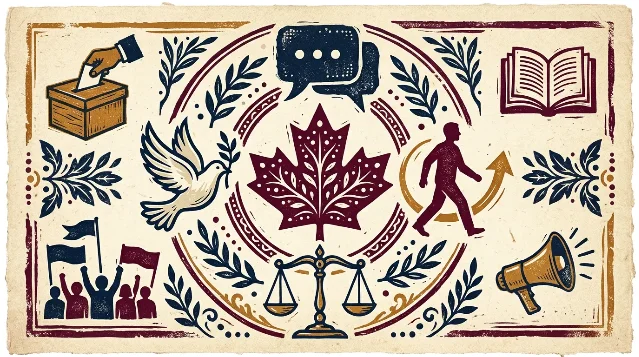
Symbolic illustration of the Canadian Charter — maple leaf surrounded by icons of rights including free expression, equality, and mobility
The Charter introduced both negative rights (government must stay out) and positive rights (government must act). (AI-generated illustration)
The Charter introduced two types of rights:
  • Negative rights — government must not interfere with freedoms like speech, religion, assembly, or association (sections 2, 7–14).
  • Positive rights — government must take action to ensure equality and access (section 15).
Section 15, the Equality Rights provision, has driven the most legal change, underpinning successful challenges on refugee rights, disability accommodation, and LGBTQ+ equality.
Exam tip: Know the difference: negative rights = government stays out; positive rights = government must act. Section 1 allows reasonable limits on Charter rights that can be "demonstrably justified in a free and democratic society" — courts use the Oakes test to assess whether a limit is justified.

Key people and events you must know

Person / EventDatesLegal significance
Louis Riel1844–1885Métis leader; led Red River and Northwest Rebellions; hanged for treason — his case raised lasting questions about minority rights and government power
Sue Rodriguez1950–1994ALS patient; challenged Canada's assisted-suicide ban at the Supreme Court (1993); lost 5–4, but her case sparked the public debate that led to legalized MAID in 2016
Tommy Douglas1904–1986Premier of Saskatchewan who introduced public healthcare; his model became the national system — a landmark example of law shaping social life
Écoles Polytechnique Massacre198914 women engineering students murdered; led to the Firearms Act (stricter gun control) and raised awareness of gender-based violence in law
The Lavallee Case1990R. v. Lavallee — Supreme Court recognized battered woman syndrome as a valid self-defence argument, transforming how courts understand domestic violence
Alan Borovoy / CCLA1964–presentLong-time head of the Canadian Civil Liberties Association; fought for free expression and equality through advocacy and court challenges — a model for how NGOs shape law
4

The significance of defence lawyers

Defence lawyers are not just advocates for individuals — they are a structural part of how law evolves. When a defence lawyer successfully argues that a law is unconstitutional, or that evidence was gathered in violation of the Charter, that ruling can change how police, prosecutors, and courts operate across the country. Post-9/11 anti-terrorism laws were repeatedly tested by defence challenges that forced legislators to rewrite provisions that went too far. 5

9/11 and the security-vs-liberty tension

After September 11, 2001, Canada passed sweeping anti-terrorism legislation that expanded police powers, authorized data collection, and created new criminal offences. The tension this created remains a core exam theme:
  • For lawmakers: How broad should new offences be? How much surveillance is justified?
  • From critics: New powers could be turned against ordinary citizens; privacy rights (s. 8 Charter) and liberty rights (s. 7) were under pressure; Muslim communities faced heightened profiling.
This tension — national security vs. individual rights — maps directly onto the Rule of Law: even in emergencies, the government must stay within constitutional limits.
Exam tip: If a scenario involves surveillance, detention without trial, or limits on expression in a security context, ask: does the government's action comply with the Charter? If there's a limit, can it be justified under s. 1?

Key numbers to know for the exam

통계 카드를 불러오는 중…

  • Individuals: Sue Rodriguez, Louis Riel, Jean Chrétien
  • Groups: Famous Five, CCLA, lobby groups, Bar Associations
  • Courts: Binding precedents, Charter challenges
  • Legislature: Statute law, new legislation after elections
  • Royal Commissions: Advisory only — no binding law, but powerful recommendations
  • Political demonstrations: Effective when part of broader advocacy, rarely sufficient alone
  • Civil disobedience: Peaceful resistance to unjust laws — can shift public opinion and future law even when the immediate goal fails

이 콘텐츠를 둘러싼 관점이나 맥락을 계속 보강해 보세요.

  • 로그인하면 댓글을 작성할 수 있습니다.