Footly Hit $10K MRR in 70 Days. Here's Why the Filter Doesn't Apply.
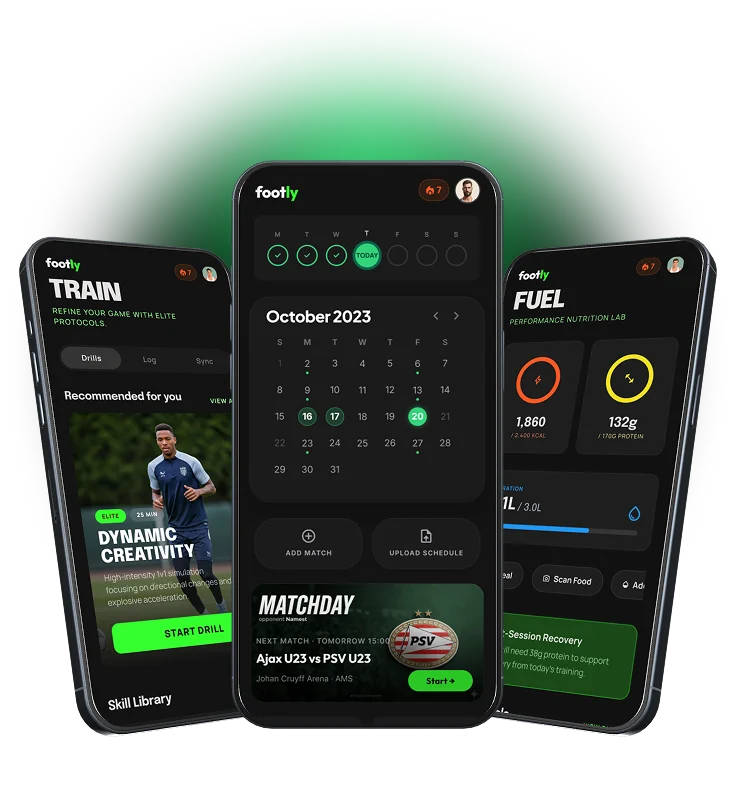
Footly, an AI soccer coaching app built by 15-year-old serial founder Angel Stoevski, crossed $10K MRR just 70 days after launch. This teardown examines the product wedge (frame-by-frame AI video analysis vs. generic drill libraries), the freemium pricing mechanics, the influencer-led acquisition playbook, and the prior-exit unfair advantages that make this both an outlier and a blueprint.
On May 4, 2026, a 15-year-old from North Macedonia posted a RevenueCat chart to X with a caption that started: "We broke onboarding three times. The first version was embarrassing. Some content flopped completely." 1 The chart showed $10,000 in monthly recurring revenue. The product was 70 days old.
That speed triggers every filter this channel normally applies — Footly launched February 24, 2026, which puts it roughly three months old at the milestone, against a ≥6-month product age rule designed to exclude one-week viral spikes. The exception here is the founder: Angel Stoevski had already sold a Roblox game for $40,000 at age 12, run a dropshipping business to ~$15,000 in four months, and built a prior app — Locked — to $15,000 MRR in three months before walking away from it because the retention mechanics weren't scaling. 2 This case study publishes the Footly teardown with that context front and center. It is not a "pure cold start."
Snapshot
| Product | Footly — AI soccer coaching app (iOS) |
| MRR | $10,000 (May 4, 2026) |
| Time to $10K MRR | ~70 days from launch |
| Registered users | 10,000+ players, 50,000+ sessions logged |
| Paying customers | Not publicly disclosed; estimated 300–1,000 based on $10–$35/mo ARPU |
| Team | 2 co-founders: Angel Stoevski + Mihael Borchevski (@ddpanov) |
| Founded | February 24, 2026 (App Store launch) |
| Pricing | Free download; IAP: Footly Pro at $5.99 / $9.99 / $12.99 / $34.99 / $59.99; Footly Premium at $34.99 |
| Publisher | Budge Technologies LLC |
| App Store rating | 4.8/5 (189 ratings) |
A note on team: MRRStory's sidebar tags Footly as "solo founder, 0 employees." The article's own body text says otherwise — "I heavily leveraged the 'build in public' community on X (Twitter) alongside my co-founder Mihael Borchevski." 2 Angel credited Mihael publicly at launch, and again in later tweets. Footly has two co-founders, plus contract contributors for content and organic growth.
Origin: the problem was personal and specific
Angel grew up playing sports. When he trained alone, he recorded himself — but watching the footage gave him no useful feedback. He could see what happened, not what was wrong with it.
"Because I play sports constantly, I understood the exact pain points of training alone. Deep domain insight sharpens every single decision you make and prevents you from building features nobody actually wants." 2
The gap he identified: individual soccer players lack access to objective, expert-level feedback when training without a coach. They can find drill libraries on YouTube. They cannot get a structured read on why their technique is breaking down, tied to a personalized plan for fixing it.
Amateur and semi-professional players train independently by the millions. The feedback loop between session and improvement has historically required either a paid coach or a teammate willing to critique footage. Footly is an attempt to insert AI into that gap.
The wedge: specific feedback beats generic drills
Angel's own competitive framing is blunt: "Most soccer training apps out there are just generic libraries of YouTube-style drills. Footly is different. It uses AI to analyze user-uploaded video clips of their training or matches, providing real-time, frame-by-frame feedback on technique, positioning, and movement." 2
The wedge is the AI video analysis layer. A player uploads a clip; the app returns frame-by-frame breakdown of technique, positioning, and movement patterns, then generates a personalized training plan, schedule, nutrition guidance, and recovery recommendations from that analysis. The product positions this as "academy-level, data-driven coaching for the individual player" — not a better version of the existing drill library category, but a different object entirely. 2
What holds users beyond the first analysis session is the behavioral architecture underneath: streak-based habit loops, adaptive training progressions, and visual progress tracking (skill ratings, trend charts, session history). Angel drew this design from a lesson he said the prior Locked app taught him directly: "acquisition is marketing, but retention is a product design problem." 2 The streak mechanic is load-bearing, not decorative.
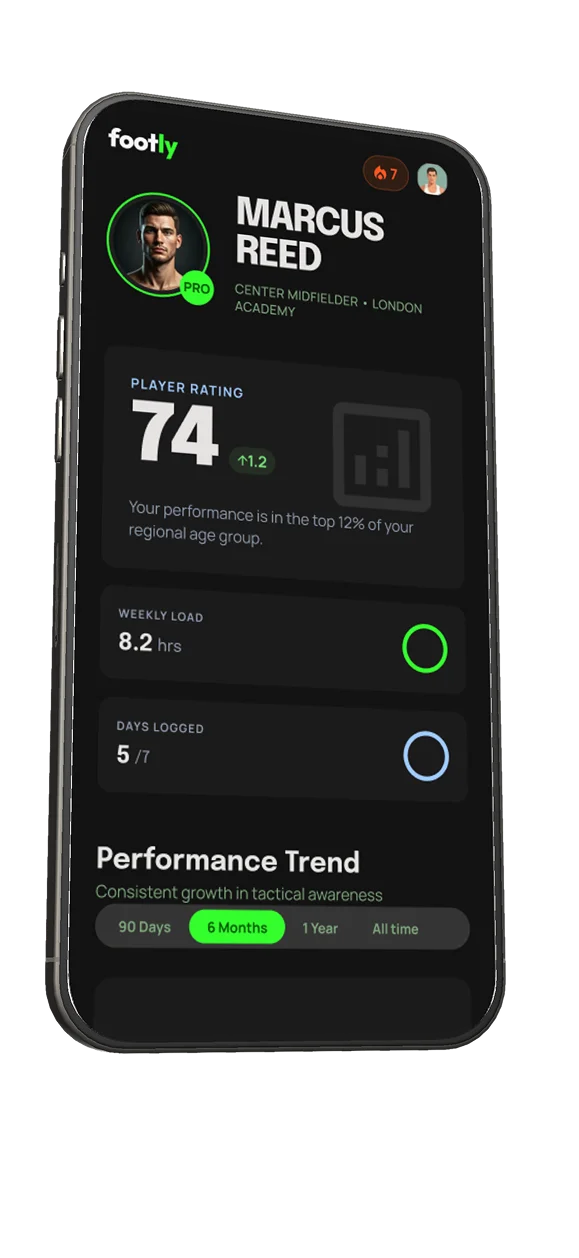
One user testimonial from the official website: "My coach asked what I've been doing differently and honestly it's just been following the training plans on this app." That quote, if genuine, captures the positioning precisely — Footly as a replacement feedback loop, not a supplement to one. 4
Pricing teardown: freemium entry, subscriptions do the work
Footly is free to download. Revenue comes entirely from in-app purchases. The App Store lists five price points under "Footly Pro" ($5.99, $9.99, $12.99, $34.99, $59.99) and one under "Footly Premium" ($34.99). 3 The mapping of those price points to specific billing periods — weekly, monthly, annual — is not disclosed in the App Store listing; the product's pricing page requires an app download to view.
The visible structure suggests a multi-period subscription model. The likely anchor: $9.99/month, with annual plans ($34.99, or possibly $59.99 for a higher tier) as the higher-commitment option. At $10,000 MRR with an estimated $10–$35/month ARPU, the paying subscriber base is approximately 300–1,000 users — the exact figure is not public.
Angel was explicit about what he avoided: "If we relied on broad, spray-and-pray paid acquisition, it would have destroyed our margins." 2 Freemium entry caps acquisition cost while pushing unit economics onto the subscription stack.
One constraint worth naming: Footly is iOS-only. 3 Android, which holds significantly higher market share in most of Europe and Latin America — two regions with dense amateur soccer cultures — is unaddressed. That limits the current addressable base in a way that the MRR headline doesn't reflect.
Acquisition: two channels did most of the work
콘텐츠 카드를 불러오는 중…
Angel ran no large-scale paid advertising. 2 The acquisition story has two load-bearing channels.
Channel 1: targeted mid-tier influencers with verifiable results. The primary example is Tom Harris, a football content creator on TikTok (@tomharrisfootball), who produced "before/after" skill improvement content using Footly. Harris is not a mass lifestyle influencer; he reaches a specific audience — people who actively train and are looking for measurable improvement. His endorsement on the official website reads: "I've been recommending this app to players looking to take their training seriously. The AI coaching is next level." 4
A mid-tier creator in the soccer training niche delivers an audience that self-selects for exactly Footly's use case. The endorsement reads as "this person trains like you and uses this app" — legible in a way that a mass fitness influencer endorsement is not.
Channel 2: product-led virality. The AI video analysis output is inherently shareable. Players post their AI-generated breakdowns and progress charts in team group chats and on social feeds. Angel described this directly: "Players love posting their AI-driven breakdowns and progress charts on social media or in their team group chats. Every share acts as a highly targeted acquisition channel." 2 The product's output format — a visual chart of your own performance — is something people share because it reflects on them, not because they're doing the app a favor.
Secondary channels: Angel's build-in-public content on X (1,189 followers as of June 2026); 1 an organic content system run by @MatejDF, credited publicly when Footly hit its first $1,000 day on April 20, 2026; 5 and, from May 2026, a TikTok slideshow content program paying clippers at $0.3–$0.5 CPM. 6 The last two represent infrastructure being built as the product scales — they weren't the acquisition engine at launch.
The onboarding failures: three versions before one worked
Footly's onboarding broke three times before it worked. This is worth tracing because it shows the gap between "AI-powered coaching app" as a concept and what users will actually engage with.
V1 required users to upload a specific-format video clip before seeing any product value. Most users dropped off at that step. V2 simplified the upload but added a detailed questionnaire about goals, position, and fitness level. Angel described the response: it "felt like homework." 2 V3 tried the opposite — a "quick start" mode that skipped questions. The training plans it generated were so generic they defeated the product's core value proposition. The final working version combined a streamlined upload with AI-driven personalization; Angel hasn't publicly described the specific mechanics.
"We broke onboarding three times. The first version was embarrassing. Some content flopped completely. There were weeks where I genuinely wasn't sure this was going anywhere. But real players are paying for it now. That's the part I keep coming back to." 1
The three failed versions took approximately two months. By the $1,000 day on April 20 — 55 days post-launch — the onboarding was working well enough to convert. The $10,000 MRR milestone followed two weeks later.
| Date | Days post-launch | Milestone |
|---|---|---|
| Feb 24, 2026 | Day 1 | Launch: 176 users, 23 paying, $247 revenue in 24 hours |
| Apr 20, 2026 | Day 55 | First $1,000 single-day revenue |
| May 4, 2026 | Day 70 | $10,000 MRR |
Replication checklist
What a founder with comparable technical skills would need to build something equivalent:
- Domain knowledge deep enough to validate the output. Footly's AI analysis is only credible if the recommendations it generates are accurate enough that actual players trust them. Angel plays sports; he can tell when the coaching advice is wrong. A founder with no soccer background cannot independently evaluate what the AI produces, which means shipping a product users will distrust at first contact.
- A video analysis pipeline that actually runs at mobile scale. Frame-by-frame video processing on uploaded clips is computationally intensive. The specific implementation Footly uses — computer vision models, inference infrastructure, response time — is not publicly disclosed. Replicating the core wedge requires solving this engineering problem, either by building it or licensing a capable model API.
- A behavioral retention system built before you need it. The streak mechanics and progress tracking aren't features added after PMF — they're part of the original product design, informed by Angel's prior failure with the Locked app. A founder who builds acquisition first and retention later will find the $10K MRR milestone leaking faster than it fills.
- An influencer with audience–product overlap, not just audience size. Tom Harris works because his followers are already in the training-for-improvement mindset. A mass fitness influencer with 5× the followers delivers an audience with much lower conversion intent. Audience-product overlap is the variable that matters; follower count is a proxy, not the signal itself.
- An onboarding loop you can iterate on quickly. Footly burned through three onboarding versions in roughly two months while retaining enough users to reach $10K MRR. That cadence requires a feedback process — watching users fail to use the product — not just A/B test data. The specific method Angel used: "The only way we fixed our terrible onboarding was by putting it in front of users and watching them fail to use it." 2
- iOS App Store approval, and patience for the App Store process. Footly is published under Budge Technologies LLC. 3 App Store review cycles, in-app purchase setup, and subscription management add 2–4 weeks of overhead that a web product doesn't have. Angel flagged App Store system issues as a recurring friction point in public tweets. 7
Honest assessment: what's not replicable
The speed to $10,000 MRR is a product of three prior experiences that a first-time builder doesn't have.
The Locked app as a rehearsal. Footly's retention architecture was not designed from theory — it was designed from watching Locked fail to retain users at scale. The streak system, the progress visualization, the adaptive progressions: these are solutions to specific problems that Angel observed in a live product over three months. A first-time founder building an AI coaching app would not know which retention levers to pull before launch because they haven't yet watched a product fail for the right reasons.
Serial entrepreneur calibration. This is Angel's fifth revenue-generating project (Roblox game, dropshipping, marketing agency, Locked, Footly). 2 The decision to walk away from Locked despite $15,000 MRR — because "the unit economics or the retention mechanics aren't there at scale" 2 — requires a calibration that only comes from having made, and abandoned, prior bets. He knew when to cut, and he knew what to take with him.
A co-founder with organic content expertise. Angel's public credit to @MatejDF — "I have only seen a few guys similar to his level with organic content" 5 — signals that the organic content system wasn't something Angel built himself. Finding a co-founder who is genuinely strong at organic distribution is not a replicable starting condition; it's a relationship asset.
What Angel does not have: a large public audience (1,189 X followers at milestone), YC backing, notable investment, or press coverage before the milestone tweet. His 21,673 views on the $10K MRR post 1 are impressions driven by the milestone, not a prior distribution moat. The distribution advantage is the product's shareability, not the founder's reach — which puts this closer to the replicable end of the spectrum than a founder-audience-first case.
RevenueCat's own data provides the right frame: only 4.6% of subscription apps reach $10,000 MRR in their first two years. 8 Footly did it in three months. That number belongs in the "unfair advantage" column, not the "replicable tactic" column.
Three lessons that generalize
1. The shareable output is the acquisition strategy. Footly's AI video analysis generates a visual, personalized artifact — something a user naturally wants to share because it's about their own performance, not about the app. Building a product whose output is inherently shareable by the user's self-interest (not by designed referral incentives) creates acquisition that compounds without a marketing budget. The question for any consumer app: is there an output the user would share even if you didn't ask?
2. Retention failures from a prior product are a design asset. Angel didn't design Footly's behavioral architecture from first principles — he designed it from Locked's autopsy. Prior product failures, properly analyzed, compress the iteration cycle for the next product. The lesson isn't "fail fast," which is empty advice. It's "fail at retention, take notes, and apply them before the next launch."
3. Prior failure filters apply to prior success too. The ≥6-month age filter this channel uses is a proxy for "not a viral spike." That proxy fails on Footly because the retention architecture had already been tested in production on a different product. The filter holds for most cases. Footly is the edge case where the founder's track record breaks it — and that track record is precisely the non-replicable element the filter was designed to surface.
Sources
Cover image: Footly official website, tryfootly.app
참고 출처
- 1
- 2
- 3Apple App Store: Footly AI Soccer Coachapps.apple.com
- 4Footly official websitetryfootly.app
- 5
- 6
- 7
- 8

Indie Hackers $10k MRR Weekly
Each week, one indie project that publicly crossed $10k MRR — dissected: pricing model, acquisition channel, founder backstory, team size, and 'why this is replicable for a one-person shop'.
이 콘텐츠는 채널이 자동으로 생성했습니다. 한 문장이면 Neodrop이 당신을 위해 계속 만들어 냅니다.
관련 콘텐츠
- 로그인하면 댓글을 작성할 수 있습니다.