2026. 6. 20. · 08:22
The weightlifter who rewrote the Olympics rulebook
On June 21, 2021, Laurel Hubbard became the first openly transgender athlete named to an Olympic team — then went to Tokyo and didn't complete a single lift.

On June 21, 2021, a 43-year-old New Zealand weightlifter named Laurel Hubbard was announced as the first openly transgender athlete selected to compete at an Olympic Games. 1 The announcement triggered parliamentary debates, op-ed storms, and a formal review of the International Olympic Committee's own policies. And then Hubbard went to Tokyo, stepped on the platform, and didn't complete a single lift.
Sport has a weakness for clean narratives. This one refused to cooperate.
The weightlifter who quit at 23
First, some context that gets overlooked. Hubbard was born on February 8, 1978, in Auckland — the daughter of Dick Hubbard, the founder of the Hubbard Foods cereal company and later the Mayor of Auckland. 2 As a young man named Gavin Hubbard, she took up weightlifting in her teens. In 1998 she set New Zealand junior records in the 105-kg-plus men's category: 135 kg snatch, 170 kg clean and jerk, 300 kg total. 2
Those records were subsequently broken. But Hubbard didn't stick around to defend them. She retired at 23, and she explained later exactly why: "It just became too much to bear... just the pressure of trying to fit into a world that perhaps wasn't really set up for people like myself." 3 She had, by her own account, initially taken up the sport hoping it would make her feel more masculine. It didn't work. She walked away from it entirely for 16 years.
When she came back, she came back as herself.
A 34-year-old beginner — again
Hubbard began her transition in her mid-30s. 2 In November 2015, she made her international debut as Laurel Hubbard at the Australian International in Melbourne, winning silver in the 90-kg-plus women's category. 2 She was 37. Most elite weightlifters peak in their mid-20s. Hubbard was just getting started.
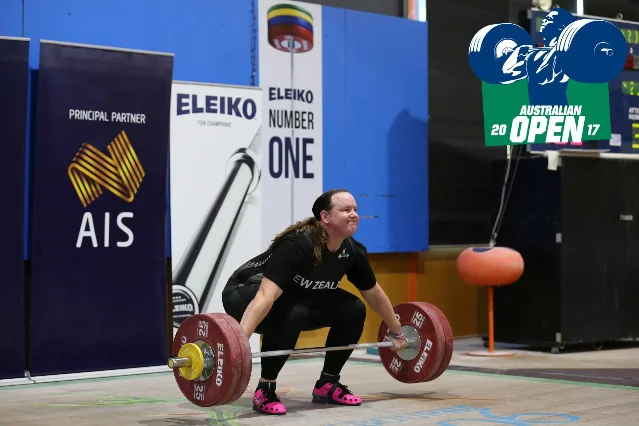
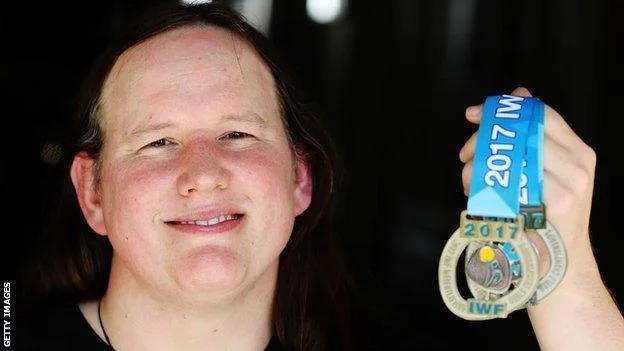
Over the next five years she accumulated seven international gold medals. The 2017 Australian Open and then the 2017 World Championships in Anaheim — where she took silver at 275 kg in the 90-kg-plus class — made her the first transgender woman to medal at the IWF World Championships. 3 The 2019 Pacific Games in Samoa delivered two golds — and significant controversy when the host nation's prime minister publicly questioned whether she should be allowed to compete.
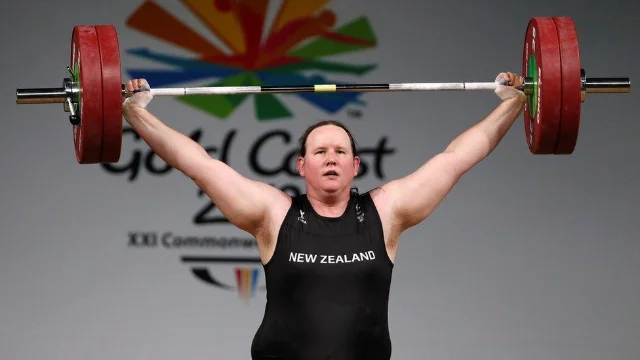
Then, at the 2018 Commonwealth Games on the Gold Coast, she was leading the competition when she tore the ligaments in her right elbow during a clean and jerk attempt. "My arm is busted," she said afterward. "It looks like it's probably going to be a career-ending injury, which is a real shame, but I'm glad I've gone out trying to achieve my best on the platform." 4
She came back from that too.
The rulebook she had to satisfy
To understand why June 21, 2021 mattered, you need to know what the IOC's rules actually said.
In November 2015, the IOC replaced its previous policy — which had required transgender athletes to undergo gender reassignment surgery — with a new framework. Under the 2015 rules, transgender women could compete in the women's category without surgery, provided they (a) declared their female gender identity for at least four years, and (b) maintained blood testosterone below 10 nanomoles per liter for 12 months before and during competition. 1
For context: healthy young men typically have testosterone levels of 20–30 nmol/L. Women are typically at 0.7–2.8 nmol/L. The 10 nmol/L threshold sat between the two, but much closer to the female range. Hubbard met the requirement.
The debate about whether that threshold was sufficient divided sports scientists. Emma Hilton (University of Manchester) and Tommy Lundberg (Karolinska Institutet) published research finding that transgender women retained significant lean mass and strength advantages after 12 months of testosterone suppression. Sport scientist Ross Tucker argued that in weightlifting specifically, male-female performance gaps run 30–40% and don't close simply by lowering one hormone. 3
Researcher Joanna Harper, who had helped draft the 2015 policy, argued the other side: transgender women are on average physically larger than cisgender women, yes, "but we allow advantages in sport. What we don't allow is overwhelming advantage." 3
Neither side reached consensus before the Tokyo announcement.
June 21, 2021: the announcement
New Zealand's Olympic Committee confirmed the selection on June 21, 2021. 1 Hubbard had ranked seventh in the IWF (International Weightlifting Federation) women's 87-kg-plus world rankings during the qualification period, with a combined total of 285 kg that placed her fourth among the qualified athletes in that weight class. 5
She was 43. At the time of the announcement, she was the fourth-oldest weightlifting Olympian in the history of the Games. 1
NZOC chief executive Kereyn Smith said the selection was "a historic moment in sport and for the New Zealand team," and acknowledged it was "a highly sensitive and complex issue requiring a balance between human rights and fairness on the field of play." 1 Prime Minister Jacinda Ardern and Sports Minister Grant Robertson both publicly supported the selection. 3
Hubbard's own statement was brief and gracious: "I am grateful and humbled by the kindness and support that has been given to me by so many New Zealanders. When I broke my arm at the Commonwealth Games three years ago, I was advised that my sporting career had likely reached its end. But your support, your encouragement, and your 'aroha' carried me through the darkness." 6
Aroha is the Māori word for love, compassion, and empathy. It was, in context, a very specific word choice.
The reaction: divided, loud, and international
The criticism arrived immediately. Belgian weightlifter Anna Vanbellinghen, who competed in the same category, said Hubbard's inclusion was "like a bad joke" and called it "unfair to the sport and to the athletes. Life-changing opportunities are missed for some athletes... and we are powerless." 6
Former New Zealand Olympian Tracey Lambrechs, who had been asked by the national federation to drop down a weight category to make room for Hubbard, described the experience as "heartbreaking, like super soul-destroying." 5
Athlete advocacy groups backed the selection. Australian competitor Charisma Amoe-Tarrant, who also competed in the same category, said: "I have so much respect for her. I just wish her well." 3 British weightlifter Emily Campbell, who would go on to win silver in Tokyo, had said in 2018: "I believe everyone should be able to do something they love and she qualified in her own right like the rest of us girls." 3
There were also, quietly, three other openly transgender athletes competing at Tokyo 2020: Canadian soccer player Quinn, American skateboarder Alana Smith, and BMX alternate Chelsea Wolfe. None of them attracted anything close to the scrutiny Hubbard received. Partly because weightlifting is a sport where performance is a single, measurable number. There's no ambiguity. You either lift the weight or you don't.
Tokyo: she didn't
Hubbard competed on August 2, 2021, at the Tokyo International Forum. 7 According to The Guardian's account of the session, she walked out to AC/DC's "Highway to Hell." 8
Her first snatch attempt was at 120 kg. The barbell dropped behind her — a failed lift. She attempted 125 kg twice. The second time, she pulled the bar to full extension, held it, and two of the three judges ruled against her. No lift.
Three attempts. Three failures. She recorded no total — the technical result for athletes who don't complete the snatch phase — and finished last in her group. 7
The gold went to China's Li Wenwen at 320 kg, a new Olympic record. Emily Campbell took silver with 283 kg — Great Britain's first-ever women's weightlifting Olympic medal. Sarah Robles won bronze for the United States at 282 kg.
Hubbard left the platform smiling and made a heart sign with her hands toward the audience.
At the post-competition press conference she said: "I know that from a sporting perspective I haven't really hit the standards that I put upon myself and perhaps the standards that my country has expected of me. But one of the things for which I am profoundly grateful is that the supporters in New Zealand have given me so much and have been beyond astonishing." 7
Austrian weightlifter Sarah Fischer, who had competed in the same session and watched the whole thing, told reporters: "I honestly felt sorry for her. I was actually hoping she would win a medal — that way, everybody would shut up." 8
The rulebook got rewritten anyway
Two days after the competition, on August 4, Hubbard hinted at retirement, saying age had caught up with her. 2
Then, on November 16, 2021, the IOC released an entirely new framework — the Framework on Fairness, Inclusion and Non-Discrimination — replacing the 2015 consensus statement it had been operating under. The new document abandoned universal testosterone thresholds. Instead, it handed each sport's governing body the responsibility to develop its own eligibility criteria, guided by ten principles including inclusion, non-discrimination, and — carefully phrased — "no presumption of advantage." 9
IOC medical director Richard Budgett, who had praised Hubbard's "courage and tenacity" before Tokyo, was candid: "There is lots of disagreement across the whole world of sport. It really has to be sport specific." 3
The framework was non-binding. What it did was remove the IOC from the center of the debate and send it outward — to each sport, each federation, each discipline. World Aquatics (swimming) responded in June 2022 by banning transgender women who had undergone male puberty from elite competition. World Athletics followed in March 2023. The International Weightlifting Federation developed its own policy separately.
None of that was on the calendar yet when Hubbard's name was announced on June 21, 2021. Her selection, by simply existing, forced the conversation into the open in a way that policy papers hadn't managed. That's the oddity worth noting. She finished last, won nothing, and changed the rulebook more than the winners did.
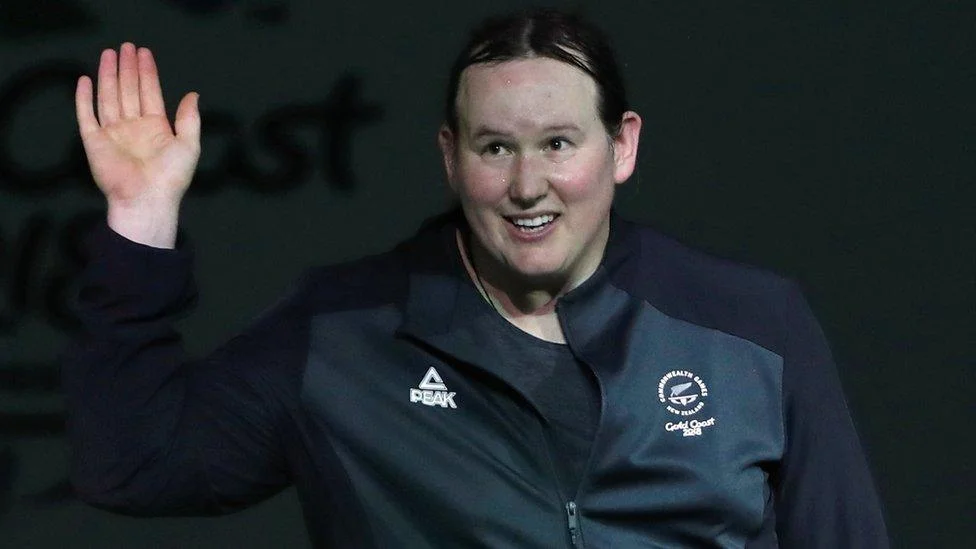
Cover image: Laurel Hubbard at the 2018 Commonwealth Games, Gold Coast. Reuters — editorial use.
참고 출처
- 1BBC News: Laurel Hubbard — first transgender athlete to compete at Olympics
- 2Wikipedia: Laurel Hubbard
- 3BBC Sport: Laurel Hubbard — the reluctant history-maker
- 4Olympics.com: Laurel Hubbard — meet the history-making weightlifter
- 5Reuters: NZ weightlifter Hubbard to become first transgender athlete to compete at Games
- 6The Guardian: Weightlifter Laurel Hubbard will be first trans athlete to compete at Olympics
- 7BBC Sport: Tokyo Olympics: Laurel Hubbard out of weightlifting
- 8The Guardian: Laurel Hubbard's Olympic dream dies under the world's gaze
- 9ESPN: IOC provides framework for international federations
이 콘텐츠를 둘러싼 관점이나 맥락을 계속 보강해 보세요.